Business hours
Monday to Friday (8.30AM - 5PM)
Weekend (Closed)


So, what exactly is a Transition to Retirement (TTR) pension? Put simply, it’s a clever strategy that lets you tap into your super as a regular income stream once you hit your preservation age, even if you’re still working.
It’s designed to do one of two things: either help you cut back your work hours without taking a big hit to your take-home pay, or give your super a final boost in a really tax-effective way before you call it a day.
Easing Your Journey From Work to Retirement

Moving from a full-time career into retirement is a massive life change. For many, the idea of stopping work cold turkey can be confronting, both financially and emotionally. The old model of working five days a week for 40 years right up to a fixed retirement date no longer fits the reality for most Australians.
Today, a more gradual wind-down is far more appealing, and that’s exactly where transition to retirement pensions come in. Think of it less like slamming on the brakes and more like gently easing your foot off the accelerator. It’s a powerful financial tool that can make this process smoother and far less stressful.
Bridging the Gap to Your Next Chapter
A TTR strategy acts as a bridge, connecting your working life to full retirement and giving you much-needed flexibility in those final years on the job. It’s built on the idea that the road to retirement isn't always a straight line.
With a TTR in place, you can aim for two main outcomes:
-
Work Less, Same Income: You could drop down to part-time hours and use the income from your TTR pension to top up your reduced salary, helping you keep your lifestyle intact.
-
Boost Your Super: Or, you could keep working full-time and combine your TTR pension with salary sacrificing to give your super balance a final, powerful, and tax-savvy injection before you finish up for good.
This guide will walk you through how it all works, step by step. We want to show you how you can take control of your financial future by understanding the mechanics, the upsides, and the potential pitfalls.
A well-planned TTR strategy can be the key to designing a retirement that starts on your own terms. It gives you the freedom to wind down your career at a pace that actually works for you.
Ultimately, our goal here is to give you the foundational knowledge to make smart, informed decisions. Getting your head around strategies like TTR is the first step towards building a solid financial plan.
Our Retirement Roadmap service is designed specifically to help people navigate these exact kinds of complexities. We provide clear, expert guidance to give you the confidence to step into your next chapter. By exploring your options now, you're paving the way for a more secure and fulfilling retirement.
How Does a Transition to Retirement Pension Actually Work?
Think of your superannuation fund like a long-term savings account, locked up tight until you officially retire. A Transition to Retirement (TTR) pension is like getting a special key that lets you access some of that money a bit earlier, while you're still working.
You're not opening a new, separate account. It’s more like flicking a switch on your existing super fund. This switch lets you move a chunk of your savings from the 'accumulation phase' (where it's all about growth) into an 'income phase', allowing you to start drawing a regular payment.
The whole point is to give you more flexibility in the years leading up to retirement. It’s designed to bridge the gap between working full-time and living completely off your nest egg, making the transition much smoother.
The Nuts and Bolts of a TTR Pension
The journey starts when you reach your preservation age. This is the age set by the government when you can legally start accessing your super, which is currently between 55 and 60, depending on when you were born.
Once you hit that magic number, you can kick off a TTR pension. You’ll need to nominate an amount from your super to move from your 'accumulation account' into a new 'pension account'. Your original accumulation account stays open, ready to receive ongoing employer Super Guarantee contributions and any personal top-ups you decide to make.
From this new pension account, you can start drawing an income. But there are some firm rules on how much you can pull out each financial year:
-
Minimum Withdrawal: You must take out at least 4% of your pension account balance.
-
Maximum Withdrawal: You can't take out more than 10% of your pension account balance.
These caps are there for a good reason. They ensure the strategy is used to supplement your income as you ease back on work, not as a way to drain your super savings before you've actually retired.
Where a TTR Fits in the Bigger Super Picture
It’s helpful to see how a TTR fits into Australia's broader retirement system. We’re in the middle of a massive shift in how Aussies are funding their later years. By 2023, a whopping 65% of Australians aged 65-74 had super, a huge jump from just 54% back in 2015.
The numbers tell a powerful story. Median super balances at retirement are now around $208,000 and are expected to hit $530,000 by the early 2060s. This growing reliance on super is precisely why smart strategies like a TTR are so important for making the most of your balance before you clock off for good. You can read more about this trend in the full report from the Superannuation Members Council.
Given how crucial super is becoming, understanding the tax rules for a TTR is non-negotiable.
A TTR pension has its own unique tax treatment. Investment earnings inside a standard super accumulation account are taxed at up to 15%. The same goes for a TTR pension account – its earnings are also taxed at up to 15%. This is a key point, as these earnings used to be tax-free before a rule change in 2017.
The income you draw from your TTR pension also gets taxed differently based on how old you are.
-
If you're aged 55 to 59: The income you receive is taxable, but you get a handy 15% tax offset to reduce the tax bill.
-
Once you turn 60: It gets even better. Any income you draw is completely tax-free.
That tax-free income stream for over-60s is the secret sauce behind some of the powerful strategies we’ll get into later. At Wealth Collective, getting this structure right is a core part of the financial planning process we deliver through our Retirement Roadmap service. Setting up a TTR correctly is about more than just paperwork; it’s about making sure it works hand-in-glove with your bigger retirement goals.
Powerful TTR Strategies to Boost Your Super
Now that we’ve got the nuts and bolts of a transition to retirement pension sorted, let's look at how people actually use them. A TTR isn't just a dry financial product; it's a flexible tool you can shape to fit what you want your life to look like in the years leading up to retirement.
Most people use a TTR pension in one of two ways. The first is about dialling back the work hours to get a better work-life balance. The second is a clever way to give your super an impressive, tax-friendly boost just before you call it a day on work for good.
Strategy 1: The Wind-Down Approach
Let’s think about Sarah, a 60-year-old nurse who’s been on her feet full-time for over 30 years. She still loves her job, but the long, demanding shifts are starting to take their toll. She’s not ready to hang up her scrubs completely, but the idea of cutting back her hours to reclaim some time for herself is sounding pretty good.
This is the perfect situation for the 'wind-down' strategy.
Sarah makes the decision to drop from five days a week down to three. Of course, this means her pay packet gets smaller, leaving a gap in her income. To plug that gap, she kicks off a TTR pension, drawing a regular, tax-free payment from her super to top up her reduced salary.
The change to her lifestyle is massive:
-
Stable Income: By combining her part-time wage with her tax-free TTR pension, her total take-home pay stays pretty much the same as when she was working full-time.
-
Better Wellbeing: With two extra days off a week, Sarah feels less stressed, has more energy, and finally has the freedom to travel a bit and spend proper quality time with her grandkids.
-
A Smoother Transition: She gets to ease into retirement on her own terms, staying connected to her profession without facing burnout.
This flowchart maps out the simple process of setting up a TTR pension to get this kind of flexibility.
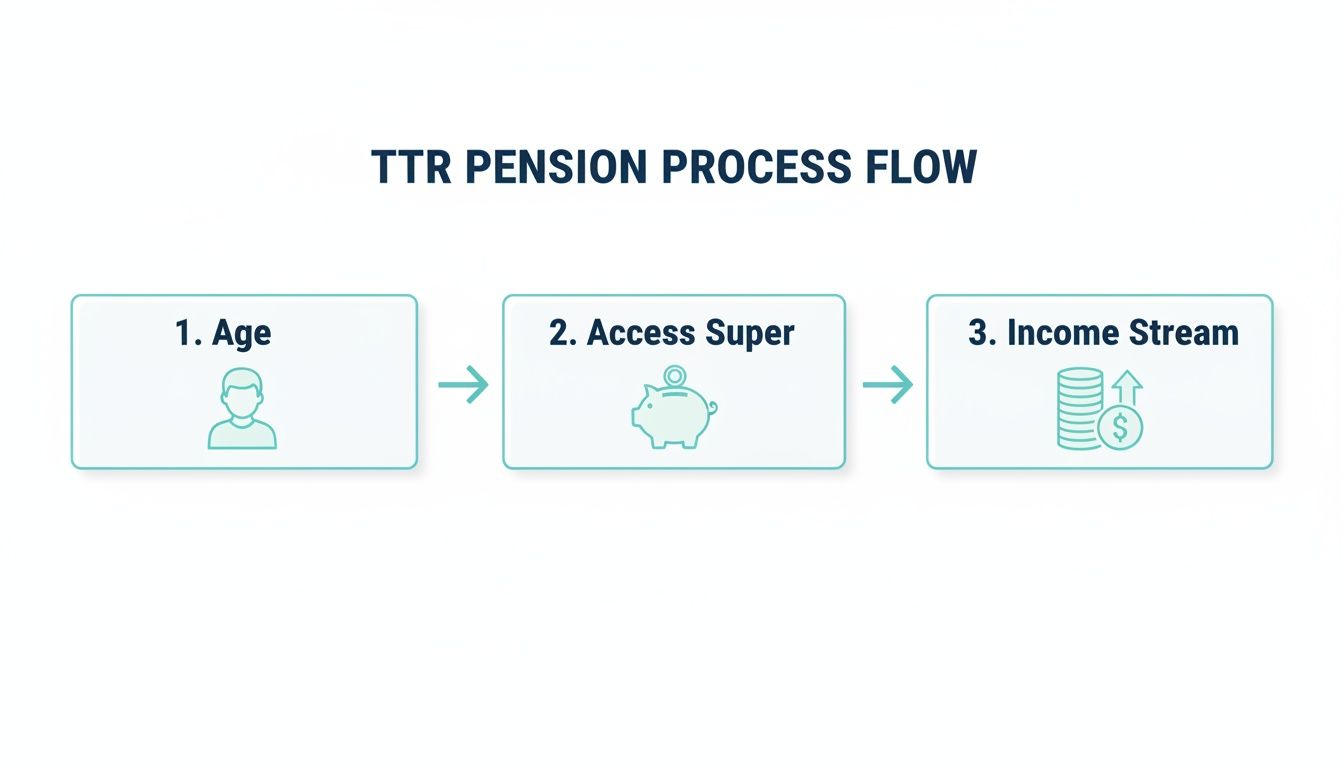
As the visual shows, once you hit your preservation age, you unlock the ability to turn a chunk of your super into a real income stream, even while you’re still working.
Strategy 2: The Supercharge Approach
Now for a completely different scenario. Meet David, a 62-year-old manager who is happy to keep working full-time for a few more years. His main goal is to pump as much as he can into his retirement savings before he finishes up. For David, the 'supercharge' strategy is a perfect match.
This tactic is a smart play that combines a TTR pension with salary sacrificing.
David keeps working his full-time hours, but he arranges with his employer to salary sacrifice a big slice of his pre-tax income straight into his super fund. These contributions get taxed at just 15%, which is a whole lot better than his personal income tax rate of 39% (including the Medicare levy).
Naturally, this lowers his take-home pay. To make up for the shortfall, he starts a TTR pension and draws a tax-free income to cover his day-to-day living costs.
By funnelling his highly-taxed salary into the low-tax world of super and replacing that cash with tax-free pension payments, David is essentially playing the tax system to his advantage. He gives his super balance a serious boost without feeling any pinch in his everyday budget.
This strategy really shows how you can use the Australian super system to build wealth efficiently. As of March 2025, total super assets in Australia hit a staggering $4.129 trillion. More importantly for pre-retirees, pension payments jumped 14.9% to $57.6 billion for the year. These figures from the Australian Prudential Regulation Authority (APRA) highlight a strong system where smart strategies like a TTR can turn your accumulated super into the reliable income you need for retirement. You can find more details in the latest superannuation statistics from APRA.
A Look at the Numbers
To see just how effective this can be, let's crunch some numbers for someone like David earning $120,000 a year. The table below lays out the potential financial win of the 'supercharge' strategy.
TTR Salary Sacrifice Strategy vs Standard Salary
| Metric | Without TTR Strategy | With TTR Strategy |
|---|---|---|
| Gross Annual Salary | $120,000 | $120,000 |
| Salary Sacrificed to Super | $0 | $27,500 |
| Taxable Income | $120,000 | $92,500 |
| Approx. Income Tax & Medicare Levy | $32,077 | $22,040 |
| Tax-Free TTR Pension Income | $0 | $20,000 |
| Net Take-Home Pay | $87,923 | $90,460 |
| Total Super Contributions (inc. SG) | $13,200 | $40,700 |
Disclaimer: This is a simplified example for illustration only. The figures are approximate and don't account for all personal circumstances. This should not be taken as financial advice.
As you can see, David not only ends up with over $2,500 more in his pocket each year but also channels an extra $27,500 into his super in a very tax-smart way.
Pulling off a strategy like this requires careful planning. You need to be sure you don’t go over your contribution caps and that all the tax implications are properly considered. This is exactly where our expertise can deliver real value and help you book an initial call to discuss your situation.
Weighing Up the Pros and Cons of a TTR Strategy

A transition to retirement pension can be a brilliant move, but it's not a silver bullet. Like any financial strategy worth its salt, it comes with both powerful advantages and potential pitfalls. Getting your head around both sides of the coin is essential.
It’s about taking an honest look at the whole picture—the exciting opportunities and the things you need to watch out for. This is the only way to figure out if a TTR really fits with what you want to achieve.
The Clear Advantages of a TTR Pension
The biggest drawcard for many people is the sheer flexibility a TTR offers. It can be the key to winding back your work hours without taking a big hit to your take-home pay. For many, this is a huge lifestyle improvement, easing the stress as you move towards full-time retirement.
But the benefits aren't just about lifestyle. The financial upside can be massive:
-
Serious Tax Savings: As we touched on with the 'supercharge' strategy, combining a TTR with salary sacrificing can make a real dent in your tax bill. You’re essentially shifting money from your highly taxed salary into the much friendlier super environment, and if you're over 60, your pension payments are tax-free. It’s a powerful way to improve your tax efficiency.
-
Boosting Your Super Balance: This tax-smart approach lets you pump extra cash into your super during your final years of work. It’s a fantastic way to accelerate the growth of your nest egg when it counts the most.
-
Freeing Up Cash for Other Goals: The extra income from a TTR pension can give you the financial breathing room to tackle other goals before you retire. Think about paying off the mortgage or clearing other debts so you can step into retirement with a clean slate.
The Potential Risks and Downsides
While the upsides are compelling, it's just as important to be clear-eyed about the risks. Starting a transition to retirement pension means dipping into your super savings earlier than you might have planned, and that decision has knock-on effects.
A TTR strategy is a delicate balancing act. You're trying to use your super to your advantage today without jeopardising your financial security down the track. Understanding the risks is key to getting this balance right.
Make sure you consider these potential drawbacks carefully:
-
Drawing Down Your Super Early: The most obvious risk is that you're spending your retirement savings. If the strategy isn't set up perfectly, you could end up with a smaller super balance when you do retire, which could affect how long your money lasts.
-
Exposure to Market Volatility: As soon as you start taking an income stream from your super, you’re more vulnerable to market dips. Pulling money out when markets are down can lock in your losses and make it tougher for your balance to bounce back. This is often called sequencing risk.
-
Extra Fees Can Add Up: Shifting your super from an accumulation account to a pension account can sometimes come with extra admin or advice fees. They might seem small, but these costs can eat into your returns over time and need to be part of your calculations.
Why Personalised Advice Isn't Just a 'Nice-to-Have'
This balanced view really hammers home one critical point: a TTR strategy isn't something to DIY over a weekend. The moving parts are complex—from tax rules and contribution caps to investment risk and your long-term income needs.
This is a core belief behind our approach at Wealth Collective. A truly successful retirement plan is one that's built just for you, reflecting your unique finances, goals, and comfort with risk. Our Retirement Roadmap service is designed to cut through these complexities, ensuring any strategy you put in place is perfectly aligned with your vision for retirement. An initial call is the best way to get this clarity and decide if a TTR pension is the right move for you.
Is a Transition to Retirement Pension Right for You?
Figuring out if a transition to retirement pension is the right move for you is about more than just ticking an age box. It’s a big decision that has to line up with your financial reality, your goals for the future, and how you feel about the risks that come with it. Think of it less as a simple financial transaction and more as a major step in designing the life you want to live.
To see if a TTR strategy actually fits into your plans, you need to take a step back and ask yourself some honest, practical questions. The answers will start to paint a clear picture and help you decide if this path is truly a good fit for your unique circumstances.
Key Questions to Ask Yourself
Before you jump in, take a moment to reflect on where you stand. A TTR pension isn't a one-size-fits-all solution, and whether it works for you depends entirely on your personal situation.
Start by thinking through these critical factors:
-
Have you reached your preservation age? This one’s non-negotiable. You can only start a TTR pension once you’ve hit the specific age set by the government, which depends on when you were born.
-
What are your retirement ambitions? Are you dreaming of winding down your work hours gradually? Or is your main goal to give your super a final, powerful boost before you stop working altogether? Your primary objective will shape how—or even if—you should use a TTR strategy.
-
Is your super balance large enough? Kicking off a TTR means you'll be drawing down on your retirement savings. You need to have a substantial enough balance to support these withdrawals without accidentally jeopardising your long-term financial security.
-
How comfortable are you with investment risk? When you draw an income from your super, your money is still exposed to the ups and downs of the market. If your balance takes a hit, withdrawing funds can lock in those losses, so you need to be comfortable with that possibility.
Answering these questions gives you a solid starting point. But let’s be honest, when the financial stakes are this high, self-assessment can only get you so far. These are complex decisions with a lasting impact.
The gap between hoping for a comfortable retirement and actually achieving one often comes down to a single thing: a clear, actionable plan. Making the right choices now can dramatically shape the quality of your future.
Confidence in retirement is almost always tied to having a solid strategy. While a State Street Global Advisors report shows that Australian optimism about retirement is on the rise, other findings highlight a significant advice gap. Research from Colonial First State revealed that only 41% of people expect a comfortable retirement without advice, a stark contrast to the 85% who feel confident when they have professional guidance. AMP also notes a staggering 9.7-year difference between the ideal and expected retirement age for those who are unprepared, compared to just 0.3 years for people with a plan. These numbers really drive home the value of getting expert guidance when you're navigating complex strategies like a TTR pension. You can learn more about how planning can bridge the confidence gap in retirement.
The Path to Clarity and Confidence
Thinking through all of this might leave you with more questions than answers, and that's completely normal. The way your super, income, tax laws, and long-term goals all interact is genuinely complicated.
This is precisely where professional advice becomes so valuable. At Wealth Collective, our Retirement Roadmap service is designed to bring clarity to these big decisions. We translate all the complexity into a clear path forward that’s built specifically for you.
Instead of guessing, you get a concrete plan. We'll help you weigh the pros and cons in the context of your own life, making sure that any strategy you put in place—like a TTR—is perfectly aligned with your vision for the future. You can start building this clarity by completing our simple fact-find questionnaire to help us understand your situation. An initial chat with one of our advisers can give you the confidence you need to choose the right path.
Planning Your Next Steps to a Confident Retirement
So, you've seen what a transition to retirement pension is, how it works, and weighed up the pros and cons. Now it's time to go from understanding the theory to taking practical action.
If there’s one thing to take away, it's this: a successful retirement plan is never an off-the-shelf solution. It has to be carefully built around your unique goals, your financial situation, and what you actually want your future to look like.
Making the right call with your life savings requires absolute clarity and confidence. The details really do matter, from getting the tax rules right to making sure your super is set up to last. This is exactly where our expert guidance can make all the difference.
Our Simple, Stress-Free Process
At Wealth Collective, we believe getting quality financial advice should be straightforward and accessible. We’ve designed a simple process to help you get the answers you need, without any pressure or obligation.
It all starts with a complimentary, 10-minute introductory call.
This first chat is just a relaxed way for you to speak with one of our experienced advisers in Perth or Dunsborough. We'll listen to get a sense of your situation and what you're trying to achieve. From there, we can see how we might be able to help you move forward.
A well-structured plan is the bridge between your financial reality today and the retirement you aspire to tomorrow. The first step is often the most important one you will take.
Our main goal is to give you a clear, actionable plan to help you build, protect, and ultimately enjoy your wealth. Whether a transition to retirement pension is the right move for you, or another strategy makes more sense, we'll give you the insights to choose with confidence.
We focus on creating practical strategies that get real results, making sure your money is working as hard as it can and your plans stay on track. This is the core of our Retirement Roadmap service, which is designed to give you certainty as you get ready for this next chapter. To see exactly how we help our clients, you can explore our detailed guide on the Wealth Collective Retirement Roadmap.
The journey to a secure retirement really does begin with a single conversation. We invite you to book your free introductory call today and take that first step towards a financially confident future.
Your TTR Pension Questions Answered
When you start digging into the details of a transition to retirement pension, a few common questions always seem to pop up. Let's tackle some of the most frequent ones to clear up how this strategy works in the real world.
Can I Take a Lump Sum From My TTR Pension?
This is a big one. The short answer is generally no, you can't take a lump sum from your super while you're on a TTR pension and still working. The whole point of a TTR is to provide a regular income stream to top up your pay, not to give you a one-off withdrawal.
Your super money stays 'preserved' until you meet what's called a full 'condition of release'. For most people, that means either retiring for good after hitting your preservation age or turning 65. Once that happens, you’re free to access your funds as a lump sum or simply keep the pension going.
What Happens to My TTR if I Stop Working?
When you finally hang up your boots and permanently retire, your TTR pension doesn't just end. It automatically ticks over and becomes a standard account-based pension. This switch is a good thing and comes with some important perks.
The 10% cap on how much you can withdraw each year disappears, giving you far more flexibility with your income. Better yet, if you're over 60, your pension payments will continue to be completely tax-free. Just be sure to let your super fund know as soon as your work situation changes so they can process the conversion smoothly.
How Does a TTR Pension Affect the Age Pension?
This is where things can get a bit tricky. A TTR pension can definitely impact your eligibility for the Centrelink Age Pension. The entire balance of your TTR account is counted under both the assets test and the income test.
For the income test, Centrelink uses a system called 'deeming'. This means they'll assume your super is earning a certain rate of income, no matter what it actually earns.
Because the rules are complex and can change, this is one area where getting personalised financial advice is non-negotiable. An adviser can map out exactly how a TTR strategy will affect any social security benefits you might be entitled to, making sure there are no nasty surprises down the track.
This kind of forward-thinking is exactly what we focus on—helping you make smart decisions that fit your entire financial life. An initial call with our team can provide the clarity you need.
Making the right choices in the years before you retire is crucial. At Wealth Collective, our award-winning advisers specialise in turning these complex topics into clear, actionable guidance. Book a complimentary 10-minute introductory call to start building a confident financial future. Learn more at https://wealthcollective.co.