Business hours
Monday to Friday (8.30AM - 5PM)
Weekend (Closed)


Thinking about taking the reins of your own super? A Self Managed Super Fund (SMSF) can be a powerful wealth-building tool, but it's a decision that requires careful thought. At its core, the choice boils down to a trade-off: you gain complete control over your retirement nest egg, but in return, you accept all the legal and administrative responsibilities that come with it.
Let's dive into the self managed super fund pros and cons to see if it’s the right move for you.
Is an SMSF the Right Choice for Your Retirement?

Choosing a super fund is one of the most significant financial decisions you'll make. A standard retail or industry fund is like a managed investment portfolio—it’s convenient, professionally handled, and your options are chosen from a pre-set menu. It’s an effective hands-off approach.
An SMSF, however, is like being your own investment manager. You get to build your retirement strategy from the ground up, choosing every asset and making every decision. The freedom is compelling, but you're also responsible for everything from legal compliance to investment performance. This highlights the core SMSF trade-off: total control versus total responsibility.
This level of control is a massive drawcard, explaining why SMSFs are a significant part of Australia’s retirement landscape. As of September 2023, there are 611,634 SMSFs in Australia, holding a colossal $901.9 billion in assets. That’s nearly 25% of the country's entire superannuation pool, which shows just how many Australians are embracing this hands-on approach to building wealth.
SMSF at a Glance: Key Pros vs Cons
So, is the extra control worth the work and risk? It depends entirely on your financial situation, expertise, and how much time you're willing to commit. To simplify things, here's a high-level look at the main arguments for and against starting an SMSF.
| Aspect | Pros (The Upside of Control) | Cons (The Weight of Responsibility) |
|---|---|---|
| Investment Choice | Unrivalled flexibility to invest in assets like direct property, unlisted shares, and art. | Requires significant investment knowledge. Poor decisions rest solely on your shoulders. |
| Costs | Can be more cost-effective for large balances (>$500k) as fees are typically fixed. | Can be very expensive for smaller balances due to high setup and ongoing fixed costs. |
| Tax Strategy | Greater ability to implement sophisticated, tailored tax strategies to maximise returns. | Complex tax rules. Mistakes can lead to severe penalties from the Australian Taxation Office (ATO). |
| Control & Flexibility | Full control over your retirement strategy, timing of investments, and estate planning. | You are the trustee, which means you are personally liable for all compliance and legal duties. |
| Time Commitment | Direct engagement with your wealth creation journey. | Requires a significant, ongoing investment of your time for administration and research. |
This table captures the fundamental tension of an SMSF. The freedom it offers is immense, but so is the workload. It’s a path that demands diligence and a genuine interest in managing your own financial future.
The journey into an SMSF should begin with absolute clarity. It's not just about chasing higher returns; it's about honestly assessing if you have the time, knowledge, and temperament to take on the role of a fund manager for your own retirement.
Before going any further, it helps to have a solid grasp of the basics. If you're new to the concept, you can learn more about how superannuation works in Australia in our detailed guide. Making an informed choice now is the foundation for a secure and prosperous retirement.
The Upside: Taking Charge of Your Financial Future
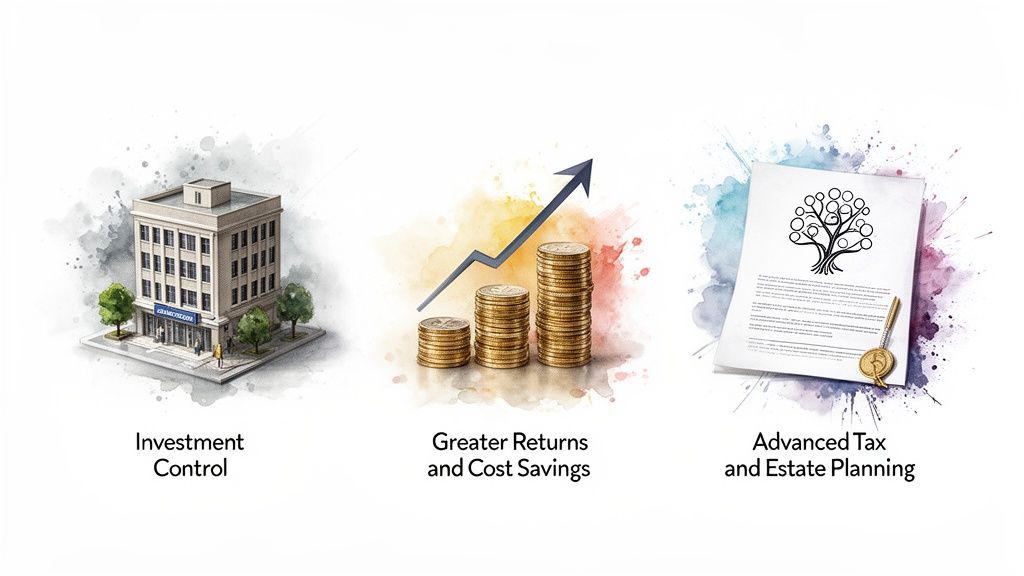
While running your own super fund comes with real responsibilities, the benefits can be a game-changer for your retirement. The core appeal is simple: you get to sit in the driver's seat of your financial destiny, building a portfolio that truly reflects your personal goals.
Let's break down the three main advantages you can unlock. The first, and often the most powerful motivator, is the incredible control and flexibility you gain over your investments. This is where an SMSF really sets itself apart.
Unmatched Investment Control and Flexibility
With an SMSF, you're no longer picking from a set menu of investment options. The entire investment universe opens up, giving you access to assets that are simply out of reach for most retail and industry funds.
This unlocks powerful strategies. For example, a business owner could use their SMSF to buy the commercial property their business operates from. The business then pays rent directly into the super fund, building retirement savings while giving the company a secure home.
But it doesn't stop at property. You can explore a huge range of other opportunities, like:
- Unlisted assets: Invest in private companies or promising startups before they hit the public market.
- Direct shares and ETFs: Build a custom portfolio of specific companies and sectors you genuinely believe in, rather than being tied to a fund manager's broad strategy.
- Alternative assets: Invest in collectibles like art or precious metals, provided you adhere to the strict ATO rules.
This level of control means your super becomes an active tool that works in concert with your wider financial life. At Wealth Collective, our process helps you navigate these choices, ensuring your investment plan is both compliant and perfectly aligned with your personal goals.
Potential for Better Returns and Lower Costs
For those with a substantial nest egg, an SMSF can be highly cost-effective. Most large super funds charge fees as a percentage of your balance. As your super grows, so do the fees, which quietly erodes your long-term returns.
SMSFs, on the other hand, typically operate on a flat-fee model for administration and accounting. Once your fund balance hits a certain point—generally around the $500,000 mark—these fixed costs can be significantly cheaper than percentage-based fees. This means more of your money stays invested and working for you.
Over a decade or more, the compounding effect of lower fees can add tens or even hundreds of thousands of dollars to your final retirement balance. It's one of the most compelling mathematical arguments for considering an SMSF.
On top of cost savings, having direct control can also lead to better performance. Research from the University of Adelaide, commissioned by the SMSF Association, found that SMSFs actually outperformed their big-fund counterparts over the five years to the 2022/23 financial year. This busts the myth that you need a professional manager to get superior returns. You can dive into the data on SMSF performance and see how they stack up.
Advanced Tax and Estate Planning
An SMSF is a powerful vehicle for smarter tax and estate planning, helping you protect and grow your wealth for the next generation. As the trustee, you have direct control over the timing of financial decisions, which becomes incredibly valuable as you move towards retirement.
For example, you can strategically time the sale of assets to minimise Capital Gains Tax (CGT). You can also segregate specific assets to fund your pension payments, which are tax-free in retirement. This provides a level of granular tax management that isn't possible in a large, pooled fund.
The benefits extend to your legacy, too. An SMSF offers much more certainty in your estate plan with tools like binding death benefit nominations. You can create crystal-clear, legally binding instructions for how your super is passed on to your beneficiaries. This helps avoid family disputes and ensures your wealth goes exactly where you want it to. These advanced strategies are a core part of how Wealth Collective helps clients build a lasting financial future.
The Other Side of the Coin: Understanding SMSF Risks and Responsibilities
The benefits of running your own super fund are appealing, but they only tell half the story. Taking on the role of trustee isn't just about making investment decisions; it's about accepting a serious and legally binding set of duties. Before you dive in, it’s crucial to understand the challenges, because the downsides can have significant financial and legal consequences.
The risks aren't there to deter you, but to ensure you're prepared. Most disadvantages fall into three main categories: the heavy compliance burden, the commitment of time and money, and the potential for costly investment mistakes.
The Heavy Compliance and Admin Load
When you set up an SMSF, you are not just an investor. You are the manager of your own superannuation fund, operating under strict laws enforced by the Australian Taxation Office (ATO). As a trustee, you are personally liable for ensuring the fund complies with all superannuation laws.
This is a substantial task. The ongoing legal work includes:
- Annual Audits: Your fund’s accounts must be formally audited by an approved, independent SMSF auditor every year.
- Financial Reporting: You're responsible for preparing the fund's annual financial statements and lodging an SMSF annual return with the ATO.
- Meticulous Record-Keeping: You must keep detailed records of every transaction, decision, and meeting for at least five to ten years.
- A Formal Investment Strategy: The law requires you to create, regularly review, and document a clear investment strategy that considers diversification and the needs of every member.
Getting this wrong can lead to harsh ATO penalties, including fines or, in the worst-case scenario, your fund losing its concessional tax status. This is where the true weight of the role becomes clear, and it’s why many trustees partner with a firm like Wealth Collective. We manage that complexity for you, protecting your nest egg from compliance missteps.
As a trustee, the buck stops with you. You can hire professionals to do the work, but you can never delegate your ultimate responsibility for the fund's compliance.
The Real Costs and Time Commitment
Another significant factor is the time and money involved. While SMSFs can be cost-effective for large balances, they rarely make financial sense for smaller super pots. The fixed costs of running the fund can erode your returns if your balance is below the widely recommended $500,000 mark.
There are several unavoidable costs:
- Setup Fees: The initial one-off cost to establish the trust deed and legal structure.
- Annual Accounting and Audit Fees: These mandatory professional services are a significant ongoing expense.
- ATO Supervisory Levy: A yearly levy paid to the ATO to cover their oversight costs.
- Potential Advice Fees: Costs for specialised financial, legal, or investment advice.
Beyond the money, there’s the time. This isn’t a “set and forget” investment. You're the one researching investments, placing trades, keeping flawless records, and liaising with professionals. It demands your active and ongoing attention.
The Risk of Poor Investment Decisions
Finally, complete investment control is a double-edged sword. It offers incredible freedom, but it also means you bear 100% of the responsibility for the results. Without a clear strategy, a disciplined process, or expert guidance, it's easy to make mistakes that could put your retirement at risk.
Common traps for inexperienced trustees include:
- Lack of Diversification: Putting all your eggs in one basket, such as investing everything in a single property or a handful of stocks, is a massive risk.
- Emotional Decision-Making: Buying or selling based on market hype or fear, rather than a solid long-term plan, rarely ends well.
- Chronic Underperformance: A portfolio that doesn't generate the necessary returns can leave you with a much smaller nest egg than a well-managed retail or industry fund.
Navigating the complexities of estate planning within an SMSF also carries risks. To ensure your wishes are carried out correctly, it is important to understand what happens to super when you die and have the right legal structures in place.
These disadvantages highlight why professional guidance isn’t a luxury—it’s a fundamental part of a successful SMSF journey. Our process ensures you have a robust, compliant, and properly diversified strategy, letting you enjoy the control of an SMSF without the stress of navigating its pitfalls alone.
Who Is an SMSF Really Suited For?
After weighing up the pros and cons, the big question remains: "Is an SMSF actually right for me?" The answer isn't just about your super balance; it’s about your personality, your goals, and whether you genuinely want a hands-on role in your finances.
An SMSF isn't for everyone. But for the right person, it's an incredibly powerful tool for building wealth.
So, who is the ideal candidate? In our experience, they tend to be high-income earners who want direct control over tax strategies, business owners seeking to buy their commercial premises through super, or pre-retirees with a healthy balance who want to personally manage their assets in the lead-up to retirement.
What these people have in common is that they are proactive, detail-oriented, and view their super as a central pillar of their financial life.
Are You a Good Fit for an SMSF?
Deciding to become the trustee of your own super fund is a major step. It demands an honest assessment of your finances, temperament, and the time you're willing to commit.
This checklist is designed to go beyond the numbers and get to the heart of what it takes to run an SMSF effectively.
SMSF Suitability Checklist: Are You Ready?
Take a moment to honestly assess where you stand. This isn't a test, but a way to ensure you're setting yourself up for success.
| Consideration | Signs an SMSF Could Be a Good Fit | Signs You Should Reconsider |
|---|---|---|
| Super Balance | You have (or are close to) a combined household balance of $500,000 or more, where cost savings can be significant. | Your balance is below $200,000. The fixed costs will likely eat away at your returns. |
| Time & Interest | You enjoy learning about finance and are prepared to dedicate a few hours each month to research, admin, and record-keeping. | You prefer a 'set-and-forget' approach and have little interest in actively managing a portfolio. |
| Investment Know-How | You have a good grasp of investment principles or are committed to working closely with a financial adviser. | You feel overwhelmed by investment decisions and aren't comfortable taking the lead. |
| Motivation for Control | Your main driver is to invest in specific assets like direct property or unlisted shares that aren't available elsewhere. | You're generally happy with the investment options in your current fund and don't have a specific need for more control. |
| Compliance Mindset | You understand and accept that you are personally liable for following complex super laws and are prepared for the paperwork. | The thought of ATO audits, legal responsibilities, and potential penalties makes you anxious. |
If you found yourself nodding along with the "Good Fit" column, you're likely on the right track. However, if the "Reconsider" column felt more familiar, an SMSF may not be the best path for you right now.
This flowchart gives a simple visual of what you're signing up for as a trustee.
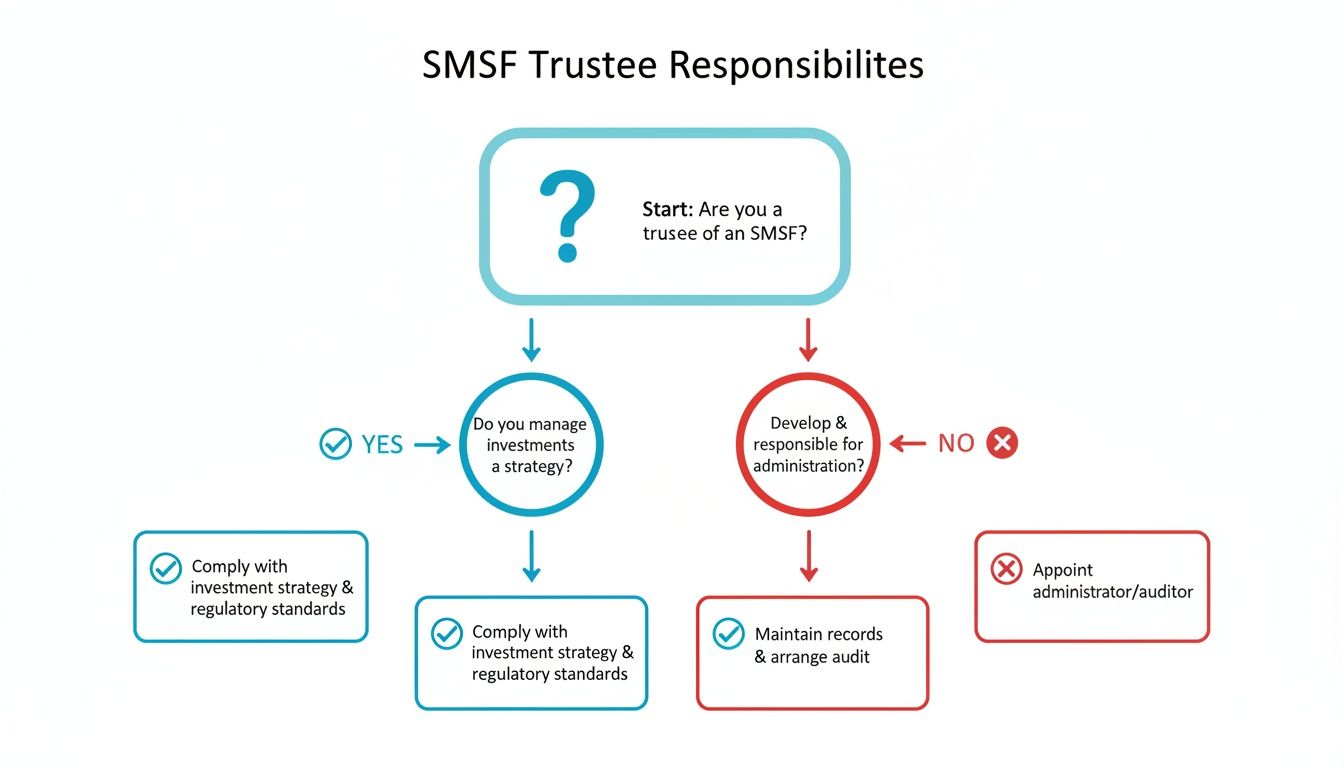
As you can see, you’re taking on two distinct jobs: managing the investments and running the fund's administration. It's a dual role that requires you to be prepared for both sides of the coin.
When to Think Twice About an SMSF
Just as there's a clear profile for who an SMSF suits, there's an equally clear one for who it doesn't.
If you have a low super balance (under $200,000), an SMSF is almost certainly not for you, as the high fixed costs can be a serious drag on your retirement savings.
Likewise, if you prefer a 'set-and-forget' approach to super and have little interest in financial markets, the hands-on nature of an SMSF will feel like a burden, not a benefit. Underestimating the time, diligence, and legal responsibility involved is a common pitfall.
The most successful SMSF trustees are those who embrace their role with diligence and a clear strategy. For them, it’s a rewarding journey; for others, the responsibility can outweigh the rewards.
Making this decision is a critical moment in your financial life. At Wealth Collective, our Retirement Roadmap service is designed to bring this kind of clarity. We help you objectively measure your situation against the real demands of running an SMSF, ensuring you make a confident, well-informed choice that aligns with your goals.
It all starts with a simple, complimentary call to see how we can help guide you.
How to Make the Right Choice for Your Super
So, you’ve weighed the pros and cons of a self-managed super fund. Now comes the final decision. At its heart, the choice is a simple trade-off: are you willing to exchange the convenience of a large fund for total, hands-on control over your retirement nest egg?
This isn't just an investment decision; it's a lifestyle one. Taking the wheel means accepting full responsibility for every choice, transaction, and piece of compliance paperwork. It demands time, a genuine interest in managing your money, and a clear-eyed view of the risks.
The core question to ask yourself is: do I truly have the time, skill, and mindset to be the CEO of my own retirement fund? If you can answer with a confident "yes," an SMSF can be an incredibly powerful and rewarding way to build your wealth.
From Information to Action
Trying to figure this out alone can be daunting. That’s why professional advice is a crucial part of your due diligence. A financial adviser acts as a co-pilot, helping you take an objective look at your goals, risk tolerance, and overall financial picture to determine if an SMSF genuinely fits your long-term plan.
At Wealth Collective, we've created a straightforward process to give you that clarity. We believe making the right choice for your future shouldn't be stressful.
Our process puts you in the driver's seat:
- Start with a Conversation: It all begins with a complimentary 10-minute introductory call. This is a relaxed, no-obligation chat for us to understand your situation and see if we're the right fit to help.
- Get Your Personalised Plan: If we move forward, our Retirement Roadmap service provides a deep-dive analysis. We'll explore your financial world to confirm whether an SMSF is the best tool to secure your future, or if another strategy would serve you better.
Protecting your retirement savings is paramount. A well-thought-out plan, supported by expert guidance, gives you the confidence to move forward, knowing your decision is based on sound strategy, not emotion.
Your Next Step Is Simple and Risk-Free
Choosing the right structure for your super is one of the most important financial decisions you'll ever make. Getting it right can significantly impact your retirement lifestyle and the legacy you leave. To build that plan, you first need a clear target for how much super you need to retire comfortably.
You've already taken the first step by weighing the self managed super fund pros and cons. The next is turning that knowledge into a confident decision that’s right for you.
If you're ready to build a successful financial future, the path forward is clear. Book your complimentary 10-minute introductory call today with our team. It’s a simple, risk-free conversation that will give you the clarity and confidence you need to take the next step.
Your SMSF Questions, Answered
As you consider an SMSF, practical questions will naturally arise. To help you get the clarity you need, we've answered the questions we hear most often.
How Much Money Do I Really Need to Start an SMSF?
This is a critical question. While there's no official legal minimum, the issue is cost-effectiveness. The fixed costs of running an SMSF—like administration, accounting, and the annual audit—can seriously erode returns on a smaller fund.
The ATO has noted that funds with less than $200,000 often struggle to deliver better net returns than large APRA-regulated funds. In our experience, the point where an SMSF starts making clear financial sense is when a household's combined super balance approaches $500,000. At that level, the fixed fees become a much smaller percentage of your assets, often making it cheaper than the percentage-based fees in your current fund.
It's not about a magic number. It’s about ensuring the fund's running costs don't sabotage its growth. A good adviser can help you do the maths for your specific situation to determine your break-even point.
Can I Borrow to Buy Property With My Super?
Yes, but it's a complex and heavily regulated process known as a Limited Recourse Borrowing Arrangement (LRBA). This structure allows your SMSF to take out a loan to buy a single asset, such as a property. Crucially, the loan is "limited recourse," meaning if the loan defaults, the lender can only claim the property itself, not the other assets in your super fund.
However, LRBAs are wrapped in red tape:
- The loan must be on commercial, arm's length terms.
- You, your family, or any related party cannot live in or rent the property.
- All rent and expenses must flow directly through the SMSF's bank account.
This strategy can be a game-changer, especially for business owners buying their own premises, but the compliance risks are significant. This is one area where professional advice is essential.
What Happens If I Make a Compliance Mistake?
As the trustee, you are personally responsible for ensuring your SMSF follows all superannuation rules. The ATO enforces these rules strictly and can impose a range of penalties for breaches, from formal warnings to significant fines.
Fines can be issued for lodging paperwork late, exceeding contribution caps, or making an unapproved loan from the fund. In the worst-case scenario, the ATO can declare your fund 'non-complying'. This is the nuclear option—the fund loses its concessional tax status, and you could face a tax bill of up to 45% of the fund's entire value.
This is why a rock-solid process and professional support are so important. Working with a firm like Wealth Collective adds a layer of protection, keeping your fund compliant so you can focus on your investment strategy.
How Is an SMSF Really Different From My Current Fund?
The fundamental difference comes down to three things:
- Control: In your current fund, you pick from a set menu. With an SMSF, you are the chef—you source the ingredients, write the menu, and are responsible for the outcome.
- Investment Universe: Your industry fund is mostly limited to shares, bonds, and large managed trusts. An SMSF opens the doors to direct property, unlisted private businesses, and even assets like gold bullion or art (if you follow the strict rules).
- Personal Responsibility: In a large super fund, a professional trustee company is legally responsible for everything. With an SMSF, that trustee is you. The buck stops with you, legally and financially.
Ultimately, an SMSF offers a degree of customisation and strategic power unavailable in a one-size-fits-all fund. This makes it an incredible tool for the right person, but a potential burden for someone who prefers a hands-off approach.
Understanding these details is a vital step in making a smart decision. If you’re ready to explore whether an SMSF is the right vehicle to build your financial future, the team at Wealth Collective is here to provide the clarity you need.
Book your complimentary 10-minute introductory call today to start the conversation.