Business hours
Monday to Friday (8.30AM - 5PM)
Weekend (Closed)


Your Investing Journey Starts Here
Let's be honest, the world of investing can feel like it's reserved for experts in expensive suits. But the truth is, it’s the single most effective way for everyday Aussies to build long-term wealth. This guide is designed to cut through the noise and show you exactly how to get started—moving from a place of uncertainty to making your first investment with confidence.
Think of it as your personal playbook. We're going to walk through the practical steps that turn your financial goals into a reality, making your money finally work for you.
The path to becoming an investor is a journey, not a single leap. It usually moves through three distinct phases: from wondering where to start, to learning the fundamentals, and finally, to taking decisive action.
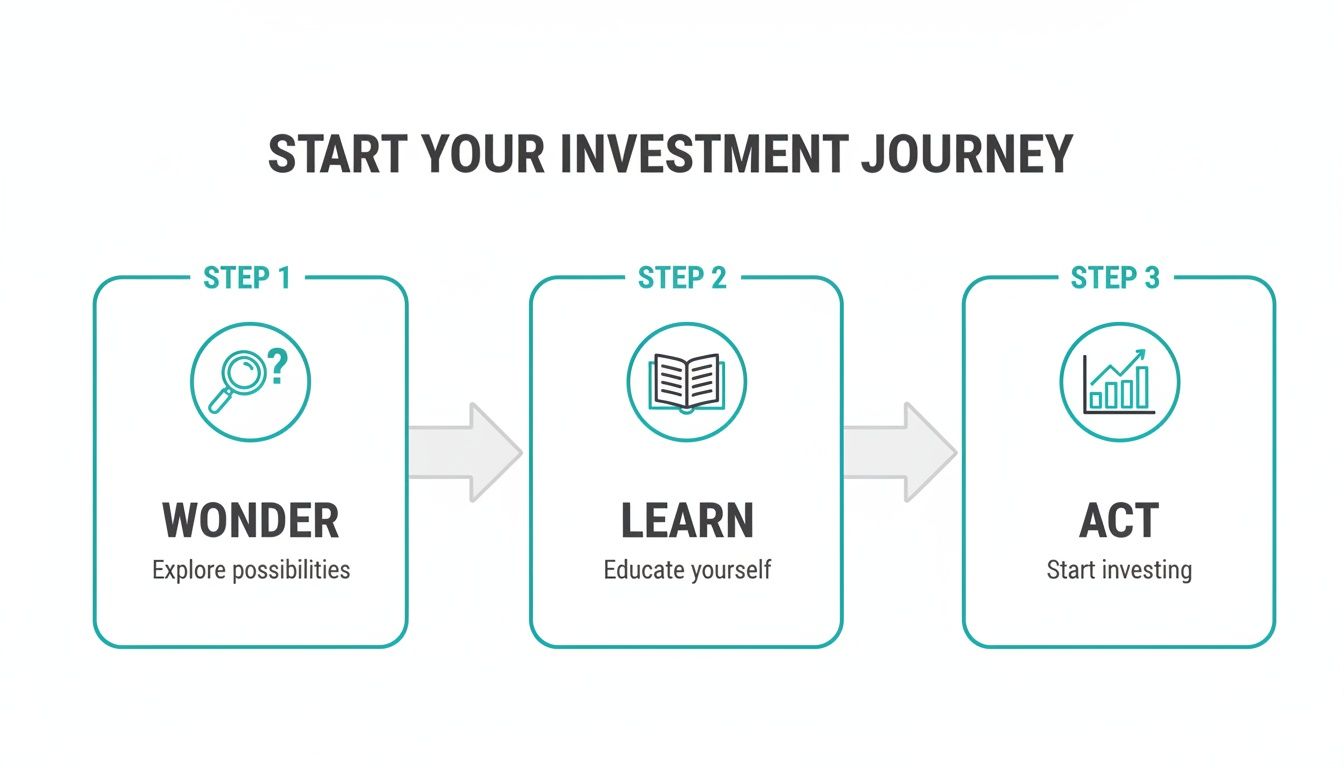
The key takeaway here is that every confident investor started with simple curiosity. Each step builds on the last, turning those initial questions into a solid, workable strategy.
Why Now Is a Good Time to Get Started
It’s easy to get caught up waiting for the "perfect" time to invest, but the current Australian economic climate offers a promising backdrop for beginners. After a period of slower growth, the economy is expected to pick up steam, moving from 1.4% in 2024/25 to a healthier 2.25% in 2025/26 and 2026/27.
This isn't just an abstract number; it points to real momentum and opportunity. For someone new to investing, a growing economy means more potential entry points for building a portfolio from scratch.
As things expand, we typically see growth in a few key areas:
- Residential Construction: A rebound in building activity often has a ripple effect on related industries.
- Business Technology: Companies are spending more on tech to boost productivity, highlighting potential in that sector.
- Consumer Spending: When people feel more confident about the economy, they tend to spend more, which can be good news for consumer-focused businesses.
At Wealth Collective, our entire philosophy is built on making complex financial ideas simple and actionable. We’ve seen firsthand that an informed investor is an empowered one, ready to make smart decisions that align with their goals.
That first step is always the hardest, but it's also the most important. The process we’ll cover in this guide is the same foundational approach we use with our clients to build wealth methodically—starting with a solid base and layering in strategy over time.
Learning how to invest isn't about trying to perfectly time the market. It's about building a sensible plan that fits your life, your goals, and your financial reality. We're here to give you the playbook to do just that.
Laying the Groundwork for Your Investment Journey
Before you even dream of buying your first share, you need to lay a solid foundation. Jumping into investing without a plan is a bit like setting off on a road trip with no map and half a tank of fuel—you might have some fun for a while, but you’re unlikely to end up where you wanted.
This initial stage is all about getting your personal financial house in order. It’s the most important, and often overlooked, part of building real, long-term wealth.

Getting this groundwork right is especially crucial right now. Australia's economy is forecast to accelerate, with growth tipped to climb from 1.4% in 2024/25 to a healthier 2.25% in 2025/26 and 2026/27. This kind of environment can create some fantastic opportunities for new investors, but it doesn't change the fundamentals. A solid plan is always your best asset.
So, let's get started.
First, Get Clear on Your 'Why'
What are you actually investing for? An investment strategy for a house deposit in five years is worlds apart from a plan for retirement in thirty years. Your timeline—your investment horizon—is the single biggest factor in figuring out how much risk you can comfortably handle.
Think about where you fit:
- Short-Term Goals (1-3 years): Maybe you’re saving for a big overseas trip or a new car. Here, the number one priority is protecting your money. You simply can't afford a major loss.
- Medium-Term Goals (4-7 years): This is classic first home deposit territory. You’ve got a bit more time up your sleeve to ride out the market’s bumps, so you can aim for better growth by taking on some calculated risk.
- Long-Term Goals (8+ years): Retirement is the quintessential long-term goal. With decades to go, you can focus on higher-growth investments, knowing you have plenty of time to recover from any downturns along the way.
Knowing your 'why' and your 'when' is the compass that will guide every decision you make from here.
Then, Take an Honest Look at Your Finances
With your goals mapped out, it’s time for a reality check. You can only invest money you actually have, which means you need a crystal-clear picture of your income, expenses, and any debt you’re carrying.
If you’ve never done it before, try tracking your spending for a month. Use an app or just a simple spreadsheet. I promise you’ll find a few surprises. Once you know where your money is going, you can create a simple budget to make sure it starts flowing towards your goals.
This isn’t about living on instant noodles. It’s about finding a few places to trim the fat so you can free up cash to invest. An extra $50 or $100 a week might not feel like much, but thanks to the magic of compounding, it can snowball into a seriously impressive sum over time.
Understanding where you stand financially is the bedrock of any successful investment strategy. It’s not about being perfect; it’s about being intentional with your money so you have surplus cash to put to work.
Finally, Figure Out Your Appetite for Risk
Let's be honest: how would you really feel if your investment portfolio suddenly dropped by 20%? Your risk tolerance is all about your gut reaction to market volatility. Would you panic and sell everything, or would you stay calm and perhaps even see it as a chance to buy more?
Most people fall into one of three broad categories:
- Conservative: You’re all about protecting your capital. You’d rather have lower, more predictable returns than risk losing money.
- Balanced: You’re willing to accept some ups and downs in exchange for moderate growth. You like the idea of mixing safer assets (like bonds) with growth assets (like shares).
- Growth/Aggressive: Your main focus is maximising long-term returns. You understand that bigger rewards often come with bigger risks and you have the stomach for the ride.
To help you connect these ideas, here’s a simple table that brings together your timeline and risk profile.
Investment Horizon and Risk Tolerance Matrix
| Investment Horizon | Typical Goal | Suggested Risk Profile | Example Investment Focus |
|---|---|---|---|
| Short-Term (1-3 Years) | Holiday, new car, emergency fund | Conservative | High-interest savings accounts, term deposits, cash |
| Medium-Term (4-7 Years) | First home deposit, major renovation | Balanced | A mix of ETFs (shares and bonds), managed funds |
| Long-Term (8+ Years) | Retirement, financial independence | Growth / Aggressive | Diversified shares, ETFs, property, alternatives |
This matrix is a great starting point for thinking about how your goals should shape the portfolio you eventually build.
Knowing your risk tolerance is what will keep you from making emotional decisions that can sabotage your success. The right balance—one that fits both your goals and your personality—is the key to building a plan you can actually stick with.
For many Aussies, their superannuation is their first and largest investment, so it’s a great real-world example of these principles in action. If you want to dive deeper into this, you can learn more about what superannuation is in Australia and how it works.
Picking the Right Accounts and Investments
You’ve done the groundwork on your finances, which is fantastic. Now we get to the part everyone asks about: choosing where to put your money and what to actually buy.
Think of it like getting ready for a big road trip. The car you choose (your investment account) depends on the journey you’re planning. A zippy convertible is great for a weekend away, but you’d want a sturdy 4WD for a trip across the outback. It’s the same with investing—the right account structure is crucial for reaching your financial destination.
Super vs. Outside Super: The Two Main Paths
In Australia, your investment world is split into two main territories: money you invest inside your superannuation fund, and money you invest outside of it. Most savvy investors use a bit of both, but they are built for very different jobs.
Investing Inside Your Super
This is your dedicated, long-haul retirement vehicle. Its massive advantage is the tax treatment. Any earnings your investments make are typically taxed at a maximum of 15%. For most people, that’s a huge saving compared to their normal income tax rate.
The catch? It’s a one-way street for a long time. That money is generally locked up until you hit your “preservation age” (usually between 55 and 60). It’s designed specifically for retirement, and the government gives you a tax break to keep it that way.
Investing Outside Your Super
This is your flexible, all-purpose fund. You have total control and can pull your money out whenever you like, which makes it perfect for goals like saving for a house deposit, a big holiday, or your kids’ education.
The trade-off for this flexibility is tax. Any profits you make—from share price growth or dividends—are taxed at your personal marginal tax rate, which could be as high as 45% (plus the Medicare levy).
It’s almost never an “either/or” situation. The smartest approach is to use both structures strategically. Use super for what it does best—compounding for retirement in a low-tax world. Use your non-super investments for all the goals you have between now and then.
This is exactly where getting some professional guidance can make a world of difference. An adviser can map out a strategy that uses both environments to their full potential, making sure your investments are structured in the most tax-effective way for your specific goals. It’s a core part of what we do in our ‘Guided Growth’ process at Wealth Collective.
A Look Inside the Investor’s Toolkit
Once you’ve sorted out the “where” (your account), it’s time to decide on the “what” (your investments). The sheer number of options can feel overwhelming, but for most people starting out, it all boils down to four main asset classes.
Let’s break them down.
Shares (Equities)
When you buy a share, you’re buying a tiny slice of a company like Commonwealth Bank or Woolworths. The idea is that as the company grows and becomes more profitable, the value of your slice goes up (capital growth) and they might share some of those profits with you along the way (dividends).
You can invest in shares a few ways:
- Individual Stocks: This involves picking specific companies you think have a bright future (e.g., BHP, CSL, or even Apple). It requires a lot of research and is riskier because your money rides on the success of just a handful of businesses.
- ETFs (Exchange-Traded Funds): This is the go-to for most new investors, and for good reason. An ETF is like a basket that holds hundreds or even thousands of different shares. By buying a single unit of an ETF, you instantly own a tiny piece of every company in that basket, giving you instant diversification and dramatically lowering your risk.
- LICs (Listed Investment Companies): These are similar to ETFs but are run by active fund managers who make the decisions on what to buy and sell. They’ve been around for a long time and are another popular way to get a diversified portfolio.
Bonds (Fixed Income)
Think of a bond as an IOU. You’re essentially lending money to a government or a big corporation. In return for your loan, they promise to pay you a fixed amount of interest (like 3% or 4% per year) for a set period, and then give you your original money back at the end.
Bonds are generally much safer than shares and provide a reliable, predictable income stream.
Property
We all know this one. It can mean buying a physical investment property to rent out, or investing in a REIT (Real Estate Investment Trust). REITs are basically companies listed on the stock exchange that own and manage a portfolio of properties—like shopping centres or office buildings.
Property can provide both rental income and capital growth, but it’s not without its challenges. It usually requires a huge upfront investment and you can’t sell it in a hurry if you need cash.
Cash
This is simply money sitting in a bank account, whether it’s a high-interest saver or a term deposit. It’s the safest place for your money, no question.
The downside is that its returns are often so low they don’t even keep up with inflation. This means that over time, your cash can actually lose its real-world buying power. To learn more about making your cash work harder, check out our guide on how a Cash Management Account works.
Figuring out the right mix of these assets is what portfolio construction is all about, and that’s our very next step.
Building Your First Investment Portfolio
Alright, you’ve done the groundwork: your finances are sorted and you’ve picked out your investment accounts. Now for the exciting part—actually building the portfolio. This is where we take your goals, your appetite for risk, and your time horizon and turn them into a real, tangible strategy.
Don’t get bogged down in complex theories. The goal here is to build something simple and strong that you can build upon for years to come. The mix of assets you end up with should be a direct reflection of the risk profile you figured out earlier, whether that puts you in the conservative, balanced, or growth camp.
The Core-Satellite Approach: Your Blueprint for Success
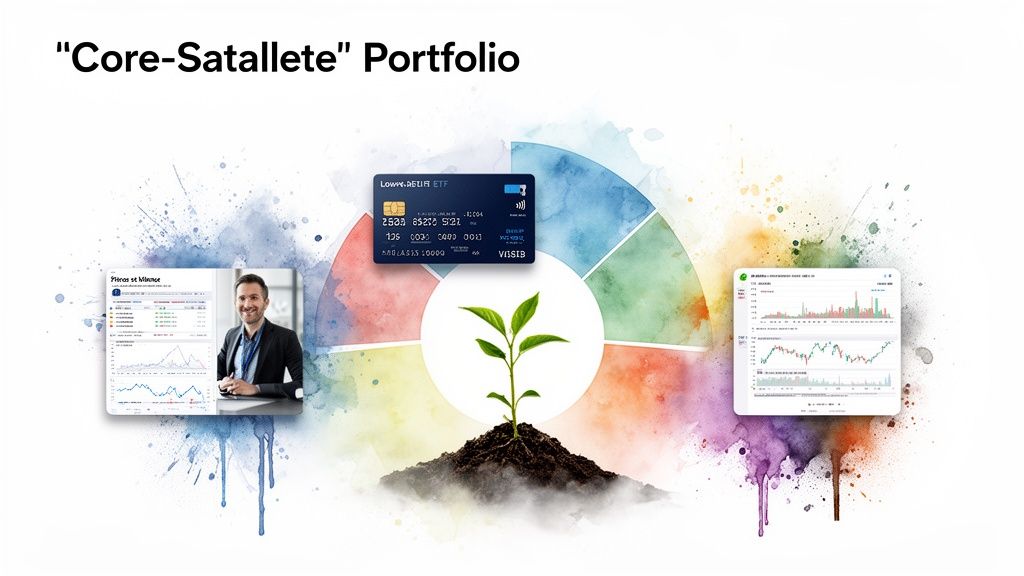
For anyone just starting out, one of the most practical and effective methods I’ve seen is the Core-Satellite strategy. It’s a fantastic way to get the best of both worlds—stability and growth—without making things overly complicated.
Think of your portfolio like a solar system. At the very centre is your ‘Core’, the sun. This is the biggest chunk of your portfolio, usually making up 70-80% of the total. It’s built on a bedrock of stable, low-cost, and widely diversified investments. For most new investors, this means putting your money into one or two large Exchange-Traded Funds (ETFs) that track major indexes, like the Australian ASX 200 or a global equivalent.
Orbiting this solid core are your ‘Satellites’. These are much smaller, more focused investments that make up the other 20-30%. Your satellites are where you can take on a bit more calculated risk in specific areas you believe have great potential.
This might look like:
- A thematic ETF focused on a specific sector, like technology or renewable energy.
- A few individual company stocks that you’ve researched thoroughly and feel confident about.
- An investment in a completely different asset class, like property, through a Real Estate Investment Trust (REIT).
The real genius of this strategy is its inherent balance. Your core acts as a steady anchor, shielding you from the worst of the market’s ups and downs. Meanwhile, your satellites give you the freedom to chase higher returns without risking the entire farm.
Why Your Core Must Be Diversified
If there’s one rule in investing you should never, ever forget, it’s diversification. People say it all the time for a reason—it’s your single best defence against risk. By spreading your money across a wide range of companies, industries, and even different countries, you ensure that a bit of bad luck in one area doesn’t derail your whole plan.
Imagine you put all your money into just two mining stocks. Your entire fortune would be at the mercy of commodity prices. But if you own a broad-market ETF instead, you instantly gain exposure to banks, retailers, healthcare giants, and tech firms. If the mining sector has a tough year, chances are another sector will be doing well, helping to smooth out your overall returns.
A great beginner portfolio isn’t about trying to pick the next big winner. It’s about building a resilient, all-weather structure that can grow steadily over the long haul. Diversification is what makes that possible.
Finding Growth Hotspots for Your Satellites
While your core is all about stability, your satellites are where you can get a bit more strategic and target specific growth opportunities. For instance, the technology sector is showing some serious momentum right now.
An Australian Industry Group survey found that tech investment is the number one priority for Aussie businesses leading into 2026. A +34 net balance of companies are planning to ramp up their tech spending, with 49% of them looking to invest in technology to become more efficient. This points to sustained demand and the potential for strong earnings in the tech space. You can always explore the full Australian industry outlook to get a feel for these trends yourself.
Of course, this doesn’t mean you should throw your entire satellite allocation into tech stocks. It just shows how you can use real-world data to make informed decisions for these smaller, growth-focused parts of your portfolio. Another popular satellite option is property, which behaves differently to shares and can add another layer of diversification. If that interests you, our guide on how to buy an investment property is a great place to dig deeper.
Putting your portfolio together is a crucial step where your strategy finally becomes reality. At Wealth Collective, our process is designed to help you construct a portfolio that is not only diversified but also perfectly aligned with what you want to achieve. If you’re feeling at all unsure about getting this mix right, booking a quick, no-obligation call with an adviser can give you the clarity and confidence to get started on the right foot.
Putting Your Investment Plan Into Action
A great strategy is worthless until you act on it. This is where the rubber meets the road—we’re moving from planning to doing, getting you set up to make that very first investment.
It might feel like a big leap, but breaking it down makes it manageable. It’s really just a matter of picking the right tools, getting them set up, and then letting a smart system do most of the work for you.
Selecting Your Online Broker
Think of your online broker as your gateway to the share market. When you’re just starting out, it’s easy to get overwhelmed by fancy features. Forget the noise. You only need to focus on three things: low fees, a user-friendly platform, and access to the investments you actually want to buy.
Australia has some fantastic options, and you’ll often hear names like CommSec, Pearler, and SelfWealth mentioned. Each one has its own vibe and caters to slightly different investors.
So, how do you choose? Here’s what I tell my clients to look for:
- What’s the brokerage? This is the fee you pay to buy or sell. Look for low, flat fees, especially for smaller trade sizes (like under $5,000). High fees are a real drag on your returns over the long run.
- Is it easy to use? You want a clean, simple interface. A platform cluttered with complex charting tools you don’t need yet will only cause confusion and analysis paralysis.
- Can you buy what you want? Make sure the broker offers the Australian and international shares or ETFs you’ve already picked out for your portfolio.
- Does it have an auto-invest feature? This is a game-changer for building wealth consistently. I strongly recommend prioritising platforms that offer it.
To help you get a feel for the market, here’s a quick snapshot of a few popular brokers for beginners. This isn’t an exhaustive list, but it’s a great starting point for your own research.
Australian Online Broker Comparison Snapshot
| Platform | Brokerage Fee (e.g., under $5k) | Best For | Key Feature |
|---|---|---|---|
| CommSec | ~$10 – $29.95 | Beginners wanting integration with their CBA bank account. | Seamless integration with Commonwealth Bank accounts and extensive research tools. |
| Pearler | $6.50 | Long-term, passive investors focused on automation. | "Autoinvest" feature that makes dollar-cost averaging incredibly simple. |
| SelfWealth | $9.50 (flat fee) | Cost-conscious investors who value a simple, flat-fee structure. | CHESS sponsorship and a flat brokerage fee regardless of trade size. |
After you’ve made your choice, the sign-up process is pretty straightforward. You’ll need to verify your identity (with a driver’s licence or passport) and provide your Tax File Number (TFN). Once your account is approved and you’ve transferred some cash, you’re officially ready to go.
The Power of Automation and Dollar-Cost Averaging
If there’s one habit that will define your success as an investor, it’s consistency. And the secret to consistency is automation.
The strategy behind this is called dollar-cost averaging (DCA). Instead of trying to time the market by dropping in a huge lump sum when you think prices are low (a recipe for stress and usually a bad idea), you invest a fixed amount of money at regular intervals.
Think $200 every fortnight, automatically.
When the market is up, your $200 buys fewer shares. When the market is down, that same $200 buys you more. This simple process smooths out your average purchase price over time and—most importantly—it removes emotion from your decision-making. You stop worrying about the daily news and just stick to the plan.
Setting up automatic contributions is the closest thing to a “set and forget” strategy for wealth building. It turns investing from a stressful decision into a background habit, like a direct debit for your financial future.
This systematic approach is a core part of the Wealth Collective’s Guided Growth process. We help our clients build systems that ensure they are consistently investing towards their goals, removing the guesswork and emotional stress.
Managing Fees and Understanding Basic Tax
Two things new investors often overlook can have a massive impact on their long-term wealth: fees and tax.
Every dollar you pay in fees is a dollar that isn’t working for you. This includes brokerage fees to buy and sell, as well as the management fees inside ETFs or funds (known as the Management Expense Ratio, or MER). Always be conscious of these costs and aim for the lowest you can find for a quality investment.
On the tax side, you only need to know two main things to start:
- Income Tax: Dividends paid out from your shares are treated as income, so they’re taxed at your personal marginal rate.
- Capital Gains Tax (CGT): If you sell an investment for a profit, that profit is called a “capital gain” and is taxable. Crucially, if you hold that investment for more than 12 months, you generally get a 50% discount on the tax you have to pay.
Understanding these basics from day one reinforces the power of a long-term, buy-and-hold approach. It encourages you to think like a true investor, not a trader, and helps you keep more of your hard-earned returns.
Putting your plan into action is the final bridge between theory and reality. If you feel you need a hand building that bridge or want to ensure your strategy is structured for optimal growth, booking a free 10-minute introductory call is a simple next step to get expert, personalised guidance.
Staying The Course and Knowing When To Get Help
You’ve done the hard work of setting up your portfolio and getting your automatic contributions ticking over. That’s a huge step. But the journey doesn’t end there; in many ways, the real work is just beginning. Now, the focus shifts to management, discipline, and mastering the psychology of long-term investing.
The Annual Check-Up: Why Rebalancing Matters
One of the biggest mistakes new investors make is either checking their portfolio constantly or never looking at it at all. The sweet spot is somewhere in the middle. I recommend setting a calendar reminder for a yearly review. This isn’t about obsessing over daily ups and downs; it’s a calm, planned check-in to see how things are tracking and to perform a vital task called rebalancing.
Think of it this way: over a year, some of your investments will inevitably do better than others. This can throw your carefully planned asset allocation out of whack. For instance, say your shares have a fantastic run and now make up 70% of your portfolio instead of the 60% you originally intended.
Without you doing anything, your portfolio has become riskier. Rebalancing is just the process of trimming back the winners (selling some shares) and topping up the underperformers to get back to your target mix. It’s a disciplined way to sell high and buy low.
Don’t Panic When The Market Dips
Sooner or later, the market will take a downturn. It’s not a matter of if, but when. Seeing the value of your hard-earned investments drop is never a good feeling, but it’s a perfectly normal part of the cycle. Your gut reaction might be to sell everything to stop the bleeding. Resist that urge.
Panic-selling is one of the most reliable ways to destroy wealth. It locks in your losses and means you’ll miss the eventual recovery. This is especially true when you have a long-term horizon. In fact, for those of us still adding to our portfolios, a market dip is a great opportunity to buy quality assets at a discount.
For example, after several strong years, some forecasts for the Australian share market in 2026 suggest a more moderate return of around 8%. This doesn’t mean we should run for the hills; it just reinforces the need for realistic expectations and a solid, diversified strategy that can handle different market conditions.
The real challenge of long-term investing isn’t picking the right stocks; it’s mastering your own emotions. A solid plan, built on your goals and risk tolerance, is your best defence against making impulsive decisions during a market storm.
Knowing When to Ask for Professional Advice
A DIY approach is an empowering way to start your investing journey, and you can manage it yourself for a long time. But life gets more complicated, and your finances will too. Knowing when to tap an expert on the shoulder is a sign of a smart investor.
It might be time to get a professional opinion if you find yourself in these situations:
- Your finances are getting complex: Maybe you’ve received an inheritance, started a business on the side, or are juggling a few investment properties.
- You’re hitting a major life milestone: Getting married, starting a family, or mapping out your retirement are huge financial moments that need a proper strategy.
- You’re feeling overwhelmed or stressed: If managing your investments feels like a chore or is keeping you up at night, it’s time to delegate. Your peace of mind is worth it.
At Wealth Collective, our whole process is built around bringing clarity to these exact situations. We take complex financial puzzles and turn them into simple, actionable roadmaps. If you’re feeling a bit lost or just want a second opinion on your next steps, a free 10-minute introductory call is an easy, no-obligation way to get some personalised guidance.
Frequently Asked Questions About Investing
It’s completely normal to have a few questions swirling around as you get started. In fact, it’s a great sign you’re taking it seriously. Let’s clear up some of the most common queries we hear from new investors in Australia.
How Much Money Do I Need to Start Investing?
You can get started with a lot less than you probably imagine. With the rise of micro-investing apps and low-cost online brokers, you can make your first move with as little as $100.
What’s far more important than a big, one-off starting amount is building the habit. Consistently putting money away, even small amounts, is what truly builds wealth over the long haul.
Is Investing Just a Form of Gambling?
This is a common misconception, but no, it’s a different world entirely. Gambling is a bet on a random, short-term outcome where the odds are fundamentally stacked against you. Investing is about strategic, long-term ownership.
When you invest, you’re buying a small piece of a real business that produces goods or provides services. You’re backing its potential to grow and become more valuable over time. It’s a strategy built on economic performance, not a roll of the dice.
The core difference is ownership versus chance. Investing is owning a slice of economic growth, while gambling is a wager on an unpredictable event. A well-thought-out investment plan is designed to grow wealth systematically, not leave it to fate.
What’s an ETF Versus a Managed Fund?
Both Exchange-Traded Funds (ETFs) and managed funds offer a ready-made, diversified portfolio. The main difference is how they’re managed.
- ETFs are typically passive. They’re designed to track a specific market index, like the ASX 200, and you buy and sell them on the stock exchange just like a regular share. They’re well-regarded for being transparent and having very low fees.
- Managed Funds are actively run by a fund manager. Their job is to hand-pick investments with the goal of outperforming the market. This hands-on approach almost always comes with higher fees.
Do I Have to Pay Tax on My Investments?
Yes, any money you make from your investments in Australia is generally considered taxable income. It usually falls into two categories:
- Income Tax: Any dividends you receive from your shares are taxed at your marginal income tax rate.
- Capital Gains Tax (CGT): This is the tax you pay on the profit when you sell an investment for more than you bought it for. The great news here is that if you hold an asset for more than 12 months before selling, you’re typically eligible for a 50% discount on the capital gains tax you owe.
Getting your head around these concepts is the first step, but a personal strategy is what really gets results. The team at Wealth Collective specialises in turning these ideas into a clear, actionable plan that fits your life. If you’re ready for some expert guidance, feel free to book a free 10-minute introductory call to see how we can help.