Business hours
Monday to Friday (8.30AM - 5PM)
Weekend (Closed)


When you think about retiring early in Australia, what comes to mind? For most of us, it’s a vision of financial freedom—leaving the workforce on our own terms, with a solid nest egg to fund a life of travel, hobbies, and time with family.
But what if early retirement isn’t always a choice?
The Unspoken Reality of Early Retirement

The dream of ditching the 9-to-5 grind ahead of schedule is a powerful one. While it’s an achievable dream with the right strategy, the hard data shows a more complicated story for a surprising number of people.
The truth is, many Australians are forced into retirement before they plan to be. This gap between the dream of a planned exit and the reality of an involuntary one is where many financial plans fall apart.
The Involuntary Exit from the Workforce
The latest figures from the Australian Bureau of Statistics (ABS) paint a sobering picture. In the 2024-25 data, of the 156,000 Australians aged 45 and over who retired, many were pushed out of the workforce unexpectedly.
A staggering 13% had to stop working due to sickness, injury, or disability, retiring at an average age of just 56.9. Another 6% were retrenched or simply couldn’t find work, forcing them into retirement at an average age of 58.3. You can dig deeper into these numbers in the full report on retirement behaviour among older Australians.
This isn’t an abstract statistic; it’s a real-world risk. An unexpected job loss, a sudden health crisis, or an industry downturn can derail even the most carefully crafted plans.
This isn’t about fearmongering. It’s about being realistic. Knowing that an early exit could be forced upon you is the single best reason to build a financial strategy that’s resilient and proactive.
Taking Back Control with a Solid Plan
So, what does this all mean for you? It means that hoping for the best isn’t a retirement strategy. The real possibility of an involuntary early retirement is precisely why you need a clear, actionable plan—it’s your best defence against uncertainty.
A robust financial plan acts as a shield, protecting your long-term goals from life’s curveballs and putting you in the driver’s seat of your financial future.
This is exactly why we created our Retirement Roadmap service at Wealth Collective. We’ve seen first hand how a concrete plan provides clarity and protection, preparing you for both sunny days and unexpected storms. Our process is straightforward:
- Clarify Your Vision: We work with you to understand your ideal retirement, whether that’s at 55 or 65.
- Analyse Your Position: We conduct a full diagnostic of your assets, debts, income, and spending to get a clear financial snapshot.
- Chart Your Course: We map out the specific, practical steps to bridge the gap from where you are to where you want to be, covering investments, super, debt, and insurance.
This proactive approach puts you back in control. Instead of worrying about what might happen, you can move forward with confidence, knowing you have a plan built to achieve your version of early retirement, come what may.
If you’re ready to build your own roadmap, our team is here to help.
Figuring Out Your Financial Independence Number

To retire early, “saving a lot” isn’t a plan; it’s a wish. To make it real, you need a target. This is your Financial Independence (FI) number—the total amount you need in investments to live off the returns without ever needing a paycheque again.
Knowing this number transforms a fuzzy dream into a concrete destination. It’s the most critical first step because it tells you exactly what you’re working towards.
The 4% Rule: An Aussie Reality Check
A well-known shortcut for finding your FI number is the 4% rule. It suggests you can withdraw 4% of your investment portfolio in your first year of retirement, then adjust for inflation each year after.
To find your number, simply multiply your desired annual retirement spending by 25. So, if you want $80,000 a year to live on, your FI number is $2,000,000.
However, this rule was developed for a standard 30-year retirement. If you plan to retire in your 40s or 50s, your money needs to last much longer, putting your portfolio under more stress. Because of this, many Australian experts now recommend a more cautious withdrawal rate of 3% or 3.5% for early retirees to build a larger safety buffer.
Using a more conservative 3% withdrawal rate means you multiply your annual expenses by 33.3. That same $80,000 lifestyle now requires a nest egg of around $2.66 million. It’s a bigger hill to climb, but building a robust plan is key to long-term success.
What Does a “Comfortable” Retirement Cost in 2026?
The cost of retirement is a moving target. Inflation and rising living standards mean the goalposts are always shifting.
To put real figures on this, we can look at the standards published by the Association of Superannuation Funds of Australia (ASFA), the industry benchmark.
Early Retirement Nest Egg Targets (ASFA Standards)
The table below shows the total nest egg needed to fund a ‘Modest’ or ‘Comfortable’ retirement lifestyle, based on ASFA’s latest figures. We’ve calculated this using the standard 4% withdrawal rule as a baseline.
| Lifestyle Standard | Annual Income (Single) | Required Nest Egg (Single) | Annual Income (Couple) | Required Nest Egg (Couple) |
|---|---|---|---|---|
| Modest | $32,666 | $816,650 | $46,997 | $1,174,925 |
| Comfortable | $51,278 | $1,281,950 | $72,148 | $1,803,700 |
Note: Figures based on ASFA standards (March Quarter 2024) and calculated using the 4% rule. These numbers do not account for any future Age Pension payments.
These numbers make one thing crystal clear: your superannuation will do most of the heavy lifting. Maximising it is non-negotiable. For a deeper dive, our guide on how much super you might need to retire is a great place to start.
Now that you have your target, let’s build the engine to get you there.
How to Fuel Your Early Retirement: Super and Investments

You’ve got your Financial Independence number. Now it’s time to build the wealth engine to reach it. Your journey relies on two key pillars running in tandem: your superannuation and a smart investment portfolio outside of super.
This is what we call the ‘Guided Growth’ phase in our Wealth Collective process. It’s all about creating serious, sustainable momentum towards your financial goals.
Your Super: A Powerful Wealth-Building Tool
Your super fund is one of the most powerful wealth-building tools available, thanks to its low-tax environment. To use it effectively for early retirement, you need to be proactive. Relying on your employer’s compulsory 11% contribution is a starting point, not a strategy.
One of the best ways to accelerate growth is through salary sacrificing. By directing a portion of your pre-tax pay into your super, you not only boost your nest egg but also lower your taxable income. It’s a clear win-win. Learn more in our detailed guide on what salary sacrificing super involves.
Here are the contribution types you need to know:
- Concessional (Before-Tax) Contributions: This includes your employer’s contribution plus any salary sacrifice. The annual cap is $27,500, taxed at a flat 15%—a significant discount for most earners.
- Non-Concessional (After-Tax) Contributions: This is money you contribute from your bank account after tax. While there’s no tax deduction, future investment earnings are taxed at only 15%. You can contribute up to $110,000 a year this way.
- The Bring-Forward Rule: This rule allows you to use up to three years’ worth of your non-concessional cap at once, letting you inject up to $330,000 into your super in a single financial year. It’s a game-changer if you receive a lump sum.
We help our clients use these caps strategically every year. It’s about funnelling as much capital as legally possible into the most tax-effective environment to let compounding do the heavy lifting.
Building Your “Bridge” Portfolio Outside Super
The catch with super is that you can’t access it until your preservation age (typically 60). If you want to retire in your 40s or 50s, you need another source of funds.
This is where your investment portfolio outside of super comes in. Its job is to “bridge the gap” between your early retirement date and the day you can access your super. The goal is to build income-generating assets you can draw from anytime.
The Building Blocks of a Pre-Retirement Portfolio
A robust portfolio isn’t just about picking a few hot stocks. It’s about creating a diversified mix of assets that can weather market storms.
Here’s what that typically includes:
- Exchange-Traded Funds (ETFs): ETFs are often the bedrock of an early retirement portfolio. They provide instant diversification across hundreds of companies in a single, low-cost trade, allowing you to invest in the entire Australian market (ASX 200), global markets, or specific industries.
- Direct Shares: Holding shares in individual blue-chip companies can offer dividends and growth potential. A common strategy is to build a core portfolio of ETFs and supplement it with high-quality individual shares.
- Investment Property: A good investment property can provide a steady stream of rental income and long-term capital growth. However, it requires significant capital, is illiquid, and needs active management.
The right mix for you is personal. The strategy for someone retiring at 45 will differ from that of someone retiring at 58. Creating a strategy that gets you to and through those early years is where expert guidance can make all the difference.
Tackle Your Debts to Fast-Track Your Freedom
You can’t out-invest a mountain of high-interest debt. It’s like trying to fill a leaky bucket—every dollar you pour into investments is matched by another draining out to lenders.
Strategically managing your liabilities is a non-negotiable part of any early retirement plan. Every dollar you stop sending to a lender is a dollar you can put to work building your own wealth.
Good Debt vs. Bad Debt: Know the Difference
Not all debt is created equal. Understanding the difference is crucial for early retirement.
-
“Good” Debt: This is debt that helps you acquire an asset that can grow in value or produce income, such as a mortgage on your home or an investment property. It’s a tool that can help build your net worth.
-
“Bad” Debt: This is the real wealth killer. High-interest, non-deductible debt on things that lose value, like credit cards, car loans, and personal loans. This debt actively works against you.
Your mission is to manage good debt smartly and eliminate bad debt aggressively. Every dollar of interest you don’t pay is a guaranteed, tax-free return.
At Wealth Collective, we see debt management as an active strategy, not a passive one. It’s one of the fastest ways to boost your savings rate and accelerate your journey to financial independence.
Avoid the Lifestyle Creep Trap
Lifestyle creep is the habit of letting your spending expand every time your income does. It’s one of the biggest roadblocks to early retirement. If your expenses keep pace with your income, you’ll never get ahead.
The key is to be deliberate. The next time you get a raise, have a plan for that money before it hits your bank account. Commit to funnelling 50% or more of that new income straight into investments, super, or your mortgage offset. This discipline can shave years off your working life. Learn more in our guide on how to pay off debt faster.
A Real-World Example: Accelerating Debt Freedom
We recently worked with a Perth couple in their late 30s. They were earning great money but were held back by a large mortgage, two car loans, and $30,000 in credit card debt.
Instead of chipping away at it for a decade, we got aggressive. We refinanced their mortgage to a better rate and used the cash freed up to attack their smallest credit card first (the “debt snowball” method). That first win provided a huge psychological boost. From there, we rolled all repayments onto the next debt, then the car loans.
The result? Within 18 months, all their “bad” debt was gone, freeing up an extra $1,500 a month. We set up an automatic transfer to channel this into their investment portfolio.
That $18,000 a year, once just covering interest, is now compounding for their future. That’s how you make real progress.
Don’t Let Life Derail Your Plan: Building Your Financial Fortress
You can have the most meticulous early retirement plan, but it’s fragile. The biggest mistake is assuming the path to retirement will be a straight line.
A lot of early retirements aren’t a choice; they’re forced by unexpected illness, injury, or disability. When that happens, a great plan on paper is worthless unless you’ve built a fortress around it. Risk management is the most important part of your journey.
At Wealth Collective, we call this the ‘Protection Plus’ part of our service because it’s about securing everything you’ve worked so hard for.
The Four Pillars of Personal Insurance
A proper financial fortress rests on four key pillars of personal insurance. Each plugs a different, potentially catastrophic, hole in your financial life.
- Income Protection: If you can’t work due to sickness or injury, how do you pay the bills? This insurance provides a monthly benefit—usually up to 70% of your income—so your household keeps running and your wealth plan stays on track.
- Total and Permanent Disablement (TPD): This pays a lump sum if you’re disabled and can never work again. This money can wipe out debt, pay for ongoing care, or fund home modifications.
- Trauma Insurance: Also known as Critical Illness cover, this pays a lump sum if you’re diagnosed with a major condition like cancer, a heart attack, or a stroke. It gives you financial breathing room to focus on recovery.
- Life Insurance: This provides a lump sum to your family if you pass away. It’s not for you; it’s for them—to clear the mortgage, cover future expenses, and provide security.
On your journey to financial independence, your ability to earn an income is your single greatest asset. Protecting it with Income Protection isn’t just a good idea; it’s essential.
Structuring Your Cover to Be Smart and Tax-Effective
How you own your insurance matters. In Australia, you can hold policies personally or, for some types, inside your superannuation fund.
Holding cover inside super can be cost-effective as premiums are paid from your super balance. However, the policies can be more restrictive, and you can’t hold Trauma insurance inside super at all.
This is where getting the right advice is crucial. We often help clients create a blended strategy—for instance, holding Life and TPD cover inside super for cost efficiency, while a more comprehensive Income Protection and Trauma policy is held outside super for better definitions and easier claims. It’s about balancing cost and quality.
A Real-World Example: A Business Owner’s Safety Net
A client of ours, a 45-year-old business owner, was working hard to retire by 55. He was fit and healthy, but we convinced him to set up a solid Income Protection and Trauma policy. Two years later, a major health scare required surgery and six months off work.
His Trauma policy paid a lump sum that covered his medical bills and allowed his wife to take time off to support him without touching their savings. Simultaneously, his Income Protection replaced his lost income, so the mortgage was paid and his business survived. His early retirement goal didn’t get derailed by a single day. That’s the power of a well-built financial fortress.
To start building your own protective strategy, a quick chat with our team can get you on the right path.
Your Early Retirement Action Plan
Let’s pull this all together into actionable steps. The key is to focus on the right moves for your current decade.
In Your 20s: Laying the Foundation
Your biggest advantage is time. Use the power of compounding to lock in solid financial habits.
- Master your cash flow: Create a budget to know where your money is going.
- Eliminate ‘bad’ debt: Make getting rid of credit card and personal loan debt your top priority.
- Automate your savings: Set up automatic transfers to your savings and investment accounts on payday.
- Engage with your super: Check your fees, review your investment option (a ‘growth’ option is likely suitable), and consider making small extra contributions.
In Your 30s: Building Momentum
This is the decade to make your money work as hard as you do.
- Supercharge your savings: As your income grows, aggressively increase the percentage you save and invest. Avoid lifestyle inflation.
- Get serious about super: Start salary sacrificing to take advantage of the low-tax environment.
- Invest outside of super: Open a brokerage account and begin building your ‘bridge fund’ with low-cost ETFs.
- Protect your loved ones: Get essential insurance like Income Protection and Life Insurance.
In Your 40s: Hitting the Accelerator
Welcome to your peak earning years. It’s time to put the foot down.
- Maximise contributions: Aim to hit the concessional super cap ($27,500) each year and use ‘carry-forward’ rules for any windfalls.
- Fine-tune your portfolio: Review your asset allocation to ensure it aligns with your early retirement timeline.
- Attack the mortgage: Focus on smashing your home loan. Every extra dollar paid is a guaranteed, tax-free return.
Your 40s are the make-or-break decade. The financial decisions you make now will have the biggest impact on whether you retire at 55 or have to work until 65.
In Your 50s: The Final Approach
You’re on the home stretch. The focus shifts from pure accumulation to protecting what you’ve built.
- Create your income roadmap: Model how you will draw down your super and investments to fund your retirement.
- Plan your Transition to Retirement (TTR): Investigate if a TTR strategy can help you wind back work hours while drawing a tax-effective income from your super.
- De-risk your portfolio: Gradually shift your asset allocation to a more conservative mix to protect your capital as retirement approaches.
This timeline shows how a smart plan helps you build a financial fortress, strong enough to handle life’s curveballs and secure your future.
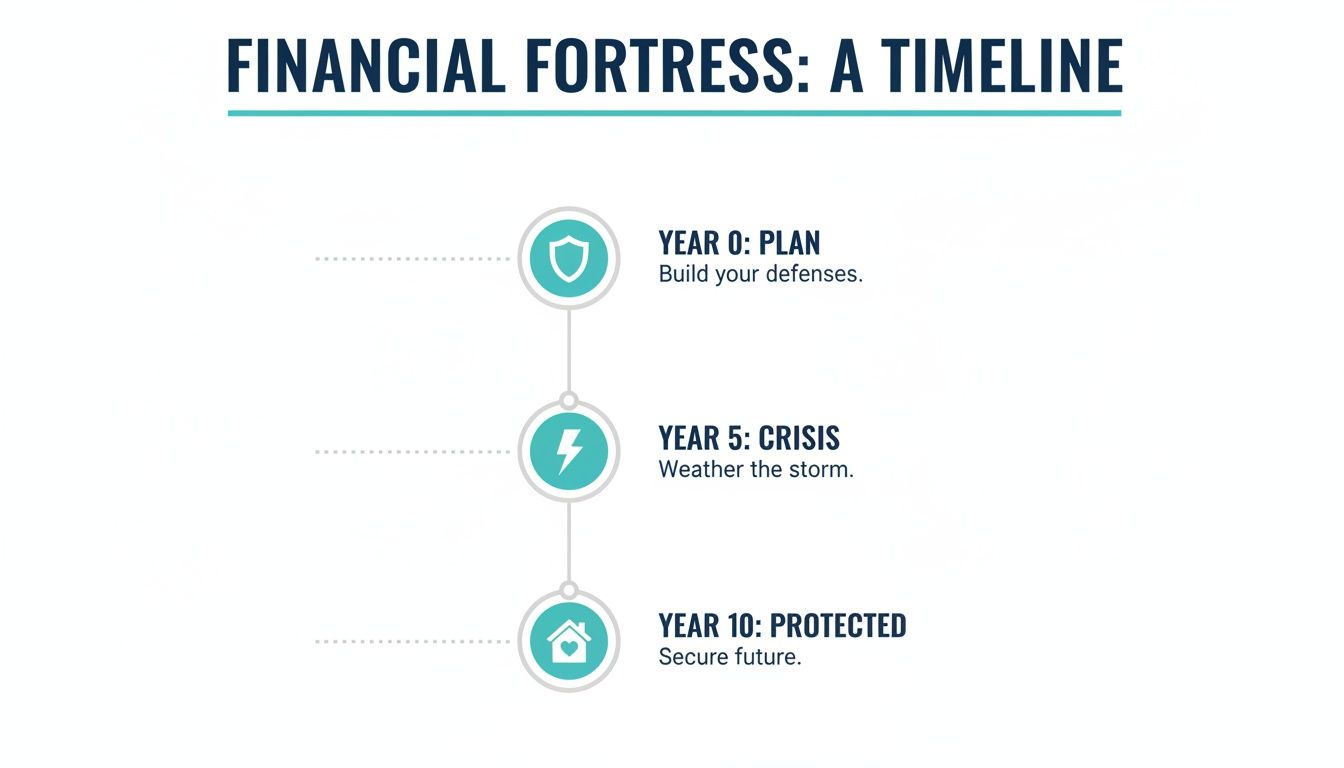
The crucial insight is that protecting your wealth is an ongoing process that ensures a crisis doesn’t derail your goals.
Reading this guide is a fantastic first step, but real progress comes from action. The strategies for retiring early only work when tailored to your specific numbers, goals, and life situation.
At Wealth Collective, we specialise in turning this knowledge into a personalised Retirement Roadmap. If you’re ready to stop just thinking about it and start building toward it, the next step is simple.