Business hours
Monday to Friday (8.30AM - 5PM)
Weekend (Closed)


At its heart, an investment property is simply real estate you buy to generate income or capital growth, not to live in yourself. While your own home is a place for making memories, an investment property is a hard-working asset, tasked with a single job: to build your wealth.
It’s a fundamental shift in perspective. Successfully investing in property requires moving from an emotional mindset to a financial one. At Wealth Collective, we specialise in guiding clients through this process, ensuring their property decisions are strategic, data-driven, and aligned with their long-term financial goals.
What Exactly Is an Investment Property?

When you're house-hunting for yourself, your heart often leads the way. You think about the commute, the feel of the neighbourhood, or whether there's enough space for the kids to run around. But with an investment property, you need to switch from your heart to your head. It’s a business decision, plain and simple.
This distinction is crucial. It dictates where you buy, what you buy, and how you finance it. The numbers, market trends, and growth potential become your new guideposts, not your personal taste.
Investment Property vs Your Own Home
It’s easy to blur the lines, but the Australian Taxation Office (ATO) certainly doesn’t. Here’s a clear breakdown of the key differences between a property you invest in and the one you call home.
| Aspect | Investment Property | Principal Place of Residence (PPR) |
|---|---|---|
| Primary Purpose | To generate a financial return through rent or capital growth. | To live in; your personal home. |
| Income | Rent from tenants is assessable income that must be declared. | No income is generated. |
| Tax on Sale | Subject to Capital Gains Tax (CGT) on any profit made. | Generally exempt from CGT under the main residence exemption. |
| Expense Claims | Most expenses (interest, council rates, repairs) are tax-deductible. | Expenses are not tax-deductible. |
| Financing | Lenders may have slightly stricter criteria or higher interest rates. | Often more favourable loan terms and access to First Home Owner Grants. |
Understanding these differences is the first step in building a sound property investment strategy. This is a core part of the Wealth Collective process, where we ensure your investment structure is optimised for tax efficiency and long-term performance.
The Two Engines of Wealth Creation
So, how does this asset actually put money in your pocket? It works through two powerful forces that, when working together, can accelerate your financial progress.
-
Rental Income (Cash Flow): This is your immediate return. Tenants pay you rent, which helps cover the mortgage, council rates, and other running costs. If you manage it well, the surplus cash becomes a passive income stream.
-
Capital Growth (Appreciation): This is the long game. Capital growth is the increase in the property’s market value over time. While you’re collecting rent, the property itself is hopefully becoming a more valuable asset, quietly building your net worth in the background.
Why Property Is a Cornerstone Strategy in Australia
Property isn’t just a popular investment in Australia; for many, it’s a foundational part of their financial plan. From young professionals in Perth to pre-retirees in the South West, people use real estate to build a more secure future.
The numbers back this up. Data from the 2021 Census showed over 2.1 million landlord households across the country, with around 180,000 of them right here in Western Australia.
At Wealth Collective, our Guided Growth service is designed to harness both rental income and capital growth. We help you create a clear, actionable plan that turns the potential of property investment into a tangible reality, aligning it with your unique financial goals.
Whether you’re a busy professional looking to build a portfolio or planning for a comfortable retirement, understanding what an investment property is and how it works is the first step. The right strategy can make it a powerful vehicle for achieving your financial aspirations. Booking a free, no-obligation initial call can help you see how this could work for you.
Exploring the Different Types of Investment Properties

So, you’re ready to invest in property. The next logical question is, what kind of property should you buy? The term ‘investment property’ casts a wide net, covering all sorts of real estate, each with its own quirks, demands, and potential returns. The right fit for you will come down to your finances, your appetite for risk, and what you’re hoping to achieve long-term.
Think of it like choosing the right vehicle for a job. A zippy city car is perfect for navigating tight streets, but you wouldn’t use it to haul building supplies—for that, you’d need a tough ute. In the same way, an apartment in Perth’s CBD serves a totally different investment purpose than a commercial warehouse in an industrial park.
Let’s break down the main categories so you can see which property type aligns with your strategy, whether you’re a professional building your first portfolio or a business owner looking for a new venture.
Residential Properties: The Classic Choice
For most first-time and seasoned investors in Australia, residential property is the natural starting point. It’s a market we all understand because we live in it, and the consistent demand for housing provides a solid foundation for investment.
These are the properties people call home:
- Houses: These are your classic stand-alone homes on their own block of land. They tend to offer great potential for capital growth and are always in demand with families looking for long-term rentals.
- Apartments/Units: Perfect for dense urban areas. For example, a modern two-bedroom apartment near the Perth CBD can attract a steady stream of young professionals, delivering a strong rental yield thanks to high demand.
- Townhouses/Villas: This is the middle ground, offering more space than an apartment without the high maintenance of a large house. They appeal to a wide range of tenants, from young families to downsizers.
The biggest drawcard for residential property is how accessible it is. The market is generally transparent, getting a loan is a well-trodden path, and finding tenants is usually straightforward, especially in a tight rental market like Perth’s.
The flip side is that management can be hands-on. You’re the one on the hook for everything from a leaky tap to finding new tenants between leases. This is where a clear plan, like our Guided Growth strategy, helps you stay on top of these demands while keeping your eyes on the prize.
Commercial Properties: A Business-Focused Asset
As the name suggests, commercial properties are all about business. Instead of renting to families, you’re leasing your space to companies. This is a diverse field, covering everything from office buildings and retail shops to industrial warehouses and medical centres.
For a small business owner, buying the premises you operate from can be a fantastic move—it turns dead-money rent payments into a wealth-building asset. For other investors, commercial property offers a different set of perks. Leases are typically much longer than residential ones, often 3 to 10 years, giving you far greater income security. Plus, tenants are usually responsible for outgoings like rates and maintenance, which trims your own costs.
Of course, the barrier to entry is higher. Commercial properties are more expensive, and if you do have a vacancy, it can last longer, potentially leaving you without income for an extended period. The market is also more exposed to the ups and downs of the economy.
Niche and Specialised Properties
Beyond the usual suspects, there are specialised properties that target very specific corners of the market. These can offer juicy returns, but they often come with more complexity and a different kind of risk.
A couple of examples to consider:
- Holiday Rentals: A holiday home down in Dunsborough or Margaret River can earn fantastic income during peak seasons. But that income is seasonal, and the management is intense, requiring constant marketing, cleaning, and guest communication.
- Student Accommodation: Properties near universities like UWA or Curtin can be a goldmine, with a constant stream of students looking for a place. These are often rented by the room to push the yield up, but it means you’ll deal with high tenant turnover.
Some investors also explore the strategy of buying property through their superannuation. It’s a complex area, so for a deeper dive, you can learn more about whether it’s worth buying property with super in our detailed guide. Getting the property type right is one of the most important decisions you’ll make, and understanding these differences is the first step to getting it right.
How Property Investment Actually Builds Wealth
So, you’ve got a handle on what an investment property is and the different shapes and sizes they come in. But how does owning a slab of bricks and mortar actually put money in your pocket and build long-term financial security? It’s not a magic trick; it’s a powerful combination of two distinct, yet complementary, financial forces.
A great way to think about it is like owning a fruit tree. The real value comes from the fruit it produces each year (rental yield) and the growth of the tree itself over time (capital growth). Getting them to work together is the foundation of any smart property strategy.
The Immediate Return: Rental Yield
Rental yield is the fruit from your tree—it’s the immediate, tangible income you earn from your investment. Think of it as the cash flow generated by your tenant’s rent payments, calculated as a percentage of your property’s value. It’s the steady, predictable income that keeps the whole operation running smoothly.
A strong rental yield does more than just cover the mortgage. It helps pay for council rates, insurance, and maintenance, and any surplus cash goes straight into your pocket as passive income.
Let’s put that into perspective. Imagine you buy a solid investment property in one of Perth’s southern suburbs. In 2026, yields in these popular investor spots are hovering around 5.2%. On a $600,000 property, that works out to be over $31,000 in gross rental income for the year. This income is the lifeblood of your investment, giving you the financial breathing room to hold the asset for the long haul.
A healthy yield makes sure your property can largely pay for itself. It’s why our Guided Growth plan puts such a heavy focus on finding properties in areas with solid rental demand—we want your investment to start contributing from day one.
The Long Game: Capital Growth
While rental yield pays the bills, capital growth is the long-term powerhouse. This is the increase in your property’s market value over time. It’s the tree itself growing bigger, stronger, and more valuable year after year.
Capital growth is where serious wealth is created. It’s not cash you can spend at the shops today, but it represents a massive boost to your net worth, quietly building in the background while your tenants pay you rent.
Take a real-world example. A property bought in Perth a decade ago for, say, $300,000 has not only provided ten years of rental income. Thanks to strong demand and population growth, its market value has likely appreciated significantly, creating a substantial equity base you can tap into for your next move.
This powerful one-two punch of income and growth is why property has long been a cornerstone of wealth creation for everyday Australians. The numbers back it up. For instance, Perth properties appreciated by an average of 7.8% annually between 2000 and 2023. You can dive deeper into historical performance across different markets on sites like Ahlend.
Bringing It All Together for Your Future
So, how do these two forces work in harmony to build your financial future?
- During your working years: The rental income keeps the investment afloat by helping to manage holding costs, while capital growth steadily builds your asset base. This is classic wealth accumulation.
- As you approach retirement: The equity you’ve built up through years of capital growth becomes a powerful tool. You could sell the property to fund your retirement lifestyle, or simply hold on to it and enjoy a reliable, passive income stream.
This is the exact philosophy behind our Retirement Roadmap service. We work with clients to build a portfolio that delivers both immediate cash flow benefits and long-term security. The goal is to create a self-sustaining asset that works for your timeline, whether you’re looking to retire in five years or thirty.
By understanding—and balancing—both rental yield and capital growth, an investment property stops being just a building and becomes a dynamic financial tool. It’s the cornerstone for building, protecting, and ultimately enjoying your wealth. The next step is to get familiar with the financial nuts and bolts that underpin this entire strategy.
Getting the Numbers Right: The Finances of Property Investing
Knowing that property can build wealth is the first step. The next, and arguably more important one, is getting comfortable with the numbers that make it all happen. This is where professional guidance is invaluable, turning complex financial decisions into a clear, executable plan.
Let’s break down the financial side of things—no jargon, just a clear look at how the money works.
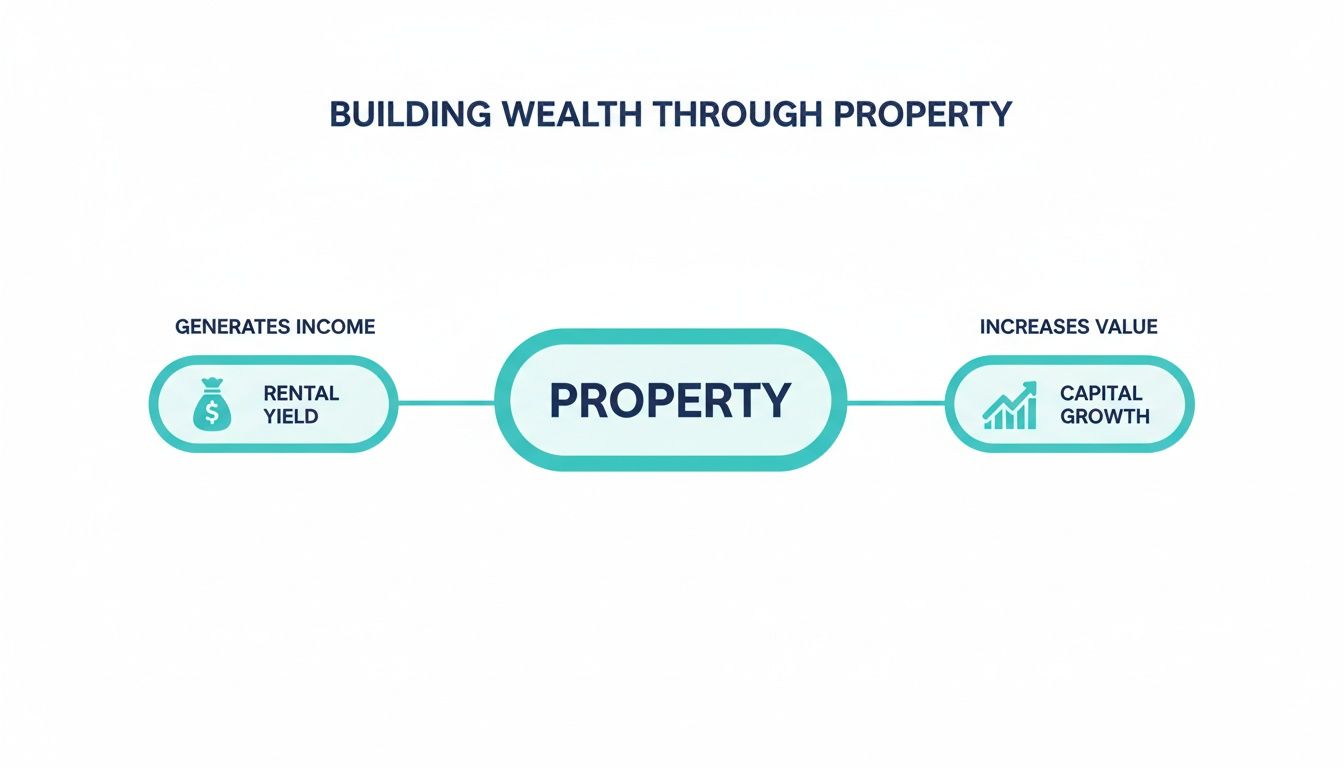
On one hand, it’s putting cash in your pocket through rent. On the other, it’s quietly growing in value in the background. This two-pronged approach is what makes property such a powerful wealth-creation tool over the long run.
Understanding the Tax Side of Australian Property
When you own an investment property in Australia, you gain access to a specific set of tax rules. They’re established government incentives designed to encourage private investors to provide housing for the rental market.
-
Negative Gearing: You’ve probably heard this term. It simply means the property’s running costs (like loan interest, council rates, and maintenance) add up to more than the rent you collect. The Australian Taxation Office (ATO) allows you to claim that shortfall as a deduction against your other income, like your salary. This can lead to a welcome reduction in your overall tax bill.
-
Depreciation: Buildings and their fittings wear out over time. The ATO recognises this decline in value and lets you claim it as a tax deduction called depreciation. The best part? It’s a “non-cash” deduction. You don’t actually have to spend the money to claim it, making it a fantastic way to lower your taxable income each year.
-
Capital Gains Tax (CGT): When you eventually sell your property for a profit, this gain is taxable. However, the ATO offers a significant concession. If you’ve owned the property for more than 12 months, you could be eligible for a 50% discount on the capital gain, effectively halving the amount that gets taxed.
Getting your head around these rules is key to making the most of your investment. We cover these in more detail in our guide to the tax benefits of a rental property.
How to Structure Your Finances for Success
Getting the tax strategy right is one piece of the puzzle; securing the right loan is another. The way your loan is structured has a massive impact on your cash flow and how profitable the investment is. Investment loans are assessed differently from the loan on your own home, so a well-thought-out strategy is non-negotiable.
We saw this play out during the 2017-2018 regulatory changes when APRA’s crackdown on investor lending made it much harder to get a loan. While things have settled, that period was a stark reminder of why having the right financial structure is so important.
For instance, we know 68% of Australian property investors use negative gearing to save an average of $11,200 in tax each year—a strategy that works particularly well for high-income earners. But with factors like rising interest rates, those holding costs can increase, making smart financial planning more critical than ever.
At Wealth Collective, this is exactly what our Retirement Roadmap and Guided Growth processes are for. We don’t just find you an off-the-shelf loan. We design a complete financial structure that works hand-in-glove with your tax strategy, manages your debt effectively, and keeps you on track toward your long-term goals.
Key Financing Decisions
When you sit down to arrange an investment loan, you’ll need to make a few important decisions:
-
Deposit and Loan-to-Value Ratio (LVR): To avoid paying Lenders Mortgage Insurance (LMI), most lenders will want you to have at least a 20% deposit. This gives you a Loan-to-Value Ratio (LVR) of 80% and shows the bank you’re in a solid financial position.
-
Interest-Only vs. Principal-and-Interest Loans: An interest-only loan means your repayments are initially lower because you aren’t paying down the loan balance. This can be great for cash flow and for maximising a negative gearing strategy. A principal-and-interest loan has higher repayments, but you’re building equity faster by chipping away at the debt from day one.
There’s no single “right” answer here—it all comes down to your personal strategy, cash flow needs, and what you want to achieve. For busy professionals and executives, nailing this structure from the outset is vital. It takes the stress out of the process and ensures your investment is set up to perform efficiently. This is precisely where having an expert in your corner can turn a good investment into a truly great one.
Your First Steps Into Property Investment
So, you’ve got the basics down. You understand what an investment property is and how it can build wealth. But what now?
Moving from theory to action can feel like staring up at a mountain. The good news is, you don’t have to climb it in one go. The journey to your first investment property is a series of small, deliberate steps, and it all starts with getting clear on your own situation.
Building Your Personal Roadmap
Before you lose an afternoon scrolling through real estate websites, the most crucial work happens right at your own desk. A solid strategy is the blueprint for everything that follows, and it’s what separates successful, confident investors from those who stumble into expensive mistakes.
It all comes down to asking a few honest questions:
- Assess Your Financial Position: Take a hard look at your income, expenses, savings, and any debts you’re carrying. This gives you a realistic picture of your borrowing power and the deposit you can comfortably pull together.
- Define Your Investment Goals: What are you actually trying to achieve here? Is it about generating passive income for an earlier retirement? Or are you focused on long-term capital growth to fund future goals like your kids’ education? Your ‘why’ determines your ‘what’ and ‘where’.
- Seek Expert Guidance: You don’t have to be an expert in tax law and loan structures, but you should have someone on your team who is. A good financial adviser helps you piece it all together, from navigating tax implications to building a plan that actually fits your life.
Turning Complexity Into a Clear Plan
At Wealth Collective, our entire process is built to guide you through these exact steps. We see our role as translators—taking the often-intimidating world of property finance and strategy and turning it into a simple, actionable plan that puts you in control.
A well-structured plan is your most valuable asset. It provides clarity, builds confidence, and ensures every decision you make is a purposeful step toward your financial future, not just a shot in the dark.
This is why we start with a free 10-minute introductory call. It’s a straightforward, no-pressure chat to see where you stand and what your next move could be. Whether your goal is accelerated wealth creation through our Guided Growth service or securing a comfortable future with a Retirement Roadmap, it all begins with that first conversation.
Feeling ready to take that first step? We’ve also put together a more detailed walkthrough on how to buy an investment property that you might find helpful.
Building wealth through property is the result of smart, calculated decisions, not luck. When you start with a solid foundation of planning and expert support, you can move forward knowing your money is working as hard for you as you do for it.
Your Property Investment Questions, Answered
It’s completely normal to have a head full of questions when you’re thinking about diving into property investment. Let’s tackle some of the most common ones we hear from clients, giving you the clarity to take the next step.
How Much Deposit Do I Really Need for an Investment Property?
The number you’ll hear thrown around most often is a 20% deposit, and for good reason. Hitting that 20% mark means you can sidestep Lenders Mortgage Insurance (LMI) – an insurance policy that protects the bank, not you, and adds to your costs. It also puts you in a much stronger position with lenders, often unlocking better loan terms.
But is it a deal-breaker if you don’t have 20%? Not necessarily. Some lenders will look at applications with as little as a 5-10% deposit. Just be aware that you’ll almost certainly have to pay for LMI. Ultimately, a bigger deposit lowers your risk and saves you money in the long run, so it’s a worthwhile goal to aim for.
Should I Buy a New Build or an Established Property?
This is one of the great debates in property investing, and the truth is, there’s no single right answer. The best fit depends entirely on your strategy and what you’re trying to achieve.
-
New Properties: Think of these as a “set and forget” option, at least initially. They often come with significant tax depreciation benefits and, being brand new, require minimal maintenance, which can be a real plus for your cash flow.
-
Established Properties: These are your classic homes, often found in well-located suburbs with a solid history of growth. The real magic here is the potential to “force appreciation” by adding value through smart renovations.
Deciding between the two is a major fork in the road. It’s where professional advice can really shine, helping you figure out which path lines up with your personal Guided Growth or Retirement Roadmap plan.
Can I Use My Super to Buy an Investment Property?
The short answer? Yes, you can use funds from a Self-Managed Super Fund (SMSF) to buy an investment property. It can be a fantastic way to grow your retirement wealth, but this is definitely the deep end of the pool.
The Australian Taxation Office (ATO) has incredibly strict rules, like the “sole purpose test,” which states the investment must be exclusively for your retirement benefits. This isn’t a DIY project. Given the complexity and the risks of getting it wrong, trying to navigate an SMSF property purchase without expert financial advice is something we strongly advise against.
What Are the Biggest Risks I Should Be Aware Of?
Every investment has its risks, and property is no different. Being aware of them is the first step to managing them. The main ones to watch for are:
- Market downturns where property values might dip.
- Vacancy periods when you have no tenant and no rental income.
- Interest rate rises that push up your mortgage repayments.
- Surprise maintenance costs, like a burst hot water system or urgent roof repairs.
The key isn’t to avoid risk entirely—it’s to have a plan for it. Your best defence is always a well-researched property, a solid cash buffer for those “just in case” moments, and ongoing guidance from a team that has your back.
At Wealth Collective, our specialty is taking these complex questions and turning them into a clear, actionable roadmap. We build strategies that give you the confidence to move forward, knowing your plan is tailored specifically to you.
Ready to get clarity on your own property investment journey? Book your free, no-obligation 10-minute call today and take that first step.