Business hours
Monday to Friday (8.30AM - 5PM)
Weekend (Closed)


TL;DR: In Australia, a financial plan typically costs $2,000 to $5,000, with fee-only planners averaging $3,200 and Western Australia clients averaging about $3,800 due to regional factors, according to benchmark cost data cited here. Ongoing advice fees often sit around 0.88% of assets under management nationally, and in practice many clients will see percentage-based fees in the broad 0.8% to 1.1% range depending on the structure and scope.
You’re probably here because you know advice could help, but you don’t want to walk into a meeting with no idea what it might cost.
That’s sensible. The concern isn't paying for sound advice; instead, it's the apprehension of investing in something vague, hard to compare, or not clearly valuable. In Perth and across WA, I hear the same question every week: what’s a fair financial planning cost, and how do I know whether I’m getting value?
The First Question Everyone Asks About Financial Advice
The hesitation usually isn’t about money alone. It’s about uncertainty.
You might be doing well on paper. Good income, growing super, maybe a mortgage, maybe a business, maybe a sense that you should be more organised than you are. But when you start looking at advisers, the pricing can feel inconsistent. One firm talks in flat fees, another talks in percentages, another offers “ongoing service” without making it obvious what you get.
That confusion is normal. Financial advice pricing can look a lot like accounting pricing. Two professionals may appear to offer a similar service, but the work behind it can be very different. If you’ve ever wondered why one professional quote looks much lower than another, this practical piece on Why Are Some Accountants Cheaper Than Others is a useful comparison because the same basic idea applies to advisers too.
Practical rule: Don’t judge financial planning cost by the fee alone. Judge it by the scope of work, the complexity of your situation, and what decisions the advice helps you make.
A good starting point is understanding how advisers charge, what those fee structures mean in plain English, and where WA tends to sit compared with the rest of Australia. Once you know that, it becomes much easier to compare quotes and ask sharper questions.
If you’re still deciding what kind of adviser you need, this guide on how to choose a financial advisor can help you sort out fit before you focus on price.
Decoding the Three Main Financial Planning Fee Structures
Think about hiring a builder.
You might agree on a fixed price for the whole renovation. You might pay for time and materials. Or you might pay an ongoing amount for maintenance over time. Financial advice works in much the same way. The fee model changes how the cost is charged, but the fundamental question is what work sits behind it.
Under ASIC’s RG 175 framework, fee disclosure matters, and benchmark data shows licensed planners charging a median initial advice fee of $3,770 and ongoing fees averaging $2,880 annually for clients with $500,000 in superannuation, according to the 2023 FAAA cost benchmark summary.
Fixed or flat fees
A fixed fee means you pay an agreed amount for a defined piece of work.
This is often the cleanest model for people who want clarity upfront. You might use it for a retirement roadmap, a super strategy review, an insurance needs analysis, or a one-off project where the scope can be clearly outlined.
The benefit is simple. You know the cost before the work starts. The trade-off is that if your situation changes mid-process, the scope may need to be updated.
Asset-based fees
An asset-based fee is charged as a percentage of the assets being managed or advised on.
This model is common when clients want ongoing portfolio oversight, regular reviews, super management, and strategic advice over time. Some people like it because the fee can feel integrated into the service. Others dislike it because percentages can be harder to translate into a dollar figure without doing the maths.
This structure works best when the adviser is doing more than investment selection. If the advice includes retirement modelling, contribution strategy, drawdown planning, tax-aware structuring, and ongoing adjustments, a percentage model can reflect that continuing work.
Hourly fees
An hourly fee is closer to paying a solicitor or consultant.
You pay for the adviser’s time rather than for a package or a portfolio-linked arrangement. This can suit people who want targeted help, a second opinion, or a short list of strategic questions answered without signing up to a broader engagement.
The downside is uncertainty. If you don’t define the work well, it can be harder to estimate the final bill.
Comparing Financial Planning Fee Models
| Fee Model | How It Works | Best For |
|---|---|---|
| Fixed fee | A set price for an agreed project or plan | People who want cost certainty and clear scope |
| Asset-based fee | A percentage charged on assets under management or advice | People wanting ongoing advice, portfolio oversight, and regular reviews |
| Hourly fee | Charged for time spent on specific issues | People needing targeted advice or a one-off consultation |
A fee model isn’t good or bad on its own. It’s appropriate or inappropriate for the job being done.
Typical Financial Planning Costs in Australia and WA
A Perth couple in their late 30s might ask for help with super, a mortgage, school fees, and whether they are on track for retirement. A 59-year-old pre-retiree might want income planning, Centrelink strategy, and tax-smart drawdown advice. Both are asking about "financial planning cost", but the price can be very different because the work is different.
Across Australia, a full financial plan often sits in the low-thousands, while narrower advice projects usually cost less and ongoing advice is priced separately. In WA, quotes can come in a little higher than what people see in eastern states. The difference is not only geography. It often reflects the kind of work local advisers handle, including business income, trusts, property portfolios, and super-focused retirement planning.

What those costs usually look like on the ground
A full plan is usually the highest starting fee because it covers several moving parts at once. That may include super, cash flow, debt, insurance, investments, tax-aware structuring, and retirement modelling. You are paying for analysis, strategy design, documentation, and the adviser’s judgement about how those pieces fit together.
A targeted advice project is narrower and often easier on the budget. It could focus on one decision, such as salary sacrifice, insurance cover, an investment review, or whether to pay down debt faster. That can suit younger professionals who want to make one smart move now without paying for a broader strategy they do not need yet.
Ongoing advice is different again. It is less like buying a document and more like having a financial coach and strategist checking the map as your life changes. For pre-retirees in WA, that ongoing work can matter because the final years before retirement often involve contribution limits, pension setup decisions, sequencing risk, and questions about how long capital needs to last.
Why WA quotes can be a bit higher
Local pricing patterns show up across professional services, not only financial advice. If you have ever compared legal fees or small business accountant costs, you have probably seen that Perth and regional WA can price differently from the national middle.
The reason is usually scope and local context, not just a markup. WA advisers often work with mining and resources income, lumpy bonus structures, family trusts, self-employed clients, and households with significant property exposure. Advice for those situations takes more investigation and more careful modelling.
That is also why a low quote is not automatically good value. If two advisers charge different amounts, the useful question is what problem each one is solving.
A better way to benchmark a quote
Treat a quote like a building estimate. The number matters, but the inclusions matter just as much.
Ask:
- What decisions will this advice help me make?
- What is included in the initial fee, and what costs extra?
- Will I get help implementing the strategy, or only recommendations?
- If there is an ongoing fee, what reviews, updates, and access does that include?
Those questions help you compare value across life stages.
A younger professional in Perth might measure value by whether the advice improves cash flow, sets up super properly, and avoids expensive mistakes early. A family in peak earning years might look for tax efficiency, risk protection, and better coordination between business and personal finances. A pre-retiree usually measures value differently again. They are often asking whether the advice can improve retirement income, reduce avoidable tax, and make big decisions feel clear instead of stressful.
If you are comparing local options, this directory of financial advisers in Perth can help you build a shortlist and see how different firms describe their fee approach.
Four Key Factors That Influence Your Final Cost
Two people can both ask for “financial advice” and need completely different amounts of work.
That’s why financial planning cost varies so much. In WA, regional pricing adds another layer. Data cited in this WA cost overview notes that Western Australia’s regional premium increases financial planning costs by 12-18% over national averages, and some super optimisation projects can reach a $5,200 median.
Complexity changes everything
A straightforward situation is usually cheaper to advise on. One income, one super fund, no trust, no business, no major insurance concerns. That’s relatively contained.
A more complex household may have multiple super funds, family cash flow pressure, share investments, a discretionary trust, business income, and estate planning issues. The advice work is broader, the research burden is heavier, and the compliance file is larger.
Scope matters more than people think
Some people need a complete strategy. Others need one good decision made well.
If you only want to review your insurance cover or sort out your super contributions, that’s very different from asking for retirement income planning, asset allocation, debt strategy, and implementation support. One is a focused brief. The other is a much larger project.
Adviser experience and qualifications affect fees
Experienced advisers usually charge more because they can identify issues faster, structure advice more effectively, and spot risks a less experienced adviser may miss.
That doesn’t mean the highest-priced adviser is automatically the right fit. It does mean very low pricing can be a signal to look more closely at what’s included, who does the work, and how customized the advice will be.
Low fees can be fair. Low fees can also mean narrower scope, less implementation support, or a less experienced team.
Ongoing service is a separate decision
Some clients need a plan and then want to run with it themselves. Others want regular reviews, accountability, and updates as life changes.
That ongoing layer changes the cost because the adviser is reserving capacity for future meetings, monitoring, adjustments, and administration. If you don’t need that level of support, it’s worth saying so. Clear scope often leads to clearer pricing.
Beyond the Price Tag How to Measure the Real Value of Advice
A Perth couple in their early 40s might be quoted $4,000 for a plan and immediately wonder whether that number is high, fair, or not worth it. That reaction is normal. The more useful question is what that fee changes over the next 10 or 20 years.
Advice is a bit like paying for a building inspection before you buy a home. You are not paying for paper. You are paying to spot costly issues early, make better decisions with confidence, and avoid fixing preventable problems later.
According to retirement outcomes data from Epic Capital, 92% of advised Australians meet their retirement goals, compared with 55% of those who self-manage. That same Epic Capital retirement outcomes data also outlines potential savings from missed opportunities and shows how an initial advice fee can be small relative to long-term gains from better super contribution strategies.

Value shows up in places people often miss
Investment returns are only one part of the picture.
For a young professional in WA, good advice may mean consolidating super, setting up the right savings system, and making sure a strong income is turning into wealth. For a family in the middle years, the benefit may be getting cash flow under control, protecting income with the right insurance, and deciding whether to direct surplus money to the mortgage, super, or investments. For a pre-retiree, the biggest win is often avoiding one expensive timing mistake around pension access, drawdown strategy, tax, or Centrelink positioning.
That is why return on advice should be measured across a few areas:
- Better decision order: Knowing what to handle first so money is not pulled in five directions at once.
- Fewer expensive errors: Catching gaps in super, insurance, tax settings, or retirement timing before they become costly.
- Follow-through: A plan only helps if it gets implemented.
- Peace of mind: Less second-guessing, especially during market falls or major life changes.
Delay has a cost too
Plenty of people hold off because they do not want to pay for advice before they are "ready". In practice, waiting can ultimately cost more than the fee.
Unused cash can sit in the wrong account for years. Extra super contribution opportunities can be missed. Old super funds can keep charging fees. Insurance can be duplicated, or worse, missing where it matters. None of this feels dramatic in a single month. Over time, it works like a slow leak in a water tank. You do not notice the loss straight away, but the level keeps dropping.
Good advice reduces expensive guesswork.
If you want a practical starting point before speaking with an adviser, these financial planning tips for getting organised before advice can help you clarify what you need.
A simple way to judge whether a fee is fair
When you look at a quote, measure it against the decision in front of you and the stage of life you are in.
Ask yourself:
- Will this help me make an important decision with more certainty?
- Will it likely save me from mistakes I would not spot on my own?
- Will I be more likely to act if someone maps it out clearly?
- Will the benefit still matter in five years, not just this month?
If several answers are yes, you are probably not just paying for a document. You are paying for clearer direction, better financial habits, and a stronger outcome over time. In WA especially, where costs, lifestyle goals, and retirement timing can vary widely from one household to the next, that is usually the measure that matters.
Real-World Examples Financial Planning Costs for Your Situation
A couple in Perth might be earning good money, paying down a mortgage, adding to super, and still feeling unsure whether they are getting ahead. Another household in their late 50s can have far more assets and feel just as uncertain. That is why cost only makes sense once you place it in a real life situation.
These are common WA scenarios. The fee changes with the work involved, but the better question is what decision the advice helps you make, and what that decision is worth over the next five to ten years.
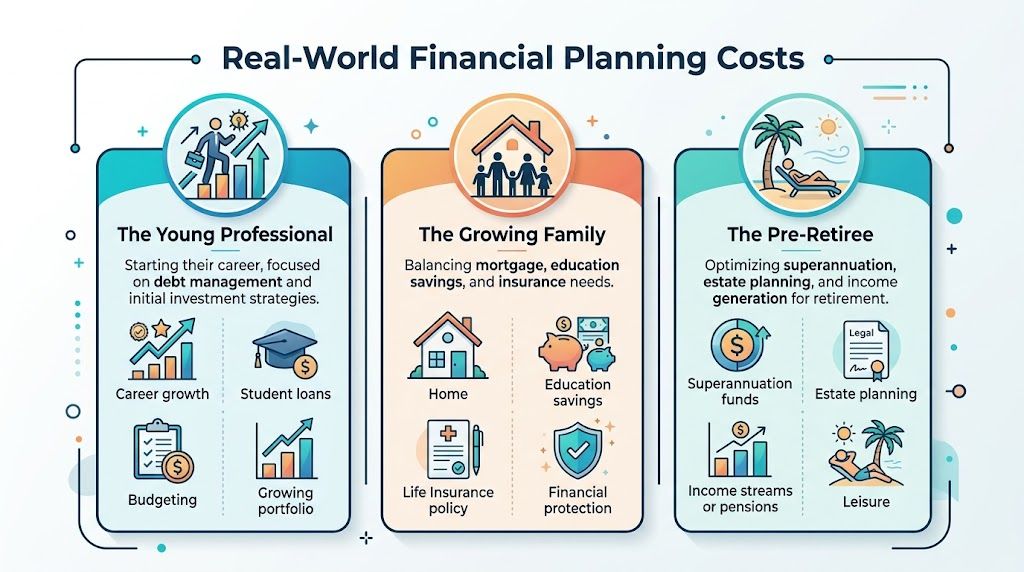
Young professional couple
They are earning well, carrying some debt, and doing many of the right things inconsistently.
A typical WA version of this case looks like two incomes, scattered savings, a few old super accounts, and a feeling that they should have more to show for their income by now. Advice here is often focused and practical. Consolidating super, setting contribution levels, cleaning up cash flow, reviewing insurance inside and outside super, and building an investment plan that matches their actual capacity to save.
For this stage, a debt reduction and super optimisation project often falls in the $3,000 to $6,000 range. According to an eMoney Advisor summary, younger clients can benefit materially from early super consolidation and structured planning, while business owners can avoid costly compliance mistakes through modular advice.
The return is often easy to miss at first because it does not always arrive as one dramatic result. It works more like setting a house on proper foundations. Fewer duplicated fees. Better use of surplus income. A clearer savings rate. Good habits started early.
Pre-retiree couple
This household is usually less worried about whether they can save and more worried about whether they can stop working without making a costly mistake.
They want straight answers. Can we retire at 60, 62, or 65? How much can we draw from super each year? Should we clear debt first? Do we need to change our investment mix now, or keep growing for longer? The work here often includes retirement income modelling, pension and super structure, contribution strategy, tax position, and sequencing decisions.
That usually means a higher fee than a younger couple would pay, because there are more variables and less room for error.
The value is clarity under pressure. A retirement plan is a bit like a flight path. A small adjustment before takeoff is much easier than trying to correct direction after you are already in the air.
Small business owner
This is often the most layered advice engagement.
In WA, many business owners have personal and business finances tangled together. They may be profitable on paper but inconsistent with cash reserves. They might be behind on super obligations, underinsured, or relying too heavily on the future sale of the business to fund retirement. Advice here often covers cash flow, super compliance, personal wealth outside the business, risk protection, and the gap between business value and retirement needs.
That is why the cost can sit above a simpler one-off plan. There is more to examine and more implementation work involved.
The payoff is usually prevention as much as progress. One avoided compliance issue, one cleaner ownership structure, or one better insurance decision can matter far more than the initial advice fee.
Some of the best advice work does not feel flashy. It feels like relief.
A practical example of this kind of staged support is a process built around focused service pillars such as insurance, wealth building, and retirement strategy. Wealth Collective uses that style of framework through Protection Plus, Guided Growth, and Retirement Roadmap, which can make pricing easier to match to the actual work required.
Start Your Wildly Successful Financial Life with Clarity
By the time individuals ask about financial planning cost, they’re not really asking for a number alone.
They’re asking whether the fee will be clear, whether the advice will be relevant, and whether they’ll feel better after paying it. That’s the standard you should use. Not the cheapest quote. Not the flashiest proposal. Clear scope, fair pricing, and advice that helps you take action.
For some people, that means a one-off project. For others, it means ongoing support. Young professionals often want help reducing debt and getting super sorted. Families may need a tighter grip on cash flow, protection, and growing wealth. Pre-retirees usually want certainty around retirement income, timing, and structure.
The right next step isn’t signing up to a big advice package on the spot. It’s having a short conversation that makes the options clearer.
If you’re weighing up advice and want to understand what a sensible fee would look like for your situation, start there. Ask what’s included. Ask what isn’t. Ask what the process looks like from the first meeting to implementation. Good advisers won’t be vague about any of it.
A short introductory call can often tell you whether you need a targeted piece of work, a full plan, or more information before deciding.
If you’d like a straightforward starting point, book a free introductory chat with Wealth Collective. It’s a simple way to talk through your situation, understand the likely scope of advice, and get clarity on what the cost could look like before committing to anything.