Business hours
Monday to Friday (8.30AM - 5PM)
Weekend (Closed)


You’ve worked hard for decades, built super, paid down debt, and probably checked your balance more often as retirement gets closer. Then you search for a retirement calculator australia tool, plug in a few numbers, and get an answer that feels precise without feeling trustworthy. One calculator says you’re on track. Another says you’re short. A third tells you your money lasts far longer than the first two.
That confusion isn’t in your head. In Australia, calculator outputs can vary sharply depending on assumptions about fees, returns, inflation, pension settings, and spending. For people trying to make real decisions about retirement age, extra contributions, downsizing, or whether to clear the mortgage first, that’s a serious problem.
The good news is that calculators are still useful. Used properly, they give you a fast first estimate, help you test trade-offs, and show where the pressure points are in your plan. Used badly, they can give false confidence or unnecessary alarm.
This guide is built to be practical. It’s not just a list of tools. It’s a way to use them more like an adviser would. Start with an independent baseline. Compare that against a fund-specific calculator. Change one assumption at a time. Look for gaps around debt, property, tax, and WA living costs. If the answers move too much, that’s your signal that the tool has reached its limit.
If you’re building wealth as well as planning retirement, these key financial insights for entrepreneurs are also worth a look.
1. ASIC Moneysmart – Retirement Planner
A common starting mistake is opening your super fund’s calculator first, seeing a comfortable result, and assuming the plan is sound. Start with ASIC Moneysmart’s Retirement Planner instead. It gives you a neutral base case before fund settings, product design, or optimistic assumptions start shaping the answer.
That independence matters.
Moneysmart is the tool I’d use first to set the baseline. It covers the core mechanics that drive most retirement outcomes: current super balance, future contributions, retirement age, income needs, and Age Pension eligibility. For a household in Western Australia, that first pass is useful because it tells you whether you are dealing with a manageable gap or a strategy problem that needs proper planning.
Why it’s the best starting point
The first job is not precision. The first job is orientation.
Use Moneysmart to test three things:
- Whether the broad direction is right. You want to know if you are roughly on track before fine-tuning.
- Which lever changes the result most. Retiring later, contributing extra, or spending less in retirement do not have equal impact.
- How much the Age Pension supports the plan. Many Australians underestimate how much of their retirement income may still depend on it.
Retirement calculators are still underused. Super Consumers Australia’s research on guidance and calculators shows many Australians have not properly stress-tested their retirement numbers, which is one reason people rely too heavily on a single output. Moneysmart is a practical place to correct that.
Practical rule: Run Moneysmart first. Then compare that result with a fund calculator. If the second tool looks materially better, check returns, fees, inflation, and pension assumptions before you trust it.
How to use it properly
Do not enter your numbers once and stop there. Run at least three versions.
Start with your current settings. Then test a later retirement age. Then test extra concessional contributions or a different spending target. Change one variable at a time so you can see what is driving the outcome. That is how an adviser would read the result, and it is the fastest way to spot whether the plan is sensitive to one assumption.
This matters more if your next decision is expensive or hard to reverse. For example, if you are weighing a large contribution, an early retirement date, or whether to keep the mortgage into retirement, a calculator can point you in the right direction. It cannot tell you the tax, structuring, and sequencing implications with enough depth to rely on alone.
Where it falls short
Moneysmart is a baseline tool, not a retirement strategy.
It starts to lose accuracy when your situation includes multiple super accounts, uneven balances between spouses, account-based pension timing, debt repayment, planned downsizing, or a gradual move out of work. It also cannot capture the full trade-off between lifestyle goals and capital preservation. That is where generic calculators often look precise while missing the actual decision.
For people who want to go further than a rough estimate, the next step is not just trying more calculators. It is getting clear on the assumptions and working out whether you need personalised financial advice for retirement planning. If one tool says you are fine and another says you are short, the gap is usually not random. It is a sign that the assumptions need scrutiny.
2. AustralianSuper – Retirement Income Calculator
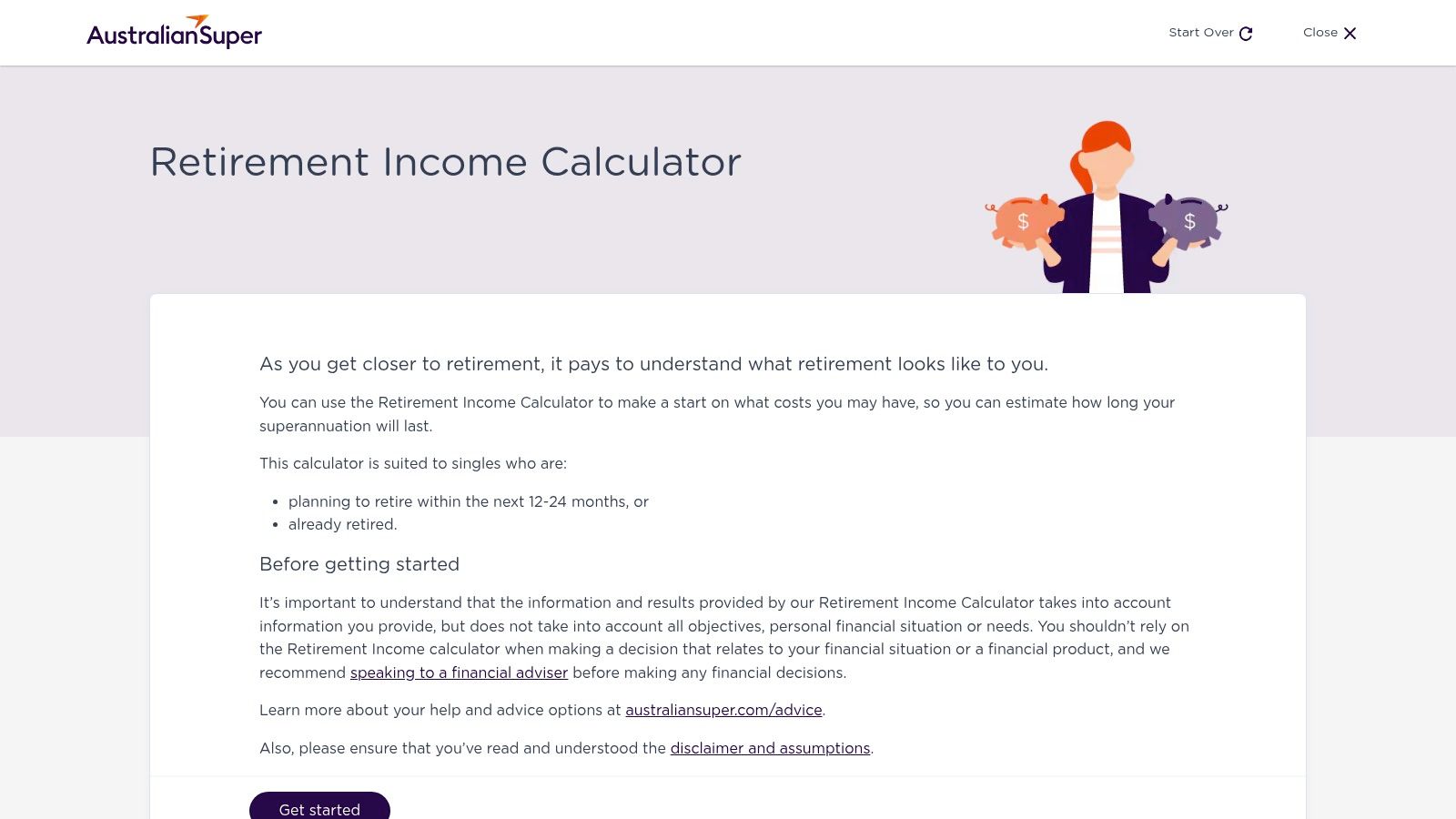
A common pattern goes like this. Someone runs Moneysmart, gets a result that looks workable, then opens AustralianSuper’s calculator and sees a meaningfully different outcome. That gap is useful. It shows where a generic estimate ends and assumption-testing begins.
AustralianSuper’s Retirement Income Calculator works well as a second tool because it is quick to adjust and easy to rerun. For Western Australians weighing practical decisions such as salary sacrifice in the final working years, a later retirement date, or part-time work before stopping completely, speed matters. You can test one change, compare it with your baseline, and see whether the result is being driven by timing, contributions, or spending expectations.
Best use case
This tool is strongest when the question is specific.
Use it to test decisions such as:
- Retiring later: A short delay can improve the result from both directions. More money goes in, and the period that portfolio needs to fund becomes shorter.
- Adding contributions: It helps show whether extra concessional contributions are producing a meaningful lift or only a modest improvement after sacrificing current cash flow.
- Comparing assumptions: Running the same scenario you used in another calculator helps expose where default settings are changing the answer.
That last point matters more than many people realise. A calculator is only as useful as the assumptions underneath it.
What to watch
AustralianSuper is still a fund tool, and fund tools usually reflect the fund’s own modelling choices unless you actively override them. If you accept the defaults without checking them, the result can look more certain than it is.
A better approach is to use it like an adviser would. Match the inputs as closely as possible to the tool you already used. Keep your retirement age, current balance, contributions, and desired income consistent. Then compare the outputs and ask why they differ. The answer is often sitting in assumptions about returns, inflation, fees, pension settings, or how income is projected through retirement.
Super Consumers Australia’s review of super fund calculators found wide variation in projected outcomes for the same sample user, which is exactly why cross-checking matters. The original findings are in its review of retirement calculators from major super funds. A tool saying you are "on track" is not a conclusion. It is a prompt to examine what had to be assumed to get there.
That is usually the point where a calculator stops being enough. If your result changes materially between tools, or the decision affects tax, pension timing, contribution strategy, or how a couple should split assets between spouses, get personalised retirement planning advice before acting.
Retirement benchmarks can still help as a sense-check, especially if you want to compare the output with the ASFA Retirement Standard.
3. Australian Retirement Trust (ART) – Retirement & Pension Calculators
Australian Retirement Trust’s retirement tools are more useful once retirement is close enough to make income decisions concrete. At that point, a generic balance projection stops answering the essential question. You need to know how super converts into pay cheques, how long that income may last, and what changes once an account-based pension starts.
That shift matters for Western Australians who are often weighing more than one moving part at once. A paid-off home in Perth, regional property, uneven employment income, or plans to help adult children can all affect how much flexibility you want from retirement income. A calculator like ART’s can help frame the pension phase, but it still works best as one tool in a wider process.
Best use case
ART is worth testing when you are near the switch from building super to drawing from it. Its value is that it pushes the conversation toward retirement income, not just the final account balance.
That is a better lens for pre-retirees because drawdown decisions create real trade-offs. Taking more income early may suit your lifestyle goals, but it can leave less flexibility later. Starting a pension at the wrong time can also affect tax outcomes, Centrelink treatment, and how assets are split between spouses.
What to watch
ART’s calculators sit within ART’s product context, so treat the output as product-guided modelling rather than a neutral answer. The projections can still be useful, but only if you check the assumptions and compare them against at least one broader baseline you have already used.
Pay close attention to what the tool assumes about investment returns, pension payments, inflation, fees, and how long retirement lasts. These inputs do more work than the headline result suggests. Small changes can produce a very different answer, especially for clients deciding whether to retire now, work part-time for longer, or draw from non-super assets first.
Calculator availability across funds is uneven, as noted earlier. ART deserves credit for offering retirement-focused tools, but access to a calculator is only the starting point. The ultimate test is whether the tool helps you examine pension decisions with enough detail to act sensibly.
Practical adviser view
I would use ART for a specific job. Stress-test the retirement income phase.
Run your numbers through it after using a more neutral calculator and keep the core inputs consistent. If ART produces a meaningfully different result, do not stop at the new number. Work out whether the gap comes from pension assumptions, income drawdown settings, or the way the tool treats retirement timing.
ART becomes less useful where the main decision sits outside its field of view. That includes debt repayment, family trust assets, business sale proceeds, investment properties, or a couple trying to decide whose super should fund income first. Once those issues start driving the outcome, the calculator is no longer the strategy. It is just one input.
That is usually the point to move from DIY modelling to customized financial advice for retirement planning.
4. Aware Super – My Retirement Planner and Retirement Manager

A couple in Perth can look healthy on paper, then get a very different result once they test the retirement they want. One partner may expect regular travel south-east Asia or interstate. The other may be planning to help adult children with housing, keep more cash available, or carry mortgage debt longer than expected. Aware Super’s My Retirement Planner is useful because it tries to translate a projected super outcome into a lifestyle frame, not just a final account balance.
That makes it a practical second-check tool after a neutral calculator. It answers a question many people really care about. Whether the savings path they are on lines up with the standard of retirement they picture.
Where Aware stands out
Aware’s strength is structure. The public planner gives users a guided result tied to retirement living standards, and the member-only Retirement Manager goes further for people already drawing income or preparing to switch into pension phase.
That setup suits users who want help turning abstract super numbers into a decision. It is also useful for comparing one retirement date against another, or seeing the effect of higher contributions before leaving work.
For an adviser, the value is not the headline number. It is the assumptions sitting underneath it.
The limitation people miss
Benchmark-based tools are helpful for orientation, but benchmarks can distort judgment if you treat them as a personal spending plan.
The ASFA Retirement Standard was updated in February 2026 and remains a widely used reference point for modest and comfortable retirement budgets. Super Consumers Australia takes a different angle in its retirement income guidance, showing that some retirees can maintain a reasonable lifestyle on less super when the Age Pension does more of the work. Both are legitimate reference points. Neither tells you what your household will spend.
That gap matters. A calculator built around a benchmark can make a disciplined spender look underprepared, or make a higher-spending household feel safer than it should. The tool is giving you a reference result, not a personalised retirement strategy.
Use benchmarks to calibrate expectations. Use your own cash flow to make decisions.
How to use Aware like a professional would
Run Aware after you have already tested the same retirement age, balance, and contribution settings in a neutral calculator. Keep the inputs as close as possible. If Aware shows a stronger or weaker result, examine why.
Start with three checks. Which lifestyle benchmark is driving the result. How the tool is treating income in retirement. Whether it assumes spending falls, stays level, or changes over time.
If you are in Western Australia, this cross-check matters even more. Living costs, housing choices, support for family, and plans for travel or regional living can shift the answer well away from any national benchmark.
Aware is a solid tool for guided modelling. It becomes less reliable once a decision depends on assets outside super, uneven spending between partners, or timing choices around debt, inheritances, or the Age Pension. That is usually the point where the calculator has done its job, and personalized advice needs to take over.
5. AMP – Retirement Needs Calculator and Retirement Simulator

A couple in Perth often reaches this point after trying one or two retirement calculators. They have a projected super balance, a retirement age, and a result that says they are either "on track" or short. What they still do not have is a clear answer to the practical question. How much will they need each year, and how long will that income hold up if spending changes?
AMP’s calculators and tools are useful because they split those two jobs. The Retirement Needs Calculator helps set an income target using a more detailed budget approach. The Retirement Simulator then tests whether the projected balance can support that target over time. Used together, they reflect the sequence an adviser would usually follow. Start with spending. Then test sustainability.
That makes AMP more useful than calculators that jump straight to a retirement income estimate based on broad assumptions.
Why AMP is worth cross-checking
AMP is one of the better DIY tools for people who are ready to move past generic lifestyle labels. If you enter actual spending categories, the result has a better chance of matching real life. That matters because a retirement plan can look healthy because the spending number was understated at the start.
I see this often with clients who own their home and assume retirement costs will fall sharply. Sometimes they do. Sometimes they do not. Travel rises, home maintenance appears, support for adult children continues, or health costs increase earlier than expected. A calculator with a proper budget input is more likely to expose that than a tool built around a single benchmark figure.
For Western Australians, that check is particularly useful. A plan for downsizing in Perth, living part of the year in the South West, helping family with housing, or keeping a caravan setup for regional travel can all shift the required income in ways a generic calculator will miss unless you feed those costs in directly.
Where AMP helps most
AMP is best used for questions about adequacy and trade-offs, such as:
- What annual income does our household spending suggest
- Will our projected super balance support that income
- How much difference would extra contributions, a later retirement date, or lower spending make
- Are we relying on assumptions that look tidy in a calculator but weak in real life
It is also a good second or third check after using a neutral tool. Keep the retirement age, super balance, and contribution settings as close as possible. If AMP produces a very different result, do not treat that as an error. Examine which assumption changed. Budget level, drawdown pattern, inflation treatment, and pension assumptions can all move the answer.
Where the tool stops being enough
AMP still has the limits of a provider calculator. It can help you estimate, but it cannot build strategy around every moving part. Once the outcome depends on assets outside super, debt repayment timing, tax structuring, an inheritance, or one partner retiring years before the other, the modelling gap gets wider.
That is usually the point where the calculator has done its job.
Use AMP to pressure-test your spending assumptions and sense-check whether the numbers are in the right range. If small input changes cause large swings in the result, or if your retirement income depends on coordinated decisions across super, property, and Age Pension eligibility, a customized strategy will add more value than another round of calculator testing.
6. Rest Super – Superannuation & Retirement Calculator

A common starting point is a household in their late 50s asking a simple question: “If we retire in a few years, will our super last?” Rest’s Superannuation & Retirement Calculator is built for that stage. It gets you to a usable estimate quickly, without burying you in technical settings.
That simplicity is useful.
For Western Australians who are only beginning to test retirement timing, contribution changes, or a rough spending target, Rest can help turn a vague idea into numbers you can compare. It pushes the right early questions. How much is already in super, when do you plan to stop work, and what sort of lifestyle are you trying to fund?
Best used as an entry-point tool
Rest works well when speed matters more than precision. I would use it early in the process, then compare the result against a neutral planner or a fund calculator with stronger pension and income settings.
It is most useful for:
- Quick checks on retirement timing: retiring at 62 versus 65, or staying in part-time work a little longer
- Testing contribution changes: salary sacrifice, personal contributions, or whether a final pre-retirement lift in super makes a noticeable difference
- Turning balances into spending questions: shifting the focus from “How much super do I have?” to “What income does that support?”
- Getting a first estimate before deeper modelling: useful if you have been putting this off because other tools feel too technical
What to question before you rely on it
Rest is better at prompting action than handling complexity. That is the trade-off.
If your retirement plan depends on Age Pension eligibility, uneven spending over time, assets outside super, or one partner retiring well before the other, a simple calculator can give a tidy answer that hides a messy reality. That matters in practice. Many retirees spend more in the early years, less in the middle years, then face higher health or care costs later. A flat spending assumption can miss that pattern.
I would also be cautious if the result looks comfortable only because the tool assumes favourable returns or a straightforward drawdown path. As noted earlier, longevity projections can vary sharply across calculators once pension treatment, returns, fees, and spending assumptions are handled differently. That is exactly why cross-checking matters.
Adviser’s take
Rest is a good first pass. It helps you get started, and that has value.
I would not use it on its own to decide whether you can retire earlier, draw more in the first decade of retirement, or structure a pension strategy around part Age Pension support. Use it the way a professional would use a basic tool. Run the scenario, note the assumptions, then test the same inputs elsewhere. If the answers diverge, do not guess. Find out which assumption is doing the heavy lifting.
That is usually the point where a calculator stops being a calculator and starts becoming a prompt for personalized advice.
7. Vanguard Australia – Retirement Income Builder
Vanguard Australia’s Retirement Income Builder is one for readers who want to stress-test a plan rather than just forecast a single path. That’s an important distinction. Retirement doesn’t unfold in a neat straight line. Markets move, withdrawals continue, and the order of returns matters.
More advanced modelling proves its worth. Some Australian retirement tools now use Monte Carlo simulations and historical stress-testing to examine sequence of returns risk using decades of market history, as described by SuperCalc Pro’s advanced retirement calculator overview. That type of modelling is better suited to the fundamental question retirees face: not “What happens if average returns arrive?” but “What happens if they don’t?”
Best for serious scenario testing
Vanguard’s style of calculator is more technical than a basic super fund planner. That’s a strength if you want to compare portfolio mixes, spending rates, and the resilience of different retirement strategies.
This kind of tool is especially useful when:
- You have investment choice: Asset mix matters once you’re drawing income.
- You want probability ranges: A single projection can hide real risk.
- You’re testing spending rules: Fixed withdrawals versus more flexible approaches can produce very different outcomes.
A retirement plan doesn’t fail because the average return was wrong. It often fails because poor returns arrived early while withdrawals kept going.
Where DIY users can go wrong
Advanced calculators can create a false sense of sophistication. Better modelling doesn’t automatically mean better personal advice. If the inputs are weak, the output is still weak.
That’s especially true if the tool doesn’t reflect your actual fees, tax position, pension eligibility, insurance settings, or assets outside super. Use Vanguard when you want to test portfolio resilience. Don’t use it as a substitute for whole-of-household retirement advice.
8. Challenger – Retire with Confidence tool

Challenger’s Retire with Confidence tool is useful when your question isn’t just “How much super do I have?” but “How should different income sources work together?”
That’s where this tool earns attention. It’s more helpful than a standard balance calculator if you’re thinking about the interaction between super drawdown, Age Pension support, and guaranteed income products.
Where it does a good job
Challenger is strongest when you want to layer income. Many retirees don’t spend evenly across retirement. They want essential bills covered with confidence and more flexible assets available for discretionary spending.
The tool is good at showing:
- Age Pension interactions: Important if you’re partially self-funded.
- Income gaps: Helpful if your projected income falls short of the lifestyle you want.
- Stability trade-offs: Particularly relevant if you’re weighing guaranteed income against flexibility.
The built-in bias to recognise
The trade-off is obvious. Challenger has a natural annuity lens. That doesn’t make the tool unusable. It just means you should understand what it’s designed to highlight.
This is a good example of why no single retirement calculator australia search result should be treated as definitive. Product-linked tools are often most useful when you know what they’re emphasising and why.
For people who value predictability over maximum flexibility, Challenger can be a strong comparison point. For people with more complex family, tax, or estate planning needs, it’s still only one piece of the puzzle.
9. UniSuper – Retirement Savings & Retirement Income Calculators
UniSuper’s calculator suite is one of the better options for users who want to explore more than a simple accumulation estimate. It moves into retirement income modelling and gives users a way to think about different market environments and income structures.
That makes it useful as a second or third calculator, not necessarily the first one you use. Once you already have a baseline, UniSuper can help you test how sensitive your plan is to changing conditions.
What makes it useful
Some retirement calculators assume a fairly standard path. UniSuper’s strength is that it nudges you to consider variation in conditions and retirement setup.
That’s particularly helpful if:
- You’re comparing drawdown strategies: It’s useful to see how different retirement income structures behave.
- You want another fund-based perspective: A second opinion can reveal whether your first result was assumption-heavy.
- You’re thinking beyond the headline balance: Retirement income quality matters more than balance size alone.
Where caution is needed
Not every calculator is built for every member structure. UniSuper itself notes that some deeper personalisation may depend on membership details, and its tools aren’t a fit for every defined benefit scenario.
The wider point is that retirement calculators often work best for relatively clean cases. Once benefits become more specialised, or the household has multiple entities and assets, online calculators start stripping out detail that really matters.
That doesn’t make them useless. It just changes their role. At that stage, they’re diagnostic tools, not decision tools.
10. TelstraSuper – Retirement Lifestyle Planner

A common late-stage DIY mistake is treating the first believable retirement result as the answer. TelstraSuper’s Retirement Lifestyle Planner is useful because it makes that habit easier to break. You can change retirement age, spending, and drawdown settings quickly enough to test whether your plan still holds once the assumptions move.
That speed matters.
A slower calculator often pushes people to accept the default settings just to get through it. TelstraSuper is better used as a stress-test tool. Run your baseline elsewhere, then use this planner to check how sensitive the outcome is to the inputs you are most likely to get wrong.
Best use in practice
I’d use TelstraSuper after I already had a rough retirement range in mind. Its value is not in producing a single target number. Its value is in showing which assumptions do the heavy lifting.
It’s particularly helpful for:
- Spending pressure tests: Increase your planned lifestyle spending and see how quickly the projection changes.
- Retirement timing decisions: Shift retirement by a year or two and compare the effect on sustainability.
- Sanity-checking another calculator: If a previous result only works under narrow settings, that usually shows up fast here.
Where WA users need to be careful
Western Australian households often have costs and asset decisions that generic national tools handle poorly. Housing is the obvious one. A Perth-based retiree deciding whether to clear a mortgage, downsize, help adult children, or keep cash available for renovations is dealing with trade-offs that a simple lifestyle slider cannot properly model. The same applies to uneven utility bills, regional travel costs, and income needs that change between active early retirement and later years.
That gap matters most when the household balance sheet is more complicated than super plus the Age Pension.
For WA users, the professional way to use a tool like this is to ask three questions. What assumptions is it making about inflation and spending patterns? What important costs are missing from my version of retirement? What happens if I run the same case through at least one independent calculator and get a different answer?
If the results are close, the tool has done its job. If the results are materially different, or your plan depends on property, tax position, pension timing, or a partner with very different super balances, the calculator has reached its limit. At that point, you are no longer checking maths. You are choosing strategy.
Top 10 Australian Retirement Calculator Comparison
| Tool | Core features ✨ | UX / Quality ★ | Value 💰 | Best for 👥 | Standout 🏆 |
|---|---|---|---|---|---|
| ASIC Moneysmart – Retirement Planner | Super & Age Pension modelling; toggle assumptions ✨ | ★★★★ Clear, plain-English | Free, independent 💰 | 👥 New planners & cross-checks | 🏆 Independent, ad-free baseline |
| AustralianSuper – Retirement Income Calculator | Balance & income projections; contribution & age toggles ✨ | ★★★★ Quick "on‑track/off‑track" view | Free; fund-defaults apply 💰 | 👥 Fund members & fund-checkers | 🏆 Fast on-track indicator |
| Australian Retirement Trust – Retirement & Pension Calculators | Accumulation, account‑based pension & TTR modelling ✨ | ★★★ Helpful for transition planning | Free; ART‑aligned inputs 💰 | 👥 Pre‑retirees moving to drawdown | 🏆 Product-linked projection guidance |
| Aware Super – My Retirement Planner & Retirement Manager | ASFA benchmark comparisons; confidence score; member drawdown tools ✨ | ★★★★ Coaching-style outputs | Free (members unlock more) 💰 | 👥 Members & benchmark-focused planners | 🏆 Confidence scoring + in‑retirement tools |
| AMP – Needs Calculator & Retirement Simulator | Need-based targets + longevity simulation; contribution levers ✨ | ★★★★ Strong educational context | Free; AMP defaults unless customised 💰 | 👥 Goal-focused planners & 'how much/how long' users | 🏆 Dual needs + longevity tools |
| Rest Super – Superannuation & Retirement Calculator | Balance & longevity estimates + lifestyle budget ✨ | ★★★ Fast, straightforward flow | Free; member health‑check pathways 💰 | 👥 Quick scenario testers & budgeters | 🏆 Integrated lifestyle budgeting |
| Vanguard Australia – Retirement Income Builder | Monte Carlo (VCMM) simulations; asset mix & spending scenarios ✨ | ★★★★★ Robust, market‑based modelling (technical) | Free; not fund‑specific 💰 | 👥 Advanced users & stress‑testing planners | 🏆 Monte Carlo capital‑markets modelling |
| Challenger – Retire with Confidence tool | Age Pension estimator; income gap analysis; annuity illustrations ✨ | ★★★★ Clear pension interactions | Free; annuity‑tilted insights 💰 | 👥 Those considering annuities & income layering | 🏆 Strong Age Pension + annuity modelling |
| UniSuper – Retirement Savings & Income Calculators | Savings + in‑retirement income modelling; market scenarios ✨ | ★★★★ Decision‑focused with education hub | Free; deeper personalisation may need membership 💰 | 👥 Uni sector members & second‑opinion seekers | 🏆 Practical retiree decision tools |
| TelstraSuper – Retirement Lifestyle Planner | Super, drawdown & Age Pension modelling; slider interface ✨ | ★★★★ Intuitive sliders for sensitivity testing | Free; TelstraSuper defaults apply 💰 | 👥 Users wanting quick, visual sensitivity checks | 🏆 Intuitive slider‑based UX |
From Calculation to Confidence: Your Next Step
A couple in Perth can run the same retirement numbers through three calculators on a Sunday afternoon and finish with three different answers. One says they can retire at 62. Another says 65. A third says the plan works only if spending drops after the first ten years. None of those outputs is automatically wrong. They are built on different assumptions, and those assumptions drive the decision.
That is the practical value of retirement calculators. They force broad goals into actual inputs. Travel, helping adult children, renovating the home, moving south, retiring early, or working part-time for a few years all have a cost. A calculator gives you a starting figure. It does not give you judgment.
Used properly, these tools work best as a cross-checking exercise. Start with Moneysmart to set a neutral baseline. Then run a fund calculator to see how provider defaults change the outcome. If sequence risk or market volatility worries you, test a tool with stronger scenario modelling. If spending is the main unknown, use one that lets you vary retirement income year by year rather than assuming a flat number from age 67 to 95.
That process matters because the gap between two calculator results usually points to the actual planning issue. It might be fees. It might be an optimistic return setting. It might be Age Pension treatment, contribution timing, or a spending target that looked reasonable until you priced it properly.
Generic tools also have clear limits. Calculators often struggle once the picture includes multiple assets, changing tax positions, and trade-offs between competing goals. In practice, DIY planning usually starts to break down when any of these issues appear:
- Debt is still in the picture: the right answer is not always "put more into super." Sometimes clearing a mortgage first gives you a stronger retirement position and more flexibility.
- Wealth sits outside super: the family home, an investment property, cash, a business interest, or inherited assets can change the strategy materially.
- You are planning as a couple: one spouse may retire earlier, have a different balance, or have different insurance, preservation age, and risk tolerance.
- Spending will change over time: many retirees spend more in the early active years, less in the middle years, then face higher health or care costs later.
- Your WA lifestyle does not match generic assumptions: housing choices, travel patterns, regional living costs, and family support often look different from national calculator defaults.
Home equity is a common blind spot. The Australian Bureau of Statistics household wealth data shows owner-occupied housing is a major store of wealth for older households. Many calculators still treat the home as background context rather than a planning variable. That is a problem if your options include downsizing, using cash flow from selling an investment property, or keeping more money outside super for flexibility.
There is also a behavioural risk. A polished projection can create false confidence, and a shortfall number can push people into rushed decisions. I see both. One client assumes everything is fine because the chart runs to age 92 without hitting zero. Another wants to make large contribution changes immediately because one calculator shows a gap, even though the result changes materially after adjusting spending, retirement age, and pension assumptions.
A useful retirement plan connects the moving parts. Super. Tax. Debt. Drawdown order. Investment mix. Pension eligibility. Timing. Estate intentions. The calculator output helps, but it cannot resolve those trade-offs on its own.
At Wealth Collective, that is the role of the Retirement Roadmap service. We use calculator outputs as working drafts, then test the assumptions that matter. How much income do you need in the first decade of retirement, not just in a generic average year? Should surplus cash go to concessional contributions, non-concessional contributions, or debt reduction? If one spouse dies earlier than expected, does the surviving partner still have enough income? If your plan relies on a narrow return assumption, how resilient is it?
If you have run several calculators and still feel uncertain, that usually means the tool has done its job. It has shown the shape of the problem. The next step is building a strategy that fits your circumstances in Western Australia, not a national default. If you want help turning rough projections into a plan you can act on, Wealth Collective can help you sort the assumptions, test the trade-offs, and build clear next steps through its Retirement Roadmap process.