Business hours
Monday to Friday (8.30AM - 5PM)
Weekend (Closed)



Super often sits in the background for years. Your employer pays in, the balance moves around, and life feels too busy to give it much attention. Then a statement arrives, or retirement starts to feel closer, and the question changes from “Is my super ticking along?” to “Am I making the most of it?”
That's the moment where strategy matters. Knowing how to maximise superannuation isn't about chasing every rule or contribution type at once. It's about using the right lever at the right time, keeping more of your money invested, and making sure your super supports the lifestyle you want later on.
Why Your Superannuation Deserves Your Attention
Two people can earn similar incomes, retire around the same time, and end up with very different options. One leaves super on autopilot, keeps old accounts open after changing jobs, and never checks whether the default investment option still suits them. The other makes a few deliberate decisions over time, trims waste, reviews contributions, and adjusts strategy as work and family life change.
That gap gets wider the longer it's left alone.
Super is one of the few structures most Australians already have in place for long-term wealth creation. It receives employer contributions automatically, offers tax advantages, and gives invested money time to grow. Used well, it can become the core of your retirement income plan. Used passively, it can become a missed opportunity.
Small decisions shape retirement freedom
The biggest mistake isn't usually one dramatic error. It's a series of small, avoidable misses. An extra account left behind after a job move. Insurance premiums inside an old fund that no longer fits. Contributions that could have been structured more effectively but weren't.
Practical rule: If your super strategy hasn't changed as your income, family responsibilities, or retirement timeline changed, it probably needs attention.
That's why a good super plan should reflect your life stage.
A younger professional often gets the most value from cleaning up the basics early and using tax-effective contributions consistently. A family in peak spending years may need to balance mortgage pressure with selective super boosting. A pre-retiree may benefit more from catch-up contributions and timing larger deposits carefully. The strategy changes, but the purpose stays the same: build retirement wealth without creating unnecessary tax, fee, or cash flow stress today.
Super is too important to treat as a default setting
Many people think maximising super means locking away as much money as possible. That's not how practical advice works. The better question is whether each dollar should go to super now, toward debt reduction, into personal investments, or toward protection and liquidity.
That trade-off matters. So does timing.
If you approach super as a strategic asset rather than a payroll deduction, you make clearer decisions. You stop guessing. You start using super as it was designed to be used: as a long-term vehicle for building financial security.
Start with the Foundations of Super Growth
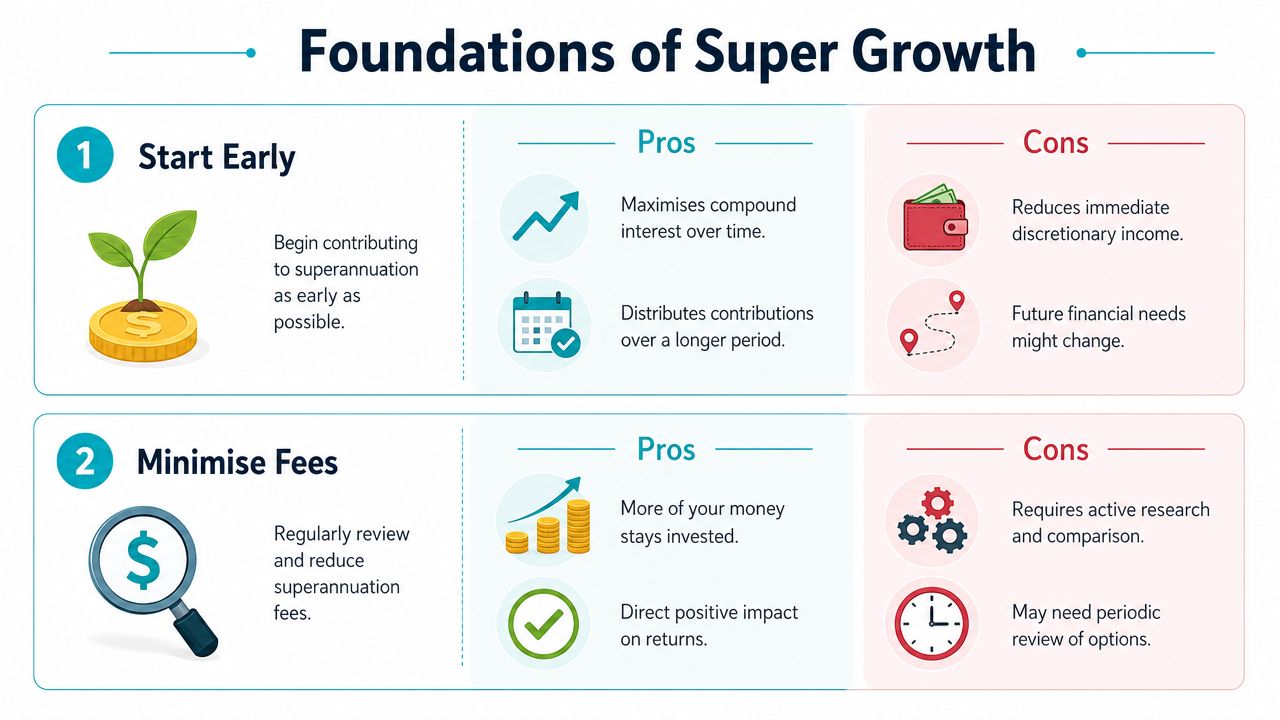
The strongest super strategies start with the simplest fixes. Before looking at caps, tax rules, or advanced contribution techniques, get the structure right. Getting the structure right involves checking for duplicate accounts, confirming employer payments, and reviewing whether the investment option still matches the job your super needs to do.
Consolidate what doesn't need to be separate
A common pitfall is retaining multiple super accounts, which leads to duplicated administration fees that can chip away significantly from the balance over time. It's also essential to verify employer Super Guarantee contributions, currently 11.5% of salary and rising to 12% from 1 July 2025, to ensure you're receiving your full entitlement, as noted in AustralianSuper's guide to boosting super before retirement.
This is often the fastest win because it removes friction immediately.
Use this checklist:
- Find old accounts: Check whether past employers opened separate funds that are still active.
- Compare insurance before consolidating: Some older accounts include cover you may not want to lose without review.
- Keep the stronger fund: Look at fees, investment menu, service, insurance structure, and whether the fund still suits your needs.
- Confirm employer payments: Make sure contributions are landing in the account you want to build.
Review your investment option
Consolidation cuts waste. Investment settings determine how your money is deployed.
A surprising number of people stay in the default option for years without checking whether it aligns with their age, risk tolerance, or retirement timeframe. That doesn't automatically mean the default option is wrong. It means you should know why you're in it.
A simple way to understand it:
| Life stage | Main focus | Common question |
|---|---|---|
| Early career | Growth over time | Am I too conservative for a long runway? |
| Mid-career | Balance growth with flexibility | Does this still fit my family and debt commitments? |
| Near retirement | Manage sequencing risk and access planning | Is my risk level still appropriate for drawdown years? |
The best investment option isn't the one with the most exciting label. It's the one that matches your time horizon and your capacity to stay invested through market volatility.
Build a repeatable review habit
Individuals don't need to monitor super constantly. They do need a routine.
A practical rhythm is to review super after major life events such as changing jobs, receiving a pay rise, taking on a mortgage, starting a family, or moving into the final stretch before retirement. This is also the point where structured advice can help. Some clients use an adviser or a service such as Guided Growth through Wealth Collective to turn these reviews into a disciplined process rather than a once-every-few-years task.
To maximise superannuation, start with these fundamental steps. Remove duplication. Verify contributions. Choose an intentional investment setting. These actions provide a clean foundation for more powerful contribution strategies to build on.
Master Your Superannuation Contribution Strategies
Once your account is clean and your investment option is intentional, contributions become the part that changes the outcome. Strategy then starts to matter. Two people on the same income can finish with very different super balances because one uses the right contribution type at the right time, and the other contributes without a plan.
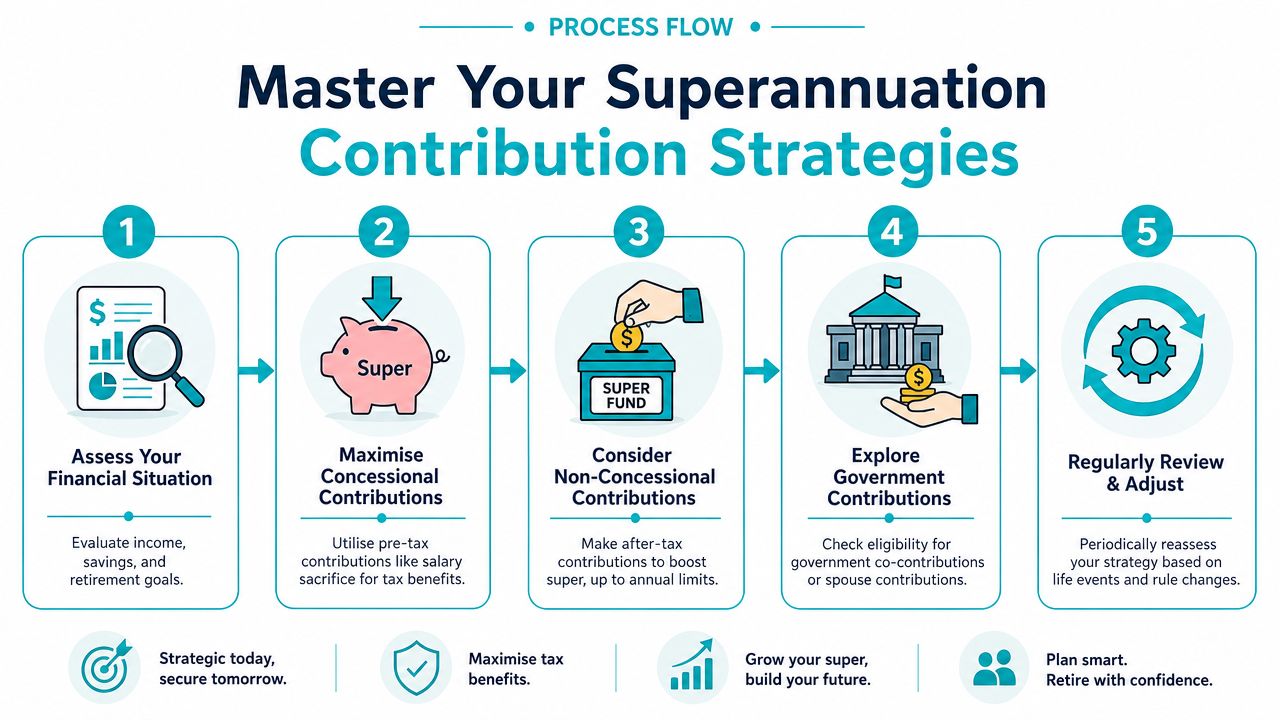
For most clients, the first question is simple. Should the next dollar go into super, the mortgage, cash reserves, or everyday life? The answer depends on life stage, tax rate, and how much flexibility you need before retirement. At Wealth Collective, we usually map this in sequence so the contribution strategy supports the broader plan rather than competing with it.
Use concessional contributions when tax savings matter now
Concessional contributions are made from pre-tax income. They include employer Super Guarantee payments and salary sacrifice amounts. From 1 July 2024, the general concessional contribution cap increased to $30,000 per year, with a further indexed rise to $32,500 expected from 1 July 2026.
For employees on solid incomes, this is often the first lever to pull because it can reduce personal tax while building retirement savings in a concessionally taxed environment. The benefit is clear, but so is the trade-off. More going to super means less hitting your bank account each pay cycle.
If you want a closer look at how salary sacrifice works in practice, this salary sacrifice super guide explains the moving parts.
A common fit is someone in mid-career who has just had a pay rise. Redirecting part of that increase into super can improve long-term outcomes without feeling like a major cut to lifestyle. That tends to work better than waiting years and trying to contribute a large lump sum under pressure.
“The best contribution strategy is one you can keep funding without second-guessing every month.”
Use carry-forward contributions when timing is on your side
The carry-forward rule can create a strong planning opportunity for people with uneven income patterns. If your total super balance is under $500,000, you may be able to use unused concessional cap amounts from the previous five years.
I often raise this with clients after a return to full-time work, a strong bonus year, or a period where family costs have eased. The value is not just the extra contribution room. The value is using that room in a year when the tax deduction matters more.
Before using this strategy, check three things:
- Unused cap amounts: Know how much concessional space is still available from prior years.
- Balance eligibility: Your total super balance must be under $500,000 at the relevant time.
- Cash flow impact: A larger deductible contribution only helps if it does not create pressure elsewhere in the plan.
This is one of those areas where the rule is straightforward but the timing decision is not. Used well, it can improve tax efficiency and accelerate super growth in a year that gives you the most benefit.
Use non-concessional contributions to move personal wealth into super
Non-concessional contributions are made from after-tax money. They do not usually create an upfront tax deduction, so the reason for using them is different. They suit people who already have money outside super and want more of their long-term wealth held in a concessionally taxed structure.
That often comes up later in the wealth-building cycle. Savings have accumulated. A redraw balance is available. An inheritance lands. An asset is sold. At that point, the question shifts from “how do I contribute from salary?” to “where should this capital sit from here?”
For households, spouse contributions can also be useful. They can help even out super balances between partners and, in some cases, may create a tax offset. The rules are specific, so it is worth checking eligibility before acting.
Match the strategy to the stage you are in
Contribution planning works best when it reflects your actual position, not a generic checklist.
| Life stage | Contribution focus | Why it often fits |
|---|---|---|
| Early career | Small, regular concessional contributions | Builds the habit early and uses time for compounding |
| Mid-career | Salary sacrifice and selective carry-forward use | Higher income can improve the tax benefit |
| Family and debt-heavy years | Flexible contributions that do not strain cash flow | Keeps progress going without creating household pressure |
| Later accumulation years | Larger concessional or after-tax contributions, where appropriate | Surplus cash and clearer retirement goals create more room to act |
The right contribution type depends on the job you need it to do. Some strategies improve current-year tax outcomes. Some build balances steadily. Others help position surplus cash inside super once your income and family commitments are more stable.
That is the shift people need to make. Stop asking which contribution type is best in general. Ask which lever gives you the best result now, given your age, income, cash flow, and retirement timeline.
Advanced Tactics for Pre-Retirees and High Earners
The final working years often create the biggest opportunity to improve retirement outcomes. Income is often higher, debt may be falling, and the retirement timeline becomes real enough to act on. Given these circumstances, broad advice like “contribute more to super” stops being useful. Precision matters.
The bring-forward rule can accelerate after-tax contributions
For people with a windfall, the bring-forward rule can be one of the most effective ways to move money into super quickly. The rule allows individuals under 75 to contribute up to three years' worth of the non-concessional cap in a single financial year. For 2024-25, that means $360,000, rising to $390,000 from July 2026. It is automatically triggered when contributions exceed $120,000 and is suited to people whose total super balance is below the relevant threshold, as explained in this video summary of the bring-forward rule.
This isn't a strategy for everyone. It suits a specific profile: someone with substantial after-tax funds and a clear reason to move them into super now rather than in stages.
Typical scenarios include:
- An inheritance: Cash that would otherwise sit outside super without a long-term plan.
- A business sale: Proceeds that need to be positioned carefully for retirement.
- A large bonus or asset sale: A one-off event that creates unusual contribution capacity.
Why timing matters more as retirement approaches
The closer you get to retirement, the less room there is to correct mistakes. A poorly timed contribution, missed cap opportunity, or fragmented account structure can have a much bigger impact than it did in your thirties.
That's why high earners and pre-retirees benefit from sequencing decisions, not just making them. One year may be best used for carry-forward concessional contributions. Another may be better suited to a non-concessional strategy. A third may require preserving liquidity outside super because retirement access rules, estate planning, or other commitments are about to change.
If you're weighing whether unused concessional caps could be part of your plan, this carry-forward concessional contributions guide is a useful starting point.
High-income years deserve deliberate planning. They're often the years when one good decision does more than five average ones.
What doesn't work
Trying to max out every available cap without regard to cash flow usually backfires. So does copying a strategy that worked for a colleague or sibling whose balance, tax position, and retirement timing are different from yours.
The right advanced strategy should answer three questions clearly:
- What outcome are you trying to create?
- Why is this the right year to act?
- What are you giving up in liquidity or flexibility by moving more into super?
That's the level of thinking that turns super from an account balance into a retirement tool.
Protecting Your Wealth Within Super
A lot of people do the hard part well. They contribute consistently, invest for growth, and build a meaningful balance over time. Then they lose ground in quieter ways. Insurance they never reviewed keeps eating into returns, an old account still holds outdated cover, or no one has checked whether their beneficiary nomination still reflects the family they have now.

Protection inside super is not a side issue. It is part of the return you keep, the cover your family can rely on, and the certainty you create if something happens to you.
Insurance inside super needs an active review
Default insurance can be useful. It often gives you a simple starting point and keeps premiums out of your monthly cash flow. But default does not mean appropriate.
I regularly see clients with cover that made sense in their first job and no longer fits their life. The amount may be too low for a young family, too high for someone close to retirement, or duplicated across multiple super accounts after changing employers. In each case, the trade-off is real. More cover can protect your household if your income stops. Too much cover, or cover held in the wrong place, can reduce the balance available for retirement.
A practical review usually starts with three questions:
- What is the cover there to do? Replace income, clear debt, support children, or protect a business.
- Do the policy terms hold up when you read them closely? Definitions, exclusions, waiting periods, and benefit periods matter.
- What is the annual cost to your long-term balance? Premiums are deducted, but the impact over time is not small.
Fees and insurance costs both matter because small deductions can materially reduce what stays invested over the long term. As noted earlier, that effect becomes more obvious over decades, not months.
Beneficiary nominations are part of the strategy
Super is not automatically distributed under your will. The fund trustee looks first at the rules of the fund and the nomination on file. That catches families by surprise more often than it should.
A binding death benefit nomination gives clearer direction about who should receive your super and in what proportions, subject to the legal rules. It also helps avoid delay, confusion, and disputes at a time when your family is already under pressure.
If you want the detail, this guide to what happens to super when you die explains how death benefits are assessed and paid.
Good super planning protects two things at once. Your income and options while you are alive, and clarity for the people who may need to deal with your affairs later.
Treat super as part of your wider protection plan
Super interacts with your insurance, estate planning, and household cash flow whether you review it that way or not. A premium inside super affects retirement growth. A lapsed or non-binding nomination can change where benefits end up. An inactive account can still hold cover you forgot about and no longer need.
At Wealth Collective, we usually review these decisions together because the best answer is rarely found by looking at super in isolation.
| Area | What to review | Why it matters |
|---|---|---|
| Insurance in super | Cover amount, policy terms, premium impact | Helps protect your household if illness, injury, or death affects income |
| Beneficiary nominations | Binding status, recipients, percentages | Reduces uncertainty around who receives death benefits |
| Account structure | Active funds, old cover, outdated settings | Cuts duplication and lowers the risk of conflicting arrangements |
That is how you protect the balance you have built, without giving away more in cost, confusion, or poor structure than you need to.
Build Your Wildly Successful Financial Life
A good super strategy becomes real the moment it answers one question clearly. What should you do next, based on where you are now?
That is the gap we see most often. People are usually aware of the main super rules, but they are less certain about priority, timing, and trade-offs. The right move for a 32-year-old on a rising income is different from the right move for a 48-year-old balancing school fees and a mortgage, or a 60-year-old trying to make the most of the final working years before retirement.

The right next move depends on where you are now
Early in your career, the biggest gain often comes from setting up the basics properly and starting a consistent contribution strategy while time is still on your side. In the middle years, the focus usually shifts to trade-offs. How much goes to the mortgage, how much stays available for family costs, and how much should be directed into super for long-term tax efficiency. Closer to retirement, timing matters more. Contribution caps, cash flow, and withdrawal plans need to line up.
Simple strategies can still be very effective. For low-to-middle income earners, one often-missed option is the Super Co-Contribution. For the 2026-27 year, an eligible person earning under $64,293 can make a $1,000 non-concessional contribution and receive a $500 government match, as explained in Australian Retirement Trust's guide to growing your super. In the right situation, that is an immediate return worth acting on.
Advice matters when the rules interact
Super decisions rarely sit neatly on their own. A higher concessional contribution can improve tax outcomes, but it may also reduce cash flow at a time when flexibility matters more. Extra insurance inside super can protect a household, but the premiums can slow long-term growth. A windfall can create a strong contribution opportunity, but poor timing can waste part of the benefit.
This is why our advice process is built around creating a clear roadmap. We start with your current position, identify the highest-value levers available now, and map out what should wait until a later stage of life. That gives each decision a purpose. It also helps avoid the common mistake of using every available strategy without checking whether it fits your broader plan.
Strong retirement outcomes are usually built through a sequence of well-timed decisions, not one dramatic move.
Confidence comes from having a roadmap
At Wealth Collective, we use super advice as part of a wider planning process. The goal is to help you decide what matters this year, what can wait, and what result each step is meant to achieve, whether that is lower tax, faster balance growth, better protection for your family, or more retirement options later.
A good plan should let you answer these questions with confidence:
- Which contribution strategy suits my income and stage of life right now?
- What trade-offs am I making between super, debt reduction, and short-term cash flow?
- Is my super structure still working for me, or just sitting there unchanged?
- What one or two actions would make the biggest difference over the next 12 months?
If those answers are still unclear, a short conversation can turn general rules into a practical plan.
If you want personalized guidance on your next super move, book an initial call with Wealth Collective. A good conversation can help you turn general rules into a practical plan that fits your income, your life stage, and the retirement you want to build.