Business hours
Monday to Friday (8.30AM - 5PM)
Weekend (Closed)


You are probably staring at the same problem a lot of Perth households are facing right now. The mortgage is due, the bills keep climbing, super is too important to ignore, and every financial advice Perth WA search result looks the same until you realise you need more than generic tips. You need a clear call on whether to pay for advice, use free support, or deal with a hardship program first.
The right move depends on what is wrong. If cash flow is under strain, triage comes first. If retirement timing, super, insurance, or debt reduction is the main concern, paid advice earns its keep. For Perth and WA residents who are weighing that decision, Wealth Collective's financial planning in West Perth is one place to start if you want structured advice rather than broad guidance.
Why Seek Financial Advice in Perth WA
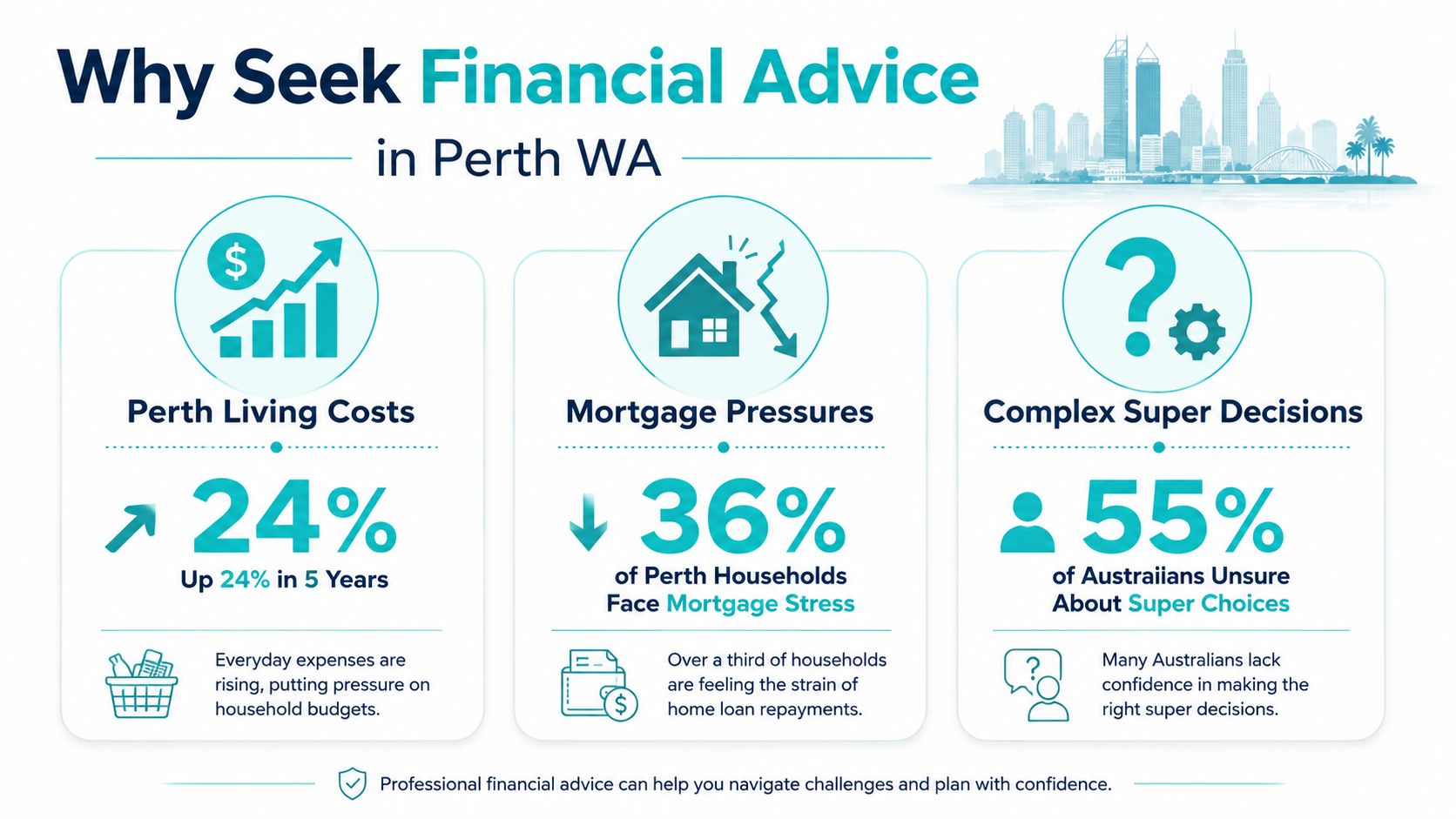
Perth households are making high-stakes money decisions while daily pressure keeps piling up. That is why financial advice Perth WA matters. You are not only picking investments, you are keeping a family budget steady, protecting income, and making retirement calls without creating avoidable mistakes.
Perth advice is harder to access, and it costs more
The adviser squeeze is real. The Financial Advice Association Australia says adviser numbers have fallen nationally from more than 28,000 to about 15,500, while retirement demand keeps rising, with about 800 Australians retiring every day for the next decade (Star Investment's Perth adviser market summary). In WA, that puts pressure on the people who need help most, pre-retirees, retirees, dual-income families, and business owners, because they are competing for fewer experienced advisers.
Advice also has a real price tag. Independent Perth market data puts a full financial plan at around $3,000–$5,000, with some initial Statement of Advice work at $3,300–$5,500 and complex cases up to $8,000. Ongoing advice is commonly $3,000–$8,000 per year, and hourly work sits around $300–$600 per hour (Perth financial planner pricing guide). That is not cheap, but it reflects the work involved in personal advice in WA.
Advice changes confidence, not just portfolios
The best reason to pay for advice is not product choice. It is the quality of the decision and the confidence that comes with it. A statewide WA survey found people who received financial advice were nearly twice as likely to feel confident about their financial future, and 62% of advised retirees said they were living the lifestyle they expected, versus 38% without advice (WA prosperity paradox survey). That gap matters because financial stress is not only about returns, it is about whether your plan stands up in real life.
Practical rule: if a decision will affect your next decade, do not rely on guesswork or a forum thread. Pay for advice when the choice is irreversible or hard to unwind.
If you want a Perth-based starting point for a structured discussion, Wealth Collective's financial planning approach in West Perth is one place to compare process and fit.
Determine If You Need Professional Advice
Not everyone needs a paid adviser today. Some people need a budgeting reset, some need debt help, and some need personalised strategy because the stakes are too high to wing it. The mistake is paying for full advice when hardship support would fix the immediate problem faster.
Use the problem, not the label, to decide
If your main issue is overdue bills, creditor pressure, or basic cash flow stress, free or low-cost help is usually the right first move. WA Government guidance says financial counsellors provide free, independent and confidential help through community organisations or the National Debt Helpline on 1800 007 007, and it also points people to fcawa.org to find a local counsellor (WA Government financial counsellor support). Many Perth households stabilise cash flow this way before they ever sit down with a paid adviser (WA financial services directory).
If your issue is retirement sequencing, super, insurance gaps, or structuring a long-term plan, paid advice is the better tool. That's because a licensed adviser can coordinate several moving parts at once. Free help usually can't do that.
A simple decision test
- Choose financial counselling first if the pressure is immediate, like rent, utilities, debt, or arrears.
- Choose paid advice first if the decision is strategic, like super contributions, retirement income, insurance, or debt reduction across a household balance sheet.
- Choose both in sequence if you're under stress now but want a proper plan later.
- Delay neither if your circumstances are changing fast, such as redundancy, relationship change, illness, or approaching retirement.
If the question is “How do I survive this month?”, talk to a counsellor.
If the question is “How do I organise the next ten years?”, talk to an adviser.
That distinction is the one most local pages miss. They talk about advice as if every problem is an investment problem. It isn't.
Compare Key Financial Services in WA
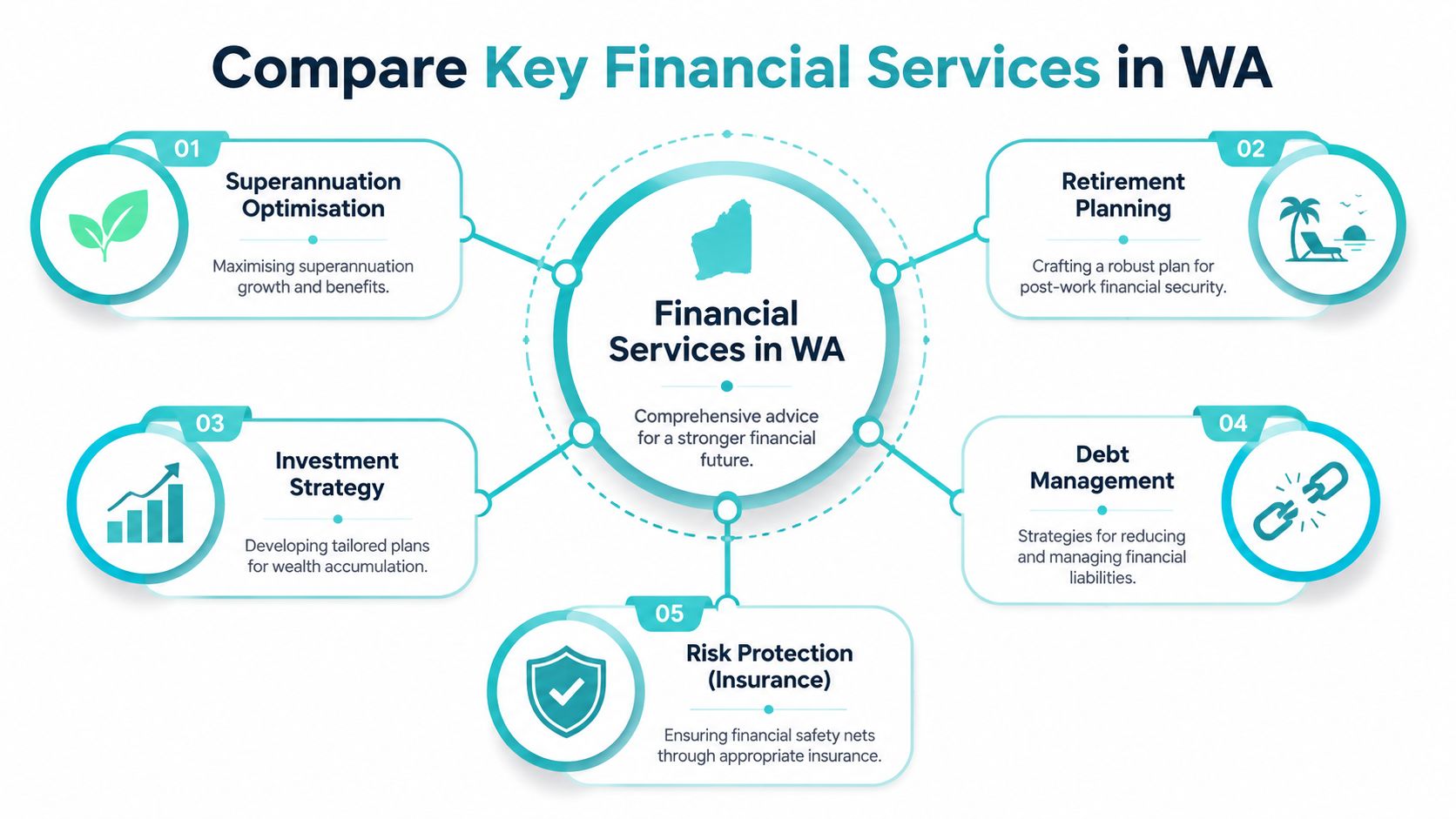
Perth residents don't need “financial advice” in the abstract. They need the right service for the right job. Super, retirement, debt, insurance, and investing are related, but they solve different problems and should be treated differently.
Superannuation is not the same as retirement planning
Superannuation optimisation is about contribution strategy, fund choice, fees, and how your super fits into the rest of your life. It suits people who are still building wealth and want to get the structure right early. Retirement planning is broader, because it covers when to stop work, how to draw income, and how to preserve flexibility.
The most effective retirement advice doesn't just talk about investments. It integrates Centrelink, aged care, drawdown sequencing and mortgage reduction (WA retirement education resources). That's the part many people get wrong. They ask, “What return can I chase?” when the better question is, “How do I turn assets into reliable income without losing options?”
Insurance and debt sit in different lanes
Personal insurance matters when your income is the asset keeping the household afloat. If a serious illness, accident, or disability would force a major lifestyle change, the first priority is risk protection. Debt management matters when interest, repayment pressure, or multiple loans are draining flexibility.
Don't treat debt reduction as a separate hobby. If your income is exposed, the wrong insurance choice can leave you more vulnerable than a high interest rate ever will. Likewise, if debt is chewing up cash flow, you may need to stabilise that before any serious investing.
| Service | Best used for | Common mistake |
|---|---|---|
| Superannuation optimisation | Better structure, contributions, and fund settings | Focusing only on returns |
| Retirement planning | Income sequencing and timing decisions | Treating retirement like a single investment choice |
| Investment strategy | Building wealth with a tailored asset mix | Copying someone else's portfolio |
| Debt management | Reducing pressure and improving cash flow | Ignoring the behavioural side of debt |
| Risk protection | Protecting income and family stability | Underinsuring because premiums feel inconvenient |
That table is the cleanest way to think about it. Start with the problem, then choose the service that fixes that problem directly.
Check Adviser Credentials and Reputation
A polished website doesn't prove an adviser is suitable. Perth clients need to check qualifications, process, and how the adviser handles disclosure before they hand over personal information or pay a fee. This step isn't optional.
Check the basics before anything else
Start with registration and qualifications. The CFP Board's planning process lays out a seven-step method, from collecting client information and defining goals through to regular review, and that structure is a strong benchmark for how advice should be delivered (CFP Board financial planning process guide). If an adviser can't clearly explain how they move from discovery to implementation, keep looking.
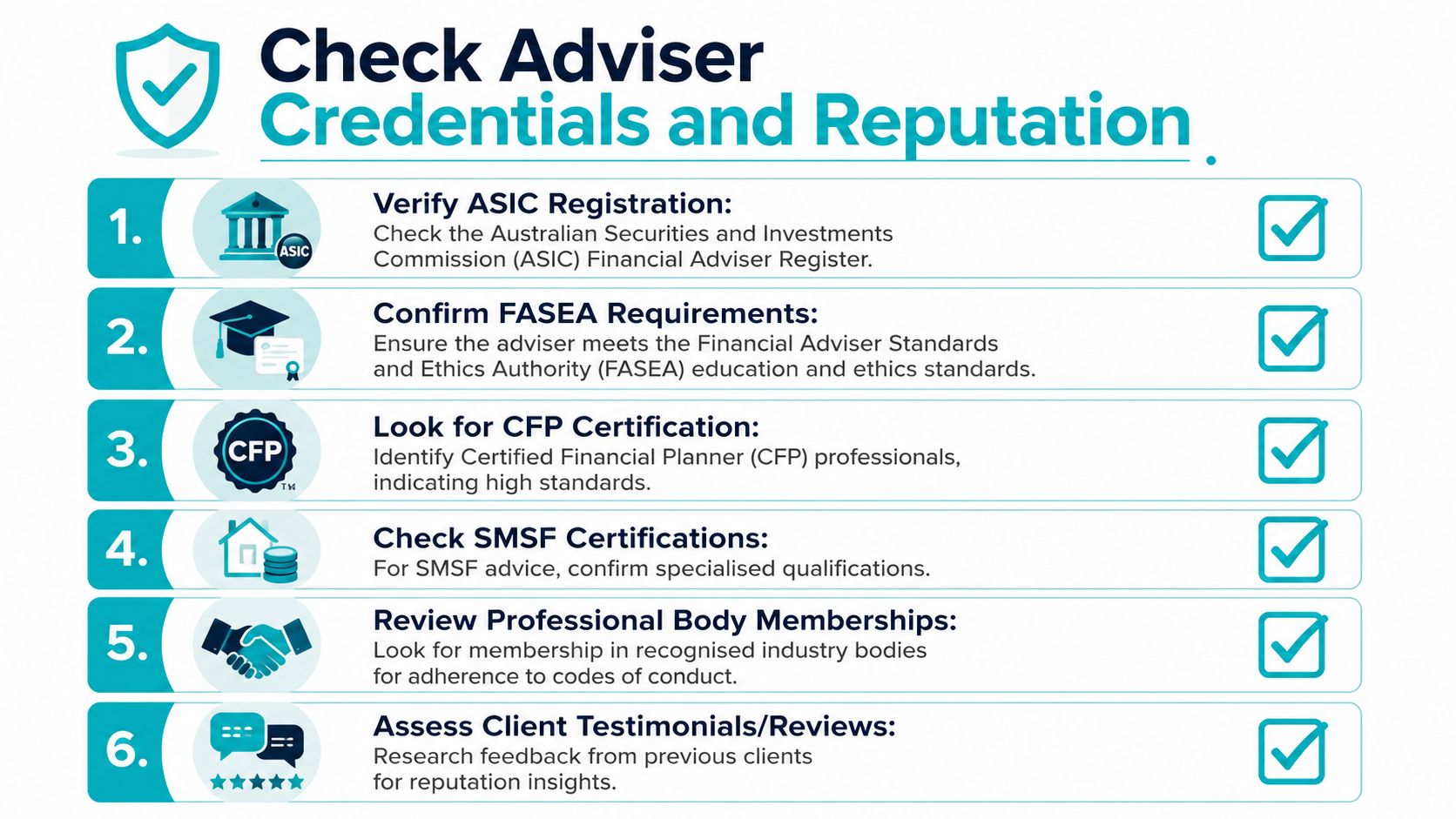
Use this short checklist:
- Verify the licence: confirm the adviser is properly authorised.
- Ask about professional standards: check whether they meet current education and ethics requirements.
- Look for relevant credentials: CFP is a useful sign of disciplined professional training.
- Match the expertise to the job: SMSF advice needs specialist experience, not generic sales language.
- Read the fee disclosure carefully: vague fees are a red flag.
- Scan reviews with caution: look for patterns, not hype.
Watch for reputation signals that matter
A good adviser is clear, methodical, and slightly boring in the best way. They explain what they do, what they don't do, and how they're paid. They don't rush you, and they don't promise easy outcomes.
If you want a Perth-specific comparison point, Wealth Collective's adviser selection guide is a useful reference for what a proper shortlist process should look like. Use it as a standard, not a sales pitch.
Ask one simple question in every first meeting, “What happens after the plan is delivered?” If the answer is fuzzy, that's your answer.
Prepare for Adviser Meetings
A strong first meeting starts before you walk in. If you turn up with no documents and vague goals, you'll pay for time that should've been spent on decisions. If you come prepared, the adviser can focus on strategy instead of admin.
Bring the right documents
Put together the basics first. You don't need a perfect folder, but you do need enough information for the advice to be real.
- Bank statements: show cash flow and spending patterns.
- Super statements: show balances, fees, and fund structure.
- Insurance policies: life, income protection, trauma, and any employer cover.
- Mortgage and loan details: interest rates, repayments, offset accounts, and redraw.
- Tax returns or income summaries: useful if your income is variable or includes more than one source.
- A list of assets and debts: keep it simple and honest.
Then write down your priorities in plain language. If retirement is your focus, say when you want out of work and what kind of lifestyle you expect. If debt is the issue, say which loan is keeping you awake. If insurance is the concern, say what would break if your income stopped.
Ask questions that expose the process
A good adviser should answer these without hesitation:
- How do you get paid?
- What's included in the fee?
- How do you review the plan after implementation?
- What kinds of clients do you work with most often?
- What happens if my circumstances change?
Those questions aren't confrontational. They're protective. You're not buying a product off the shelf, you're paying for judgement, structure, and follow-through.
Understand Advice Costs and Timelines
Perth advice costs money, and you should price it before you sign anything. A proper initial advice engagement usually sits in the $3,000–$5,500 range, with ongoing reviews at $3,000–$8,000 per year and hourly rates of $300–$600. That gives you the benchmark before you compare any proposal or decide whether the fee makes sense for your situation.
Know what you're paying for
You are not paying for a document alone. You are paying for the adviser's thinking, the strategy work, the paperwork, the coordination, the implementation, and the review process that follows.
If the adviser is helping with retirement sequencing, super changes, debt reduction, or insurance strategy, the fee should match the complexity of the work. A basic one-off recommendation and a full strategy for a household with multiple moving parts are not the same job, and they should not be priced as if they are.
Use a proper pricing reference before you commit. Wealth Collective's Australian advice fee guide is a practical way to see how fees are usually structured, so you can judge whether a quote is fair and whether it matches the work on offer.
Do not compare advice fees to a free online calculator. Compare them to the cost of getting a major decision wrong. That is the only comparison that matters.
Expect the process to take time
A real advice process has stages. It starts with an introductory call, then discovery, then strategy work, then a meeting to present the plan, followed by implementation and review. That sequence is normal because good advice needs context, not a rushed answer.
If someone promises a full strategic answer in a quick chat, treat that as a warning sign. Perth households dealing with super, retirement, insurance, or debt need a process that is clear and thorough, not one that skips straight to a conclusion.
Ask how long each stage usually takes, what information you need to provide, and when you will see the first recommendation. Good advisers answer those questions directly. Poor ones avoid them.
If you want a broader price comparison for Perth, the Perth advice pricing guide is useful context before you book a meeting. Use it to pressure-test the quote, not to chase the cheapest option.
Next Steps with Wealth Collective Service Pillars
Once you know what kind of help you need, the next decision is who can deliver it cleanly. Wealth Collective's approach is built around Protection Plus, Guided Growth, and Retirement Roadmap, which map neatly to the problems Perth households are trying to solve. That's the right way to organise advice, by life stage and need, not by product shelf.
Choose the pillar that matches your situation
Protection Plus suits people who need personal insurance sorted properly. Guided Growth fits clients who want disciplined investment and super strategy without constant noise. Retirement Roadmap is for pre-retirees who need income sequencing, drawdown decisions, and a workable plan for life after work.
The useful part is the process. Wealth Collective offers a free 10-minute introductory call, then builds a personalized Statement of Advice for the right clients, backed by a satisfaction guarantee and transparent communication. That makes the first step low-friction, which matters if you're still deciding between free counselling, hardship support, or paid advice.
The right adviser doesn't start by selling. They start by clarifying the decision in front of you.
If your problem is urgent, use counselling first. If your problem is strategic, use professional advice. If you're not sure which camp you're in, a short introductory call can save a lot of wasted time.
If you're ready to stop guessing, book a free introductory call with Wealth Collective and talk through your current situation, your goals, and the next practical step. If you need Perth financial advice that's clear, structured, and built around your circumstances, start the conversation now.