Business hours
Monday to Friday (8.30AM - 5PM)
Weekend (Closed)



The most popular retirement advice is also the least useful: save a large enough super balance and everything else will work itself out. It won't. A balance is a starting point, not a retirement income plan.
For a Perth couple in their early 60s, the important questions are more practical. When can you access super? How will you fund the years before the Age Pension? Should you reduce the mortgage, increase withdrawals, or preserve capital? What happens if one of you needs aged care, markets fall, or your spending changes?
Good financial advice for retirees connects those decisions. It turns a lump sum into an income strategy that can adapt to tax, debt, health, investment risk and changing eligibility rules.
Why a Super Balance Alone Does Not Mean You Are Ready
A super balance can look reassuring while hiding serious weaknesses. Two couples with the same balance might have completely different retirement prospects because one has a mortgage, different spending needs, less secure income, or no plan for the years before Age Pension eligibility.
The Australian retirement benchmarks make that clear. For retirees aged 65 to 84, the ASFA March quarter 2026 comfortable lifestyle benchmark is $55,923 a year for a single person and $78,566 for a couple. The corresponding Age Pension benchmarks are $31,223 and $47,070. ASFA translates the comfortable target into retirement savings of about $630,000 for a single person and $730,000 for a couple at age 67. These figures are useful reference points, but they're not personal plans. Your mortgage, travel, health, housing and family commitments can move your target substantially. ASFA's Retirement Standard provides the benchmark, not the answer.
Retirement readiness is a cash-flow question
A balance tells you what you own. It doesn't tell you how much you can spend, when to draw it, or how long it may last.
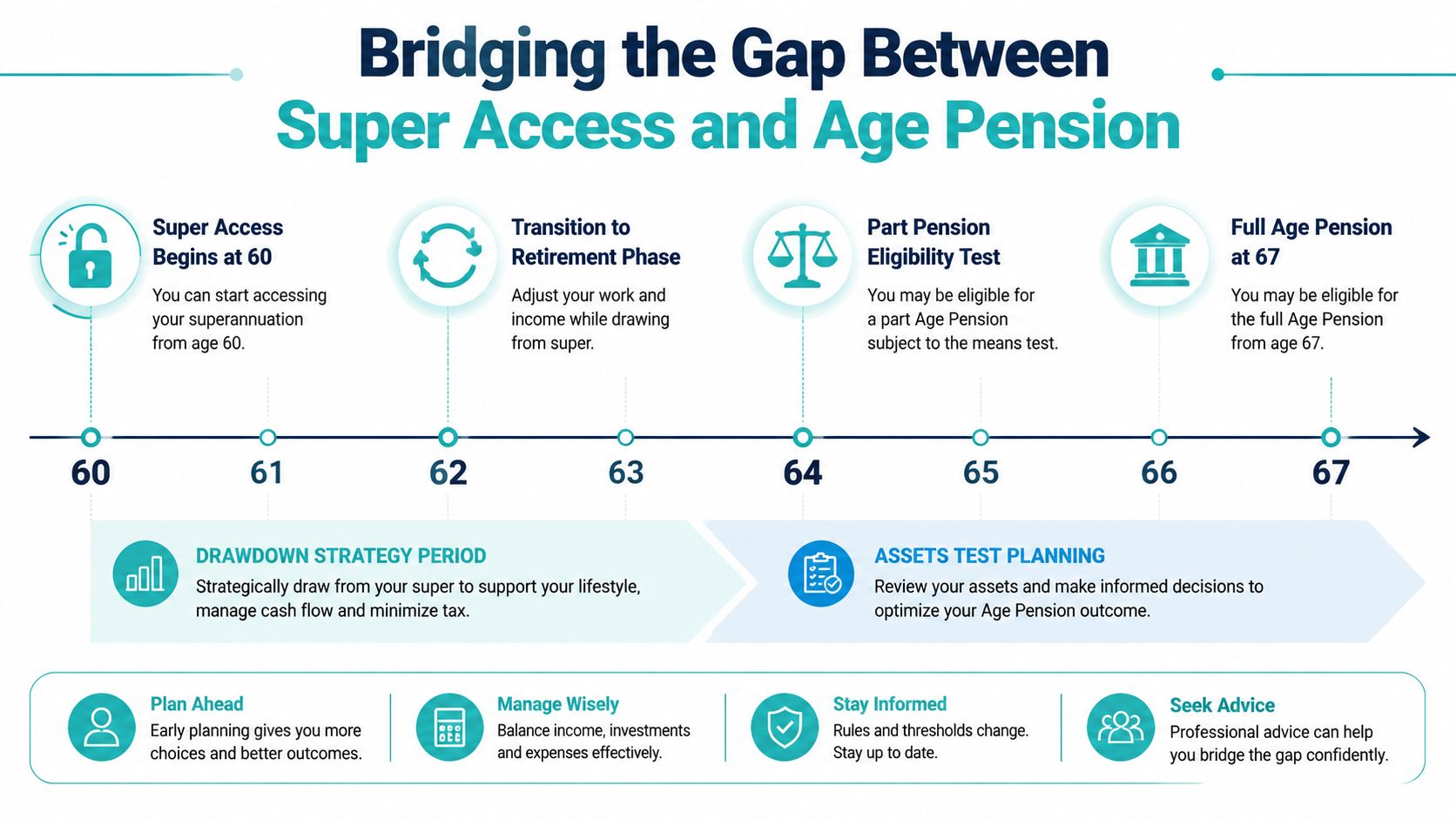
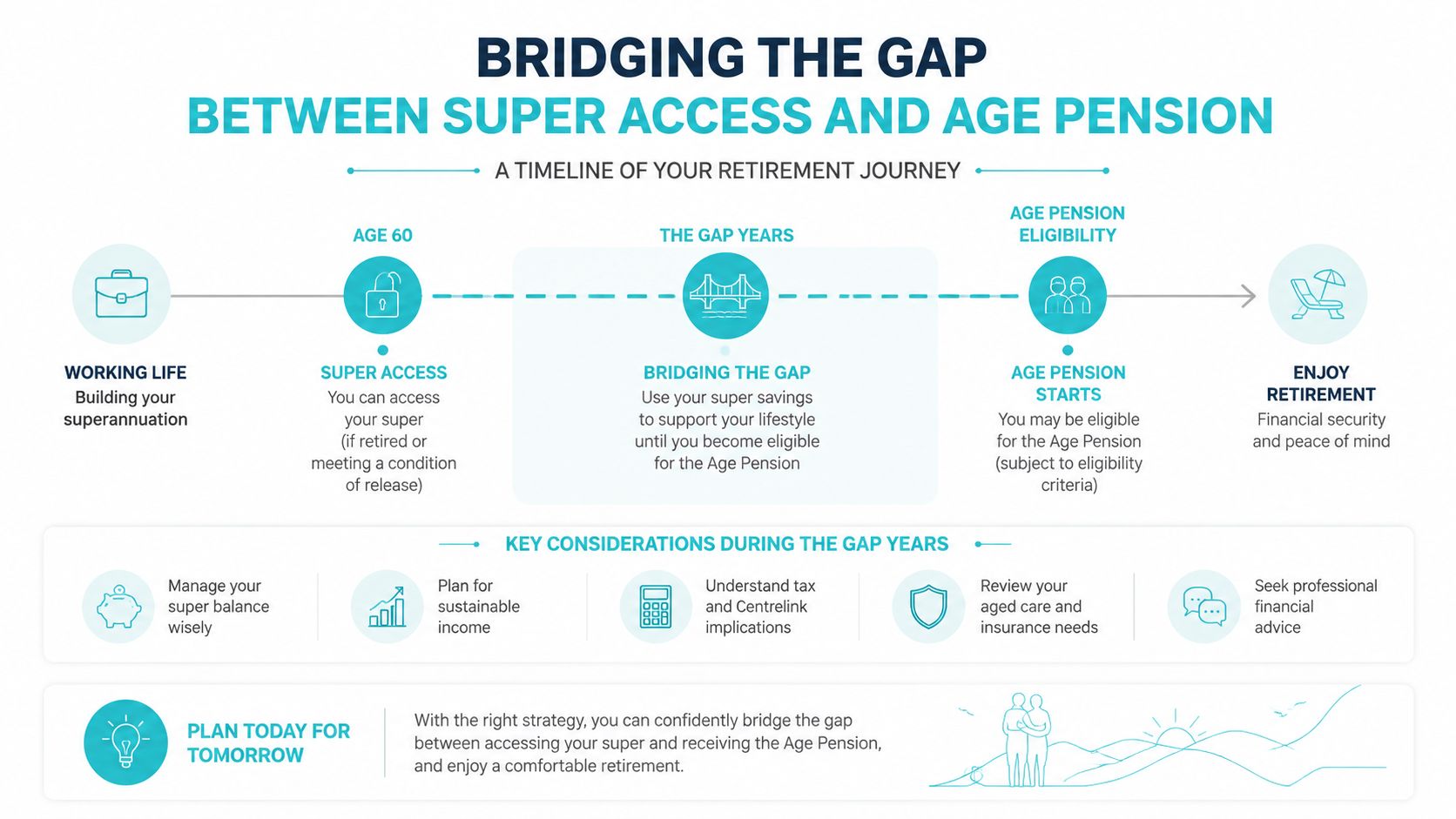
Super access and pension access also operate on different timetables. Preservation age rises from 55 for people born before 1 July 1960 to 60 for anyone born from 1 July 1964 onward, subject to a condition of release, according to the Australian Taxation Office rules for accessing super to retire. The Age Pension age is 67 or older, and Services Australia makes clear that it isn't the same as preservation age. Services Australia's retirement guidance explains why people often need a deliberate income bridge.
A Perth homeowner can also overestimate the value of property equity. A house in Joondalup, Wanneroo or Mandurah may be valuable, but it doesn't automatically pay the electricity bill or fund a suitable care arrangement. Selling, borrowing or downsizing carries emotional, tax and transaction consequences.
Health costs deserve equal attention. If private cover is part of your plan, researching the cost of health insurance for over 65s can help you test whether your projected budget reflects real choices rather than a tidy spreadsheet assumption.
Practical rule: Don't ask only, “Do I have enough super?” Ask, “What income can this money produce, what could derail it, and how will we respond?”
If you're still testing the balance question, use this guide to how much super you need to retire, then build the answer around your actual spending and risks.
Six Areas Where Retirees Need Advice
Retirement advice is not an investment pick followed by a set-and-forget pension. It is a coordinated plan for income, tax, care, family and risk, with each decision changing the others.
Income generation and drawdown strategy
Your account-based pension needs a withdrawal strategy, not just its default minimum. Minimum drawdowns can preserve capital while leaving you spending below the lifestyle you planned. Set separate targets for essential costs, flexible spending and cash reserves, then decide which account funds each one and when.
Tax minimisation
Super withdrawals and pension income can produce different tax outcomes, depending on your age, account structure and components. Poor sequencing may create unnecessary tax while another account sits unused. Have your adviser model the order of withdrawals with your accountant, particularly if employment income, investment income or a property sale is part of the plan.
Aged care funding
Aged care planning belongs on the agenda before a health crisis. You and your partner need to understand how savings, property and cash flow could meet accommodation and ongoing costs without leaving the healthy partner unable to live independently. That funding strategy must align with your estate plan.
Estate planning and beneficiaries
A valid will is only one part of the arrangement. Super death benefits, binding nominations, ownership structures and powers of attorney must work together. Review nominations after divorce, remarriage, a death or another major family change, or an avoidable dispute may follow.
Insurance and risk management
Retirement changes the risks worth insuring. Income protection may matter less as work winds down, while health, life, home, liability and long-term care risks deserve a fresh review. Keep a policy because it serves a defined purpose, not because it has always been there. Cancelling cover without testing the consequence creates a different problem.
Transition-to-retirement planning
If you are still working, a transition-to-retirement strategy can coordinate reduced hours, super contributions and income withdrawals. It may suit a gradual move from FIFO, professional or business income into retirement, but the numbers must be tested against tax, cash flow and preservation rules.
These decisions connect. Paying down debt can reduce investment capacity while lowering the income your retirement plan must produce. Larger withdrawals may improve life now but change future pension outcomes. Altering ownership can affect both estate planning and means testing.
Good advice does not sell six separate products. It coordinates six decisions around one household plan.
An integrated process shows how one choice affects the rest of your financial life, including the spending gap before Age Pension eligibility and the risk of treating minimum drawdowns as a sensible lifestyle budget.
Bridging the Gap Between Super Access and Age Pension
The years between super access and Age Pension eligibility are where many otherwise organised retirees lose clarity. You may be able to access super at 60, yet still have several years before the Age Pension becomes available. That period needs its own plan.
Build the bridge deliberately
Start with the income you need, not the amount a calculator happens to produce.
- Define essential spending. Separate housing, utilities, food and medical costs from travel, gifts and discretionary spending.
- Identify every income source. Include employment, defined benefit income, investment income and eventual pension entitlements.
- Choose the withdrawal order. Decide whether super, cash, taxable investments or debt reduction should carry the early years.
- Review the portfolio's risk. Keep enough accessible liquidity for planned spending without turning the whole portfolio into cash.
- Model the pension transition. Test how assets and income may affect eligibility when Age Pension age arrives.
The Age Pension eligibility calculator can provide a useful starting point, but a calculator won't decide whether your withdrawal strategy fits your tax position or household risks.
Don't confuse minimum withdrawals with an ideal lifestyle
Retirement income phase accounts have legislated minimum drawdown requirements. Drawing only the minimum can preserve tax-effective earnings inside super, but it can also leave you underspending relative to your target. Treasury and parliamentary analysis has noted that retirees often default to minimum drawdowns, creating a behavioural gap between protecting the balance and using money to support life.
The answer isn't to withdraw aggressively. It's to set a spending policy. A couple might use a stable base income for bills, then review discretionary withdrawals when markets, health or family needs change.
Debt makes the calculation sharper. A mortgage carried into retirement means your target income includes repayments that a debt-free couple doesn't face. Reducing debt may lower future withdrawals, but using super to clear the loan can affect liquidity, tax and investment exposure. The decision needs modelling rather than a blanket rule.
If debt exposure is a concern, general resources such as Social Security debt protection tips may help you think through broader protection issues. Australian super and pension rules still require Australian-specific advice.
For a WA couple, the sensible bridge may involve a planned lump-sum debt reduction, carefully timed contributions while one partner remains employed, and a deliberate split between super and non-super assets. The point isn't to chase the highest pension or preserve the largest balance. It's to coordinate income, flexibility and security across the whole transition.
How Advisers Add Value Beyond Investment Returns
Investment returns matter, but retirement outcomes often turn on decisions made around them. An adviser can improve the result by setting withdrawal rules, coordinating accounts and testing how income changes when work, debt or pension eligibility changes. These benefits will not appear as a separate return figure on a quarterly statement.
A DIY retiree may hold sensible investments yet draw from the wrong account, miss a pension means test or sell after a sharp fall. Another may pay for advice that delivers little more than a model portfolio and generic annual reviews. The service model matters because the advice must fit the household, not just the investment balance.
Compare the service models
| Feature | Platform / Robo-Hybrid | Mid-Tier Adviser | Boutique / Comprehensive Adviser |
|---|---|---|---|
| Typical approach | Standardised portfolios and digital tools | Personal advice with defined service packages | Personalised retirement and wealth planning |
| Main strength | Lower-friction investment management | Balance between access and personal guidance | Coordination across tax, super, debt, estate and aged care |
| Main limitation | Limited household context | Scope may vary between firms | Higher fees may apply where advice is complex |
| Suitable for | Straightforward investment needs | Retirees wanting regular guidance | Couples with layered income, debt or family issues |
| Key question | Can the system handle my decisions? | Who will make and review the recommendations? | Will the adviser coordinate the whole strategy? |
Fees may be percentage-based, fixed, or combined. A percentage fee is easy to understand but can become expensive as assets grow. A fixed fee gives clearer cost control, provided the written agreement states what the adviser will do, how often reviews occur and what falls outside scope.
A Perth couple with substantial super and a partly paid-off mortgage in Joondalup needs a different service from a debt-free household in Dalkeith with complex investments. Paying more is justified only when the adviser addresses the decisions that affect your cash flow, tax position and family plans.
Wealth Collective presents its Retirement Roadmap as a personalised service for people aged 50 and over, covering retirement goals, investments and superannuation. It is one example of a structured advice offering. Compare its scope, fees and adviser experience with other options before deciding.
Judge advice by decisions improved, not by investment charts alone.
Ask what the adviser will do when markets fall, pension rules change, one partner stops work, or aged care becomes relevant. Ask how recommendations will be recorded and reviewed, and who remains responsible for coordinating the moving parts. Those answers reveal more than a polished performance graph.
A Realistic Retirement Advice Case Study
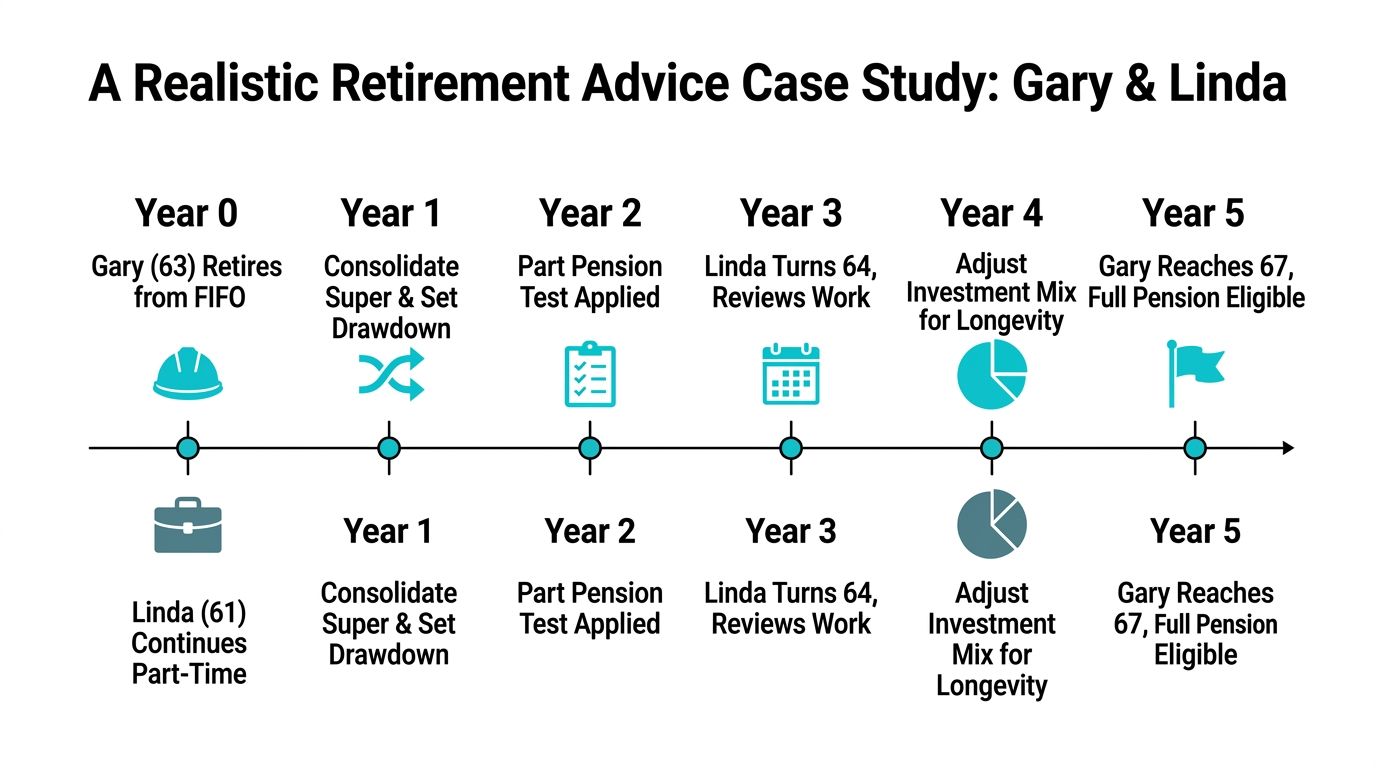
Gary is 63 and has recently retired from a FIFO mining role. Linda is 61 and still works part-time in administration. They live in Wanneroo, hold $1.4 million across two super accounts, and have a $180,000 mortgage. They've been careful with money, but they're taking irregular withdrawals and haven't tested how Gary's defined benefit pension may interact with future Age Pension eligibility.
Discovery comes before recommendations
Their first meeting doesn't begin with an investment product. It begins with questions:
- Lifestyle: What do they want their ordinary weeks to look like, not just their holidays?
- Income: How much does Gary need now, and when will Linda's part-time work reduce or stop?
- Debt: Is the mortgage a manageable liability or a source of retirement anxiety?
- Family: Are they helping adult children, and what must remain protected?
- Health: What assumptions have they made about future medical or care needs?
The discovery meeting exposes the missing model. Gary's defined benefit pension has never been assessed alongside their super, mortgage and future pension tests. Their balance is sizeable, but their income pathway is unclear.
Strategy turns a balance into decisions
The strategy session tests whether clearing the mortgage from super before age 65 creates a more tax-efficient outcome than continuing minimum withdrawals. It also considers liquidity, Linda's ongoing income, investment risk and the effect of reducing debt on their required retirement cash flow.
Their accountant becomes part of the process. Capital gains timing is coordinated rather than treated as an isolated tax job. Super accounts are reviewed for consolidation, fees, investment settings and beneficiary nominations. The plan also gives Gary a spending framework, which addresses his anxiety about outliving savings without promising an outcome no adviser can guarantee.
Implementation needs ownership
An advice engagement may take 6 to 10 weeks from the first call to a Statement of Advice, with the final timetable depending on complexity and client decisions. Initial advice may cost $4,000 to $7,000, depending on the work required, and the fee should be confirmed before substantial work begins.
Ongoing reviews then test whether the strategy still works as Linda changes her hours, Gary approaches pension age, markets move, or their health and family needs shift. The adviser shouldn't rebalance a portfolio. They should revisit the decisions that give the portfolio a purpose.
Gary and Linda's outcome isn't a magic return or a perfect forecast. It's a coordinated plan for debt, income, tax, pension eligibility and emotional confidence.
Choosing the Right Adviser for Your Retirement
Retirement advice requires a different skill set from accumulation advice. You want someone who regularly handles income decisions, pension testing, tax sequencing, aged care and estate coordination, not someone who moves working clients into a standard portfolio.
Start with these questions:
- How often do you advise clients moving from super access towards Age Pension eligibility? Ask for the type of strategy they use, not confidential client details.
- How do you charge? Request the initial advice fee, ongoing fee, review frequency and any product-related costs in plain English.
- How do you work with accountants and estate lawyers? Retirement decisions rarely sit neatly inside one professional silo.
- How do you approach FIFO income and property? WA clients may have irregular mining income, concentrated property wealth or debt linked to a family home.
- How will you monitor the plan? Find out who contacts you, what triggers a review and how changes are documented.
A support team can matter too. Understanding the role of a financial advisor assistant helps you distinguish administrative support from the adviser's actual responsibility for strategy and recommendations.
Look for relevant qualifications, current authorisation and professional memberships, but don't stop at credentials. Ask the adviser to explain a retirement decision in a way you and your partner can follow.
The guide to choosing a financial adviser can help you prepare a shortlist.
Red flags are straightforward. Be cautious if the conversation leads with a product, fees remain unclear, the adviser can't explain pension planning, or your main contact changes frequently. A good first meeting should leave you with clearer questions, not pressure to sign immediately.
Your Next Step Toward Retirement Clarity
Retirement readiness isn't the number printed on your super statement. It's the strategy wrapped around that number.
You need a plan for the years between super access and Age Pension eligibility, a withdrawal approach that reflects your actual lifestyle, and a debt strategy that doesn't inflate your required income. You also need contingencies for aged care, health costs and estate decisions, because preserving a balance means little if the money isn't available for the life you want.
Australian retirement research supports the value of engagement. A 2025 survey found that 41% of non-retired Australians had actively reviewed their super performance, up from 36% a year earlier, while 28% had sought advice from their super fund, up from 23% the previous year. The same research found that 85% of non-retired Australians who receive advice say they're on track to reach their retirement goals, compared with less than half of those without advice. The survey report doesn't remove the need for personal judgement, but it reinforces the practical benefit of taking action.
A single conversation can expose assumptions that years of DIY management leave untouched. Book an initial discovery call with Wealth Collective to map where you stand, identify what you may be overlooking, and decide whether full advice makes sense for your circumstances.
Wealth Collective offers retirement-focused guidance through its Retirement Roadmap, including review of super, investments, debt and retirement income decisions. Visit Wealth Collective to book an initial call and test whether your plan holds up under practical scrutiny, with no obligation to proceed.