Business hours
Monday to Friday (8.30AM - 5PM)
Weekend (Closed)



Eligible Australians under 75 can contribute up to $390,000 in non-concessional contributions over a single financial year under the bring-forward rule for 2026–27, provided their total super balance was below $1.84 million on the prior 30 June. A Perth couple selling an investment property, or a younger professional receiving an inheritance, may have a valuable opportunity, but the right answer depends on more than the cash available.
The decision isn't just “should this money go into super?” You need to weigh how much can go in, how long the contribution window lasts, what your total super balance was at the relevant date, and how the move could affect tax and Centrelink outcomes. The bring-forward rule is best treated as a once-every-three-years planning event, not as another annual super task.
When a Lump Sum Changes the Retirement Picture
A Perth couple in their early sixties recently found themselves with a familiar problem. They sold an investment property and had $320,000 sitting in the bank after settlement. Their options were concrete: clear the mortgage, add the money to the offset, or move some or all of it into super as a non-concessional contribution.
Putting $320,000 into super could strengthen their retirement position, but it would also move the money away from the flexibility of an offset account. Paying down debt could reduce interest and simplify retirement cash flow. Keeping the money in the bank would preserve access, but leave more of their wealth outside the super system. The right choice depends on their debt, investment mix, retirement timing, spending needs and likely Centrelink position.
Bring forward non concessional contributions can earn its place. A large, one-off amount doesn't fit neatly into an annual contribution habit. The bring-forward rule allows an eligible member to use future years' non-concessional caps earlier, subject to the relevant balance and age rules set out by the Australian Taxation Office.
Practical rule: Don't decide where a lump sum goes by looking only at the tax treatment. Compare liquidity, debt reduction, retirement income and government benefit consequences side by side.
The same issue appears earlier in life, with a different emphasis. A 45-year-old who receives a $250,000 inheritance may view the money as a long-term wealth-building seed rather than a final retirement top-up. Super could provide a tax-effective investment environment, while personal investments, debt reduction or a property deposit may offer greater access and control.
Both events create potential non-concessional contribution opportunities. The older client's opportunity may be more time-sensitive because age and total super balance tests can limit future access. The younger client has more time to build a strategy, but still shouldn't contribute before checking whether the money is needed for housing, business plans or family commitments.
Three decisions matter throughout this process:
- How much can go into super under the applicable cap?
- Over what timeframe will the contribution window operate?
- What could go wrong, including excess contributions, loss of flexibility, balance growth and Centrelink effects?
What the Bring-Forward Rule Actually Does
A non-concessional contribution is generally an after-tax personal contribution to super where you don't claim a tax deduction. It differs from a concessional contribution, such as an employer contribution or salary-sacrifice amount, because the contribution comes from money that has already been taxed personally. The bring-forward rule applies only to non-concessional contributions.
For 2026–27, the annual non-concessional contributions cap is $130,000, according to the ATO's non-concessional contributions guidance. An eligible member may be able to use:
- One year, up to $130,000.
- Two years, up to $260,000.
- Three years, up to $390,000.
Think of it as prepaying future super contribution capacity. Instead of paying for one year's groceries at a time, you're buying several years' worth at today's known price. The trade-off is that the future capacity has already been used. It isn't a bonus amount added on top of the normal caps.
How the window starts
If you're eligible and contribute more than the standard annual cap, the bring-forward arrangement is generally activated automatically. You don't treat it like a savings account where unused annual amounts sit separately forever. The ATO records the contribution history and the relevant bring-forward period, while your super fund reports contributions through its normal processes.
The ATO also explains that an unused portion of the bring-forward cap can be used across the remaining one or two years of the arrangement. That can help when a client receives part of a lump sum now and expects another payment later. It doesn't remove the need to check the remaining cap before making another contribution.
For a plain-English overview of the underlying contribution type, see Wealth Collective's guide to what non-concessional contributions are. The important distinction is simple: you're moving after-tax wealth into super, and the bring-forward arrangement changes the timing of the available cap.
Eligibility, Caps and the Total Super Balance Test
Before any money moves, I check three gates. Missing one can change the result from a multi-year contribution opportunity to a much smaller contribution, or no non-concessional contribution capacity at all.
The three eligibility gates
Age comes first. The ATO states that, from the 2022–23 financial year, the age restriction for accessing the bring-forward rule is under 75 years old. The earlier age restrictions were 67 in 2020–21 and 2021–22, and 65 for prior years. The contribution must be assessed against the rules that apply when it's made, and clients aged from 67 to 74 may also need to consider the applicable work test or exemption before contributing.
The prior 30 June balance comes next. For 2026–27, the ATO states that a member with a total super balance below $1.84 million on 30 June of the previous financial year can use the full three-year arrangement, subject to the other rules. The balance test isn't based on what you see today. It uses the total super balance at the specified prior 30 June.
Your recent history matters too. You must not already have triggered a bring-forward arrangement in the preceding two financial years. A contribution made without checking history can consume future capacity or create an excess.
The ATO's 2026–27 bring-forward thresholds can be summarised as follows:
| Prior 30 June Total Super Balance | Maximum Bring-Forward Amount | Bring-Forward Window Triggered |
|---|---|---|
| Below $1.60 million | $390,000 | Three years |
| $1.60 million to below $1.70 million | $260,000 | Two years |
| $1.70 million to below $1.84 million | $130,000 | One year |
| $1.84 million or more | $0 | No bring-forward arrangement |
The relevant total super balance can include interests across accumulation and pension phases, together with investment earnings accrued to 30 June. That makes a current fund statement useful, but not sufficient by itself. I also want to see the prior year-end position and any accounts held with other funds.
Why a small balance movement matters
A client close to a threshold shouldn't rely on a rough estimate. Investment movements, pension interests and contributions can alter the calculation, and the applicable threshold is tested at the specified date. For readers dealing with pension phase mechanics, Wealth Collective's explanation of the superannuation transfer balance cap provides useful background, but the bring-forward balance test still needs to be checked separately.
The key recommendation is straightforward. Obtain the verified total super balance before lodging the contribution, then match the contribution amount to the window that applies. Don't assume that having less than the headline threshold automatically gives you the full three-year amount. The tapered bands matter.
Choosing the Right Bring-Forward Window
The longest available window isn't automatically the best one. I match the window to the amount available, the client's age, the likelihood of receiving more money and the chance that their super balance will move into a different eligibility band.
| Window | Contribution Cap | Best When | Future Cap Remaining |
|---|---|---|---|
| One year | $130,000 | You need only a standard top-up or want to preserve future flexibility | Two future annual caps remain available outside the current contribution |
| Two years | $260,000 | You have a medium-sized lump sum and want to use two years' capacity now | One future annual cap remains outside the current arrangement |
| Three years | $390,000 | You have a larger lump sum and the balance and age tests support the full arrangement | No separate future annual cap remains during the three-year window |
The practical difference is timing. A 58-year-old with $380,000 available and the required eligibility may trigger the full three-year window, then contribute an amount within the $390,000 cap. A younger client whose balance is moving towards the upper threshold may prefer a smaller top-up if preserving future flexibility is more valuable than filling the available window today.
Use only what you need
If you need $130,000, contributing $130,000 may be cleaner than deliberately triggering a longer arrangement. If you need $250,000 and qualify for two years, using the $260,000 capacity may suit the cash flow. But don't elect a longer practical commitment merely because the headline amount is available.
Your contribution history needs to be tracked across the relevant period. The carry-forward concessional contributions guide covers a different type of super contribution, but it's a useful reminder that concessional and non-concessional strategies shouldn't be blended casually. They have different caps, tax treatment and planning purposes.
There are also situations where timing needs specialist attention, including an ATO election and certain capital gains tax small business events. Those circumstances can affect how the contribution is classified or how the available cap should be used. Before transferring a large amount, get the contribution plan documented, including the intended financial year and the amount that will be counted.
The best window is the shortest one that solves the client's actual problem without consuming flexibility they may need later.
Two Worked Examples Using 2026–27 Numbers
Worked examples make the mechanics easier to apply, but they don't replace a personal calculation. The results below use the specified figures and focus on the contribution pathway rather than predicting investment returns.
Example one
A 62-year-old has $300,000 in super and receives a $250,000 inheritance. Assume the member's prior 30 June total super balance and contribution history allow a two-year bring-forward arrangement.
The two-year cap is $260,000, based on the $130,000 annual cap for 2026–27. The member contributes the full $250,000, leaving $10,000 of the available two-year capacity unused. The arithmetic balance after the contribution is $550,000, before allowing for investment movements, fees or other contributions.
The central benefit is not that the member has received a special bonus. They've moved part of the inheritance into the super environment while using contribution capacity that would otherwise have been spread across the relevant years. The central risk is liquidity. Once contributed, the money isn't just a personal bank balance that can be withdrawn whenever circumstances change.
For tax purposes, this is an after-tax contribution and no personal tax deduction is claimed. The money may then be invested within super, but the eventual tax outcome depends on the fund, investment income, pension status and future withdrawals. A precise “tax paid inside versus outside” comparison requires the client's income, investments and account structure, so it shouldn't be guessed from the contribution amount alone.
Example two
A 58-year-old has $1.5 million in super and sells a business for $500,000. Assume the member satisfies the conditions for a full three-year arrangement. The maximum non-concessional amount that can be contributed under that arrangement is $390,000, not the full sale proceeds.
The remaining $110,000 must stay outside the non-concessional contribution, unless another valid strategy applies. It could remain personal capital, support debt reduction or be considered as part of a spouse strategy, but it can't be pushed into the member's super as an additional non-concessional amount without creating a cap problem.
The arithmetic super balance after the $390,000 contribution is $1.89 million, before investment movements and other contributions. That figure reinforces why the post-contribution position matters, even though eligibility was determined using the prior 30 June balance.
A separate concessional contribution strategy may also be relevant where the client has available carry-forward capacity and sufficient taxable income, but that is a different calculation. It may provide a tax deduction while being taxed under the concessional contribution rules inside super. The amount and value of that strategy can't be stated without income and contribution records.
Don't force every dollar from a sale or inheritance into super. Use the available cap, then give the excess a separate job.
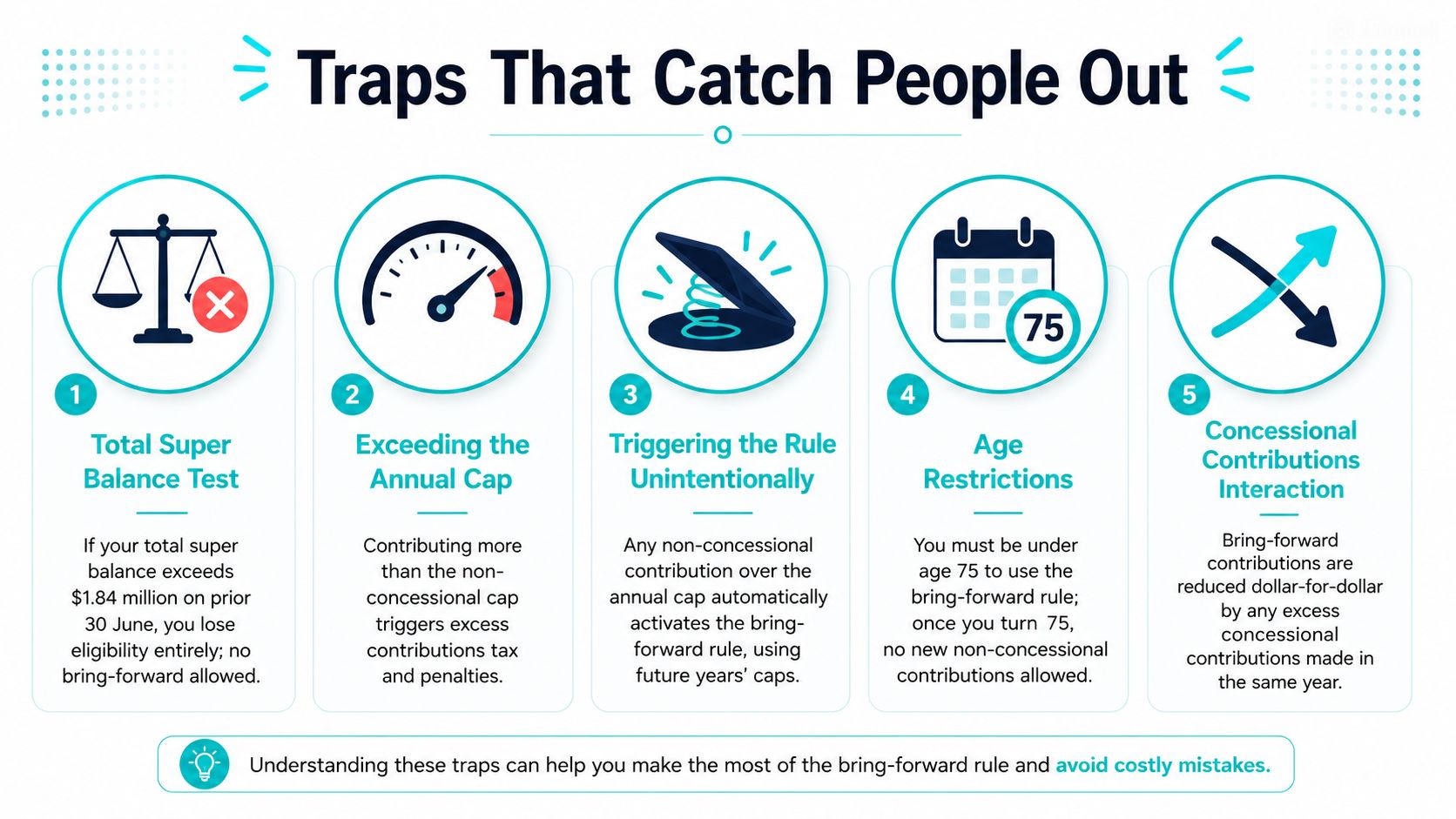
Traps That Catch People Out
The most expensive mistakes happen before the contribution arrives in the fund. Clients often focus on the amount they want to transfer and forget that the ATO applies eligibility, timing and contribution-history tests together.
Five checks I insist on
Prior 30 June balance: If your total super balance was at or above the relevant threshold on the prior 30 June, you may lose access to the bring-forward arrangement. For 2026–27, the full three-year arrangement requires a balance below $1.84 million, as set out in the ATO contribution caps and limits guidance.
Exceeding the available cap: Contributing more than your available non-concessional cap can create an excess contributions issue. Excess amounts may attract additional tax treatment, and the ATO's determination and release process needs prompt attention.
Re-contribution history: Money previously associated with a capital gains tax small business concession or a personal injury election can have specific rules. Don't assume that calling a payment “after-tax money” makes it an ordinary non-concessional contribution.
Incorrect timing records: A contribution received around the end of a financial year can be counted in a different year from the one you intended. That can alter the window and cause unexpected double-counting when a second contribution is made.
Centrelink consequences: Moving a lump sum into super can change the assets Centrelink assesses, along with the treatment of financial investments under deeming rules. For someone receiving or approaching the Age Pension, the super decision needs to be modelled with the broader household position, not just the fund balance.
The age rule deserves its own warning. The ATO's current position is that the bring-forward age restriction is under 75, so clients approaching that point shouldn't delay a contribution decision without checking the exact timing and eligibility circumstances.
If an excess has already occurred, act quickly. Review the fund records, keep the ATO correspondence, confirm the associated earnings treatment and obtain advice before choosing whether to release the excess or take another permitted pathway. Waiting can reduce your options and make the problem harder to unwind.
Your Planning Checklist Before You Contribute
Run this checklist before making the transfer. The order matters because the financial plumbing should be confirmed before the money moves.
Confirm the balance date. Download your latest super information from myGov or your fund's member portal, then verify the total super balance at 30 June of the previous financial year. Include every relevant super interest, not just the account you plan to pay into.
Choose the window. Decide whether the one-year, two-year or three-year arrangement matches the lump-sum size and your likely future balance. A smaller window can preserve flexibility, while a longer window may suit a genuine retirement top-up.
Check age and fund acceptance. Confirm you're under 75 and ask the fund whether it accepts non-concessional contributions, particularly where a transition-to-retirement or pension arrangement is active. Don't rely on an old fund instruction.
Record the contribution date. Keep a contribution log so you know exactly when a bring-forward arrangement started and how much capacity remains. The fund's receipt date can matter around financial year-end.
Retain evidence. Save the deposit slip, bank transaction and contribution statement. Those records may become important if you later consider a re-contribution or spouse-splitting strategy.
Model the personal outcome. Decide whether the money belongs in super or should remain taxable and accessible. Include debt, cash reserves, investment income, Age Pension assets and deeming effects where relevant.
For small business owners, broader retirement planning resources can also help you compare super with business and employer benefit decisions. The Duncan & Associates Insurance Brokers guide to choosing a 401(k) plan for a small business is written for a different retirement system, but it provides useful context when reviewing how business structures support long-term retirement planning.
Wealth Collective helps clients test contribution eligibility, select an appropriate bring-forward window and connect the super decision with debt, investment, tax and retirement-income planning. Book an initial call by visiting Wealth Collective, so your contribution amount and timing support the retirement outcome you want.