Business hours
Monday to Friday (8.30AM - 5PM)
Weekend (Closed)



You're in your late fifties, living in Perth, and retirement has stopped feeling like a distant idea. Two super statements sit on the kitchen counter. One balance looks reasonable, the other reflects years of part-time work and career breaks. You're wondering whether the money can support the life you want, when you can access it, and how to turn it into income without spending too quickly.
That uncertainty is normal. Superannuation retirement planning isn't only about building the largest possible balance. It's also about deciding when to contribute, how to invest, when to start drawing, how super interacts with the Age Pension, and how to protect both partners if their balances are different.
Why Super Sits at the Centre of Retirement Planning
Australian retirement income usually comes from three places: superannuation, the Age Pension and voluntary savings outside super. The balance between them varies from household to household, but super often carries the greatest responsibility because it's designed specifically to fund life after work and receives concessional tax treatment inside the fund.
Employer contributions, salary sacrifice and personal deductible contributions generally enter the concessional contribution system. Investment earnings inside a super fund are generally taxed at 15%, rather than at an individual's marginal tax rate. The tax result depends on the contribution type, fund structure and personal circumstances, but the basic reason super matters is clear. It gives Australians a dedicated, tax-advantaged environment for long-term retirement savings.
The size of the system shows how central it has become. Australians held about $4.43 trillion in superannuation assets as of March 2026, and public analysis projects that total could reach around $38 trillion by 2063. These figures are reported in background analysis of superannuation in Australia, and they help explain why retirement decisions increasingly centre on super balance growth, drawdown strategy and contribution timing.
The shift is visible in retirement incomes too. The Australian Bureau of Statistics reported that 28% of retired people said superannuation was their main source of income in 2024–25, up from 20% in 2014–15. The same ABS release recorded 922,000 people receiving a lump sum from a superannuation scheme in 2024–25. Super is no longer just an account you check occasionally. It's a major source of retirement cash flow and a critical access asset.
The three sources of retirement income
A practical plan considers each source together:
- Superannuation: Usually the main asset to structure before and after retirement. The key questions are how much you have, how it's invested and how you'll draw it.
- Age Pension: A government income stream subject to eligibility, income and assets rules. It may supplement super rather than replace it.
- Voluntary savings: Cash, investments, property income and other assets can help fund the years before super access or provide flexibility around larger expenses.
The lifestyle target matters as much as the balance. The ASFA Retirement Standard commonly used in Australian planning places a comfortable lifestyle at around $73,000 a year for a couple and roughly $51,000 for a single retiree. Those figures are useful reference points, not personal guarantees. Your Fremantle mortgage, regional travel plans, health costs and support for adult children may produce a very different target.
Practical rule: A retirement balance only becomes meaningful after you connect it to the annual income you want and the years that income may need to last.
The final years before retirement deserve careful attention because contribution timing, investment risk and tax treatment have a larger effect on a balance that's already substantial. If you're still unclear about fund structures, the guide to how superannuation works in Australia provides a useful foundation. For broader context on pension structures and tax treatment, you can also review pension plan types and tax rules.
How Superannuation Rules Actually Shape Your Choices
Super rules create the timetable for your retirement. They determine when preserved benefits can usually be accessed, when the Age Pension may become available, and how much can move into the retirement phase.
The first date is your preservation age. It's now 60 for everyone, although older Australians may have been subject to lower preservation ages during the transition. The transition has finished, so those approaching retirement today should plan around access from age 60, provided they meet a condition of release. The preservation-age explanation from AMP sets out why this rule matters.
The second date is the Age Pension age, currently 67. That creates a potential gap between finishing full-time work and becoming eligible to claim the government pension. ABS data shows that retirees' average retirement age was 57.3 years in 2024–25, while the average age of people aged 45 and over who retired during the year was 63.8 years. The gap means your plan may need to fund a period using cash, investments, part-time work or accessible super.
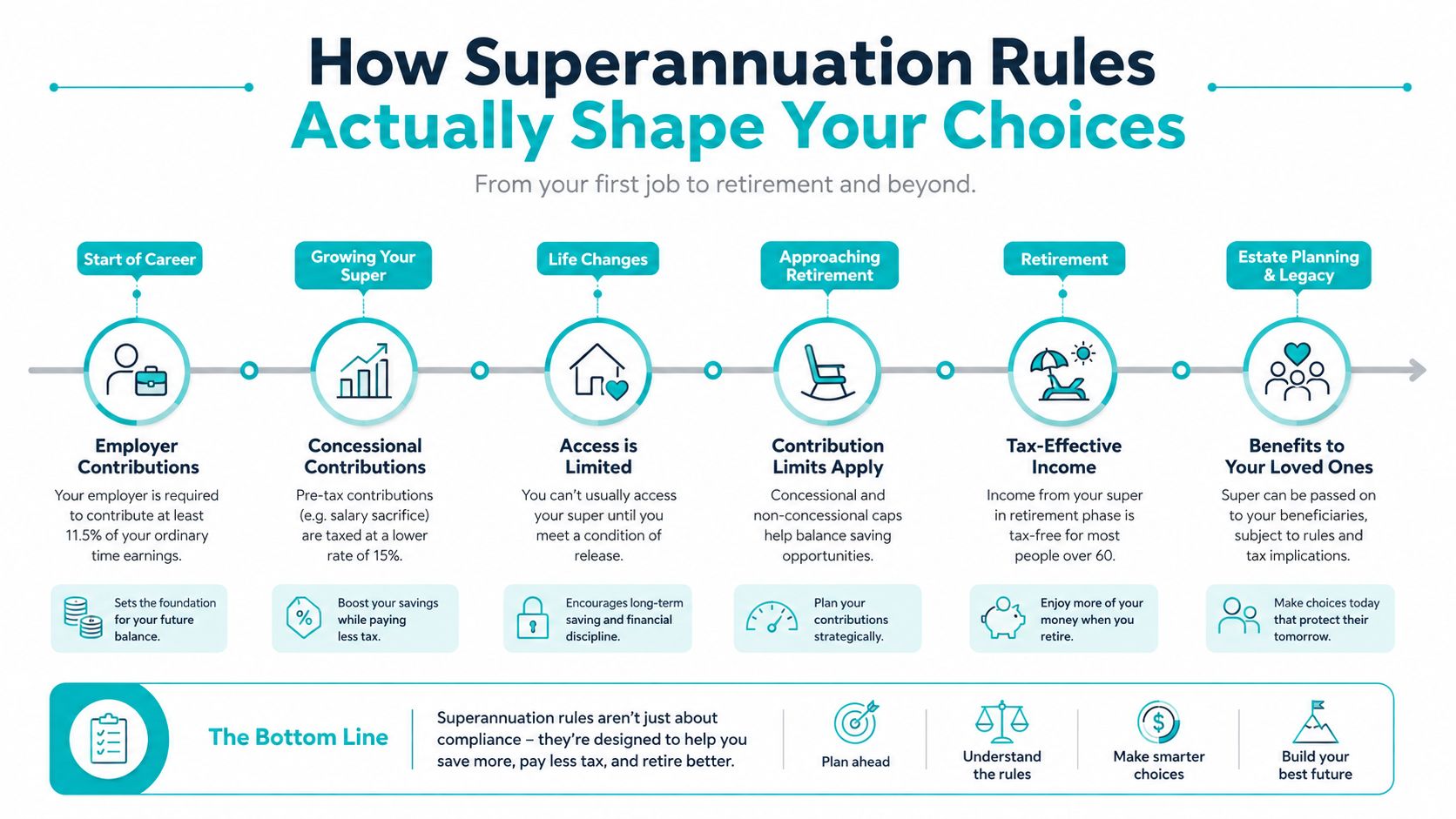
Three rules to place on your timeline
Preservation age sets the earliest practical access point. Reaching the age alone doesn't automatically make every withdrawal available. Your employment status and the relevant condition of release still matter.
Age Pension age sets a separate government milestone. Access to super and eligibility for the Age Pension are different tests. A person may be able to draw super before qualifying for the Age Pension.
Drawdown rules affect the income you must take. Once you start an account-based pension, legislated minimum withdrawals apply. For retirees under 65, the minimum rate starts at 4% and increases with age, as outlined in this Australian retirement planning guide.
These rules interact. Someone leaving work at 58 might need outside-super savings first, then access preserved super after meeting the relevant release condition. Someone retiring after 60 may have more flexibility, but still needs to decide whether to take a lump sum, commence an account-based pension or combine super income with part-time work.
The transfer balance cap is another important boundary. From 1 July 2026, the general transfer balance cap is $2.1 million, which limits how much can be transferred into the retirement phase. The ATO's key superannuation rates and thresholds should be checked when planning a pension commencement, because caps and thresholds can change.
Contribution Strategies That Move the Needle
At 45, an extra $5,000 can be directed into super rather than paid as cash. That choice may strengthen retirement savings, but it also reduces money available for current expenses. Contribution planning therefore starts with household cash flow, then considers tax position, account balances and future withdrawals.
Concessional contributions are before-tax amounts, including employer Superannuation Guarantee payments, salary sacrifice and personal contributions claimed as a tax deduction. From 1 July 2026, the general concessional cap is $32,500, compared with $30,000 from 1 July 2024 to 30 June 2026, under the ATO concessional contributions cap rules. Amounts within the cap are generally taxed at 15% in the fund, with exceptions and additional tax applying to some high-income earners.
Non-concessional contributions generally come from after-tax money. From 1 July 2026, the standard cap is $130,000, while the cap is $0 when total super balance is $2.1 million or more at 30 June 2026. Check the current contribution cap guidance before moving savings into super or considering a bring-forward arrangement.
Match the lever to the household
| Contribution type | 2025/26 cap | Tax treatment |
|---|---|---|
| Concessional contributions | $30,000 | Generally taxed at 15% in the fund |
| Non-concessional contributions | $120,000 | Generally made from after-tax money |
| Spouse contributions | Included within relevant contribution limits | May support a spouse tax offset, subject to eligibility |
| Carry-forward concessional contributions | Unused amounts from eligible prior years | Available where total super balance conditions are met |
The 2025/26 figures differ from the changes applying from 1 July 2026. If unused concessional capacity remains from the previous five years and total super balance is under $500,000, carry-forward rules may permit a larger deductible or salary-sacrifice contribution. The guide to carry-forward concessional contributions explains how those unused amounts can be applied.
A spouse contribution may suit a household where one partner has taken time away from paid work or earns little income. It can distribute retirement savings more evenly between two accounts and may support tax concessions, subject to eligibility. Both partners' caps and balances need checking before contributing.
Salary sacrifice works like redirecting part of a pay packet before it reaches your bank account. For the 45-year-old earning $110,000, directing an additional $5,000 to super means that amount enters the fund before personal income tax and then incurs contributions tax there. Taking it as cash provides greater short-term flexibility, while leaving less available for long-term investment after tax.
The final balance difference depends on investment returns, fees, contribution timing, employment and future withdrawals. A sound comparison models those variables rather than promising an outcome. Through Wealth Collective's Retirement Roadmap process, the practical test is whether the contribution supports the income the household will need later without creating a cash-flow problem now.
Investment Options and How to Think About Risk
Super funds usually offer a menu that includes cash, fixed interest, Australian shares, international shares, property and diversified options such as balanced portfolios. Each option combines income, growth potential, liquidity and volatility differently.
Cash and fixed interest are defensive assets. They're generally used to reduce portfolio fluctuations and provide stability, although they may produce less long-term growth than shares or property. Australian and international shares, along with property, are growth assets. Their values can move sharply, but they're often used when an investor has enough time to tolerate market cycles.
| Option | Risk level | Typical role |
|---|---|---|
| Cash | Lower investment volatility | Liquidity and capital stability |
| Fixed interest | Lower to moderate | Defensive diversification |
| Australian shares | Higher | Long-term growth exposure |
| International shares | Higher | Geographic diversification and growth |
| Property | Moderate to higher | Growth and income diversification |
| Balanced or diversified | Varies | Mix of growth and defensive assets |
A $200,000 balance split 70% into growth assets and 30% into defensive assets has a different experience from the same balance split 50/50. The first allocation has more exposure to market movements, while the second gives defensive assets a larger role. Neither produces a guaranteed outcome, and no responsible comparison can calculate a future dollar balance without agreed assumptions about returns, fees and inflation.
Use time, not headlines
A long runway may allow a person to hold more growth exposure, provided they can stay invested during falls. As retirement approaches, some investors use a glide path, gradually reducing growth exposure and building a pool for near-term withdrawals. The right path depends on the retirement date, other assets, expected Age Pension income and the person's emotional response to volatility.
Chasing last year's top-performing option creates a different risk. It encourages investors to buy after strong returns and switch after a fall, often turning a long-term allocation decision into a reaction to recent headlines.
Your investment mix should answer a retirement question, not a performance-ranking question.
Transition to Retirement in Practice
A 58-year-old Perth professional earning $110,000 is considering reducing work hours. The person wants more time, but the lower salary makes the decision feel uncomfortable. A transition-to-retirement strategy may combine a pension income with salary sacrifice, allowing the person to reshape work without immediately abandoning super contributions.
The strategy could involve starting a TTR pension after reaching preservation age, salary sacrificing an additional $10,000, and using pension payments to replace part of the reduced wage. The $10,000 contribution may receive concessional tax treatment inside super, while the pension provides cash flow. The exact benefit depends on the person's age, fund, taxable income, contribution cap, pension balance and employment arrangement.
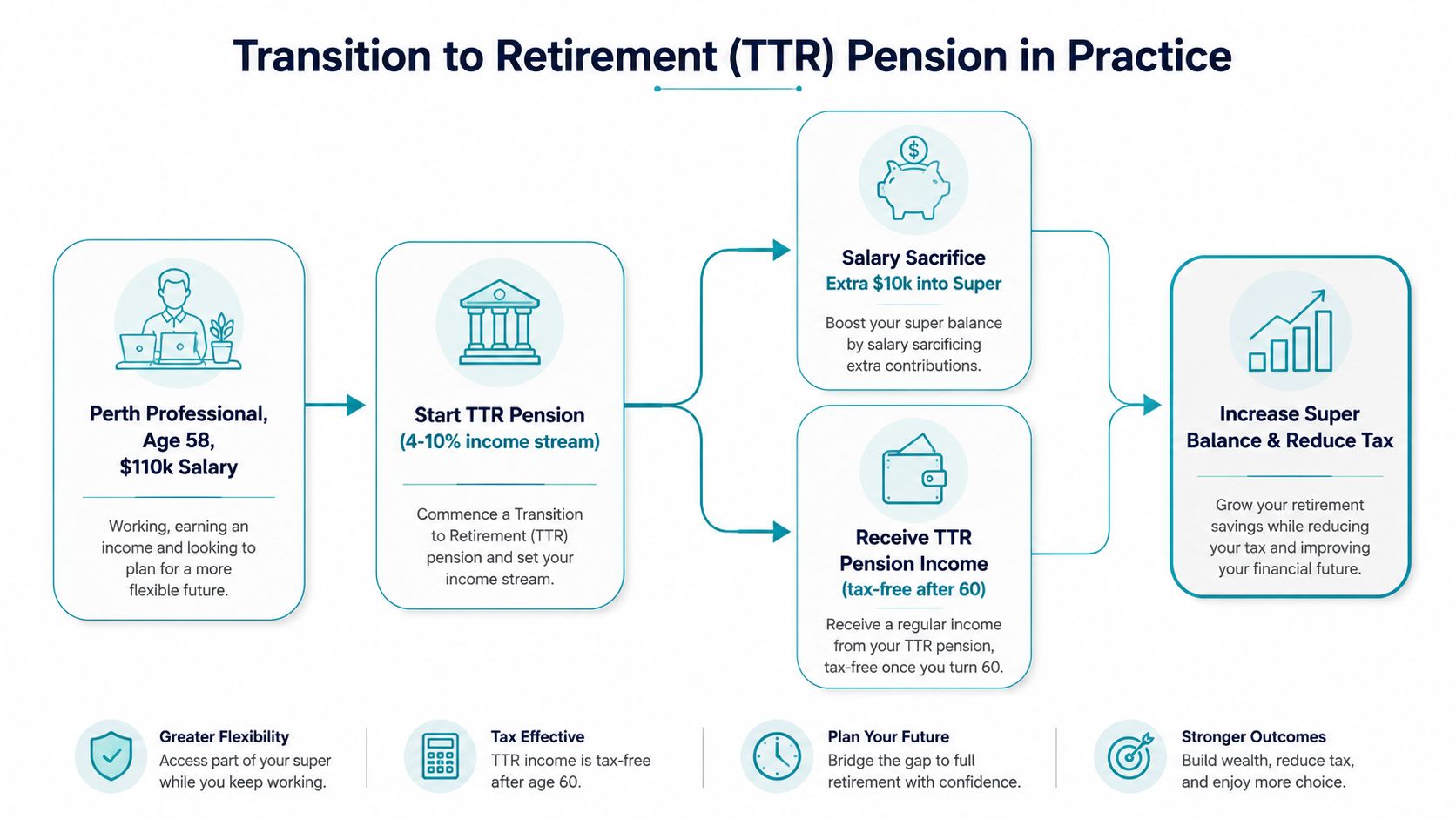
What the numbers don't decide
A TTR pension must generally pay between 4% and 10% of the account balance each year, subject to the applicable rules. Before age 60, pension payments may have different tax treatment from payments after age 60. Once a member is 60 or over, benefits from a taxed super fund are generally tax-free when paid as a lump sum or pension, as described in this guide to transition-to-retirement pensions.
Investment earnings inside the TTR environment also need careful consideration. The strategy may reduce tax on earnings compared with accumulation treatment in some circumstances, but the result depends on the pension structure and current legislation. The pension balance must also support the required payments, so drawing too much can undermine the purpose of building retirement income.
TTR often makes most sense when someone is still working, wants to reduce hours and can use the income stream without increasing lifestyle spending. It may make less sense after full retirement, when an ordinary account-based pension may better reflect the person's access and tax position.
A representative example isn't a recommendation. The adviser needs to test whether the salary-sacrifice contribution fits within the cap, whether the pension payments replace the intended income, and whether the strategy still works if markets fall or retirement happens earlier than expected.
Turning Super Into a Reliable Retirement Income
Accumulation asks how large your super balance can become. Decumulation asks how that balance can provide dependable income without running out too soon. A strong retirement plan must address both. The change from saving to spending is less like switching off a tap and more like managing a tank: withdrawals, investment returns and the length of retirement all affect how long the money lasts.
An account-based pension turns super into an income stream. You select an investment strategy and withdraw at least the legislated minimum, while retaining flexibility to take more when needed. For retirees under 65, the minimum drawdown rate starts at 4% and rises with age. Payments can be regular, but the remaining balance still moves with markets and must support an uncertain lifespan.
From 1 July 2026, the general transfer balance cap is $2.1 million. This generally limits how much can move into retirement phase. Amounts above the cap may stay in accumulation or be managed through another permitted structure. Pension commencement, contributions and timing therefore need to be considered together.
Build the income in layers
A practical retirement income plan may combine:
- Account-based pension payments, matched to essential and discretionary spending.
- Age Pension income, assessed under the relevant income and assets rules.
- Cash reserves, for known expenses or periods of market stress.
- Other investments and property income, where available.
- Annuity income, for people who prefer greater certainty and accept less flexibility.
Each layer has a different job. Pension payments provide control, cash can reduce the need to sell investments after a market fall, and guaranteed income can cover selected ongoing expenses. The right mix depends on spending needs, health, assets and comfort with investment risk.
Account-based pension assets also affect Age Pension assessment. Centrelink applies deeming rules to financial assets, using set rates rather than the return the portfolio achieves. As a result, the account may influence both the income test and the amount withdrawn, even when investment performance differs from the deemed rate.
Balance comparisons offer context, not a retirement target. APRA statistics published by Moneysmart show average super balances of $263,400 for ages 60–64, $285,800 for ages 65–69 and $308,600 for ages 70–74, based on December 2025 data in the Moneysmart retirement-income framework. Those averages exclude the effects of housing, debt, health, dependants and Age Pension eligibility.
Women often retire with less super because of interrupted employment, caring responsibilities and different lifetime earnings. Australian women are retiring with about a third less super than men, with the gap reaching about 33% for the 50s cohort and around 25% for the early 60s cohort, as discussed in this analysis of retirement outcomes for women. Couples should review each person's account, not only their combined balance. For WA households using Wealth Collective's Retirement Roadmap, this means testing spending, withdrawals and income layers together before choosing a pension structure.
The central decumulation decision: Spend enough to enjoy retirement, while setting withdrawals so a poor market period, longer life or unexpected expense does not force a major lifestyle change.
Your Next Steps and the Retirement Roadmap
A useful plan turns broad concern into dated actions. Over the next twelve months, review the decisions that can change your retirement outcome rather than checking the balance without context.
Check contributions against the relevant caps. Include employer contributions, salary sacrifice and personal deductible contributions. The caps applying from 1 July 2026 include a $32,500 concessional cap, a $130,000 non-concessional cap, and a $2.1 million general transfer balance cap, according to the relevant ATO superannuation thresholds.
Review your investment option against your timeline. Compare your current allocation with the year you expect to stop work, the income you'll need and your other assets. Don't switch solely because another option recently performed better.
Model a TTR or retirement-income scenario. Test reduced hours, pension payments, cash reserves and Age Pension timing together. A projection should show what happens under different market and retirement-date conditions.
Review beneficiaries and account ownership. Check nominated beneficiaries, binding nominations where appropriate, and whether the lower-balance partner has adequate protection.
Request an Age Pension estimate. Services Australia can provide information about eligibility and assessment. Treat the estimate as one part of the plan, not the entire strategy.
Prepare questions for an adviser. Ask how your super will become income, how much you need to draw, how the plan handles market falls, and what happens if one partner retires earlier.
Retirement rules, contribution caps and Age Pension means-test thresholds can change, so revisit the plan after major legislation, tax or family changes. A written Retirement Roadmap can connect accumulation, decumulation and government benefits into one sequence instead of leaving each decision in a separate product conversation.
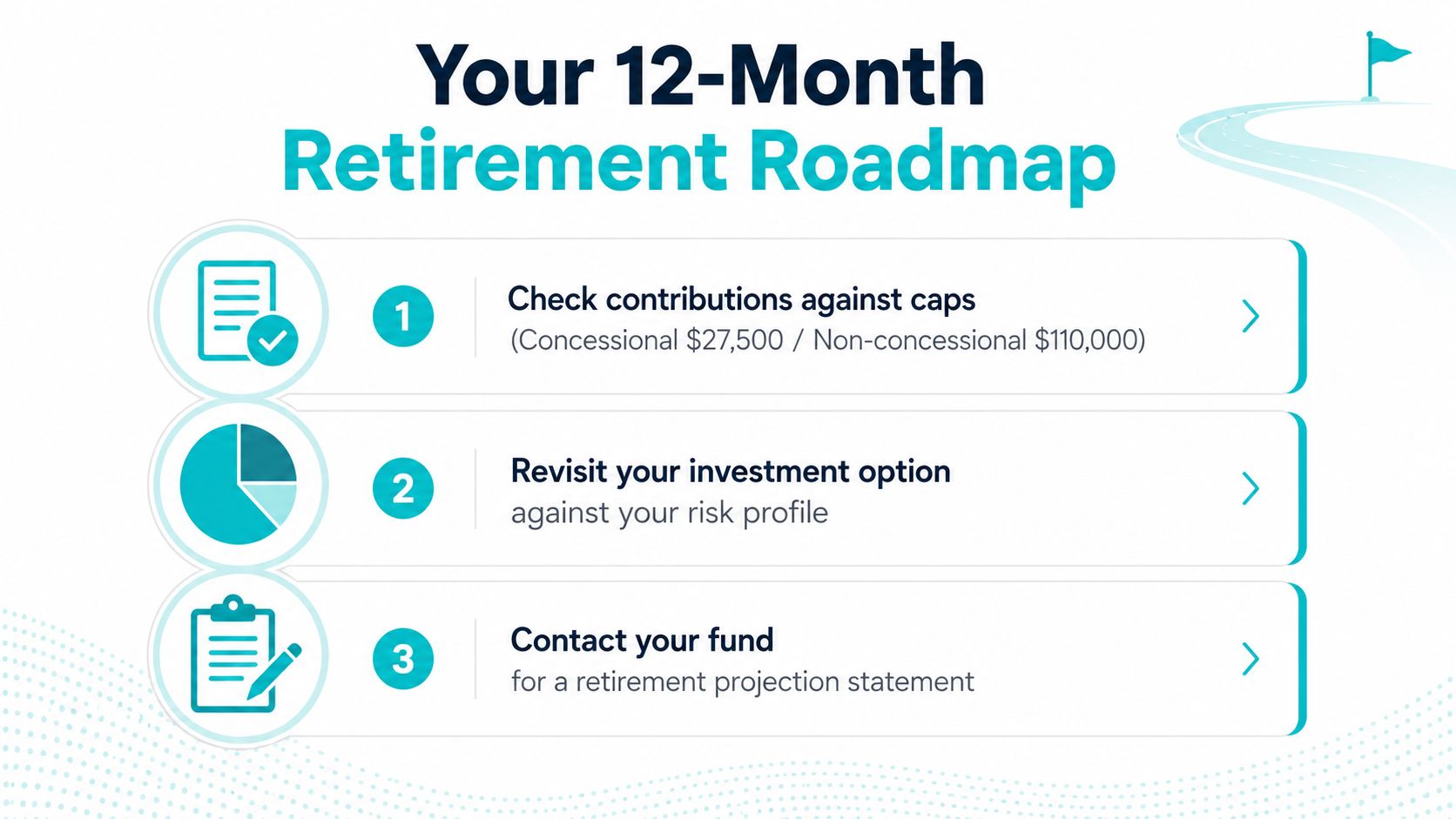
Wealth Collective's Retirement Roadmap process can compare your current super fund with other options, consider fees and investment settings, and help structure super into a regular, tax-effective income stream such as an account-based pension. It's designed for Australians in Perth, Dunsborough and beyond who want a clear sequence of decisions, so book a free introductory call through Wealth Collective to discuss your retirement plan.