Business hours
Monday to Friday (8.30AM - 5PM)
Weekend (Closed)


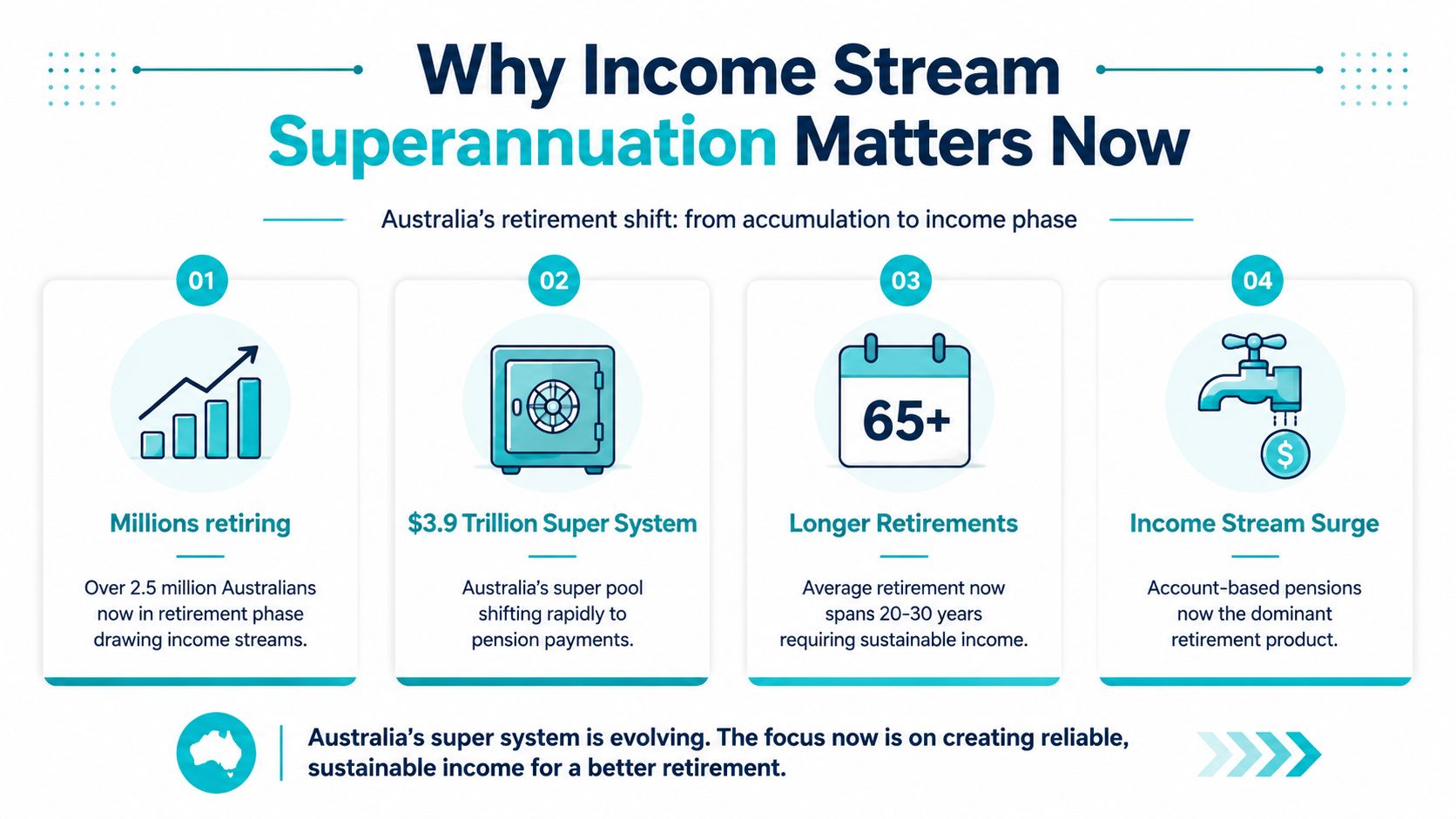
Australia's superannuation system is moving decisively from saving money to paying it out. Treasury says 1.6 million Australians aged 65 and over currently receive income from a superannuation product, while an estimated 2.5 million Australians will move from accumulation into retirement phase over the next 10 years. Treasury's retirement withdrawal guidance shows why income stream superannuation deserves more than a product comparison. The timing of commencement can affect your tax position, Centrelink assessment, investment flexibility and access to the Age Pension.
For a pre-retiree, the central question isn't, “Should I start a pension?” It's, “What happens if I start it now, rather than later?” The right answer depends on your age, work status, spending needs, super balance, other assets and proximity to Age Pension eligibility.
Why Income Stream Superannuation Matters Now
Treasury projects that superannuation drawdowns will rise from 2.4% of GDP in 2022–23 to 5.6% of GDP by 2062–63. The ATO's explanation of the retirement phase defines this phase as the point when a person starts drawing super as an income stream or lump sum. The implication is clear: super is becoming a major retirement income source, so commencement timing deserves careful planning.
ASFA reports that superannuation income payments reached $59 billion in 2021–22, exceeding annual Age Pension expenditure of around $51 billion that year. Its ASFA retirement income research also states that super is materially improving retirement incomes for nearly 2 million retired Australians. The research records 320,230 members receiving income stream payments at an average of $47,600 a year, while super benefit outflows total around $30 billion per quarter.
What the decision means for you
An income stream converts some or all of your accumulated super into scheduled payments. You set payment rules, investment settings and reporting arrangements instead of holding the balance solely for occasional withdrawals.
The commencement date is the part that requires judgement. Starting too early can change how Centrelink assesses your financial position and may bring the account into retirement phase before you need the income. Starting later can preserve flexibility, but it may delay access to retirement-phase treatment. The amount transferred also counts toward the transfer balance cap, so a rushed conversion can limit how much you later move into retirement phase.
The practical point: starting an income stream is a financial decision with a commencement date, not just an administrative conversion.
Model the timing against your spending needs, employment income and likely Age Pension position. Compare projected income with the ASFA retirement standard to identify whether you need a modest supplement, a dependable income floor or flexible withdrawals. Then test the tax, Centrelink and transfer balance cap consequences before commencing.
Types of Superannuation Income Streams Explained
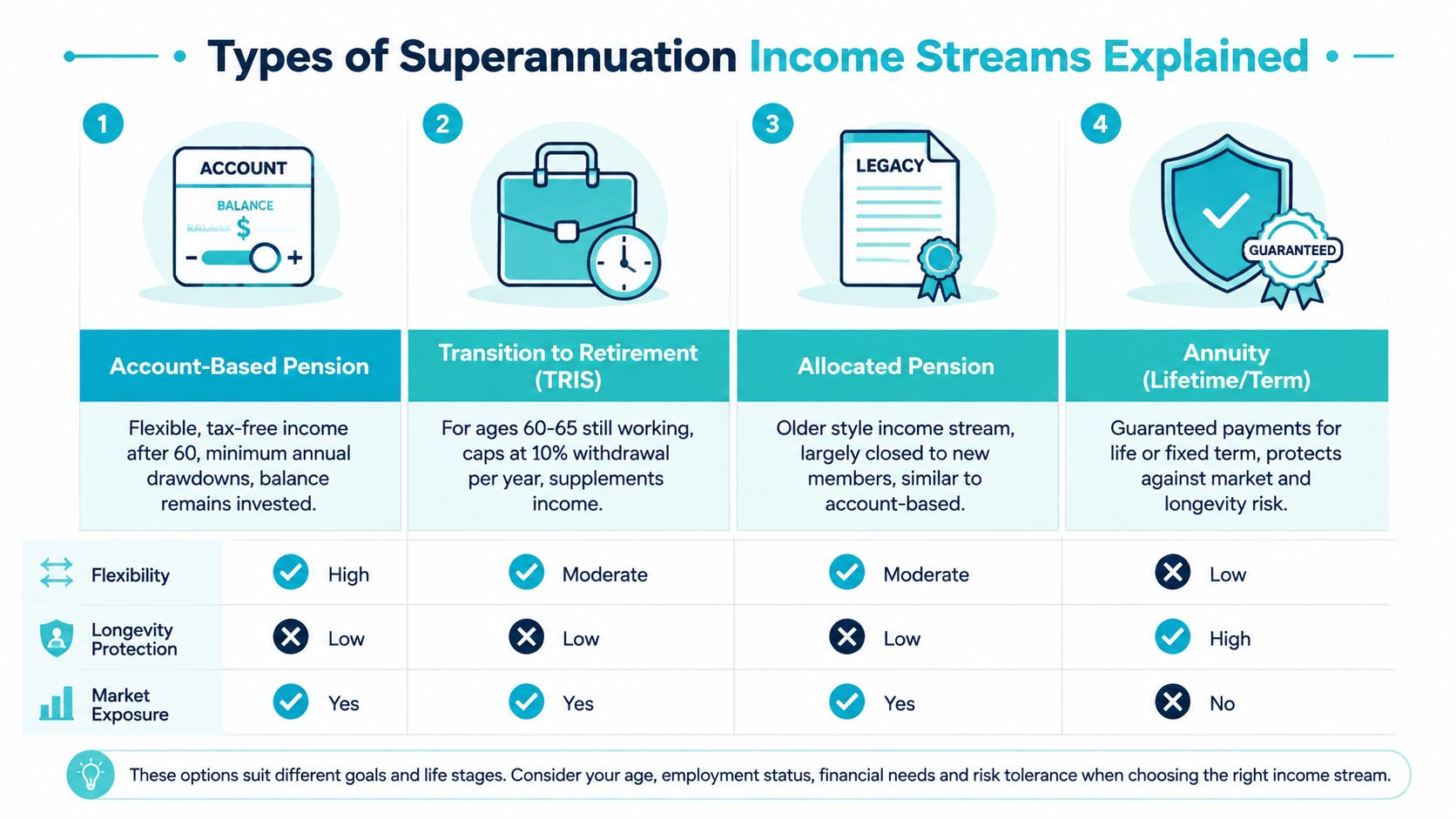
The right income stream depends on the trade-off you accept between flexibility, certainty, investment exposure and longevity protection. The commencement date matters just as much as the product. Start before you need the payments, and the account may affect your Age Pension means test sooner. Transfer too much into retirement phase, and you may use more of your transfer balance cap than intended.
Account-based pensions
An account-based pension is the usual choice for retirees who want control. You transfer an eligible super balance into a pension account, select an investment strategy and draw payments according to your cash-flow needs. The balance remains exposed to investment performance, so it can rise or fall, while withdrawals reduce the capital available for later income.
This option suits someone with other secure income, tolerance for market movements or a wish to retain access to capital for beneficiaries. You control the payment amount and investment settings, but you must meet the applicable minimum drawdown requirements. The amount moved into retirement phase also counts toward your transfer balance cap, so confirm the available space before commencing.
Starting an account-based pension can also change how Centrelink assesses your financial position. Test the timing against employment income, spending needs and your likely Age Pension entitlement rather than treating conversion as routine administration.
Transition-to-retirement income streams
A transition-to-retirement income stream, or TRIS, is intended for someone who has reached the relevant access point but continues working. It can supplement wages while you reduce work hours, helping maintain household cash flow. Its rules are more restricted than those for a full retirement-phase pension.
Annual TRIS payments are capped at 10% of the account balance, as set out in ATO guidance for superannuation professionals. Treat it as a controlled planning tool, not unrestricted access to super. Match the payment level to your wages, contribution strategy, intended retirement date and Age Pension plans.
Allocated pensions
Allocated pensions are an older income stream and are largely closed to new members. If you already hold one, review its specific terms and tax treatment instead of assuming they match a modern account-based pension. Similar names do not guarantee identical rules or product features.
Annuities
An annuity exchanges a lump sum for guaranteed payments over a fixed term or for life. It reduces exposure to market volatility and the risk of outliving your savings, but usually provides less access to capital and less control than an account-based pension.
An annuity can suit someone who wants certainty for essential expenses. A blended structure may work better, with guaranteed income covering core costs and an account-based pension funding discretionary spending. Check access conditions, alternative investments and the effect on Centrelink before committing.
For a practical comparison of structures, payment features and planning considerations, read Wealth Collective's retirement income stream guide.
Drawdown Rules and Tax Implications You Must Know
An account-based pension requires an annual minimum withdrawal. The amount is calculated from your pension balance at 1 July and your age, under the retirement income stream rules outlined in Treasury's review of retirement income streams. Review the account-based pension rules explained before setting your payment schedule.
Minimum drawdown rates by age
| Age Group | Minimum Drawdown Rate |
|---|---|
| Under 65 | 4% |
| 65 to 74 | 5% |
| 75 to 79 | 6% |
| 80 to 84 | 7% |
| 85 to 89 | 9% |
| 90 to 94 | 11% |
| 95 or over | 14% |
These percentages apply to the relevant pension account balance. For example, a $600,000 balance at 1 July for someone aged 65 to 74 produces a $30,000 minimum withdrawal, based on the 5% rate. This example is not a personal payment recommendation. Commencement timing and your fund's administration process can affect the first-year calculation, so confirm the required amount before the financial year closes.
Missing the minimum payment can jeopardise the pension's intended tax treatment. Schedule the withdrawal and check that it has been processed.
Tax offsets and the transfer balance cap
Eligible income from an Australian super income stream may receive a tax offset equal to 15% of the taxed element and 10% of the untaxed element, subject to annual caps. For 2025–26, the maximum tax offset is generally $12,500. The maximum rises to $13,125 in 2026–27, according to The ATO's supporting information for superannuation income stream tax tables.
The transfer balance cap governs how much can move into retirement phase, not how much you must withdraw each year. From 1 July 2025, the general cap is $2 million per person across all retirement-phase pensions, rather than applying separately to each account. Amounts above the cap remain in accumulation phase, where earnings continue to be taxed at 15%, as explained in The transfer balance cap explanation from Colonial First State.
Commencement timing therefore affects more than cash flow. Starting earlier may create regular income and tax offset access, while using cap space sooner can restrict later pension transfers. Starting later may preserve that cap space, but delays pension payments. Model the commencement date, annual withdrawals, tax components and available cap space together before converting super.
The Centrelink and Age Pension Interaction Most People Miss
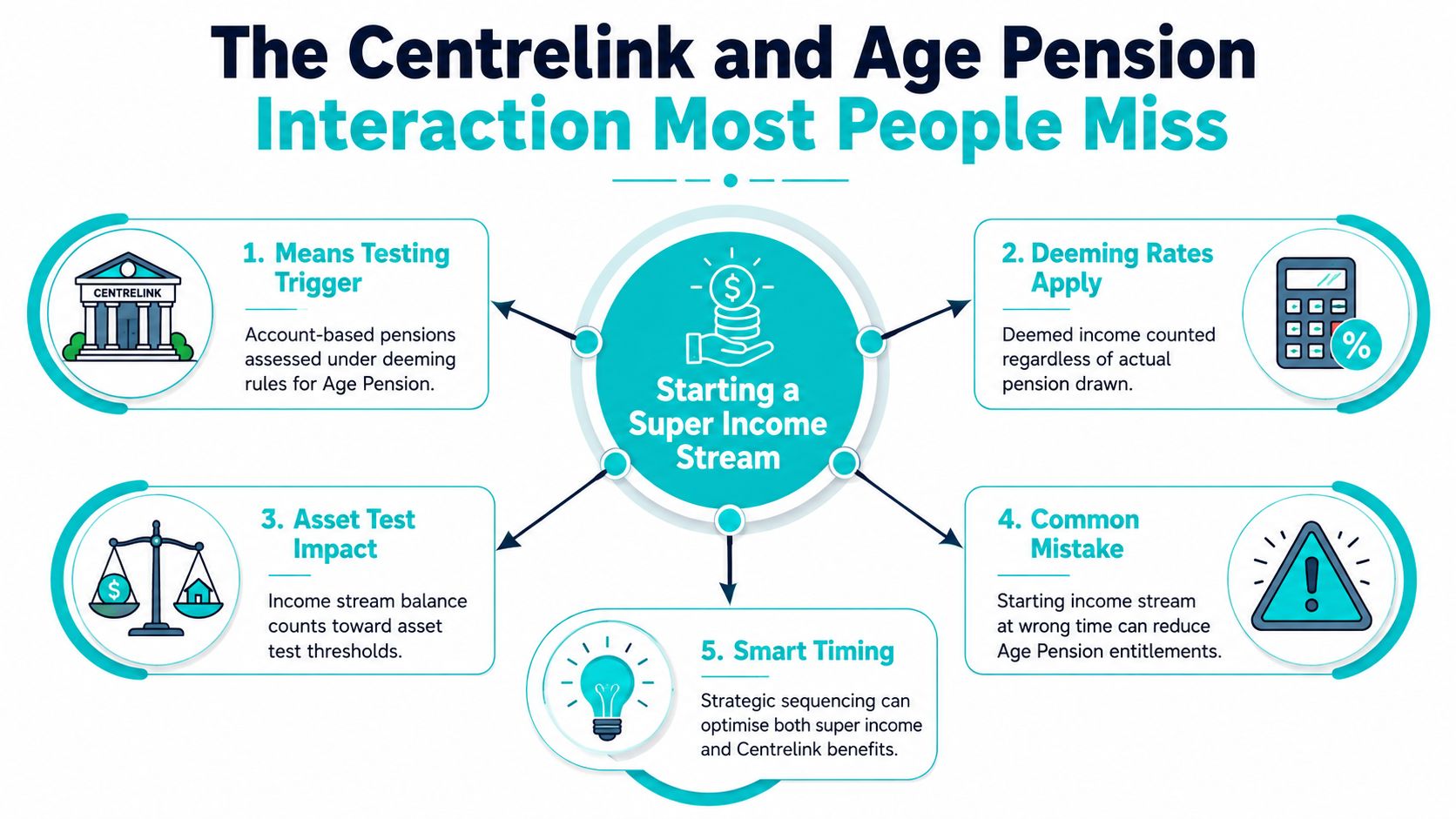
A pre-retiree with $400,000 in super may assume moving to a pension automatically improves Age Pension eligibility. The assessment can change as soon as the income stream commences, so the commencement date deserves the same attention as the investment choice.
Government guidance says super is generally treated differently for the Age Pension income and assets tests before a fund starts paying a superannuation pension. Once payments begin, the account is assessed as an income stream and may also affect deeming-based income treatment. Services Australia's superannuation guidance explains this distinction.
Why commencement timing changes the result
Before commencement, super may receive different Centrelink treatment from a pension account. After commencement, both the balance and income treatment can change. Starting earlier may improve regular cash flow and provide access to the applicable super income stream tax offset, but the new income stream may become assessable under means-testing and deeming rules.
That trade-off also interacts with the transfer balance cap. Commencing a pension uses retirement-phase cap space, which can limit later transfers even if the Age Pension outcome looks favourable. Delaying commencement may preserve cap space and a different Centrelink assessment, but it can leave you funding spending from another source.
Your household position determines the result. Centrelink may consider your partner's circumstances, employment income, financial assets, home ownership, payment selection and commencement date. A strategy that improves after-tax cash flow can reduce Age Pension entitlement, while a delay can preserve eligibility but postpone pension payments.
Avoiding the common trap
Starting a pension because retirement has begun is not a strategy. Delaying it solely to protect Centrelink benefits is no better. Compare both paths using the income you need to spend, the expected Age Pension, the tax treatment and the cap space each commencement date consumes.
Timing should be modelled, not guessed. The commencement date can change your super treatment, Age Pension assessment and access to future retirement-phase transfers.
Before lodging paperwork, ask an adviser to model the cash flow, tax and Centrelink results under different commencement dates. The recommendation should identify which assumptions drive the outcome, including household assets and required withdrawals. A poorly sequenced arrangement can create unnecessary complexity if you later need to restructure it.
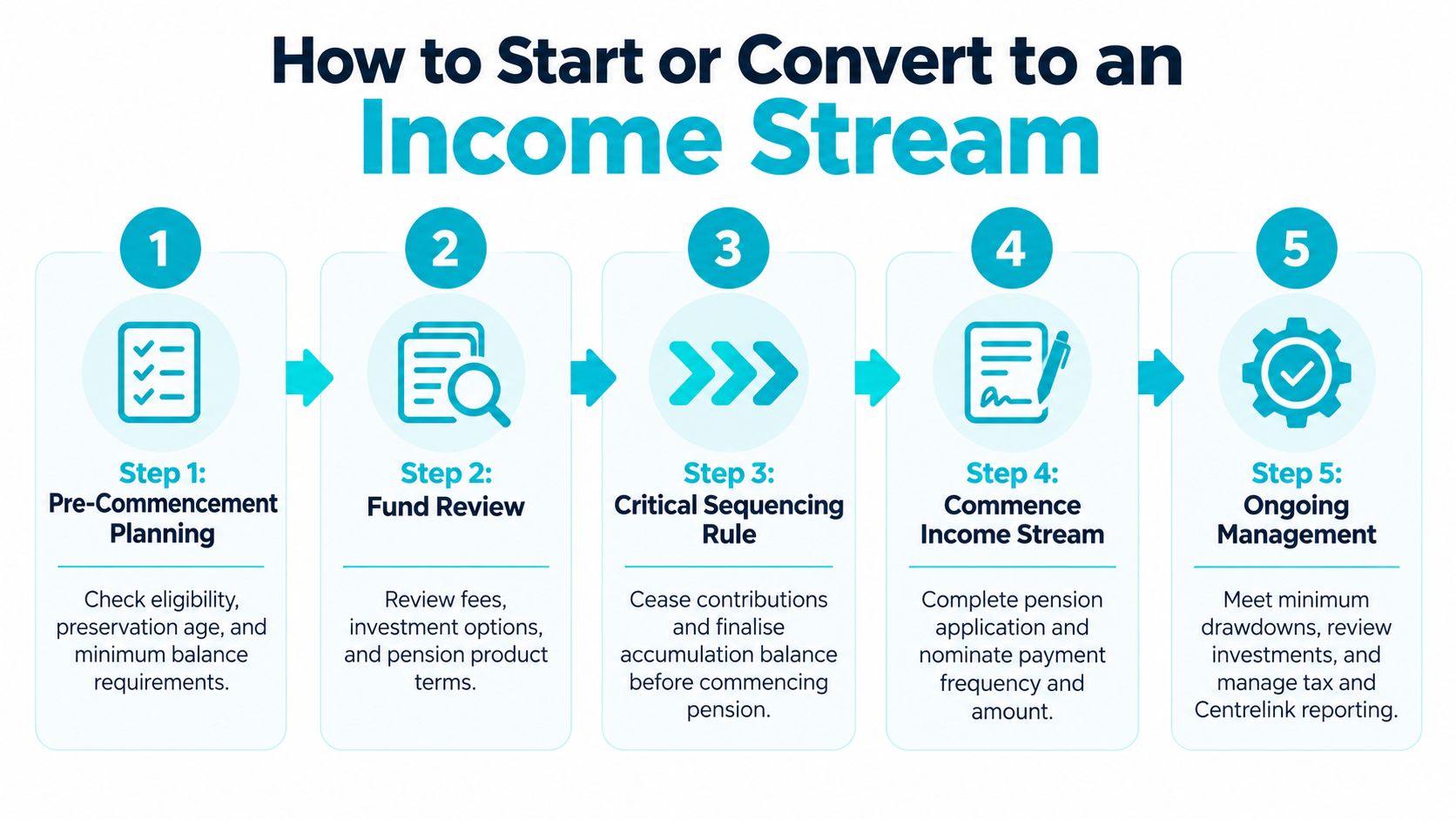
How to Start or Convert to an Income Stream
Starting an income stream is easy only after the decisions are settled. The application is usually routine. The main effort lies in choosing what to transfer, selecting the commencement date, and completing each prerequisite in the right order.
Start with the balance sheet
List every super account, contribution arrangement, investment option and insurance feature. Confirm whether employer or personal contributions are still expected, whether consolidation would remove duplicated fees, and whether a defined benefit or legacy pension needs specialist advice.
Check your eligibility and condition of release before submitting an application. Your fund will set its own requirements, including forms, identification, payment nominations and investment instructions.
Sequence the conversion carefully
Once an income stream starts, the capital supporting it generally cannot be topped up with new contributions or rollovers. ATO guidance for APRA-regulated funds sets out the payment structure and the restriction on adding capital after commencement.
Complete accumulation-phase contributions, transfers and consolidation before commencing the pension. An expected employer contribution can make an immediate commencement poorly timed. The date also affects retirement-phase cap space and can change the interaction with Age Pension means testing, so compare the cash flow, Centrelink outcome and transfer balance position before signing.
Complete the operating plan
Set the payment frequency and amount, choose the investment mix, and nominate the account receiving payments. Your fund or SMSF must record the commencement date, opening balance and pension type accurately. Transfer balance cap reporting applies where relevant.
After commencement, review the account regularly. Confirm the minimum payment has been met, check that investment risk still suits your spending horizon, and update Centrelink details when assessable circumstances change. An income stream requires ongoing oversight, not a set-and-forget approach.
Choosing the Right Income Stream for Your Situation
Your age and employment status narrow the options, but they don't make the decision for you. Start with the question, “What job must this money perform?” Income replacement, flexibility, protection from market falls and lifetime certainty are different jobs.
If you're still working
A 60-year-old who wants to reduce working hours may consider a TRIS. The income can supplement reduced wages, but the 10% annual payment cap limits how much can be accessed. The strategy should be tested against ongoing contributions, salary sacrifice arrangements, tax and the point at which the pension becomes a retirement-phase arrangement.
If you're still accumulating super, don't convert the entire balance automatically. Keeping some money in accumulation may preserve contribution flexibility, while a carefully sized TRIS provides the cash flow you need.
If you're fully retired
A 67-year-old couple may favour account-based pensions for control over payments and investments. But the right answer still depends on their essential spending, other assets, Centrelink position and tolerance for market movement. A minimum drawdown is not necessarily the same as a sustainable spending plan.
You may choose an annuity for core expenses and retain an account-based pension for travel, home improvements or other variable spending. That blend trades some liquidity for greater certainty. If housing debt is part of the retirement equation, a practical explanation of a retirement interest-only mortgage can help you compare housing finance with super withdrawals, although the products and eligibility rules need separate advice.
If certainty is your priority
An annuity deserves attention if the fear of outliving your savings outweighs the desire for unrestricted access. It can provide guaranteed payments for a fixed term or life, but capital access may be more limited than with an account-based pension.
My recommendation is to avoid choosing by label. Compare each option against your spending floor, health, family plans, investment comfort and Age Pension timing. If a decision changes Centrelink treatment, transfer balance cap usage and access to capital, get the modelling completed before you sign the application.
Your Next Steps Toward a Confident Retirement Income
Suppose you're approaching retirement with super in several accounts, a part-time role and a possible Age Pension claim ahead. You could start an income stream immediately, but that may change how Centrelink assesses your assets and income. You could delay, but then you need a clear source for current spending and a plan for completing contributions before commencement.
That is why the best retirement income decisions are sequenced. First, identify the income you need. Next, compare account-based pensions, TRIS arrangements, annuities and any existing pension products. Then model drawdown requirements, tax offsets, transfer balance cap capacity and Centrelink outcomes under realistic commencement dates.
The decision isn't only about maximising income this year. It's about creating a structure that remains workable when markets move, spending changes and your Age Pension circumstances develop. Your plan should also explain who will monitor payments, investment settings, reporting and beneficiary instructions.
Wealth Collective's Retirement Roadmap is designed to organise those decisions into a clear advice process. An award-winning adviser can use an initial conversation to understand your position, identify the key modelling questions and determine whether a full retirement strategy is appropriate. The firm offers a free 10-minute introductory call, which gives you a practical place to start rather than another generic pension checklist.
Wealth Collective helps pre-retirees compare income stream options, sequence commencement, and model the tax, transfer balance cap and Centrelink consequences before decisions are locked in. Visit Wealth Collective to arrange a free 10-minute introductory call and discuss the retirement income questions that matter in your situation.