Business hours
Monday to Friday (8.30AM - 5PM)
Weekend (Closed)


You're probably feeling this already.
Your super balance might still look solid. Your retirement date might still be realistic. But the numbers that once felt comfortably sufficient now look oddly tight when you price groceries, insurance, rates, power, travel and medical costs against them. That's inflation impact on retirement. It rarely arrives as one dramatic event. It shows up as a series of ordinary bills that stop behaving.
Most retirement articles reduce inflation to a single problem: your money buys less. That's true, but it's incomplete. In Australia, inflation also moves the target itself. It changes what “comfortable” retirement costs, shifts super caps and pension settings, and exposes the gap between headline inflation and the categories retirees spend on.
If you're within a decade of retirement, or already drawing from super, this matters now. A plan built on static dollar amounts is a weak plan.
When a Comfortable Retirement Quietly Stops Feeling Comfortable
Margaret retired in Perth a few years ago with what looked like a sensible budget. The plan was straightforward: draw a steady income from super, keep spending organised, and enjoy the freedom she'd worked for. Nothing reckless. Nothing extravagant.
Then the quiet squeeze began. The weekly shop crept up. Power bills became harder to ignore. Insurance renewals landed with numbers that felt out of step with the rest of the household budget. Her income looked the same on paper, but the lifestyle attached to that income had changed.

That's the part many people miss. Retirement plans usually start in nominal dollars, but you live in real purchasing power. If your pension payment or account-based drawdown stays flat while essential expenses rise, you haven't maintained your lifestyle. You've taken a pay cut.
The problem isn't only higher prices
A retiree can feel poorer without any obvious planning mistake. That's because inflation doesn't need to wreck every category at once. It only needs to push up the categories you can't easily avoid.
For most retirees, those pain points are familiar:
- Day-to-day essentials like food, utilities and insurance
- Fixed nominal income from account-based pensions or cash-heavy portfolios
- Super and tax thresholds that shift with inflation and alter decision-making
- Longevity risk because a long retirement gives inflation more time to do damage
A retirement plan fails quietly before it fails obviously.
That's why I'm sceptical whenever someone says, “I just need to hit a certain balance and I'll be fine.” A retirement number on its own doesn't tell you much unless you know what income it can produce, how that income will adjust, and how your spending is likely to behave over time.
If you're still accumulating, stop asking only how much super you need. Ask what kind of retirement income that super can support in real terms. Wealth Collective's guide on how much super you need to retire is a useful starting point, but the bigger issue is whether your target still works after inflation shifts the ground under it.
What Inflation Actually Measures for Australian Retirees
You retire in Perth with a budget that looked sensible on paper. Two years later, groceries, power, council rates, insurance and car costs have all moved, but the headline inflation number on the news says price pressure is easing. That gap matters. Retirement planning goes off course when you use a national average to price a household that spends like a retiree.
The starting point is simple. CPI is broad. Retiree inflation is personal.
The Consumer Price Index tracks price changes across a general household basket. It still matters because governments, analysts and retirement calculators use it as a baseline. But it is not the best stand-alone guide for someone in or near retirement, because retirees usually spend more heavily on categories that are harder to trim and often rise at different speeds from the headline number.
Why retiree inflation often feels worse than reported inflation
The Australian Bureau of Statistics publishes living cost indexes that are closer to retiree spending patterns than CPI. In the June 2026 release, the ABS reported quarterly changes of 0.6% for the Pensioner and Beneficiary LCI and 0.5% for the Age Pensioner LCI in its Selected Living Cost Indexes release.
That is the first point many retirees miss.
The second point is more important. Inflation is not just a threat to purchasing power. It also changes the reference points you plan around. The benchmarks move. The thresholds move. The spending categories that hurt most are not evenly spread across your budget.
A working household might absorb higher prices by cutting discretionary spending. A retiree has less room to play that game if the pressure is coming from food, utilities, insurance, healthcare, transport or housing-related costs. Those are the line items that shape day-to-day comfort.
CPI versus retiree living costs
| Category | CPI weight (%) | Pensioner LCI weight (%) |
|---|---|---|
| Household basket coverage | Broad economy-wide basket | Retiree-oriented spending basket |
| Housing and utilities | Included | Heavily felt in retiree budgets |
| Food | Included | Material spending category |
| Transport | Included | Material spending category |
| Insurance | Included | Material spending category |
| Retiree relevance | General benchmark | Better match for many retirees |
I'm not filling that table with numbers I can't support in this section. The conclusion is clear without pretending to precision. If you use the wrong inflation measure, you set the wrong retirement income target.
That mistake shows up in three places.
First, you can understate how fast your real spending need is rising.
Second, you can misread whether indexed income sources are keeping up with the costs you feel.
Third, and this is something many articles overlook, you can ignore the way inflation reshapes the retirement framework itself. Age Pension settings, super thresholds, caps and transfer decisions do not sit still forever. Inflation changes the numbers around your plan, not just the prices inside it.
Where indexation helps, and where it falls short
Australia does some things properly here. Age Pension increases are designed to reflect cost pressures rather than leaving retirees stuck with flat nominal payments. That helps.
It does not make you inflation-proof.
If your own spending is tilted toward categories rising faster than the relevant index, indexation only covers part of the gap. If you hold too much cash or draw a fixed dollar amount from super without regular review, the shortfall gets larger in practice, even if the statement still looks tidy.
My advice is blunt. Stop asking whether inflation is up or down in the abstract. Work out which prices drive your household, which income sources adjust, which ones do not, and whether your planning assumptions match the version of inflation you are going to live through.
The Long-Term Drag on Income Streams and Nest Eggs
A Perth couple retires at 65 with a neat plan. The mortgage is gone, super is in pension phase, and the first few years feel manageable. Then the squeeze starts. Rates, insurance, repairs, groceries and health costs keep stepping up, while the income they set at retirement barely moves. Nothing looks broken on the statement. Their standard of living still slips.
That is how inflation does the damage in retirement, gradually then all at once.
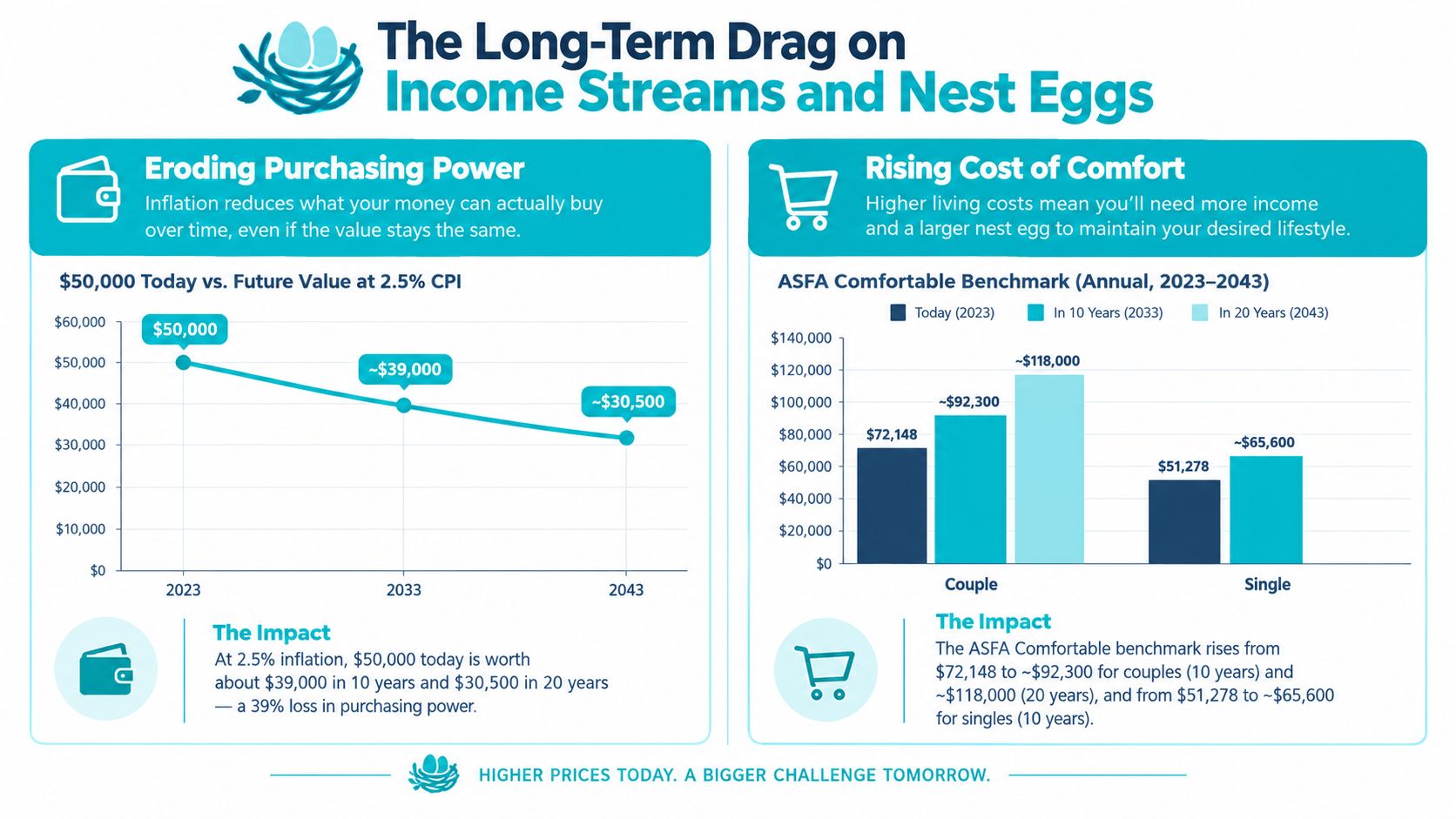
A lot of Australian retirement modelling uses inflation assumptions around the Reserve Bank's long-run target band midpoint. On paper, that looks harmless. Over a retirement that can run 20 to 30 years for many 65-year-olds, it is not harmless at all. A modest annual rise in prices can steadily cut what the same dollar income buys.
A flat income is a pay cut in retirement
If your account-based pension pays the same dollar amount each year, your real income falls every year prices rise. That is the core problem. Stable withdrawals and stable living standards are two different things.
Plenty of pre-retirees build a retirement budget as if year one will look like year fifteen. It will not. Food, utilities, council rates, home maintenance, private health costs and out-of-pocket medical spending do not wait politely while your drawdown stays fixed.
Your spending target moves, even if your plan does not
The drag is not limited to purchasing power inside your own budget. Inflation also shifts the practical benchmark for what counts as a workable retirement.
ASFA updates its Retirement Standard regularly because the cost of a comfortable retirement does not sit still. Retirees feel that in the categories that bite hardest. Ongoing household bills. Insurance. Car costs. Health. Replacing appliances. Maintaining the home. If your plan assumes those costs will rise gently in line with a broad headline figure every year, you are setting yourself up for disappointment.
That is why old target numbers become dangerous. A super balance that looked adequate five years ago may now support a thinner lifestyle than you intended, even before we get to market returns or tax settings.
Here is where retirement plans usually fail:
- They price retirement as a one-year event. Retirement is a multi-decade cash flow problem.
- They use a fixed dollar drawdown for too long. That keeps the paperwork tidy and lets purchasing power erode.
- They treat longevity as secondary. A longer life gives inflation more time to grind away at income and capital.
- They hide in cash. Cash helps with short-term spending and reduces sequence risk for near-term withdrawals, but a portfolio parked there for years is choosing low real returns.
The cash point matters. I see this mistake constantly. People approaching retirement get spooked by market volatility and move too much into term deposits and savings accounts. That can make sense for one to three years of planned withdrawals. It is a poor strategy for the rest of the portfolio if you still need growth to keep pace with rising costs.
A better question is simple: how long will your assets support your spending after inflation keeps lifting the amount you need each year? Wealth Collective's article on how long retirement savings may last under different drawdown assumptions is useful for thinking about that pressure properly.
The most dangerous retirement plan is the one that feels safe at 65 and starts failing at 78.
Longevity turns a small inflation problem into a large one
Inflation risk and longevity risk belong in the same conversation. Separate them, and you miss the danger.
A short retirement can cover up a weak income strategy. A long retirement exposes it. If your portfolio is built only to avoid visible volatility, with too little real growth, inflation can do the slow damage a market fall did not. You do not notice it in a single quarter. You notice it when travel drops off, the car lasts longer than it should, the house needs work you keep postponing, and withdrawals rise because the same life costs more.
My advice is direct. Do not judge your plan by whether year one looks comfortable. Stress-test whether the income can still support your lifestyle after 10, 15 and 20 years of rising costs. That is the test that matters.
How Inflation Reshapes the Retirement Benchmark
Inflation isn't only a threat. Sometimes it creates opportunities. The problem is that people never use them because they don't realise the rules are moving too.
The common narrative says inflation just makes retirement worse. That's lazy thinking. In Australia, inflation also changes pension settings, super contribution caps and transfer limits. That can help you, hurt you, or do both at once depending on timing.
The benchmark itself moves
ASFA updated the lump sums needed for a comfortable retirement to $630,000 for singles and $730,000 for couples in February 2026, up from $595,000 and $690,000 respectively, according to the ASFA media release on comfortable retirement balances.
That's the point too few people absorb. The benchmark is not fixed. If you're five to ten years from retirement and still using an old target number, you may be solving for yesterday's cost of retirement rather than tomorrow's.
Indexation can work in your favour
Australia's Age Pension has a stronger inflation mechanic than many private retirement incomes. Treasury states that the Age Pension is indexed to the greater of CPI or Male Total Average Weekly Earnings in its retirement income policy material. In plain English, that means the Age Pension is designed to keep up not just with prices but, at times, with wages as well.
Defined-benefit pensions in the Commonwealth system also have explicit CPI protection. The pension is adjusted on the first payday in January and July each year based on the ABS CPI for the previous quarter, as explained by CSC in its guide to CPI rates and your pension.
That's useful. It still doesn't mean retirees are immune, because household spending can rise faster than the index used for adjustment.
Australian retirement thresholds and how they index
| Threshold or Payment | Indexation Driver | Recent Direction | Effect on Retiree |
|---|---|---|---|
| Age Pension | Greater of CPI or wages | Moves with inflation or wages | Can provide a stronger floor than flat private income |
| Defined-benefit pension payments in relevant schemes | CPI | Reviewed twice yearly | Helps preserve purchasing power over time |
| General transfer balance cap | Inflation | Expected to rise in 2026 | May increase tax-planning flexibility |
| Concessional contribution cap | Inflation | Rose in 2026 | May allow larger deductible contributions |
| Non-concessional contribution cap | Inflation | Rose in 2026 | May expand contribution strategy options |
A good plain-English reference for recent super indexation changes is Wealth Collective's explainer on the ASFA Retirement Standard, especially if you're trying to connect spending benchmarks with strategy.
Complexity rises with the opportunity
Bell Potter noted that in 2026 the general transfer balance cap was expected to rise from $2.0 million to $2.1 million on 1 July 2026, while contribution caps rose from $30,000 to $32,500 concessional and from $120,000 to $130,000 non-concessional, and a new tax change affecting balances above $3 million was set to take effect from 1 July 2026, in its February 2026 superannuation newsletter.
That means inflation can open planning windows. It can also create tax drag, timing pressure and bad decisions if you act without a model.
Inflation changes more than your grocery bill. It changes the rules around your retirement capital.
If you're approaching retirement with a larger super balance, don't treat inflation as a single negative force. It may lift caps and pension settings while also complicating contribution timing, drawdown choices and estate planning. That's not a reason to panic. It's a reason to stop relying on generic retirement advice.
Comparing Strategies That Hedge Inflation Risk
A couple in Perth retires with a tidy super balance, keeps two years of spending in cash, and assumes the rest can sit conservatively because “we're not chasing big returns anymore”. Ten years later, the cash has done its job for stability but failed its job for purchasing power. Their portfolio feels safer on paper and weaker in real life.
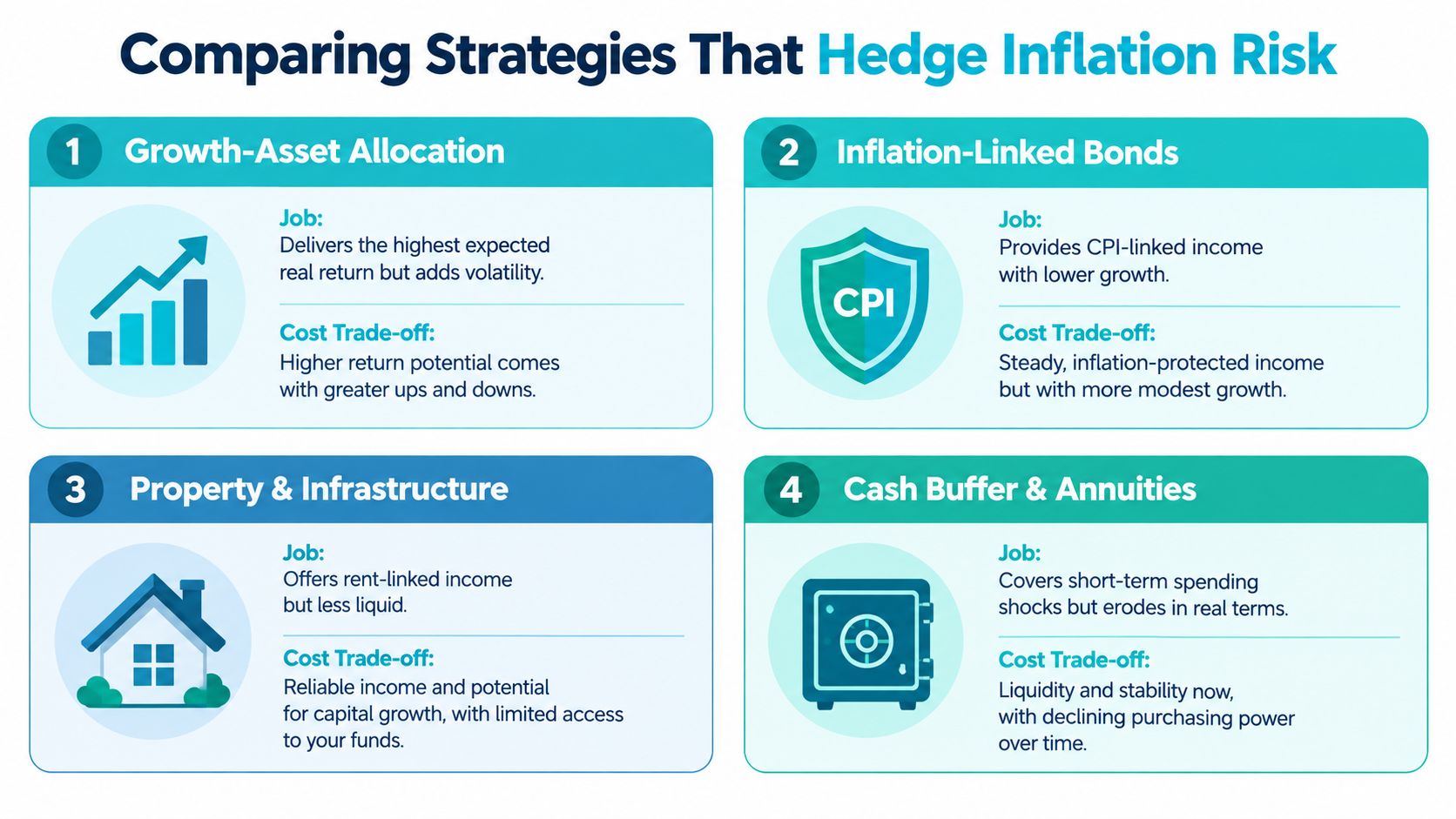
That is the core mistake. Inflation risk is not solved by one product or one rule. You need a mix of tools, with each one assigned to a specific part of the job.
Growth assets
Growth assets are still the main engine for outrunning inflation over a long retirement. Shares, property securities and diversified growth funds will be volatile. Retirees who want every year to feel calm usually pay for that calm with lower future spending power.
That trade-off matters more than people admit.
If your retirement may last 25 to 35 years, a portfolio built mostly for short-term comfort is usually a poor fit. You need enough exposure to assets that can grow faster than inflation after fees, tax and withdrawals. Otherwise, the benchmark for a comfortable retirement keeps rising while your real income slowly goes backwards.
The risk is early-retirement market falls. Withdraw from a falling portfolio too aggressively and you lock in losses. The fix is not to abandon growth. The fix is to pair growth with cash flow design.
Inflation-linked income
Some spending should not be left fully exposed to markets. CPI-linked annuities and other indexed income streams can help cover the part of your budget that has to be paid regardless of headlines, rate cuts or sharemarket falls.
This approach works best for the expenses that bite hardest when prices rise. Food, utilities, insurance, council rates and basic healthcare do not become optional because markets had a bad year. If an expense must be paid regardless of market conditions, funding it with a fully market-dependent income stream is asking for trouble.
The cost is obvious. You give up flexibility and often some growth potential. That is not a flaw. It is the price of certainty.
Flexible spending rules
Flexible spending rules are where many retirement plans either survive or fail.
Retirees do not experience inflation evenly. Insurance might jump sharply. Travel can become much more expensive for a few years. Electricity can hurt more than the headline CPI number suggests. That is why a flat withdrawal rule is too blunt. A better system splits spending into required costs and lifestyle choices, then adjusts the second bucket when markets or prices move against you.
MoneySmart's superannuation calculator assumptions are a useful reminder that retirement spending is not only about CPI. They also reflect rising community living standards. In plain English, retirees do not just want to maintain life. They want retirement to remain enjoyable and dignified as costs and expectations shift.
For people who like the discipline of financial independence planning, the FloosYo subscription audit for FIRE is a practical way to identify recurring costs that can be cut without damaging lifestyle. That gives you room to absorb inflation without touching the spending that actually matters.
Cash buffer and short-term reserves
Cash still has a role. Just keep it in its lane.
Its job is to cover near-term withdrawals and stop you selling growth assets after a market drop. Its job is not to preserve purchasing power for the next 20 years. Retirees who hold too much cash for too long usually feel prudent while inflation erodes the value of that caution.
Set the buffer against spending needs, not against a round number that feels safe. A retiree with part Age Pension support and low fixed costs may need a very different reserve from a retiree drawing heavily from an account-based pension.
Which strategy belongs where
Use each tool where it earns its place:
- Growth assets defend long-term purchasing power.
- Indexed or partly indexed income protects the spending that must be met every year.
- Flexible spending rules let discretionary costs absorb pressure first.
- Cash reserves buy time during market stress.
The point is allocation by purpose. Inflation does not just erode buying power. It also changes the retirement target itself, shifts super settings over time, and puts pressure on different spending categories in different ways. A good strategy reflects that. A weak one treats your whole retirement budget as if every dollar faces the same risk.
Building Your Personal Inflation-Resilient Retirement Plan
You are 62, planning to retire at 67, and your spreadsheet says the numbers work. Then inflation runs hotter for longer, council rates jump, insurance climbs, and the super rules shift around you. Five years later, the same retirement income can buy less, and the benchmark you were aiming for has moved as well. That is the trap.
Stop reading and start modelling your own numbers in real dollars.
A decent retirement plan is a working model built around your spending, your super, your Age Pension position, your tax settings and the trade-offs you are willing to make. Many pre-retirees within 10 years of retirement need to stop estimating and start modelling, because inflation does not just erode purchasing power. It also changes the thresholds, caps and drawdown settings that shape how retirement income gets delivered.
Start with the numbers that actually drive the outcome
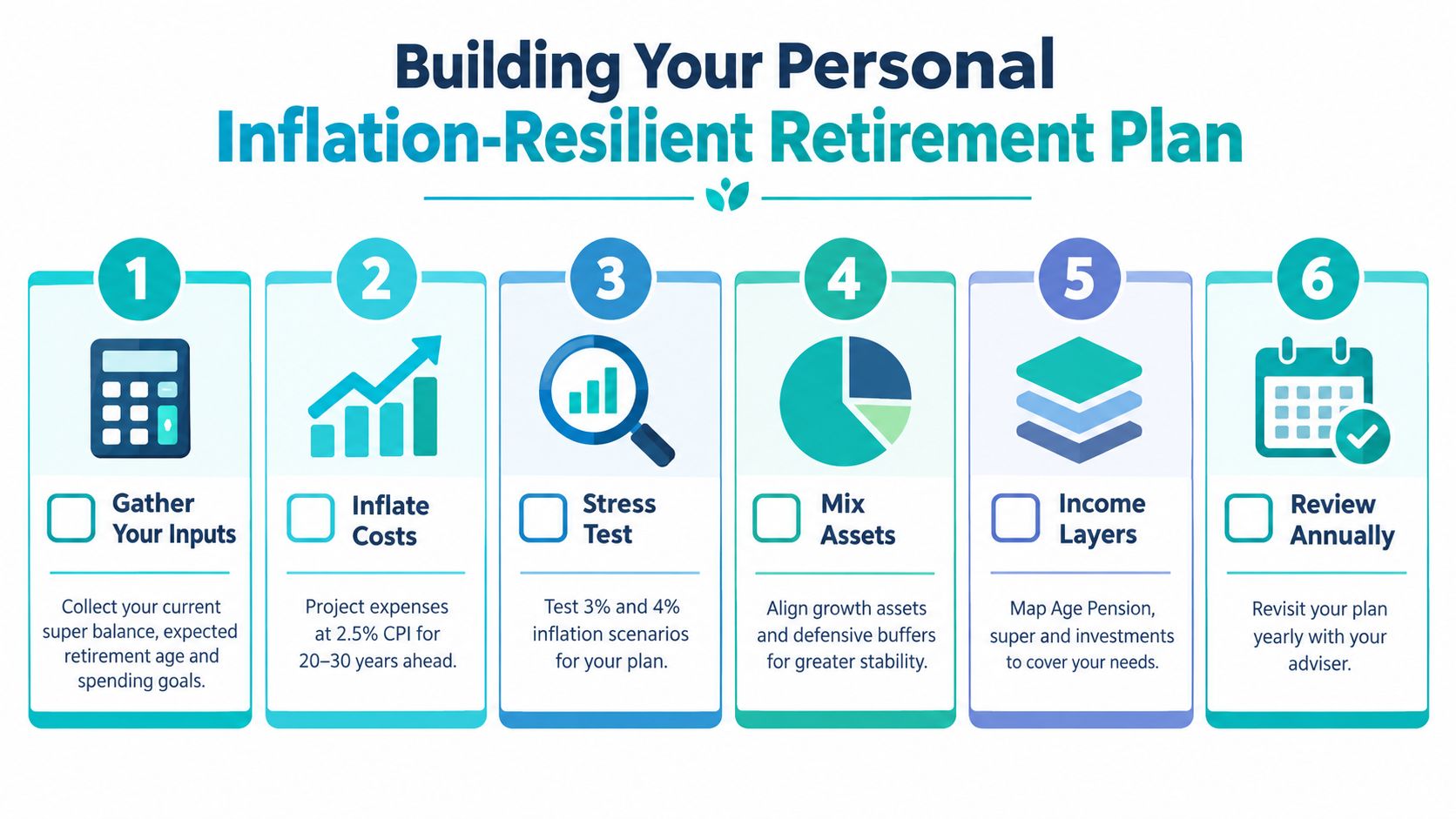
Pull together the inputs that matter before you touch a calculator:
- Total super balance. Include every account.
- Expected Age Pension entitlement. Check it properly. Do not assume you will get nothing or get the full amount.
- Target spending in today's dollars. Start with lifestyle, not a rule-of-thumb withdrawal rate.
- Essential versus discretionary spending. This tells you where you have flexibility and where you do not.
- An inflation assumption. Use a base case, then test a higher path that lasts longer than you would like.
Do not build one neat forecast and call it done. Run at least three versions. A base case, a stubborn inflation case, and a bad timing case where inflation stays high while markets are weak.
Use a retirement target, then pressure-test it
Benchmarks help. Blind reliance does not.
As noted earlier, Australian retirement modelling often starts with income replacement ranges and CPI-adjusted spending targets. Fine. Use that as a reference point, then bring it back to your household. Your plan has to answer a simple question. Can your income support your standard of living in today's dollars after prices rise, rules change and your spending mix shifts toward the categories retirees feel hardest?
If part of your retirement plan includes direct property exposure, read this real estate investing after 50 guide with a critical eye. Property can help, but it can also create liquidity problems, concentration risk and extra costs at the wrong time.
Build the plan in layers, not one big pool
Retirement income works better when each dollar has a job.
Set it up in this order:
Indexed or partly indexed income
Start with income sources that already move, at least in part, with inflation.Core spending cover
Match your required expenses to the steadiest income available.Flexible spending funded by growth assets
Draw lifestyle spending from assets that can outpace inflation over time, knowing the ride will be uneven.A cash reserve sized to actual withdrawals
Hold enough to avoid forced selling, not enough to lose purchasing power for years.Tax-aware super decisions
Contribution timing, pension commencement, transfer balance limits and minimum drawdowns all matter. Inflation can shift these settings over time, which means the benchmark itself does not stand still.
That last point gets missed far too often. People focus on whether groceries and power bills rise. They ignore the second-order effect. Inflation also changes the super settings and retirement thresholds that influence tax, pension eligibility and drawdown decisions.
Review spending by category, because retirees do not live inside the CPI
Your personal inflation rate matters more than the headline figure.
Check the categories that usually do the damage first:
- Insurance premiums
- Utilities and council rates
- Healthcare and medications
- Car costs and fuel
- Home repairs and maintenance
- Travel
- Support for adult children or grandchildren
A couple with a paid-off home, rising health costs and frequent travel can feel inflation very differently from a headline average. That is why broad assumptions fail. Category-level budgeting gives you something you can act on.
Review the plan once a year. Review the spending assumptions every time your lifestyle changes.
Decide now where the pressure will land
This is the part that separates a usable plan from a fantasy.
Answer these questions clearly:
- Which expenses get paid no matter what?
- Which expenses can be cut for a year or two without wrecking your lifestyle?
- How much market volatility can you tolerate before you start making bad decisions?
- Would more guaranteed or inflation-linked income help you sleep, even if it lowers flexibility?
- Are you holding too much cash because it feels safe, not because the plan needs it?
Every answer involves a trade-off. More certainty usually means less growth or less access. More growth usually means more short-term volatility. Pick deliberately.
Turn the review into a concrete action list
Do this in one sitting with a spreadsheet or an adviser:
- List each retirement income source and note whether it rises with inflation, stays flat, or depends on markets.
- Split spending into required and optional categories.
- Model everything in today's dollars.
- Test multiple inflation paths and poor market timing.
- Check whether indexed super caps or threshold changes create a contribution, pension or withdrawal opportunity.
- Re-run the model every year and after any major spending change.
If you are close to retirement, rough rules and old target balances are not good enough. Check the mechanics.
Wealth Collective's Retirement Roadmap process models retirement cash flow, super settings and investment structure together, which is the right way to handle inflation risk. If you want a retirement plan that reflects real Australian inflation, super rules and spending pressure, Wealth Collective can help you pressure-test the weak spots before they become expensive mistakes.