Business hours
Monday to Friday (8.30AM - 5PM)
Weekend (Closed)


You're probably in the same spot I see every week. You log into your super account, see a balance that took decades to build, and ask the question that matters: will this cover the life I want once work stops?
For a lot of West Australians in their late 50s or early 60s, that question lands hard. The mortgage might be nearly gone, the kids may be off the payroll, and retirement finally feels close enough to touch. But the balance on the screen doesn't tell you much on its own. A lump sum looks reassuring until you convert it into annual spending, rising living costs, and a retirement that could run for decades.
That's why I don't start with “How much super do you have?” I start with how long that super can produce income. Australian modelling makes that point brutally clear. In an ANU-backed retirement income model, the median super duration for women at a 66% replacement rate was 8.6 years for ages 15 to 24 and 3.9 years for ages 45 to 54. For men, the comparable medians were 10.8 years and 6.5 years (ANU modelling of superannuation balance duration). That's a very different lens from a headline account balance.
There's also a practical risk people overlook. Once you move from building wealth to drawing it down, small mistakes become expensive. Taking too much too early, sitting in the wrong investment mix, or ignoring the minimum pension rules can shorten the runway fast. The same goes for non-investment risks. If you're helping ageing parents or thinking about your own retirement security, it's worth looking at tools that protect seniors from phone scams, because preserving retirement capital isn't just about returns. It's also about stopping avoidable losses.
Introduction Why Knowing Your Super Longevity Matters Now
The balance isn't the answer
A $300,000 balance, a $600,000 balance, even a seven-figure balance can all fail the same test if the spending plan is wrong. Retirement isn't funded by a number on a statement. It's funded by reliable income over time.
That's the shift to make. Stop asking, “Is my balance enough?” Start asking, “How long will my super last in retirement if I spend the way I live?”
Australian life expectancy makes this impossible to ignore. A 67-year-old Australian can expect to live another 19 years if male and 22 years if female, based on ABS data cited in Super SA guidance, and Treasury has estimated that 1.6 million people aged 65 and over already receive income from a superannuation product, while about 2.5 million Australians are projected to move from accumulation into retirement over the next 10 years (Australian super and retirement income statistics).
If your retirement could run for two decades or more, a rough guess won't cut it.
What usually goes wrong
Many people make one of three errors:
- They focus on the lump sum. That's emotionally understandable, but financially useless without a drawdown plan.
- They use a generic target. A target might help with direction, but it won't reflect your actual spending.
- They ignore the moving parts. Returns, inflation, fees, pension rules, and Age Pension timing all matter.
Practical rule: Don't judge your retirement readiness by your super balance alone. Judge it by how many years of spending it can support.
The better way to think about it
A workable estimate needs to blend three things:
- Your spending pattern
- The mandatory pension withdrawal rules
- The lifestyle you're trying to fund
That's the combination most online articles skip. They give you a target and leave out the mechanics. I'd rather give you the framework I'd use in a first retirement modelling conversation, in plain English, so you can test your own numbers before you pay for advice.
The Five Inputs That Determine How Long Your Super Lasts
Retirement drawdown modelling isn't complicated. But it does need the right inputs. If you guess badly, the output is junk.
Here's the visual framework I want clients to use before they touch a calculator.
Start with the balance you can actually use
Your starting balance is the opening figure for your account-based pension or the amount you expect to transfer into retirement phase. Don't round it up because you hope markets will be kind. Use today's value or a conservative retirement-date estimate.
For context, ASFA-reported June 2023 balances for people aged 60 to 64 showed an average of $355,451 and a median of $189,618, while APRA retirement-account data showed an average retirement-account balance of $355,000 across 1.27 million retirement accounts. APRA also reported average account balances of $131,980 across large-fund members in 2024 to 2025 (super balance benchmarks and retirement account data). Those numbers matter because many people compare themselves to a target while sitting much closer to the median.
Use a net return, not a fantasy return
The second input is your expected net return after fees. Retirees either get too optimistic or too defensive.
You don't need a heroic assumption. You need one you can stick with. If your portfolio is set very conservatively, don't model growth-like returns. If it's mostly growth assets, don't model it as cash. What matters is consistency and realism.
Decide what you'll actually spend
Your annual withdrawal amount is the big lever. Not your aspirational budget. Not your “we'll be frugal” budget. Your real spending.
Include basics, insurances, rates, repairs, healthcare, travel, gifts, and the odd large expense that always shows up. If you understate spending at the start, the whole model gives you false confidence.
Build in inflation and fee drag
Your retirement won't be lived in flat dollars. Spending rises over time, even if your lifestyle doesn't. Fees continue too.
That means your model needs two separate ideas:
- Inflation on spending, because groceries, utilities, health costs, and travel won't stay still
- Fees on the portfolio, because your gross return is never your spendable return
Factor in pension rules and government support
The fifth input is where most DIY calculators fall over. You need to account for minimum account-based pension drawdown rules and the likely role of the Age Pension.
Australia's minimum pension percentages rise with age. They are 4% under age 65, 5% for ages 65 to 74, 6% for 75 to 79, 7% for 80 to 84, 9% for 85 to 89, 11% for 90 to 94, and 14% from age 95 onward, applied to the 1 July balance or commencement value for a new pension (minimum drawdown percentages for account-based pensions).
That matters because your chosen spending amount can't sit below the legal minimum forever. If your own budget says one figure but the minimum says a higher figure, the higher figure wins.
If you want a quick way to trial different balances and assumptions, use a proper super projection tool such as this superannuation growth calculator, then test the output against your spending and pension minimums rather than treating the estimate as complete.
Gather these five inputs first. Until you do, any answer to how long your super will last is just a guess dressed up as a plan.
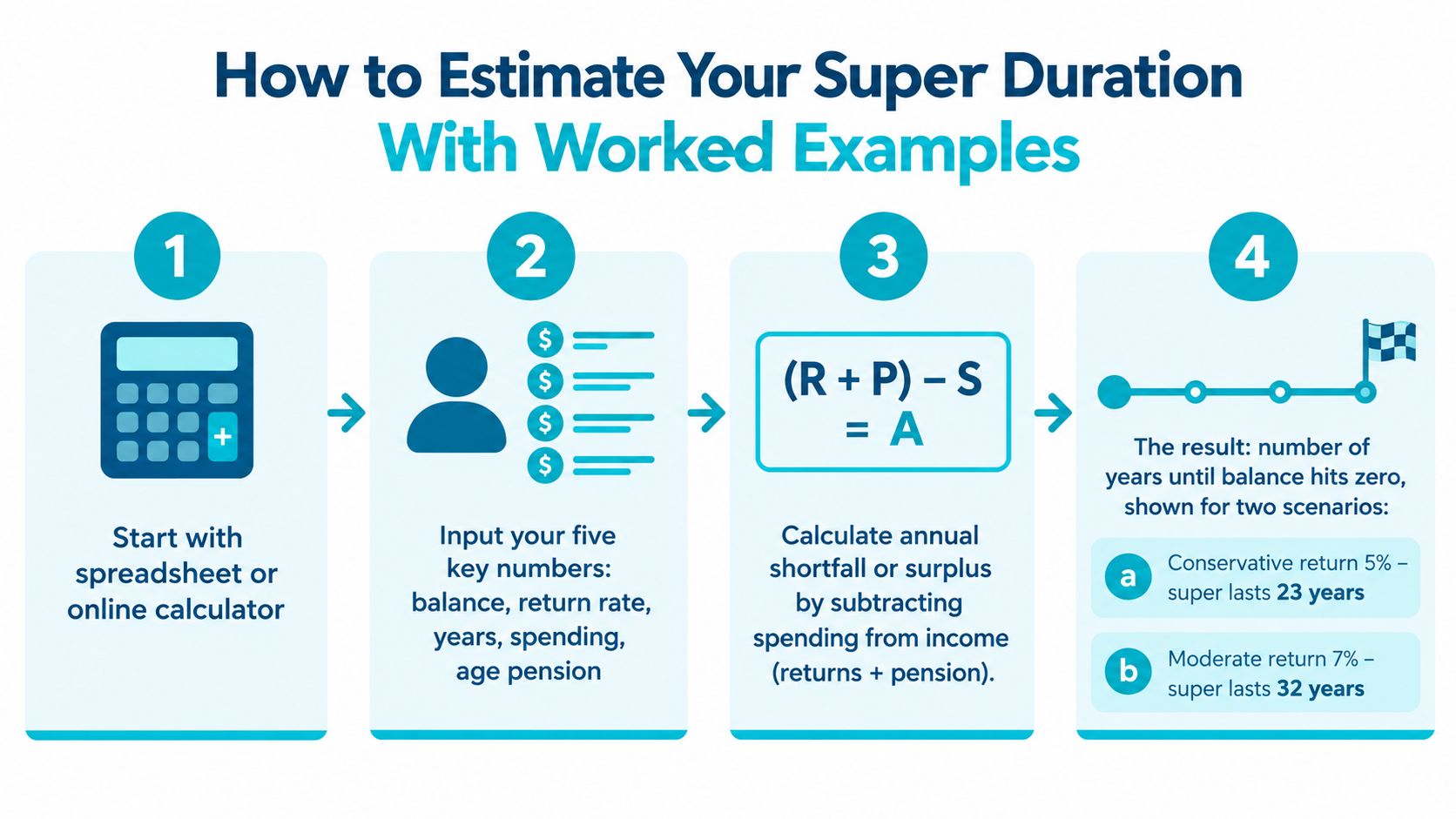
How to Estimate Your Super Duration With Worked Examples
The question becomes useful. Not “Do I have enough?” but “What happens if I spend this much, with this balance, under these rules?”
Worked example one for a single retiree
Take a single retiree with $350,000. That balance sits close to the broad averages many Australians recognise, which makes it a useful starting point.
Now test it against the ASFA 2026 Retirement Standard, which says a comfortable retirement at age 67 requires about $55,932 a year for a single and has a lump-sum super target of about $630,000 (ASFA Retirement Standard benchmarks). A single person with $350,000 is well below that comfortable lump-sum benchmark. That doesn't mean retirement is impossible. It means the spending target has to be realistic.
At age 60, the legislated minimum pension withdrawal would be 4%, so the minimum income from that balance starts at $14,000 under the pension rules already noted in the earlier section. If the retiree wants to spend far more than that, the gap must come from additional drawdown and, later, potentially Age Pension support.
Here's the practical sequence I'd model:
- Start with the opening balance.
- Apply a realistic net return assumption.
- Subtract the greater of the planned spending withdrawal or the minimum pension amount.
- Increase spending over time for inflation.
- Repeat each year until the balance reaches zero.
For a single person at this balance level, longevity usually depends less on the account headline and more on whether spending sits closer to a modest lifestyle or a comfortable one.
Worked example two for a couple aiming for comfort
Now take a couple with $630,000. That number matters because ASFA says a comfortable retirement at age 67 needs about $78,566 a year for a couple, with a lump-sum super target of about $730,000 (ASFA Retirement Standard benchmarks).
A couple with $630,000 is close, but not quite at the benchmark lump sum. If they retire at 67 and aim for a full comfortable lifestyle immediately, they need to stress-test the model hard. Their required withdrawal may exceed the minimum percentage, especially in early years when travel and discretionary spending are highest.
What the examples prove
The point isn't that one balance is “good” and another is “bad”. The point is that spending target changes everything.
Here's what I tell clients to look for when they run their own model:
- Check the first five years carefully. Early retirement spending does the most damage if it's too high.
- Compare your withdrawal to the legal minimum. If your plan is below the minimum, your model is wrong.
- Run at least two return assumptions. One conservative, one moderate. Don't rely on one version of the future.
- Watch the slope of decline. A balance that falls steadily can still work. A balance that collapses early usually means spending is too aggressive.
If the maths only works with perfect markets and restrained spending, the plan doesn't work.
A simple calculator can help you map those scenarios. If you want to test different ages, balances, and retirement income targets, this retirement calculator for Australia is a useful starting point. Then pressure-test the result with your own spending history, not just a generic default setting.
Comparing Retirement Lifestyles and What They Cost Today
A Perth couple retires at 67 with their home paid off, $700,000 in super, and a plan to spend $85,000 a year for the first decade. On paper, that sounds close to the mark. In a drawdown model, it is a very different result from spending $73,000 or $49,000 a year, especially once minimum pension rules and market returns start doing the work.
That is why lifestyle labels matter less than the annual number attached to them.
Retirement Lifestyle Income Targets to Model
Use a benchmark first, then replace it with your own spending.
| Lifestyle Level | Annual Income Target | Lump Sum Benchmark |
|---|---|---|
| Comfortable single | $55,932 | $630,000 |
| Comfortable couple | $78,566 | $730,000 |
| Comfortable couple aged around 65 | $73,077 | Not stated in this benchmark |
| Modest couple aged around 65 | $48,868 | Not stated in this benchmark |
These figures are useful because they give you something concrete to test against your balance, your age, and your required drawdowns. If you want the benchmark figures in one place before you plug in your own numbers, the ASFA retirement standard guide is a useful reference.
One result in the same benchmark material is worth paying attention to. 67% of Australians believe at least $500,000 is required, and 42% believe at least $1 million is needed. The perception gap suggests many Australians may overstate the lump sum they believe is necessary when they have not yet converted lifestyle expectations into an annual spending target.
What the numbers mean in practice
A couple targeting about $49,000 a year is planning a very different retirement from a couple targeting $73,000 or $78,000. That difference is not cosmetic. It changes how much has to come out of super each year, how heavily the portfolio depends on investment returns, and how likely the Age Pension is to carry part of the load later.
Home ownership is the first filter. If you own your home outright, benchmark spending often lands closer to reality because housing costs are lower. If you expect to rent, carry debt, or fund major renovations, the benchmark can be too low by a wide margin.
Spending shape matters too. Many retirees spend more in the first 10 years, not less. Travel, helping adult children, replacing cars, and long-postponed projects usually happen early. That is exactly when larger withdrawals do the most damage to longevity.
Choose the row that matches your life
Use the table like this:
- Model the modest figure first if your day-to-day spending is controlled and big discretionary items are limited.
- Model the comfortable figure second if you want regular travel, higher dining and entertainment spend, or more room for private health and lifestyle costs.
- Add your own adjustments for rent, debt repayments, family support, or planned one-off costs.
- Check whether Age Pension support is likely later, because that can reduce the amount super needs to fund on its own.
One more point gets missed all the time. Super access starts from your preservation age, not whenever you decide you are finished with work. Your preservation age depends on date of birth, rising from 55 before 1 July 1960 to 60 for anyone born from 1 July 1964 onward (ATO preservation age rules). If you stop work before then, your income plan needs a bridge.
Benchmarks help. Your actual annual spending, and the minimum pension you must withdraw each year, decide how long your super lasts.
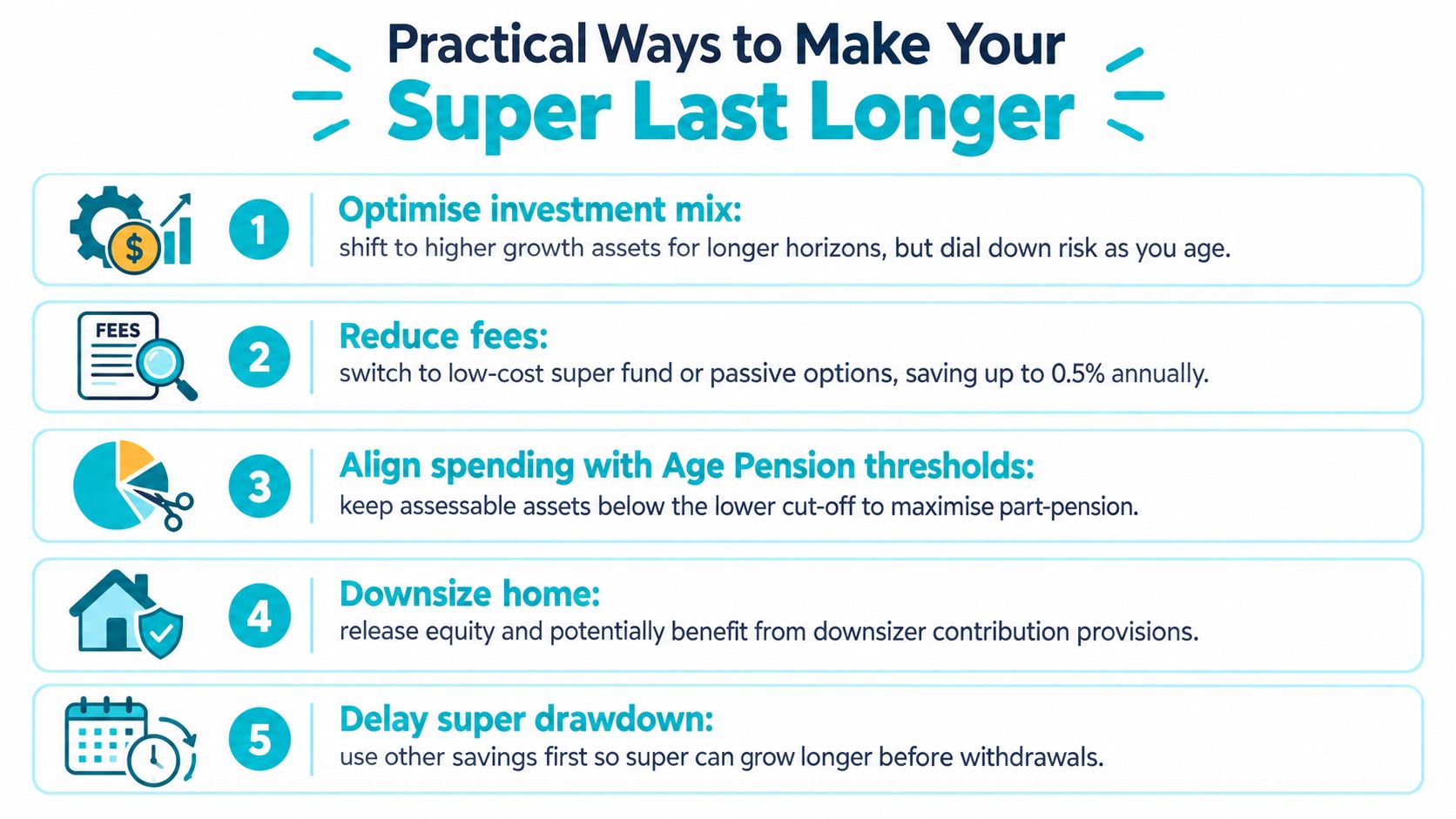
Practical Ways to Make Your Super Last Longer
Retirement longevity improves when you pull the right levers early. Not all of them are obvious, and not all of them involve spending less.

Keep enough growth in the portfolio
One of the most common mistakes I see is moving too defensive too early. If your retirement could run for decades, your money still needs to work. That doesn't mean taking reckless risk. It means not parking the whole portfolio in low-growth settings out of fear.
Sequence risk is real, so the answer isn't “go aggressive”. The answer is a sensible mix with enough growth to support a long horizon and enough liquidity to avoid selling badly after a market fall.
Treat minimum pension rules as a floor, not a target
The minimum drawdown percentages exist for compliance. They are not a lifestyle strategy.
If the minimum is more than you need, take the minimum and redirect surplus carefully within your broader plan. If the minimum is less than you need, make sure the extra draw is deliberate and sustainable.
Cut avoidable fees and account clutter
Fees look small on a statement and large over a long retirement. Consolidate where appropriate, simplify old accounts, and understand what you're paying for investment management, advice, and administration.
You don't need the cheapest structure at all costs. You do need to know whether the value is there.
Coordinate super with everything else
Retirement income doesn't sit in a vacuum. Debt, cash reserves, partner balances, tax position, and eventual government support all shape how long the capital lasts.
That's also where broader wealth decisions matter. For people weighing super against property or downsizing options, outside perspectives on portfolio structure can help frame trade-offs. A resource like David Beshay Real Estate portfolio tips can be useful if property is part of your retirement mix, provided you assess it alongside liquidity, maintenance, and income timing rather than assuming property solves every retirement problem.
Don't waste your pre-retirement years
If you're still working, you still have room to improve the outcome. The ATO's super guarantee table shows the compulsory employer contribution rate is 12.00% for the 2025 to 2026 and 2026 to 2027 financial years, meaning a worker on ordinary qualifying earnings of $100 receives $12 paid into super (ATO super guarantee rates). That won't fix an inadequate plan overnight, but it reinforces a simple point. The final working years matter.
This is one area where formal modelling can help. In practice, a structured advice process such as a Retirement Roadmap can test contribution timing, pension commencement, spending trade-offs, and account structure together rather than adjusting one lever in isolation.
Bottom line: The best way to make super last longer isn't one trick. It's a coordinated drawdown plan with spending discipline, sensible investing, and timing decisions made before you're forced into them.
Plan Your Next Step With Confidence
The question isn't whether retirement will cost money. It's whether your current settings give that money the best chance of lasting as long as you do.
The people who retire with the most confidence usually do four things well. They gather accurate inputs. They test more than one scenario. They choose a lifestyle target. Then they make practical adjustments while there's still time to do something about it.
That's the part many people put off. They wait until work is nearly finished, then hope the numbers line up. Sometimes they do. Often they need tuning. Spending may need to shift. Pension timing may need work. Investment settings may be too cautious or too exposed. None of that is fatal, but all of it is easier to fix earlier.
If you're close to retirement, have your key documents ready before you seek advice:
- Your latest super statements
- A rough annual spending figure
- Any debt balances
- Details of other savings or investments
- Your target retirement age
That gives an adviser something real to model, not just a conversation based on gut feel.
The strongest plans I see aren't built on rules of thumb. They're built on personalised projections that account for your likely spending, your account structure, your timing, and the trade-offs you're prepared to make. That's where a clear process helps. Wealth Collective's Retirement Roadmap starts with a free 10-minute introductory call, then works through your retirement timeline, super position, and income needs in a structured way so the drawdown strategy matches your life rather than a generic benchmark.
If you've been asking how long will my super last in retirement, you don't need another vague article or another rule copied from overseas. You need your own numbers, tested properly, with a plan you can live with.
If you want help turning your super balance into a retirement income plan, Wealth Collective helps Australians map out drawdowns, test lifestyle scenarios, and make smarter decisions about super, spending, and retirement timing. Start with the free introductory call, bring your current super figures and spending estimate, and get clarity on what your money can realistically support.