Business hours
Monday to Friday (8.30AM - 5PM)
Weekend (Closed)



Around $630,000 for a single and $730,000 for a couple is the ASFA benchmark for a comfortable retirement in Australia, assuming you own your home outright. If you only want a modest retirement, the benchmark drops to $110,000 for a single and $120,000 for a couple.
That's the straight answer. The question is whether you want a retirement that feels tight and cautious, or one that gives you room for travel, hobbies, and the occasional splurge without watching every dollar.
The Short Answer to How Much You Need
If you're asking how much money do i need to retire in Australia, the cleanest starting point is the ASFA Retirement Standard. It gives you a benchmark instead of guesswork, and that matters because most of us are trying to plan around fear, not facts.
For a homeowner aged 65 to 84, ASFA estimates a comfortable retirement costs $55,923 a year for a single and $78,566 a year for a couple, while a modest retirement costs $36,434 and $52,473 respectively. Those spending levels translate into target super balances at age 67 of about $630,000 for a single and $730,000 for a couple for a comfortable retirement, versus $110,000 and $120,000 for a modest one, all in today's dollars and with the Age Pension assumed where relevant. ASFA Retirement Standard
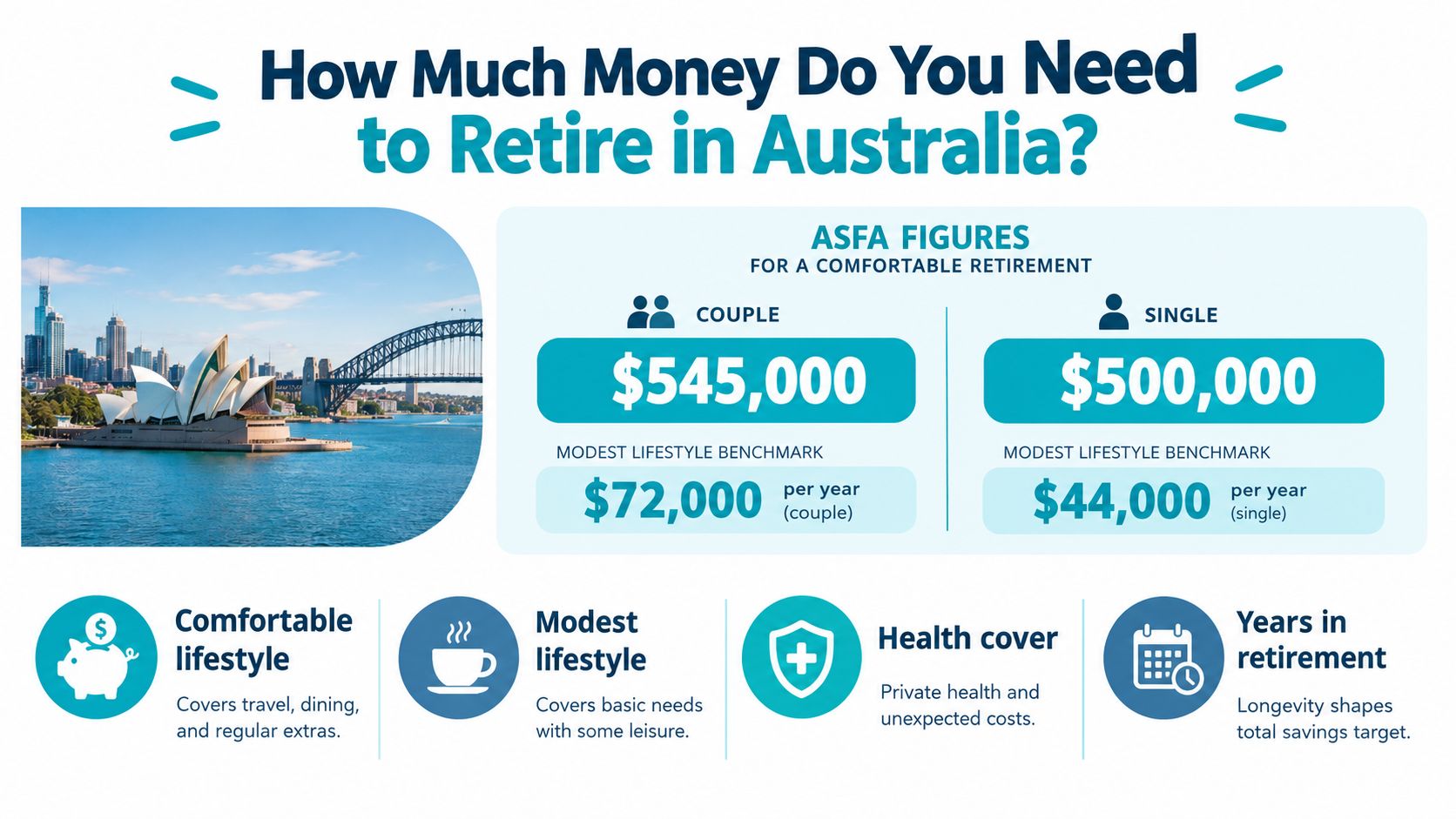
Practical rule: start with the ASFA comfortable figure, then adjust it for your actual life, not someone else's idea of retirement.
A Perth couple with the family home paid off and no appetite for overseas travel may land below the comfortable benchmark. A renter in WA with health costs, a mortgage, or a strong travel habit may need more. That's why a single number only helps if it becomes a personal plan.
If you want the broad planning lens, I've laid it out in this guide on how much super you need to retire.
Understanding the ASFA Benchmark
Why use the ASFA benchmark at all? It gives you a practical starting point, because retirement involves more than covering groceries and bills. ASFA separates comfortable and modest lifestyles, helping you decide what level of spending fits your plans.
A comfortable retirement allows room for experiences and flexibility. MoneySmart, citing ASFA, describes it as typically including annual domestic trips, one overseas trip every seven years, regular hobbies and social outings, plus occasional restaurant and takeaway meals. The same guide lists lump-sum targets of $630,000 for a comfortable single and $110,000 for a modest single. MoneySmart retirement spending guide
See the full ASFA Retirement Standard breakdown for the benchmark figures and assumptions.
Annual spending first, lump sum second
Start with the lifestyle, then calculate the capital required to support it. Asking for a super balance before defining your annual spending reverses the planning process. Your target depends on housing, travel, health costs, family support and the income you expect from other sources.
A modest retirement can work well when your Perth home is mortgage-free and your plans are simple. A comfortable target makes more sense if you want regular weekends in Margaret River, interstate visits to grandchildren, or greater capacity for unexpected costs.
Your retirement number should reflect your WA lifestyle, not a national average you have never tested against your own budget.
Wealth Collective's planning process turns that benchmark into a personal spending target, income strategy and super balance goal. Define those priorities before chasing a single figure. That approach gives you a clear target and a practical way to adjust it as your circumstances change.
Retirement Costs in Western Australia
Western Australia doesn't always line up neatly with national retirement assumptions. GESB's guidance shows a comfortable retirement at about A$52,383 a year for singles and a modest retirement at A$33,386 a year for singles, with couples at A$48,184 for modest living. That gap tells you everything you need to know, the basket of goods and services you assume changes the answer. GESB retirement cost guidance
For a Perth household, this isn't academic. A retiree in Subiaco, Mandurah, or Dunsborough might spend very differently depending on transport, social habits, and whether the home is already owned outright. A couple who has trimmed discretionary travel and lives mortgage-free can reasonably need less than a national comfortable benchmark. A renter in Perth, or someone carrying bigger health costs, can need more.
Why WA households should model their own costs
One practical way to sanity-check retirement spending is to look at recurring household costs, especially energy. If you want a local reference point for everyday bills, the Perth electricity bill guide is a useful starting point because it reminds you that even routine costs differ by household and suburb. That's the same logic retirement planning uses, your real budget comes from your real life, not from a spreadsheet headline.
What I see most often is this, people overestimate how much they'll need for some expenses and underestimate others. They forget that housing status, local services, car use, and health spend can swing a WA retirement budget materially. Don't copy a national number and call it a plan.
Replacement Rates and the Age Pension
A replacement rate shows how much of your working income retirement needs to replace. It gives you a more useful target than copying a national balance figure. A Perth worker earning $90,000 who plans on replacing 65% of that income needs $58,500 a year in retirement income.
The Age Pension can cover part of that target, but eligibility and payment levels depend on income, assets, relationship status, and homeownership. A qualifying single homeowner might receive roughly $30,000 a year, leaving a substantial amount for superannuation and other investments to provide. A renter or someone with higher medical and housing costs needs a different calculation.
What the pension does and doesn't do
Treat the pension as the floor of your plan, not the target. It can reduce the amount your super must provide, especially when you own your Perth home outright. It does not replace the planning needed for rising bills, vehicle costs, health care, repairs, or the flexibility to help family.
The MoneySmart retirement spending guide is a useful reference for testing your assumptions, but your personal target must come from your own income, housing, and spending pattern.
The pension is a safety net. Super is what gives you choices.
For WA pre-retirees, the practical question is simple: what income will your household require, what might the pension contribute, and how much must your super fund? The Wealth Collective's planning process should model those figures together, then set a clear savings and investment target. That approach gives you a number based on your Perth circumstances, rather than a generic national benchmark.
Superannuation Rules and Access
A lot of people feel trapped by super because they confuse preservation age with pension age. They're not the same thing. The Australian Taxation Office says you can access super once you reach your preservation age if you're retired or have started a transition-to-retirement income stream, and the preservation age runs from 55 for people born before 1 July 1960 up to 60 for people born on or after 1 July 1964. ATO super withdrawal options
That rule matters because it changes the timing of your plan. If you're 35, you've got decades for contributions, market growth, and course correction. If you're 55, you're much closer to the finish line, and every decision has less room to recover.
Two example paths
A 35-year-old in Perth who starts planning early can use time as an ally. They can shape contributions, investment settings, debt reduction, and housing decisions without panic. A 55-year-old has to be more direct, because the margin for error is smaller and the timing of access matters more.
For both, the question is the same. How much income do you need, when can you access it, and what has to happen between now and then to make the gap manageable? That's exactly the point where when can I access my super becomes a central planning question, not a technical footnote.
Why Your Age Changes the Target
The target balance changes because the clock changes. At 35, you can still influence almost every variable that matters, contribution rate, investment mix, housing decisions, and retirement age. At 55, you're mostly working with what's already on the board.
A younger client in Perth can usually close a gap gradually. An older client often has to solve the problem with sharper decisions, like debt reduction, downsizing, or adjusting retirement timing. That's not bad news, it's just reality.
How the Wealth Collective process turns this into a plan
The practical first step is a retirement income calculation, not a product sale. Wealth Collective's Retirement Roadmap service models super, investments, Age Pension, and retirement income decisions so you can see the actual gap and the levers available to close it.
Don't guess your retirement number from a headline. Model it against your home, your spending, and your timing.
That's the right order of operations. First, define the lifestyle. Second, test it against your likely pension and super. Third, decide whether the answer means working longer, saving more, changing investments, or adjusting housing. That's how a vague worry becomes a workable strategy.
Your Path to a Wealth Collective Plan
If you're sitting on a rough estimate and still feel unsure, that's normal. The answer isn't to keep reading calculators until the anxiety disappears, it's to turn the numbers into a personalised plan that fits your life in WA.
Wealth Collective helps pre-retirees map out retirement income, super settings, and the decisions that sit around them, including housing, debt, and government support. The outcome should be simple, a clear retirement number, a timeline, and a set of actions that make the target realistic.
If you want a clear retirement number based on your own WA situation, book an initial call with Wealth Collective. We'll help you test your current position against a practical retirement roadmap so you can see what's enough, what's missing, and what to do next.