Business hours
Monday to Friday (8.30AM - 5PM)
Weekend (Closed)


You may have arranged a life insurance policy, updated your Will and nominated people on your super account. Yet those documents can still point in different directions. The central question isn't only how much cover you have. It's who owns the policy, who controls the proceeds and whether the money reaches the right people without becoming tangled in the estate.
In Australia, that question matters because superannuation is legally held in trust until accessed. Life insurance inside super is therefore generally treated as a non-estate asset, rather than something that automatically follows your Will. MoneySmart explains the difference between life cover inside and outside super, but many families still receive advice that stops at “name a beneficiary”.
When the Payout Lands in the Wrong Hands
Consider a Melbourne tradesman who dies unexpectedly. He has a current de facto partner, children from an earlier relationship and a substantial life insurance policy. He assumed his Will would direct everything sensibly.
It doesn't work that way if the policy is personally owned and the proceeds are paid to his estate. The money can become part of the estate administration process, while questions about the Will, competing claims and the identity of the proper beneficiaries are resolved. His partner may need cash for the mortgage and household expenses, but the payout isn't necessarily available on the terms he expected.
That outcome isn't caused by inadequate cover. It comes from a mismatch between ownership, nomination and the intended legacy. A Will controls estate assets. It doesn't automatically control a policy owned through super, and it may not prevent an estate-owned policy from becoming subject to disputes or delay.
The ownership decision comes first
Personal ownership usually gives the insured person direct control over the policy and beneficiaries. Super ownership separates the policy from the estate, but the super fund trustee applies superannuation law and the fund's nomination rules. A trust can place the policy and its proceeds under a trustee's control, with distributions governed by the trust deed.
The structure determines who receives the money, who makes decisions and how the proceeds are administered. It also affects whether the payment supports a spouse directly, remains available for children, or is managed over time for a vulnerable beneficiary.
For a plain-language explanation of the difference between wills, trusts and probate, wills trusts and probate explained is a useful starting point. You should also understand that what happens to super when you die depends on the fund rules, valid nominations and the people legally entitled to receive the benefit.
Practical rule: Don't ask only whether your life insurance is “covered”. Ask who owns it, who can challenge the payment and who controls the money after it arrives.
What Life Insurance in Trust Actually Means
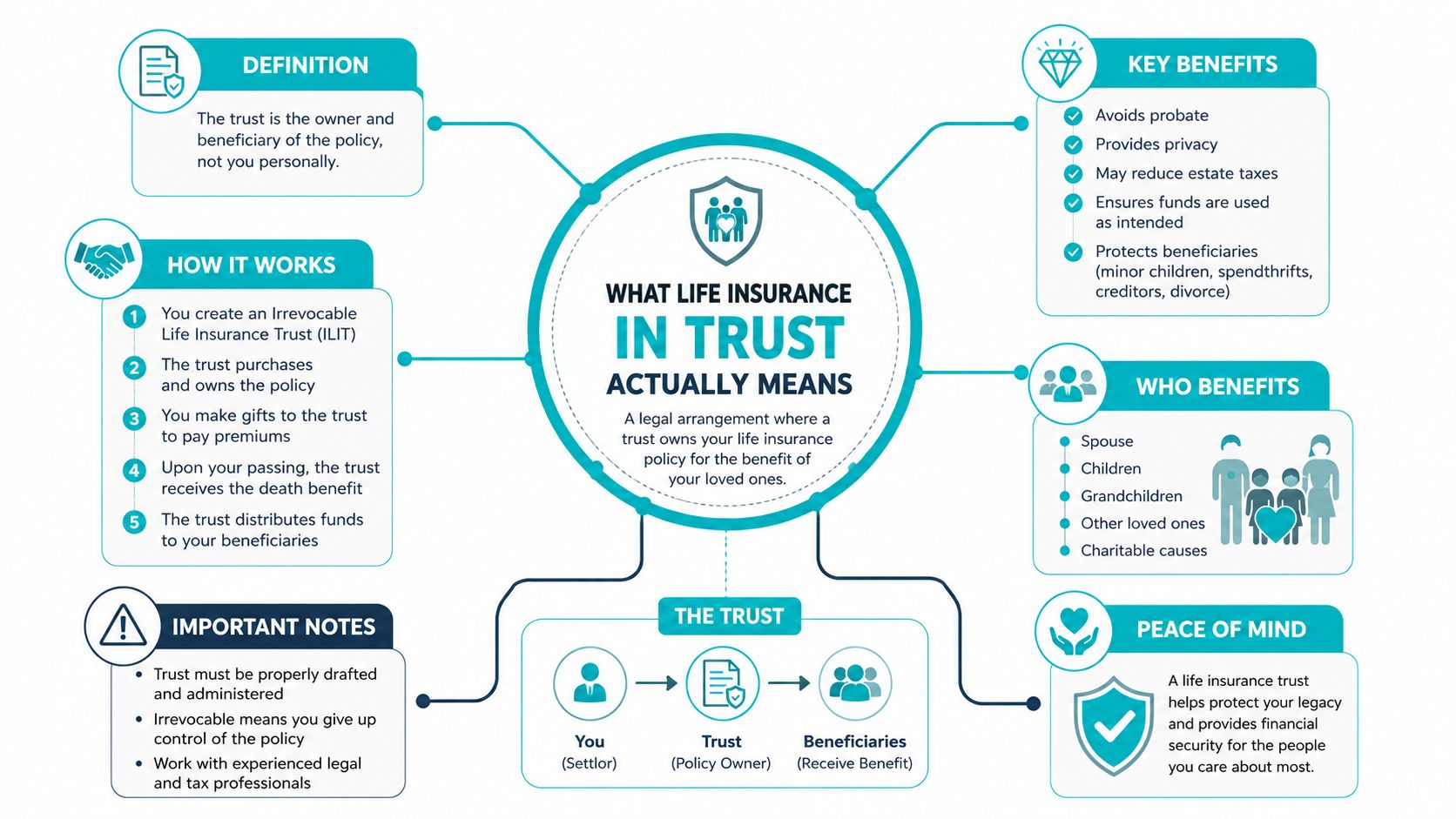
Life insurance in trust means a trustee owns the policy for the benefit of named beneficiaries. The life insured is the person whose death triggers the benefit, while the trustee is the legal owner responsible for maintaining the policy and dealing with the insurer.
The policy remains valid because the insurer has issued it to the trustee in that legal capacity. Ownership and insured status are separate roles. The trustee holds the contract, pays or arranges premiums, keeps the policy in force and receives the proceeds when the insured event occurs.
Three simple ownership analogies
Personal ownership is like owning a house in your own name. You control the title, but the asset is connected to your personal affairs and may need to be dealt with through your estate.
Super ownership is like having an employer or super fund hold the deed for you. The asset sits inside a regulated structure, and the trustee follows the fund's governing rules when deciding how benefits are paid.
Trust ownership is like appointing a property manager to hold the deed and pass it to your children under instructions you establish. The trustee, not the life insured, administers the asset for beneficiaries under the trust deed.
The trust deed is the operating manual. It identifies the beneficiary class and gives the trustee powers to receive, hold and distribute money. A revocable beneficiary arrangement generally allows the policy owner to change the nomination. An irrevocable beneficiary arrangement gives the beneficiary stronger rights and usually requires consent before the arrangement can be changed. The correct choice depends on the intended control, not on a generic preference for “more protection”.
You don't have to be the trustee, and you don't have to be the life insured. For example, one person may be insured, a corporate trustee may own the policy, and a spouse or children may benefit under the trust deed. If you're comparing policy options before discussing ownership, ABS Insurance Brokers life insurance solutions provides context on the underlying cover. For the trust mechanics themselves, how does family trust work is a useful companion explanation.
Three Ways Australians Can Own Life Cover
Australians generally choose between personal ownership, super ownership and trust ownership. None is automatically superior. The right structure depends on whether your priority is flexibility, cash flow, control over beneficiaries, tax treatment or administration.
| Factor | Personal Ownership | Super Ownership | Trust Ownership |
|---|---|---|---|
| Control | The policy owner usually controls beneficiaries and policy decisions | The super trustee applies fund rules and valid nominations | The trustee controls the policy under the trust deed |
| Payment pathway | Proceeds may be paid to a beneficiary or estate, depending on the policy nomination | Proceeds are dealt with through the super trust process | Proceeds are received and distributed according to the trust structure |
| Estate connection | Can become part of the deceased estate if directed there | Generally treated as a non-estate asset | Can be directed away from the personal estate |
| Beneficiary nominations | Usually more direct and flexible | Binding and non-binding nominations have specific superannuation rules | The deed and nomination must work together |
| Death benefit tax | Generally not assessable when paid directly to a nominated beneficiary or estate, subject to circumstances | May be taxable in some circumstances | Generally not assessable when the payment remains a death benefit, subject to the structure |
| TPD access | Living benefits may be more directly accessible | TPD payment and release rules can restrict timing and affect tax | Depends on the policy, trustee powers and whether the benefit is paid through super |
| Administration | Usually simplest | Fund administration and nomination management apply | Deed, trustee duties, records and ongoing coordination are required |
Personal ownership
Personal ownership is often the cleanest option for a single adult, a couple with straightforward affairs or anyone whose main need is direct flexibility. The trade-off is that the policy may become entangled with the estate if the nomination is missing, invalid or intentionally directs proceeds to the estate.
Super ownership
Super ownership can be efficient for premiums and may keep the policy outside the estate. The compromise is control. The fund trustee must apply superannuation law, and nominations need to be valid under the fund's rules. A nomination guide from AIA explains that nominations for policies inside super have defined eligibility and allocation requirements.
Trust ownership
Trust ownership gives the most deliberate control over how beneficiaries receive the money. It can be useful where the family has children, blended relationships, a business or a need for staged distributions. It also creates genuine trustee responsibilities, so it shouldn't be used only because the phrase “avoid probate” sounds attractive.
How Tax Treatment Changes With Ownership
The tax outcome depends on what the payment is, who receives it and whether the proceeds remain a death benefit or are transformed by another arrangement. Ownership matters, but ownership alone doesn't answer every tax question.
For personal policies, death benefits paid directly to a nominated beneficiary or into the estate are generally not assessable income. A trust can receive a death benefit and distribute it under the trust deed, with the same broad treatment where the proceeds remain a death benefit. The technical position can change if the policy includes bonuses, cash values, a surrender or another transaction.
| Tax Element | Personal Ownership | Super Ownership | Trust Ownership |
|---|---|---|---|
| Death benefit | Generally not assessable when paid directly to a beneficiary or estate | Can be taxable in some circumstances when paid as a superannuation death benefit | Generally not assessable when the proceeds remain a death benefit and the deed supports the distribution |
| Policy cash value or bonus | Treatment depends on the policy event | Superannuation rules may affect the eventual benefit | Certain policy cash values or bonuses paid to a trustee can be non-assessable in relevant circumstances |
| Capital gains | Depends on the policy transaction and ownership facts | Capital gain on an insurance benefit paid to the super trustee is disregarded in the relevant guidance | The trust relationship can be ignored for CGT purposes where a beneficiary is absolutely entitled |
| TPD | Depends on the policy and how the benefit is paid | Tax can range from nil to 20% plus Medicare levy depending on the relevant factors, as outlined by MetLife's TPD insurance guide | Depends on whether the benefit is paid through super or directly under the trust arrangement |
| Premium treatment | Depends on the policy and purpose | Premiums for eligible death or terminal medical condition cover held by a super trustee are generally deductible to the trustee | Depends on the trust's purpose, policy type and tax advice |
The ATO ruling on insurance held in trust and CGT states that where a beneficiary is absolutely entitled to a policy as against the trustee, the trust relationship is effectively ignored for CGT purposes. It also explains that transferring legal title to that absolutely entitled beneficiary doesn't itself create a CGT event.
Don't confuse a non-assessable death benefit with a universally tax-free outcome. Superannuation can introduce separate tax treatment, particularly for benefits paid to people who aren't tax dependants or for TPD benefits. Before changing ownership, read is life insurance tax deductible alongside advice from a financial adviser and tax professional.
Who Benefits Most From a Trust Structure
A trust earns its place when the family needs control after death, not merely a different name on the policy.
Young families
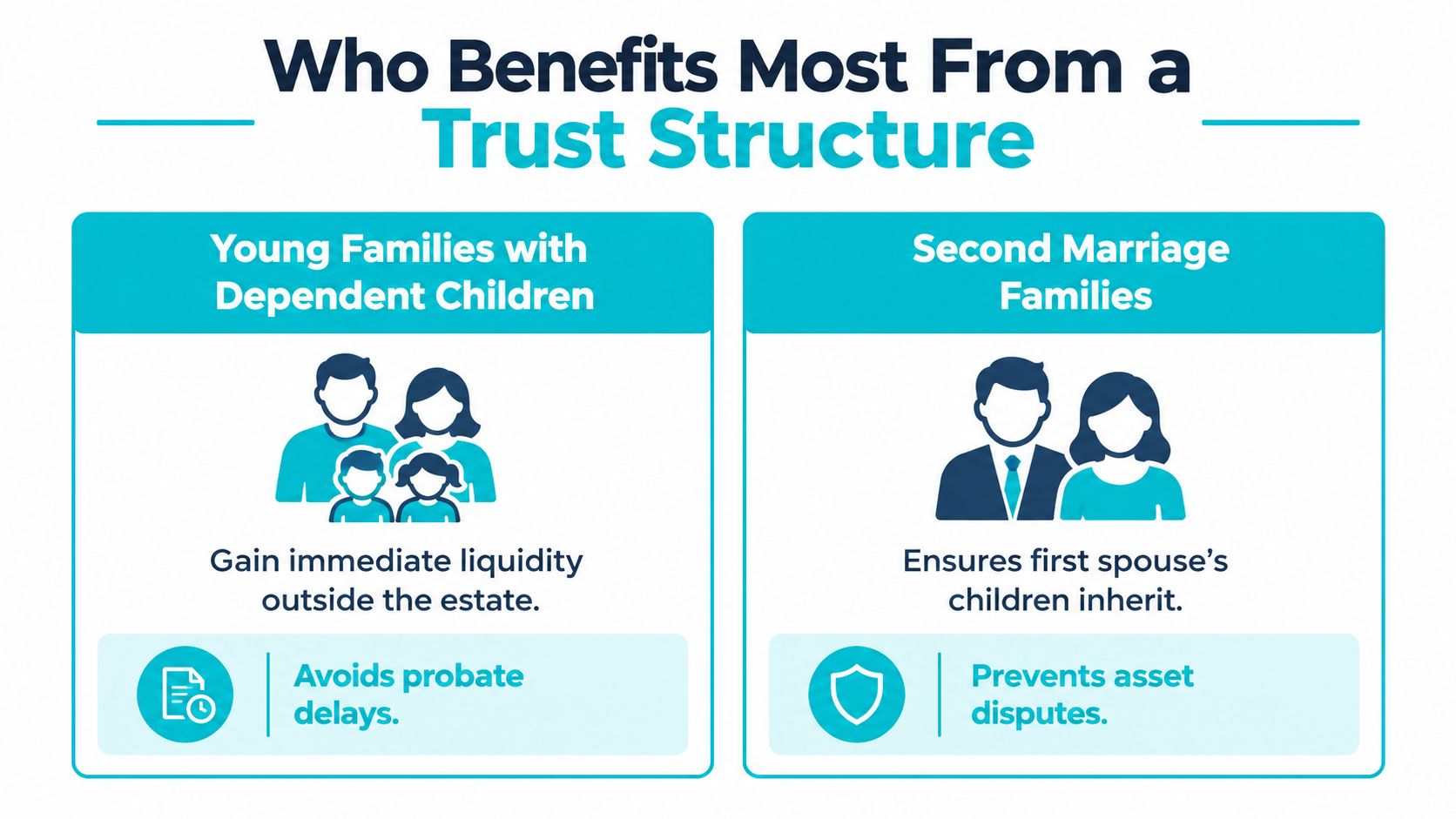
Parents with dependent children may want the proceeds available quickly and managed by an adult rather than paid as an uncontrolled lump sum to a child. A trust can keep the insurance money outside the personal estate and allow the trustee to apply funds to housing, education and living costs under the deed.
That doesn't mean every young family needs a separate trust. If the estate is simple and the intended adult beneficiary can receive and manage the money directly, personal ownership or a carefully maintained super nomination may be more practical.
Business owners
A business owner may need insurance to support a buy-sell arrangement, provide liquidity or protect the family from the financial effect of losing a key person. Trust ownership can help separate the policy from personal assets and create a controlled pathway for the proceeds, but the shareholding agreement, policy ownership and funding obligations must all say the same thing.
A trust won't fix an unfunded buy-sell agreement or a policy that the wrong entity owns. The adviser, accountant and solicitor need to coordinate the documents before the policy is issued.
Blended families
Second marriages and blended families often need two outcomes at once. The surviving partner may need immediate financial support, while children from an earlier relationship need protection against an unintended change of control. A discretionary trust can give the trustee room to apply funds according to carefully drafted terms rather than forcing every beneficiary into the same payment arrangement.
Special-needs beneficiaries, people exposed to bankruptcy risk and beneficiaries who may misuse a lump sum can also benefit from staged distributions. The trust deed must be drafted for that purpose, and the trustee must understand the responsibility involved.
Where the Advice Gets Oversold
“Put the policy in trust” is not a strategy. It's a conclusion that only makes sense after someone has examined your family, estate, policy and intended beneficiaries.
The first problem is cost and administration. A custom trust deed, trustee arrangements, record-keeping and professional reviews create work that personal ownership doesn't. That complexity can be poor value where one adult beneficiary will receive the proceeds cleanly and no meaningful control issue exists.
The second problem is assuming a trust solves superannuation nomination failures. It doesn't. A binding nomination for superannuation death benefits is typically valid for three years and must be renewed to remain effective, as explained in Australian estate-planning and insurance guidance from Zurich. If it lapses, the fund trustee may have discretion under the fund rules. A Will doesn't automatically repair that gap.
Trustee duties are not optional
The trustee must keep the policy in force, act within the deed and maintain a clear separation between trust money and personal money. The trustee also needs to understand who can benefit and whether a nomination is consistent with the trust's terms.
Super ownership can be more practical for some TPD and income protection arrangements because the super trustee may claim eligible premiums as deductions. But the eventual benefit may have different tax and release consequences. Macquarie's adviser material on insurance through super explains the distinction between deductible premiums, disregarded capital gains on the insurance benefit paid to the trustee and possible tax on later superannuation death benefits.
A Will plus a valid binding super nomination is often simpler where:
- The family is straightforward: One partner or a small number of adult beneficiaries can receive and manage the proceeds.
- The estate has no control problem: There are no blended-family, creditor or vulnerable-beneficiary concerns requiring staged distributions.
- The policy is inside super: The nomination can be maintained and aligns with the intended outcome.
- The administration burden matters: You don't want a trust deed and trustee obligations without a clear planning benefit.
Your High-Level Setup Checklist
Good structures are built in an order. Start with the decision, then document the ownership, then maintain the nominations.
Confirm the ownership pathway in writing. Prepare a short strategy memo stating why the policy should be personal, inside super or owned by a trust. Include the intended recipient, payment timing and the role of the Will.
Review the trust deed. Check the trustee's powers, beneficiary classes, distribution provisions and ability to receive insurance proceeds. A trust that cannot do what the strategy requires is not a solution.
Choose trustees carefully. The trustee needs to understand premiums, records, nominations and distributions. If a company acts as trustee, confirm who controls that company and whether succession arrangements match the estate plan.
Nominate beneficiaries clearly. For super-owned cover, the allocation must total 100%, and each nominated person must be eligible under superannuation law and the fund's rules. Keep the nomination consistent with the broader plan.
Review and update regularly. A binding super nomination is typically valid for three years, while broader estate-planning guidance recommends reviewing the estate plan at least once every five years, as outlined in the Zurich guidance cited earlier. Review sooner after marriage, divorce, a new child, a major business change or a change in trustee control.
Before signing anything, compare your documents with a solicitor and adviser. An online tool may help you organise basic information. If you're researching options, find the best will generator, but don't treat a generated Will as a substitute for coordinated advice where trusts, super and insurance interact.
Turning the Decision Into a Plan
The right starting point is not a trust deed. It's a review of what you already own and what you want to happen.
A structured conversation should identify:
- Current ownership: Who owns each policy, and is any cover held through super?
- Family responsibilities: Who depends on your income, and who needs protection or staged support?
- Existing nominations: Are they binding, current and consistent with the Will?
- Superannuation position: Which fund rules apply, and could a death benefit or TPD payment have a different tax outcome?
- Business interests: Does the policy need to support succession, ownership transfer or key-person planning?
- Control after death: Should one beneficiary receive the money directly, or should a trustee manage distributions?
Wealth Collective's Protection Plus process is designed to organise that conversation around personal insurance, superannuation and estate-planning coordination. Its free 10-minute introductory call can be used to review your current ownership, dependants, super balances and nominations before deciding whether a full Protection Plus review is appropriate.
The recommendation may be personal ownership. It may be super ownership with a carefully maintained binding nomination. It may be a trust, but only where the additional control justifies the legal and administrative work. A good adviser won't push one structure onto every client. They'll show you what each path does, where it can fail and which documents need to match.
Wealth Collective helps Australians review personal insurance, superannuation ownership and beneficiary nominations so the policy structure supports the family and legacy outcome you actually want. Visit Wealth Collective to book the free 10-minute introductory call and discuss whether life insurance in trust is appropriate for your circumstances.