Business hours
Monday to Friday (8.30AM - 5PM)
Weekend (Closed)



Australia's compulsory, tax-advantaged retirement savings system held approximately $4.3 trillion as at 30 June 2025. Super is funded primarily by employer contributions and personal savings, helping replace or supplement the Age Pension and turn working-life income into retirement wealth.
That scale makes the question “what is super?” more important than a simple dictionary definition. Superannuation is a long-term investment account with special tax rules, contribution limits, investment choices, insurance arrangements and legal access conditions. The decisions you make while money enters the account can affect how effectively it supports you later.
The system supported 23.3 million member accounts across the Australian workforce as at 30 June 2025, according to APRA's June 2025 superannuation statistics. Understanding your own account is therefore less about memorising jargon and more about knowing where your money comes from, how it's invested, what tax applies and when you can use it.
The Core Purpose of Australian Superannuation
Superannuation works like a walled garden for long-term wealth. Money enters during your working life, receives tax treatment intended to encourage retirement saving, is invested within the fund and remains subject to access rules until you meet the relevant conditions.
That structure separates super from an everyday transaction account. You generally cannot withdraw it whenever you choose, which helps preserve savings for the period when employment income stops or falls. The broader purpose is to help Australians fund retirement rather than depend entirely on government support.
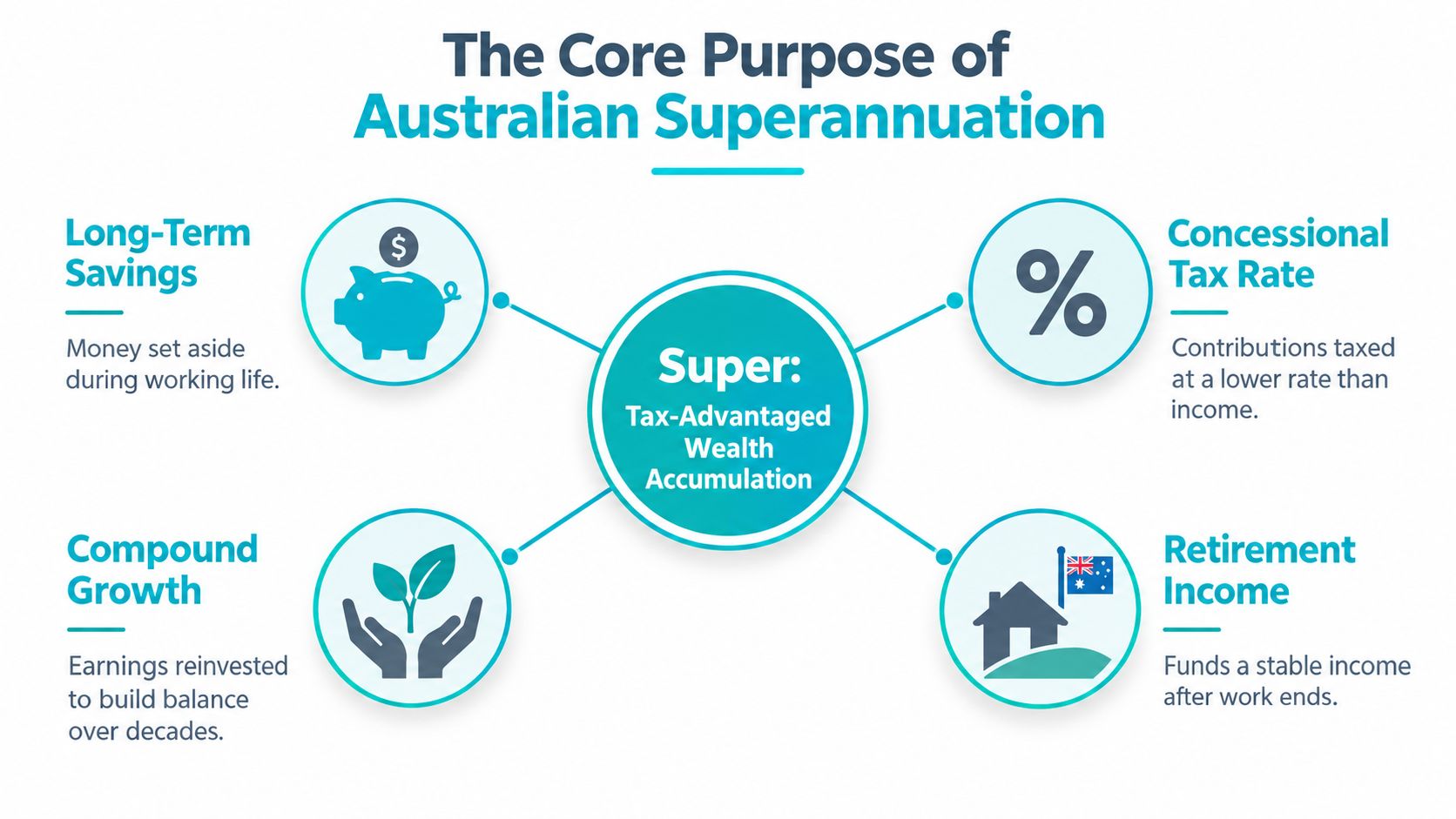
Four jobs your super account performs
Your super account usually performs several functions at once:
- Receives retirement savings: Your employer generally pays compulsory contributions, and you may add salary-sacrifice or personal contributions.
- Invests for the long term: The fund invests your balance across options such as shares, property, fixed interest and cash, depending on the strategy you select.
- Uses a separate tax environment: Contributions and investment earnings are handled under superannuation tax rules rather than ordinary personal-account rules.
- Provides retirement capital: Once you satisfy the applicable release conditions, you may use the balance as a lump sum, an income stream or part of a broader retirement strategy.
Compounding explains why decisions made early can matter later. Investment earnings that stay invested can generate further earnings, although returns are not guaranteed and balances can rise or fall. A longer investment horizon gives your account more time to experience different market conditions and reinvest earnings.
Australia's super system has become one of the world's largest retirement savings pools. That growth is why fund choice, fees, insurance and investment settings deserve attention, even when retirement seems far away. The right settings can differ according to your circumstances, so understanding what superannuation means in Australia provides a useful foundation for reviewing your account.
The same review should consider contribution caps, available tax concessions and the rules that apply to high balances. Wealth Collective's advisory process can help connect those technical settings with practical decisions about building and using retirement wealth.
Practical rule: Treat super as part of your household balance sheet, not as an account you can ignore until the year before retirement.
How Compulsory Employer Contributions Work
The Superannuation Guarantee, usually called SG, requires employers to contribute to super for eligible employees. From 1 July 2025, the legislated rate is 12.0% of ordinary-time earnings, subject to applicable rules and limits, as explained by the Australian Taxation Office.
Ordinary-time earnings usually cover regular hours and salary components. Bonuses, overtime, commissions, leave payments and other remuneration can be treated differently. Checking how each payment is classified helps employees confirm that their super has been calculated correctly.
A simple payroll example
Suppose an employee earns $100,000 in ordinary-time earnings. At the current SG rate, the employer contribution would be $12,000 before investment returns, taxes or other adjustments. The payment generally goes to the employee's nominated complying super fund or the fund chosen under the employer's arrangements.
The SG rate has risen progressively. It was 11.0% during the year beginning 1 July 2023, increased to 11.5% from 1 July 2024 and reached 12.0% from 1 July 2025. The change from 11.0% to 12.0% represents about a 9.1% relative increase in the compulsory rate over those two years.
For a small business owner, the current rate affects payroll software, employment contracts, cash-flow forecasts and payment processes. For an employee, it provides a practical checking point: compare eligible earnings with payslips, fund records and the contributions received.
Why high earners may see a contribution limit
The current quarterly maximum contribution base is $62,500. The maximum compulsory employer contribution for that quarter is therefore $7,500 under the ATO's maximum contribution base.
The cap limits the compulsory SG obligation for that quarter. It does not prevent an employer from contributing more. An employment contract, award or negotiated remuneration arrangement may require additional super, so high-income employees should review the full terms of their package rather than assume the statutory minimum is the entire benefit.
A payroll review should compare ordinary-time earnings, payslips, contribution dates and fund statements. This process can reveal missing payments or classification errors before they affect long-term retirement savings. Wealth Collective's advisory process can then connect these payroll details with contribution-cap decisions and broader wealth-building goals.
Payday super, covered in detail below, is scheduled to tighten payment deadlines from 1 July 2026.
Voluntary Contributions and Tax Concessions
Compulsory employer contributions create the foundation, but many people use voluntary contributions to influence how quickly their retirement balance grows. The first distinction to understand is between concessional and non-concessional contributions.
Concessional contributions generally come from before-tax income. They include employer SG payments, salary-sacrifice contributions and personal contributions you claim as an income-tax deduction. Non-concessional contributions are generally made from after-tax money and aren't claimed as a deduction.
Concessional contributions
Concessional contributions are generally taxed inside the fund at 15%, rather than at the contributor's marginal income-tax rate. That difference can make salary sacrifice useful, particularly for people whose marginal tax rate is higher, but the outcome depends on income, contribution timing, existing employer payments and other tax considerations.
For the 2025–26 financial year, the general concessional-contributions cap is $30,000, according to the ATO's explanation of concessional and non-concessional contributions. Employer contributions count towards this cap. If you earn a salary and receive employer SG, the amount available for salary sacrifice is not the full cap. You need to subtract the employer contributions expected for the year first.
Unused concessional-cap amounts from prior years may be carried forward, subject to the relevant eligibility rules. That can create planning opportunities, but only if you check your available amounts and reconcile them against payroll records.
Non-concessional contributions and government support
After-tax personal contributions don't usually receive the same immediate deduction, but they can suit people who have available cash, irregular income or proceeds from selling an asset. They count towards the non-concessional cap, so they also need to be planned carefully.
Eligible low- and middle-income earners may receive an Australian Government co-contribution of up to $500 for 2025–26 when they make qualifying personal after-tax contributions that aren't claimed as a deduction. The higher income threshold is $62,488, and eligibility also depends on factors such as age, employment income, complying-fund status and total super balance. The ATO's personal super contribution instructions explain the conditions.
The Low Income Superannuation Tax Offset may also refund up to $500 into super for eligible people with adjusted taxable income of $37,000 or less, offsetting tax paid on eligible concessional contributions. These benefits aren't interchangeable. A deductible personal contribution is concessional, while an eligible non-deducted contribution may qualify for the co-contribution and counts as non-concessional.
Before adding money: Check the contribution type, the cap it uses and whether your employer has already used part of the available concessional limit.
High-income earners need an extra check. Where income plus concessional contributions exceeds $250,000, Division 293 tax may impose an additional 15% tax on some or all taxable concessional contributions. A contribution strategy should therefore reconcile payroll data, existing employer contributions, carry-forward amounts and Division 293 exposure. The ATO's guidance on personal super contributions provides the relevant tax context.
A detailed guide to concessional contribution limits can help you identify the questions to ask before changing salary sacrifice or making a deductible contribution.
Navigating High Balances and Payday Super Reforms
A growing super balance can strengthen retirement security, but it also changes the planning task. Tax treatment, investment choices and coordination with business, property and personal assets become more important as super represents a larger share of your wealth.
From 1 July 2026, people whose total super balance exceeds the $3 million large super balance threshold will face an additional 15% tax on the proportion of earnings related to the amount above that threshold, according to the Australian Taxation Office's explanation of the reform.
What the threshold doesn't mean
Crossing the threshold does not place the higher tax on the entire super balance. The additional tax applies to the share of earnings associated with the amount above the threshold. For 2026–27, the very-large-balance threshold is $10 million, with a further 10% applying to the portion above it. Both thresholds are scheduled to be indexed to CPI.
The calculation may involve several moving parts, including market movements, multiple super funds, and contributions or withdrawals made during the relevant period. A headline threshold alone is not a reason to withdraw money or stop contributing. The sound choice depends on your tax position, investment mix, retirement-income needs and estate plan.
What payday super changes for business owners
From 1 July 2026, employers are scheduled to pay super with each payday instead of quarterly. The contribution rate remains 12%, but the shorter payment cycle changes how owners manage cash flow, payroll approvals and clearing-house processes.
For a Western Australian small business, quarterly payments may currently leave a temporary cash-flow buffer. Payday payments reduce that buffer, so the business needs to reserve the contribution amount as each pay run is processed. Owners should review:
- Payroll settings: Confirm qualifying earnings and contribution calculations.
- Cash-flow planning: Set aside super alongside wages, tax and other employment costs.
- Payment systems: Check that the clearing house and fund can transmit contributions promptly.
- Contractor arrangements: Assess whether a contractor may be entitled to super based on the working arrangement.
- Exception handling: Set up a process for correcting rejected or delayed payments.
Payday super keeps the eligibility rules and basic 12% rate in place. Its practical effect is an earlier operational deadline, which makes accurate payroll records and sufficient working capital more important. A Wealth Collective adviser can help business owners connect these payroll changes with contribution-cap decisions and broader wealth planning.
Preservation Rules and Accessing Your Retirement Wealth
Super's restrictions are part of its design. The same rules that prevent casual withdrawals during your working life help preserve the account for retirement, but they also mean you need a release strategy before you reach the point of relying on the money.
Access usually depends on reaching your preservation age and satisfying a condition of release. Retirement is one pathway, while reaching age 65 is another. Other legal triggers can apply in specific circumstances, so the correct answer depends on your age, work status and personal situation.
The three decisions behind a retirement strategy
Access isn't the same as spending. Once release conditions are met, you still need to decide how the money should support your lifestyle.
- Choose the access timing. You may retire fully, reduce work or continue working while using an appropriate transition-to-retirement arrangement, subject to the governing rules.
- Choose the payment structure. A lump sum provides flexibility, while an income stream can create regular retirement cash flow. Some people use a combination.
- Choose the investment risk. The appropriate mix may change as the account moves from accumulation to drawdown. A member taking regular income may need a different balance of growth assets and defensive assets from someone with many working years ahead.
A transition-to-retirement strategy can be useful for someone reducing work hours while preserving income, but it isn't automatically suitable. The tax treatment, payment limits, investment settings and employment circumstances all need to be assessed together.
The account also needs an insurance review before retirement. Cover that made sense while you had employment income and dependants may no longer fit once you stop work. Conversely, cancelling cover without considering health, family and financial obligations can leave a serious gap.
The rules about when you can access super are technical because the consequences of getting the timing wrong can be significant. Retirement planning should connect the super balance to other assets, debts, Centrelink considerations, spending needs and estate objectives.
Retirement insight: A balance is not a retirement plan. You need a reliable way to convert capital into income without taking unnecessary investment or tax risk.
Optimising Your Super with Wealth Collective
Super optimisation isn't one isolated transaction. It's an ongoing process that aligns contribution timing, investment selection, insurance, account structure and retirement income with the rest of your financial life.
For a young professional, the priority may be checking the fund's investment option, consolidating unnecessary accounts and deciding whether salary sacrifice fits the household budget. For a dual-income family, the decisions may include coordinating contributions, reviewing insurance and balancing super growth against a mortgage or other debt. A high-income executive may need to consider the concessional cap, Division 293 exposure, carry-forward amounts and the interaction between super and investments outside the fund.
Small business owners face a different set of questions. They need to keep employee contributions accurate, prepare for payday super, manage working capital and protect the business and family if illness or incapacity interrupts income. Pre-retirees and retirees need to shift attention towards access conditions, investment volatility, pension payments, tax and the sequence in which they use different assets.
A practical review framework
A useful review starts with evidence rather than assumptions:
- Contribution audit: Compare employer payments with ordinary-time earnings and check whether salary sacrifice has been processed as intended.
- Cap assessment: Identify concessional contributions already made, available carry-forward amounts and possible Division 293 exposure.
- Investment review: Check whether the investment option reflects your time horizon, capacity for loss and retirement date.
- Insurance check: Test whether cover inside super remains appropriate for your dependants, debts and income.
- Retirement roadmap: Estimate how the balance may support income, then coordinate it with cash, property, business interests and government benefits.
Wealth Collective's Guided Growth process addresses superannuation optimisation, investment strategy, debt reduction and wealth building. Its Retirement Roadmap focuses on converting accumulated assets into a structured retirement plan, while Protection Plus addresses personal insurance and financial resilience. The firm offers a free 10-minute introductory call before developing advice designed around a client's circumstances.
The key lesson is simple. Super is not just money your employer sends to a fund. It's a tax-structured investment vehicle with rules that reward deliberate planning and penalise avoidable mistakes. Reviewing it periodically can help you identify unsuitable investments, duplicated accounts, missing insurance, uncoordinated contributions or an income strategy that doesn't match your retirement goals.
Wealth Collective can review your super contributions, investment choice, insurance and retirement access strategy, then connect those decisions with your broader wealth plan. Visit Wealth Collective to book a free 10-minute introductory call and discuss practical opportunities to build, protect and use your retirement wealth.