Business hours
Monday to Friday (8.30AM - 5PM)
Weekend (Closed)


For a healthy Australian professional, income protection premiums typically land between roughly 1% and 6% of insured annual income each year. The only honest answer for you is a personalised quote, because the waiting period, benefit period, occupation and definition of disability can swing the price far more than the insurer's brand.
You may be comparing quotes at the kitchen table, trying to work out whether cover fits alongside a mortgage, school fees, super contributions and everyday bills. The uncomfortable question is simple: if your pay stopped because illness or injury kept you from working, how long could your household run normally?
A headline price can help you set expectations, but it can't tell you whether the policy is suitable. The right premium is the cost of a contract that starts paying when your savings and sick leave run out, continues for the period your family needs, and uses a disability definition that reflects the work you do.
What Income Protection Actually Costs in Australia
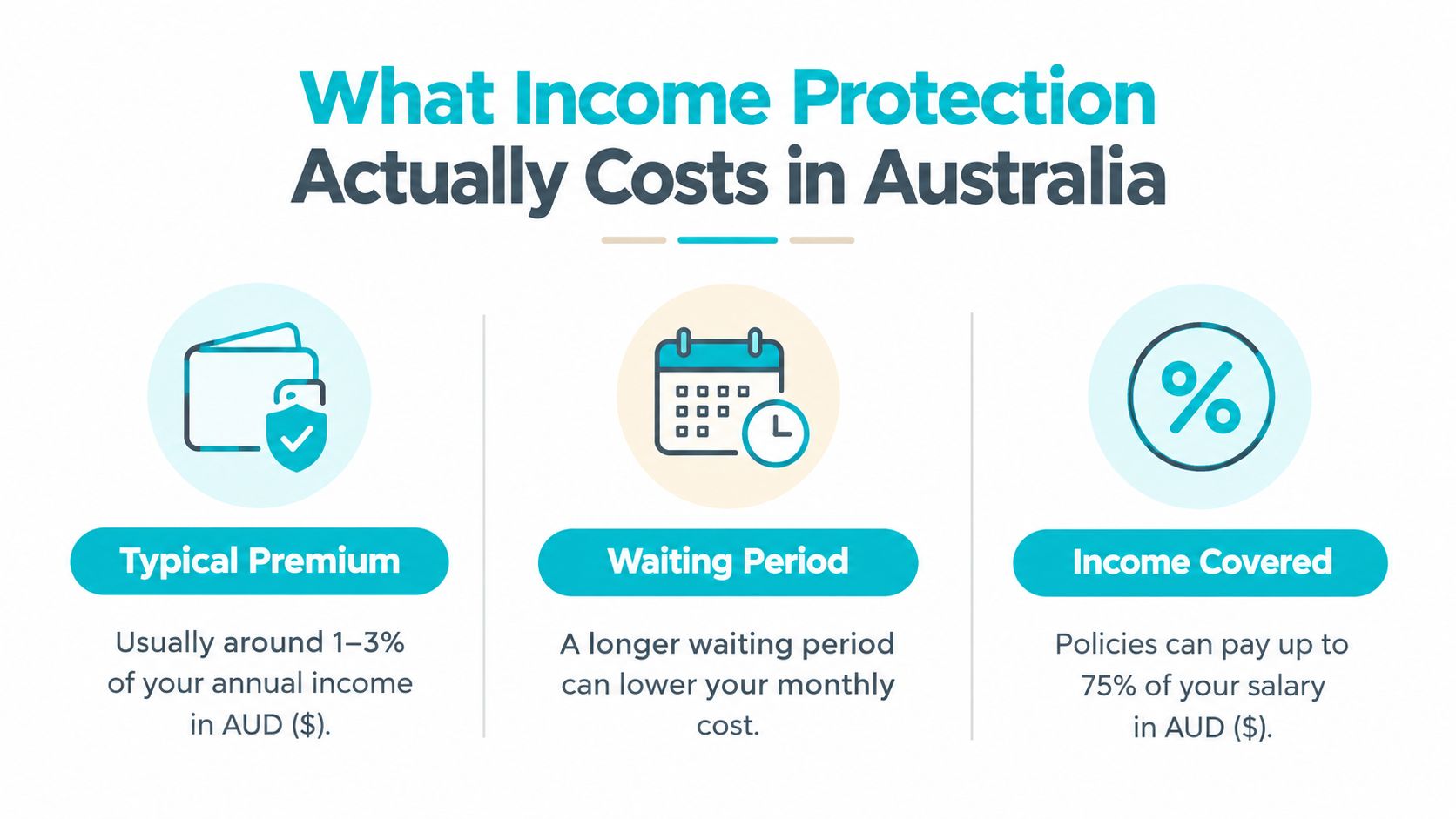
A healthy professional may pay roughly 1% to 6% of insured annual income for income protection, but treat that as a starting range, not a quote. The figure changes with age, occupation, health, smoking status, benefit amount, waiting period, benefit period, policy wording and whether the policy is owned personally or through superannuation.
Australia's market is substantial. APRA-reported figures for December 2023 indicate that approximately 2.8 million Australians held income protection policies, while insurers recorded about $3.2 billion in annual premium income. That premium total describes money paid for cover, not benefits ultimately claimed, and it isn't a price guide for a particular Perth household. The Australian market figures and their limitations are outlined here.
The three price levers that matter most
The waiting period determines how long you fund yourself before the insurer starts paying. A longer wait can reduce the premium, but only makes sense if your sick leave, savings or other household income can carry the gap.
The benefit period determines how long payments can continue. Shorter cover may suit someone with substantial assets or strong employer support. A longer period costs more because the insurer is taking on exposure to a longer absence from work.
The definition of disability determines whether you qualify. Own-occupation cover generally tests whether you can perform your specific job, while an any-occupation test can require you to be unable to perform other suitable work. Those are very different promises.
If you want a broader comparison of policy features and insurer selection, Wealth Collective's guide to income protection insurance in Australia is a useful starting point. Don't use a single advertised premium as your decision. Use it to begin a household model.
How an Income Protection Policy Works
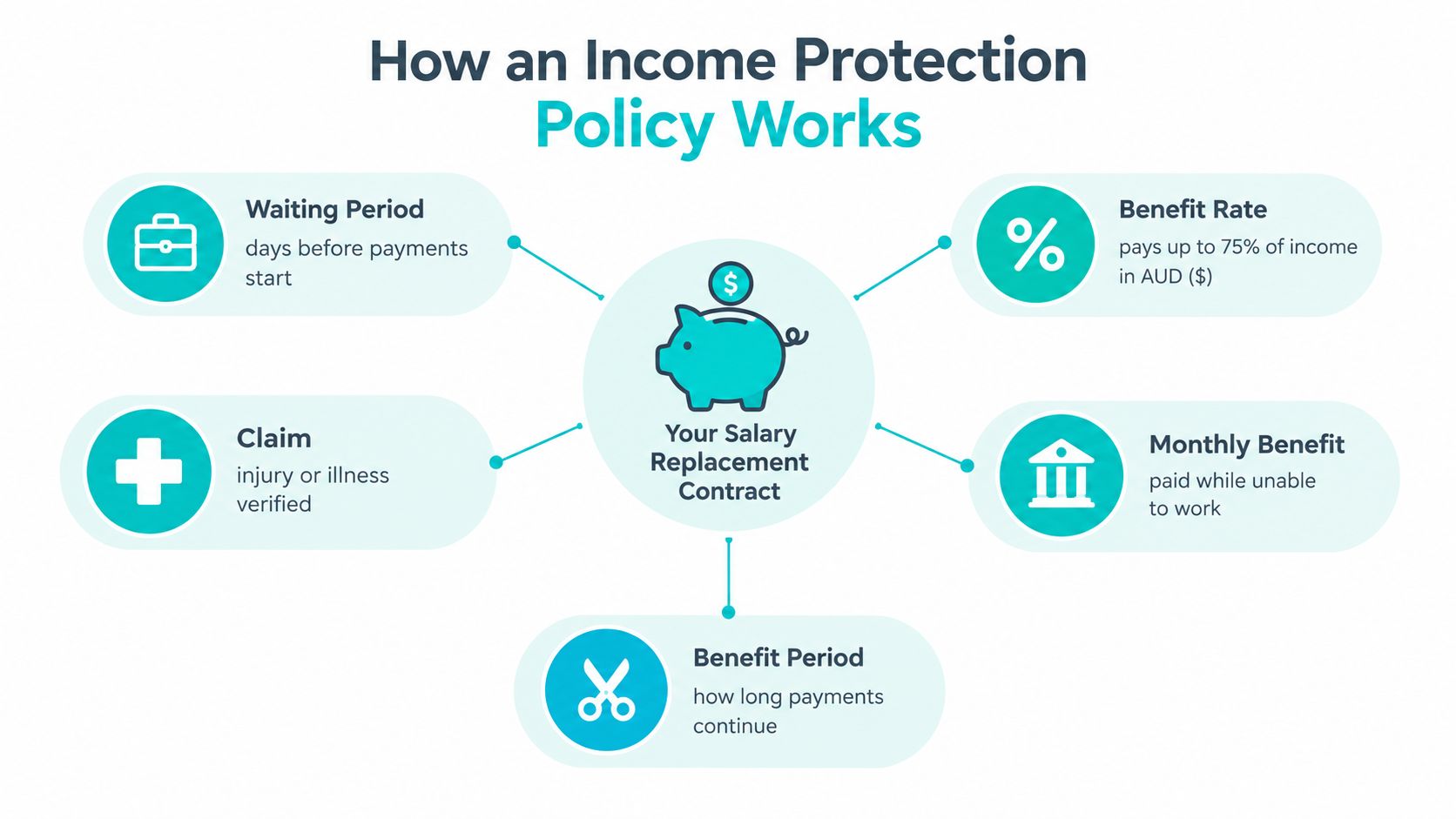
Income protection is a salary replacement contract, not a lump-sum windfall. If illness or injury stops you working and you meet the policy definition, the insurer pays a monthly benefit based on your pre-disability income and the contract terms.
Moneysmart gives examples of policies replacing 75% or 90% of pre-tax income, with the benefit generally calculated using annual earnings during the 12 months before illness or injury. That means your cover should reflect actual earnings, employment structure, debts and essential spending, rather than a standard dollar amount. Moneysmart explains the income calculation and policy structure.
Think of the policy as a financial bridge
The waiting period sets where the bridge starts. If you choose a 90-day wait, your savings, sick leave or partner's income must carry the household until that period ends. A shorter wait starts the bridge earlier, but insurers generally charge more for taking on that earlier exposure.
The benefit period sets how far the bridge reaches. A two-year benefit period may cover a temporary disruption, while a benefit period extending to age 65 is designed for a longer interruption to earning capacity. Neither is automatically right. The correct choice depends on assets, debt, employability, business continuity and the income your household would still receive.
Read the disability definition before admiring the price
A policy may assess your ability to perform your own occupation, another occupation suited to your education and experience, or any occupation. A surgeon, electrician, dentist, executive and small-business owner can each face a very different financial consequence from a definition that treats them as able to work elsewhere.
Also check how the policy handles partial disability, rehabilitation, offsets, indexation, mental health claims and changing income. These details affect what the contract promises when you can work in a reduced capacity, not just when you stop work completely.
For broader context on how business owners can think about protection structures and tax considerations, Stewart Accounting Services' guidance on key-person policies provides useful background. It isn't a substitute for Australian policy advice, but it helps clarify why personal income protection and business risk protection shouldn't be treated as the same thing.
The Six Variables That Move Your Premium
Insurers price the insured monthly benefit, not an arbitrary lump sum. The ATO identifies the main pricing inputs as occupation risk, age, gender, smoking status, health history, benefit amount, waiting period, benefit period, policy definitions and stepped or level premiums. The ATO's income protection guidance explains the pricing and benefit framework.
| Variable | Lower premium | Higher premium | Typical effect |
|---|---|---|---|
| Occupation | Lower physical and underwriting risk | Higher physical, medical or hazardous risk | Riskier work generally costs more |
| Age | Younger applicant | Older applicant | Premiums generally rise as age and claim exposure rise |
| Health and smoking | Strong health history and non-smoker status | Relevant conditions or smoking | Underwriting may increase cost, apply exclusions or alter terms |
| Monthly benefit | Lower insured benefit | Higher insured benefit | More replacement income creates a higher premium |
| Waiting period | Longer wait | Shorter wait | Longer waits usually reduce cost |
| Benefit period and definition | Shorter period or narrower protection | Longer period and stronger disability definition | More comprehensive promises generally cost more |
Risk profile comes before brand
A 30-year-old office-based professional and a 55-year-old tradesperson can request the same monthly benefit and receive very different quotes. The difference isn't arbitrary. The insurer is assessing the likelihood of a claim, the potential duration of that claim and the contract's test for disability.
Age, health history, smoking status and gender all influence underwriting. You shouldn't hide or minimise relevant medical information to chase a lower price. A cheap application that creates disclosure problems at claim time is a false economy.
Contract settings are choices, not technical fine print
The monthly benefit is tied to income and policy limits. A higher benefit costs more, but underinsuring can leave the household unable to meet mortgage repayments, childcare, medical costs and basic living expenses.
The waiting period is the easiest setting to understand. If your employer provides meaningful sick leave and you hold a reliable cash reserve, you may tolerate a longer wait. If you're self-employed, a contractor or a small-business owner whose income stops quickly, a shorter wait may be worth the additional premium.
Benefit period and disability definition require more judgement. A short benefit period can be reasonable where you have assets and a clear return-to-work plan. Own-occupation cover usually provides a more relevant test for specialised professionals, but the contract must be read carefully.
Stepped or level premiums
Stepped premiums often begin lower and rise as you age. Level premiums generally begin higher but are structured to provide more stable pricing over time, subject to the policy terms and possible insurer changes.
Don't compare only the first year's premium. Ask how the premium structure fits your working life, expected income and future affordability. The lowest opening price may not be the lowest long-term cost, and the strongest contract may not be the right choice if it becomes unaffordable later.
Three Realistic Cost Scenarios for Western Australian Households
The examples below show how to think about policy design, not what any person will be quoted. There are no verified insurer rates for these profiles, so I won't invent monthly premiums or pretend that a demographic description produces a reliable price. The useful figures are the insured incomes and the benefit examples supplied by Moneysmart.
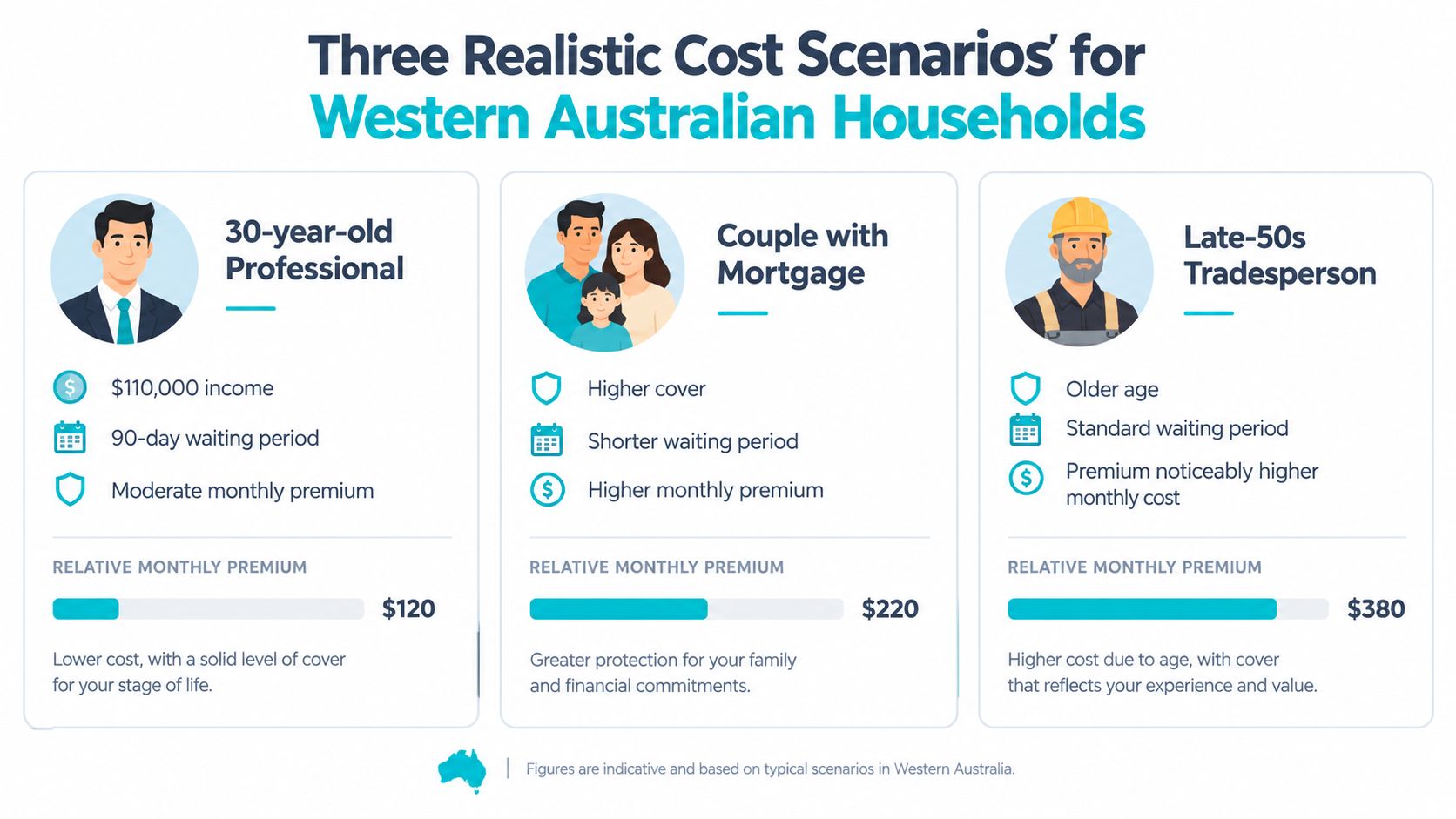
A 30-year-old professional on $110,000
A professional earning $110,000 may consider a 90-day waiting period and a benefit period extending to age 65. Using Moneysmart's 75% or 90% examples as a guide, the theoretical replacement range would be calculated from the policy's accepted income and limits, rather than assumed as a guaranteed payment.
The 90-day wait can suit someone with accumulated leave and accessible savings. It becomes dangerous if the household has only a small cash buffer or if rent, mortgage and fixed commitments continue without interruption. Before choosing it, calculate the cash required for the full waiting period.
A 42-year-old dual-income family earner on $95,000
A family earner on $95,000 may prefer a 60-day waiting period and a two-year benefit period. The second income can help carry household costs, which may make a shorter benefit period workable, but the decision should account for mortgage repayments, dependants, school costs and the partner's job security.
Stress-test the plan against reduced household income. If the family can cover core expenses from the partner's income and savings, the shorter benefit period may control cost. If one income is carrying most of the debt, a longer period could be more appropriate.
A 50-year-old small-business owner on $180,000
A business owner earning $180,000 may want a 30-day waiting period and cover extending to age 65. That combination can be expensive because it offers earlier payments and potentially longer claim exposure, while underwriting may also examine the owner's occupation, health, business structure and income history.
The business needs its own continuity plan. Personal income protection won't automatically pay staff, preserve revenue or replace a key person's operational contribution. Separate those questions from the household's need to replace personal earnings.
Practical rule: Change one setting at a time. If you shorten the waiting period and extend the benefit period together, you won't know which decision caused the premium change.
For each profile, request quotes using identical benefit amounts, waiting periods, benefit periods, occupation definitions, indexation and premium structures. Then compare the gross premium, expected after-tax cost, cash required during the waiting period and the consequences if the benefit period ends before the household has recovered.
Tax Treatment and the Real Net Cost
The gross premium isn't the whole price. Under ATO guidance, premiums paid personally for insurance against loss of employment income are generally deductible, while premiums paid through superannuation and deducted from super contributions aren't personally deductible. The ATO explains the deductibility of income protection premiums.
The ATO gives a practical example involving a $250 monthly combined premium. The premium contains $175 for income protection and $75 for personal-injury cover. Only the $175 income-protection component is deductible, assuming the relevant requirements are met.

Calculate the net cost properly
Start with the eligible personally paid premium. Estimate the tax saving using your marginal tax rate, then subtract that saving from the gross premium. The result is an indicative net cost, not a guaranteed refund, because the outcome depends on ownership, premium allocation, taxable income and the policy's exact structure.
Don't assume a bundled policy is fully deductible. Ask the insurer or adviser to identify the income-protection component clearly. For broader financial-services tax context, Wisely's tax advisory for finance leaders offers useful background on how tax analysis fits into financial decision-making.
Claim payments replacing salary or wages remain taxable income. Your household budget should therefore model the after-tax amount you can use, not just the policy's stated monthly benefit. Wealth Collective's guidance on whether income protection is tax deductible covers the distinction between premium deductions and taxable benefits.
Why the Cheapest Quote Is Often the Most Expensive Mistake
A lower premium usually means the insurer is making a smaller promise, taking on less risk or asking you to carry more of the burden. The price may fall because the waiting period is longer, the benefit period is shorter, the disability test is harder or the premium structure starts cheaply and rises later.
Claims data gives useful context, but it doesn't turn a policy into a guarantee. ASIC's major review examined data from 1 January 2013 to 31 December 2015 and found an average income protection declined-claim rate of approximately 7% across the reviewed data. The same review reported that around 90% of life-insurance claims across the products reviewed were paid in the first instance. The review and later APRA reporting are discussed here.
Earlier APRA reporting discussed in that source showed finalised income protection acceptance rates of about 95% to 97% for two reporting groups, with a typical claim timeframe of approximately 1.7 months. Those are historical benchmarks, not promises about your claim. Policy wording, medical evidence, disclosure, exclusions, waiting periods and the contractual disability definition still decide the outcome.
What a cheap quote may conceal
Ask these questions before you celebrate a saving:
- What disability test applies? Own occupation and any occupation can produce very different claim outcomes.
- When do payments start? Match the waiting period against sick leave, savings and partner income.
- How long can payments continue? A short benefit period may end while you still can't earn.
- How does the premium change? A stepped structure may become harder to afford as you age.
- What income is covered? Check how the insurer defines earnings for employees, contractors and business owners.
- What exclusions and offsets apply? Other benefits or policy conditions may reduce what you receive.
Saving a small amount each month isn't worthwhile if the contract fails to protect the risk that keeps you awake. Choose the cheapest policy only after confirming that its waiting period, definition, benefit period and premium path suit the household.
A Five-Step Process to Estimate and Compare Your Premium
Calculate the monthly income to insure. Start with your actual earnings and use the policy's permitted percentage, with Moneysmart's examples of 75% or 90% of pre-tax income as a reference point. Then remove expenses the benefit won't need to fund and account for tax.
Choose the waiting period. Match it to sick leave, savings, partner income and business cash flow. Don't choose a long wait that leaves you unable to pay the mortgage.
Choose the benefit period. Consider whether your household needs short-term recovery support or protection against a prolonged loss of earning capacity.
Compare equivalent quotes. When you compare income protection policies, keep the benefit amount, waiting period, benefit period, occupation definition, indexation and premium structure consistent.
Model the after-tax cost and stress-test the contract. Apply the ATO deductibility logic to eligible personal premiums, then ask what happens if you need to fund the waiting period, work only partially, face a claim assessment issue or outlive the benefit period.
A quote comparison is valid only when the underlying promises match. If one policy starts later, ends earlier or uses a weaker disability definition, its lower premium isn't evidence of better value.
Turning a Price Question Into a Protection Plan
The three decisions I prioritise are straightforward. Match the waiting period to your liquidity, not to the cheapest quote. Choose an own-occupation definition where the budget and underwriting allow it, particularly when your career depends on specialised skills. Finally, compare the after-tax cost, not just the premium printed on the quote.
Policy ownership, superannuation funding, income structure and underwriting can still change the result. Wealth Collective's Protection Plus process reviews those moving parts, compares suitable cover and connects the recommendation to the rest of your financial plan. Its Perth and Dunsborough advisers offer a free 10-minute introductory call before making recommendations.
Wealth Collective can help you model income protection against your household cash flow, debts, superannuation and long-term goals, rather than selecting cover from a generic price table. Visit Wealth Collective to book a free 10-minute introductory call and start a practical Protection Plus review.