Business hours
Monday to Friday (8.30AM - 5PM)
Weekend (Closed)



You're sitting at the kitchen table with your latest super statement open. The balance looks substantial, but you still can't answer the questions that matter: When can I stop work? How much can I spend each year? What happens if markets fall just as withdrawals begin? Then the Age Pension rules, tax, health costs and your partner's plans add another layer of uncertainty.
That's the point at which many Australians search, “Do I need a financial planner for retirement?” My direct answer is this: you probably don't need ongoing advice if your finances are simple and you're confident making coordinated decisions. You should seriously consider advice if several major decisions interact, or if you can't explain your retirement plan in clear dollar terms.
The Moment Most Australians Start Asking This Question
The question usually appears in the later part of working life, not because you've failed, but because retirement has stopped feeling theoretical. Your super balance is larger, your intended retirement date is closer, and every market headline feels more relevant. You may also be wondering whether stopping work changes your access to super, your tax position or your eligibility for government support.
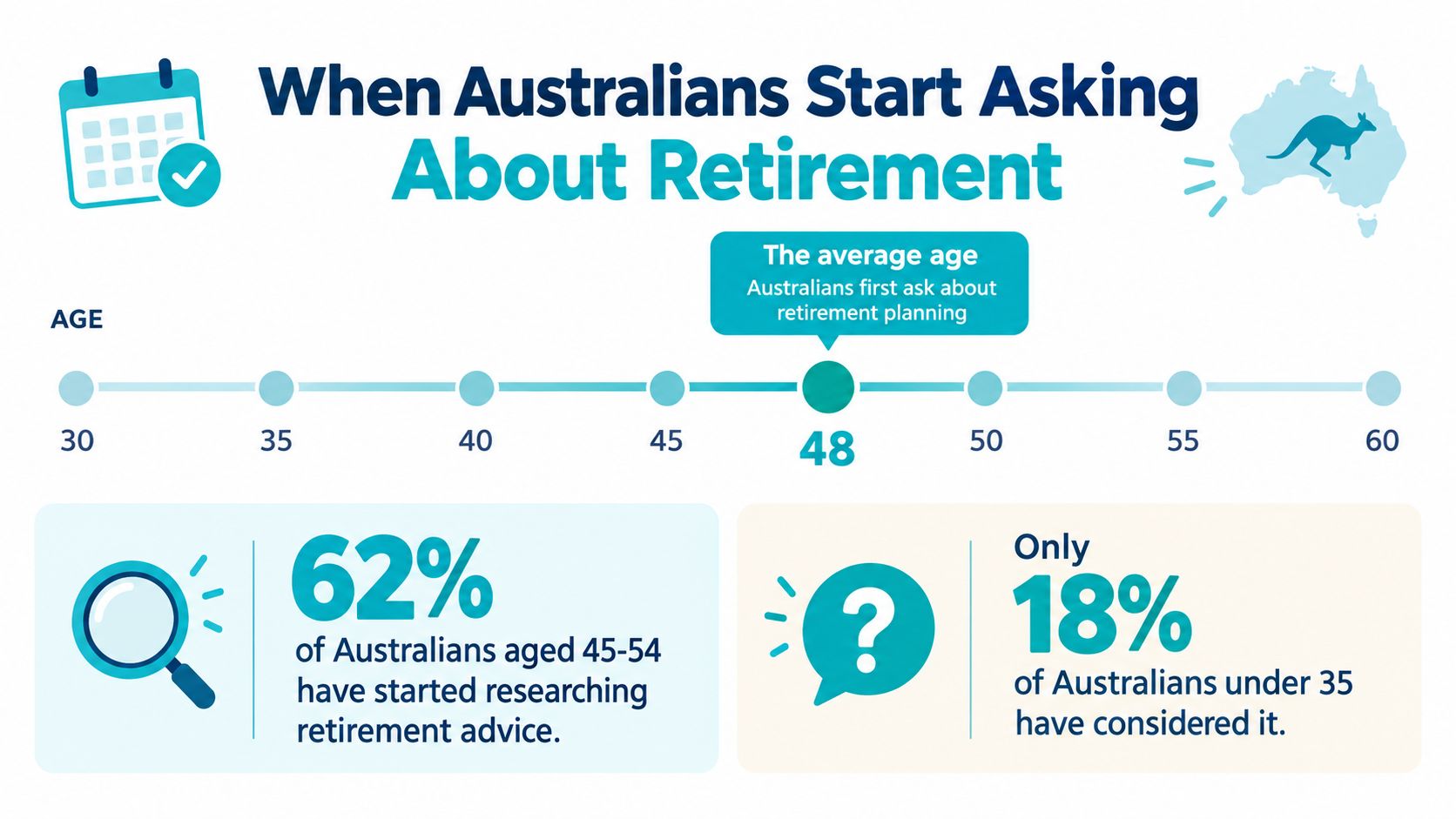
That concern is reasonable. Among Australians aged 50 to 66, 48% worry they'll run out of money in retirement, 32% feel behind in their preparation, and only 18% report having a clear financial plan, according to ASIC's research into retirement confidence. Those figures don't mean everyone needs a financial planner. They show that many people reach this stage without a plan they can confidently test.
Start with the decisions, not the job title
A useful first check is whether you can answer three questions:
- Retirement timing: What income will replace your salary, and when will it start?
- Spending: What annual amount can you spend without making your savings fragile?
- Contingencies: What happens after a market fall, a health event or a change in your work plans?
If you can answer those questions using your own figures, understand the assumptions and know when you'll review them, DIY planning may be perfectly suitable. If you can't, professional advice can turn a vague concern into an organised decision process.
The rest of the answer depends on the moving parts in your life. A couple with one super fund, no debt and modest spending needs faces a different problem from a business owner with property, several accounts, adult children and an uncertain retirement date.
Why Retirement Has Become a Bigger Decision Than It Used to Be
Retirement planning used to be presented as a superannuation question. In practice, it's an income-management problem. You're deciding how to convert accumulated assets into reliable spending while coordinating investment risk, tax, Centrelink rules, inflation, longevity, health costs and estate intentions.
The scale of the transition is significant. ASIC reported that approximately 3 million Australians would become eligible to start drawing on superannuation during the following decade, alongside around 6 million people already at or above preservation age, as reported in its Moneysmart retirement planner update. Yet only 27% of Australians had ever received personal financial advice, so plenty of people approach retirement without customised guidance.
Accumulation is only half the job
Many savers understand how to add money to super. Fewer have a documented answer for which account to draw from first, how withdrawals affect taxable income, how much cash to hold, or how a partner's position changes the household result.
That's why the reasons Australians seek advice tend to be practical: investment structure, retirement-income planning, superannuation growth and household cash flow. These aren't isolated choices. A withdrawal decision can affect tax. An investment change can affect risk. A change in assessable assets or income can affect Age Pension outcomes.
Practical rule: If one mistake could affect decades of household income, don't judge advice solely by whether it produces a higher investment return.
The same principle applies if retirement involves a move overseas. Before making a major lifestyle decision, read about planning your Spanish retirement move and then have the tax, currency, residency and income implications assessed against your broader Australian plan.
A planner isn't mandatory. The right question is whether your retirement decisions are connected tightly enough that a spreadsheet, calculator or general investment account can't give you a reliable answer.
Self-Direction Versus Professional Advice at a Glance
DIY retirement planning can work. It requires more than selecting an investment option and hoping the balance lasts, though. You'll need to set assumptions, track spending, understand super access rules, review investment risk and update the plan when circumstances change.
For a straightforward household, ASIC's Moneysmart tools can provide a useful starting point. The limitation is that general calculators won't know your full family structure, health concerns, property exposure, tax position or preferred legacy strategy.
| Your situation | Often workable on your own | A planner typically adds value |
|---|---|---|
| One or two uncomplicated super accounts | You're comfortable consolidating, selecting investments and monitoring fees | The planner checks whether consolidation, investment risk and insurance settings fit your retirement plan |
| Stable spending and no major debt | You can estimate income needs and maintain a cash-flow plan | The planner tests spending against market falls, inflation and changing retirement dates |
| No property, business or complex family arrangements | You can research general super and Age Pension information | The planner coordinates super, tax, government benefits and beneficiary decisions |
| Several income sources or investment assets | DIY becomes harder because withdrawals and tax interact | The planner models sequencing across super, investments, property income and cash |
| Low confidence about your target retirement date | You may keep working or saving without knowing whether it's necessary | The planner quantifies the capital, spending and contingency assumptions behind the decision |
| You want accountability during retirement | You can set your own review dates and act on them | The planner provides an organised review process as markets, health and policy change |
The strongest case for advice appears when complexity and uncertainty occur together. One complicated asset may be manageable. Several connected decisions are where errors become harder to spot.
You also don't have to choose between complete independence and a permanent advisory relationship. Some people need a one-off plan, a second opinion or help at the retirement transition, then manage their investments themselves.
The Decision Variables That Actually Drive the Answer
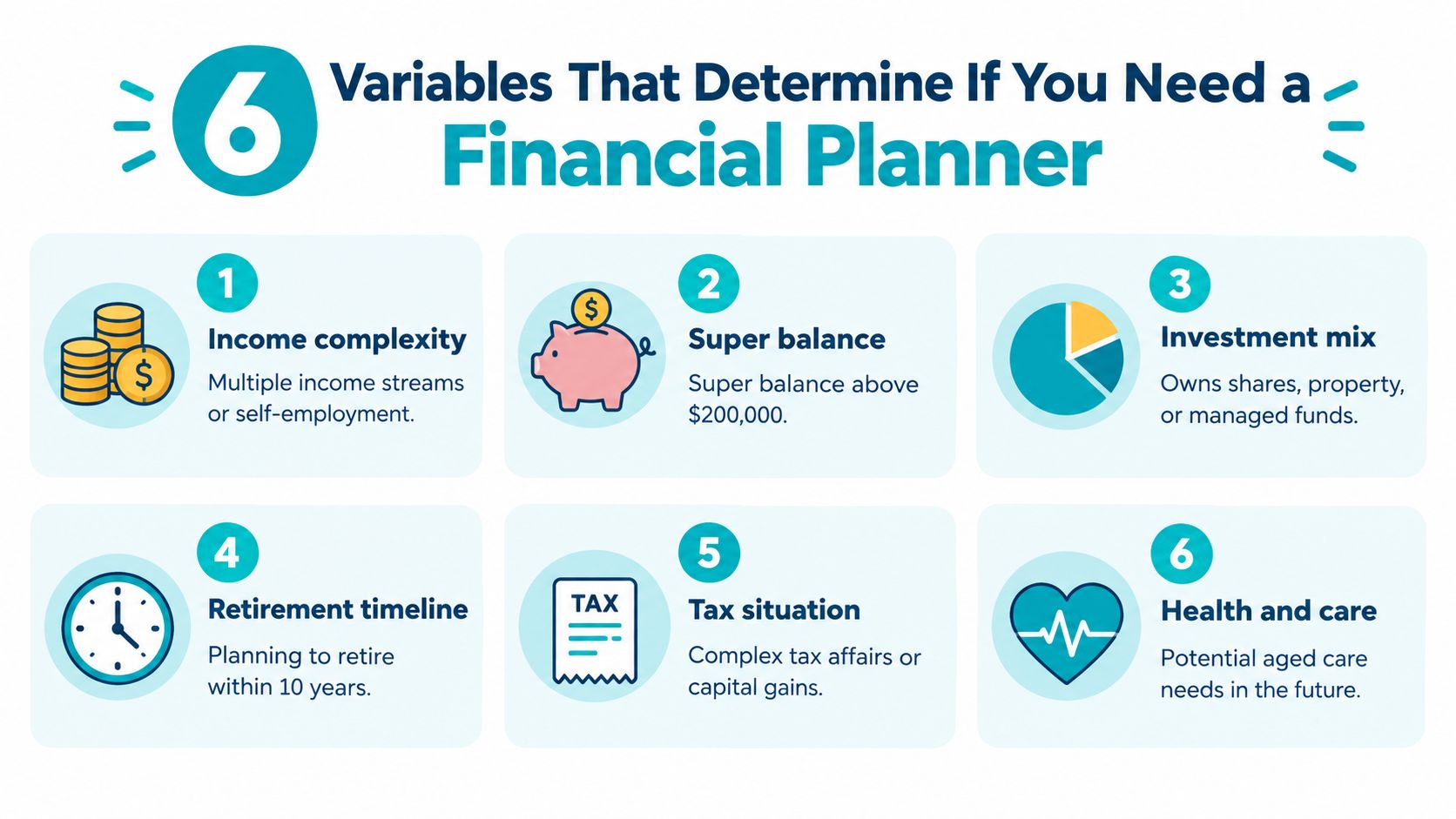
Use these six variables as a personal rubric. Tick the ones that describe your household. One or two may not justify advice on their own. Several together usually warrant a proper conversation.
Complexity in your financial life
Multiple super accounts, an investment property, a private company, shareholdings or a blended family all add decisions. A business owner may need to coordinate a sale, debt repayment, personal super and future income. A couple with different retirement dates may need separate transition strategies.
Complexity doesn't automatically mean a planner is necessary. It does mean you should understand how each decision affects the others before acting.
Tax and Age Pension interaction
The Age Pension uses both an income test and an assets test. The published 2026 income cut-off point is $2,701.40 per fortnight for a single person and $4,128 combined for a couple living together, according to Services Australia's income-test guidance.
Asset thresholds also vary by relationship status and homeownership. The 2026 asset-test free areas range from $333,000 for a single homeowner to $766,000 for a couple who don't own their home, based on Services Australia's asset-test information. That's why a withdrawal, gift, investment sale or change in housing can't be assessed in isolation.
Estate and family goals
If you want to help adult children, leave a specific inheritance, support a partner or fund possible aged care, your spending plan must include those priorities. Superannuation death benefits and beneficiary nominations also deserve deliberate attention.
Health and longevity
An early retirement, family history of longevity or a realistic possibility of aged-care costs changes the amount of flexibility you need. You may value guaranteed income, accessible cash or a more defensive investment structure differently from someone with no dependants and substantial non-super assets.
Decision confidence
Can you state your retirement date, sustainable annual spending and response to a major market fall? If you and your partner have different answers, that confidence gap is itself a reason to seek help.
Time until retirement
The five-to-ten-year period before retirement deserves particular attention. Contributions, debt reduction, investment risk and the timing of work changes can compound into a materially different income outcome. Waiting until your final pay packet makes the decisions more compressed.
If you're assessing the cost of support, review financial advice fees in Australia and compare the fee with the complexity of the decisions you're asking someone to coordinate.
What a Good Retirement Planner Actually Helps You Decide
A capable retirement planner doesn't just choose an investment option. They help you decide how your assets become income, then test whether the strategy remains workable when circumstances change.
That may include comparing an account-based pension with other retirement-income structures, deciding which assets to draw from first, and coordinating super withdrawals with non-super investments. It can also involve modelling different retirement dates, spending levels and market conditions.
The work happens in the interactions
A planner should model more than a target balance. They should examine:
- Withdrawal sequencing: Which account supplies income first, and why?
- Market risk: What happens if markets fall early in retirement while you're withdrawing?
- Spending resilience: Which expenses are essential, flexible or one-off?
- Government benefits: How could income-stream and asset decisions affect Age Pension outcomes?
- Family protection: What happens if one partner dies, needs care or can no longer manage finances?
- Review triggers: When should the strategy change because spending, portfolio weights or retirement timing has shifted?
A 2026 peer-reviewed study of more than 55,000 Australian retirement-portfolio rebalances found that advised rebalances produced slightly higher risk-adjusted returns, lower volatility and less concentration risk than self-directed rebalances, as reported in the Australian rebalancing study. The finding matters because advice value isn't limited to picking the highest-returning asset. It can come from maintaining discipline, controlling concentration and making withdrawals fit the household plan.
If you're already retired, the relevant service is retirement-income planning, not accumulation advice. Wealth Collective describes this work through its financial planning for retirees offering. For a broader perspective on the role advice can play in life decisions, financial advisor assistance can also be useful context, provided you still assess an Australian adviser against local rules and your specific needs.
The fee is defensible when you're paying for coordinated decisions, clear assumptions and an organised response to uncertainty. It's harder to justify if the service only recommends a product without explaining how it fits your income, tax, Centrelink and family objectives.
Common Misconceptions About Who Needs Advice
A large super balance doesn't make retirement planning automatically simple. It may create more choices around tax, Age Pension eligibility, income products, investment concentration and estate planning. More money can reduce financial pressure, but it can also increase the consequences of selecting the wrong structure.
The opposite misconception is that a small balance means advice can't help. If income is tight, sequencing withdrawals, reducing unnecessary risk and understanding government support may matter even more. The value comes from the decision, not from a particular account size.
Software isn't a complete retirement plan
Investment platforms and super calculators are useful for testing basic assumptions. They generally won't replace personalised modelling of longevity, aged-care costs, partner outcomes, tax, family support or a market fall during the early withdrawal years.
Nor should you assume your super fund's default guidance covers every decision. ASIC and APRA found that 21% of superannuation licensees didn't provide members with information, guidance and access to advice about drawdown strategies beyond the legislated minimum, according to their 2025 industry update.
The uncomfortable truth: Being engaged with your super fund doesn't guarantee that someone has tested your personal retirement-income strategy.
Advice also isn't reserved for the final months before retirement. A planner may be more useful when there's still time to adjust contributions, debt, work arrangements and investment risk. Seeking help isn't an admission that you've done something wrong. It's a decision to make the trade-offs visible before they become urgent.
Questions Worth Asking a Planner Before You Sign Up
Don't hire someone because they use the word “retirement” in their title. Ask what they'll analyse, how they're paid and what happens after the initial recommendations.
A good first conversation should identify your goals, household structure, assets, liabilities, intended retirement date and current concerns. You should receive a clear scope of advice, an explanation of fees and a description of the assumptions the planner will model.
Take these questions with you
- Credentials and experience: What qualifications do you hold, and how much of your work involves Australian retirement-income planning?
- Scope: Will you assess super, investments, tax coordination, Age Pension interaction, debt, estate issues and beneficiary arrangements?
- Fees: Is the engagement fixed-fee, ongoing, asset-based or a combination? What exactly is included?
- Conflicts: Do you receive commissions or other payments from recommended products?
- Modelling: Will you test retirement dates, spending levels, market falls, inflation and different withdrawal sequences?
- Review process: How often will the plan be reviewed, and what changes trigger a new recommendation?
- Implementation: Will you help put the strategy into place, or only provide a written document?
- Fit: Can you work with your accountant, solicitor and other professionals where required?
For questions that overlap with tax work, Allied Tax Advisors' CPA checklist provides a useful prompt for assessing a tax professional's role alongside your financial planner.
You can also read how to choose a financial adviser before booking meetings. The first call should feel like a two-way assessment. You're checking whether the adviser understands your situation, communicates clearly and can explain the work without hiding behind jargon.
Your Next Step Toward a Clearer Retirement Plan
You likely need advice if two conditions are present. First, your retirement involves interacting decisions across super, tax, investments, debt, Age Pension rules, health or family arrangements. Second, you don't feel confident stating your retirement date, sustainable spending level and response to a setback.
If neither condition applies, DIY planning may be enough. Keep your assumptions written down, use impartial tools, review the plan when your circumstances change and avoid making major decisions based solely on market noise.
If both conditions apply, don't wait for perfect certainty. Start with a conversation that tests whether professional advice is useful for your actual numbers. A planner should be able to show you which decisions require coordination, what assumptions matter and where the biggest risks sit.
Wealth Collective's process starts with a free 10-minute introductory call. If there's a fit, its Retirement Roadmap engagement is designed for people aged 50 and over and can bring together retirement goals, superannuation, investments, debt and retirement income. The value of that process is not a generic retirement benchmark. It's a plan built around your household's spending, timing, assets and priorities.
Bring your latest super statements, a rough household budget, details of investments and debts, and your preferred retirement date. You don't need every answer before the call. You do need to be honest about what you know, what you don't know and which decision is keeping you awake.
The direct answer to “Do I need a financial planner for retirement?” is therefore personal but not vague. If your situation is simple and your confidence is high, you may not. If your decisions interact and your confidence is low, book the call.
Wealth Collective helps Australians turn superannuation, investments, debt and retirement-income decisions into a practical Retirement Roadmap. Visit Wealth Collective to book a free 10-minute introductory call and find out whether advice fits your next step.