Business hours
Monday to Friday (8.30AM - 5PM)
Weekend (Closed)


Professional management doesn't automatically beat do-it-yourself investing. The better question is whether handing over investment decisions solves a specific problem for you after fees, tax and the effect of your own behaviour are taken into account. A manager's authority can make a portfolio easier to run, but it can also add cost and reduce your direct control without improving your outcome.
Australian evidence gives little reason to pay more just because a portfolio is professionally managed. ASIC's discussion of managed-fund fees and returns reports that average management fees fell only modestly, from 90 basis points in 2014 to 87 basis points in 2020, and found no statistically significant relationship between fees and risk-adjusted returns. That doesn't prove every manager is poor value. It does mean a higher fee needs a clear explanation.
For pre-retirees, the test is practical: can the arrangement help manage withdrawals, keep risk aligned with changing needs, or reduce costly reactions to market falls? For a confident investor with a suitable low-cost portfolio, delegated authority may solve no meaningful problem at all.
A useful preparation step is to record your questions and priorities before an advice conversation. A VoxNote finance call transcription can help turn a discussion into a clear record of what was agreed, what remains uncertain and what needs follow-up.
Why Most Investors Get Discretionary Fund Management Wrong
The phrase discretionary fund management, or DFM, often invites a false comparison: professional manager versus DIY investor. In practice, the choice is between different ways of implementing an investment plan. The manager's title doesn't establish that the plan is suitable, that the fees are worthwhile, or that the investor will be better off after tax and costs.
ASIC has also reported that, on average, fund managers underperformed index benchmarks after fees. That doesn't make every actively managed portfolio a poor choice. It does make headline performance an inadequate reason to delegate decisions. A manager should be able to explain what they do differently, why that matters to your circumstances, and how you'll judge the benefit over an appropriate period.
The behavioural case deserves equal scrutiny. Some investors make harmful decisions under pressure, such as abandoning a plan during a downturn or chasing recent winners. Delegating trades may reduce the temptation to intervene, but only if the mandate reflects the investor's needs and the investor can live with the manager's decisions. If the arrangement instead encourages frequent changes or creates anxiety about every holding, discretion may make behaviour worse.
The test isn't whether a professional manages your money. It's whether their authority solves a problem you can identify and measure.
DFM is one option alongside a diversified super investment option, an ETF portfolio, a managed fund or an investor-directed account. Compare the alternatives on the same basis: investment approach, total fees, tax consequences, access to cash, and the support you receive.
What Discretionary Fund Management Actually Means
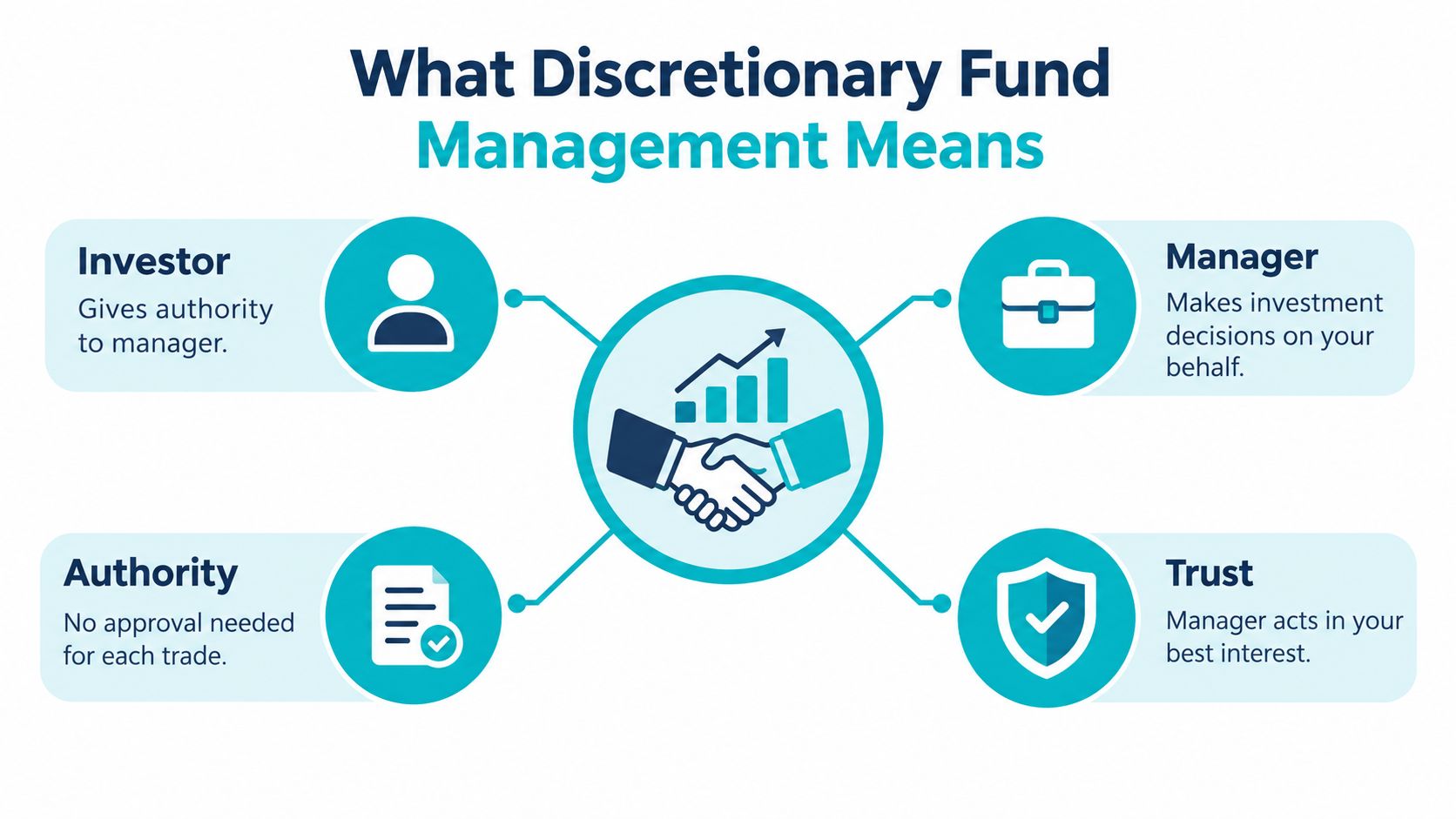
In Australia, discretionary fund management is commonly delivered through a managed discretionary account (MDA), including separately managed accounts (SMAs) and individually managed accounts (IMAs). The client gives a licensed operator authority to buy and sell assets within an agreed investment program. The portfolio is managed for that individual, rather than as part of a pooled registered managed investment scheme, as ASIC's guidance on MDA services explains.
Think of the manager as a pilot, but not one free to choose any destination. You agree on the flight plan: the investment objective, the level of risk you can accept and the types of assets the manager may use. The manager can make decisions during the journey without asking you to approve every trade, but the agreed plan sets the limits.
That authority distinguishes an MDA from advisory management, where the adviser generally makes a recommendation and the client approves transactions. It also differs from a pooled managed fund. With a pooled fund, investors hold units in a shared investment scheme; with an MDA, assets are held and managed on an individual basis. You can read more about that distinction in this explanation of what a managed fund is.
The mandate is the boundary
A well-drafted investment program should set out objectives, risk tolerance, permitted asset classes, concentration limits, liquidity needs and rebalancing rules. It can also account for ethical preferences and tax constraints. A model portfolio may inform the manager's approach, but it shouldn't replace an assessment of whether the mandate suits the individual client.
That matters because discretion is a legal authority, not a promise of expertise. ASIC's framework addresses suitability, conflicts, disclosure, custody, reporting and operator obligations. The practical question is whether each transaction can be traced back to the client's agreed program and suitability assessment, rather than justified only by a general market view.
“The manager can act without asking for every trade, but only within the authority you've actually granted.”
How a DFM Arrangement Works Day to Day
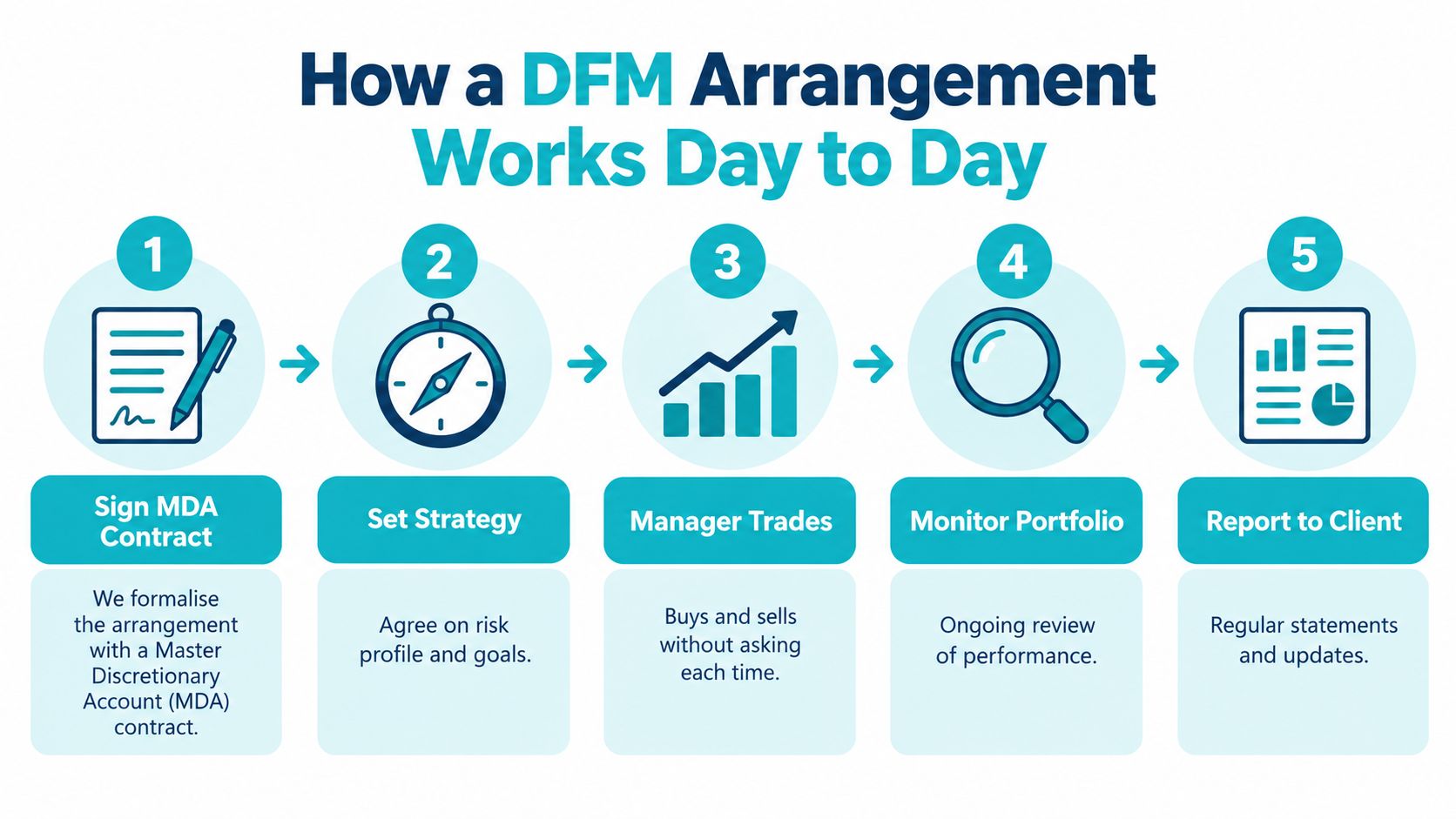
The arrangement starts with a suitability discussion and documentation, not with a manager selecting stocks. The client and adviser establish the investment program, including its objectives, risk limits, cash needs and restrictions. The client then enters an MDA contract that sets out the authority granted to the operator and the service's terms.
Once the account is established, the manager makes investment decisions within that mandate. Trades are carried out for the individual portfolio, so the client doesn't need to approve each purchase or sale. The client generally retains beneficial ownership of the underlying assets, while a custodian may hold them on the client's behalf. Ask explicitly who holds the assets, how they're recorded and how you can access information about them.
What happens after the portfolio is invested
The manager monitors the holdings against the agreed investment program. If the portfolio drifts from its intended allocation, the manager may rebalance without seeking approval for each trade. If the mandate allows it, the manager can also raise cash for a planned withdrawal. That convenience is useful only when the cash rules, authority and client's spending needs are clear.
Reporting should let you understand what you own, what changed, how the portfolio performed and what fees were charged. Don't settle for a performance figure without holdings and cost information. Ask how often reports arrive, whether they show transactions and total costs, and who you contact when your circumstances change.
A structured advice process should connect the mandate to the client's wider position, including superannuation, income needs and retirement plans. The setup should also include a clear way to review suitability and amend the investment program. If a manager can't explain how a proposed trade fits the mandate, the governance isn't doing its job.
Fee Structures and What You Are Actually Paying For
A DFM's cost isn't one number unless the provider has made it one. The total may include an investment-management fee, a platform or administration charge, advice fees, transaction costs and indirect costs within underlying investments. Each layer should have a clear purpose. If the provider can't show what a fee pays for, don't assume the service justifies it.
| Fee Layer | What It Covers | What to Verify |
|---|---|---|
| Management | Portfolio construction and investment decisions | Fee basis, services included and any performance fee |
| Platform or administration | Account administration, custody arrangements and records | Whether charges are fixed, asset-based or both |
| Advice | Personal recommendations and ongoing advice | Scope, frequency and whether it overlaps with other services |
| Transaction | Costs associated with buying and selling investments | How costs are disclosed and whether trading is frequent |
| Indirect | Costs within underlying funds or investment products | Whether these appear in the total cost information |
A fee comparison needs to match like with like. A low-cost super option may not include personalised portfolio decisions or advice; a higher-cost arrangement should therefore demonstrate a benefit that matters to the client, such as tax-aware rebalancing, cash-flow matching or help avoiding damaging investment decisions. Don't count benchmark outperformance as the only acceptable benefit, but don't accept vague claims about expertise either. A useful starting point is understanding financial advice fees in Australia.
For context, APRA's annual superannuation bulletin reports that, for the year ended 30 June 2024, entities with more than six members paid $10.2 billion in fees, with 89.2% paid by members. Those figures don't show that an MDA is better or worse than a super option. They do show why investors should take the cost of every layer seriously.
ASIC's Regulatory Guide 179 requires an MDA contract to disclose fees and costs. Where an ongoing fee arrangement applies, the client must give written consent, and the consent process must state the ongoing fees expected during the next 12 months. Providers must also report total management costs and other fees and costs for the relevant period. Review the figures against the service you received, and check the ASIC guidance on MDA fee disclosure.
Where Discretionary Authority Earns Its Keep
Consider a couple approaching retirement who expect to draw regular income from a balanced portfolio. If their mandate specifies how much cash to retain and how the manager may rebalance, the manager can respond to withdrawals and portfolio drift without asking the couple to approve every trade. That may reduce administrative friction and help keep decisions connected to a spending plan. It doesn't remove investment risk or guarantee that assets won't need to be sold at an inconvenient time.
Now consider a busy professional balancing salary sacrifice, an investment property and limited time to monitor a separate portfolio. A clear mandate can let a manager maintain the agreed investment mix and implement permitted changes while the client focuses elsewhere. But if the mandate ignores tax constraints or the client's broader finances, the same convenience can produce decisions that don't fit.

When authority helps, and when it doesn't
Delegation can be useful when the manager needs to rebalance, raise cash or act within agreed tax settings without waiting for the client's approval. That can matter when markets are unsettled or the client is travelling, unwell or unable to manage ongoing decisions. These are practical advantages, not proof that the arrangement will outperform a simpler portfolio.
The same arrangement can work against the client if the mandate is too broad, the manager takes risks the client can't tolerate, or the client's circumstances change without a corresponding review. A pre-retiree's risk capacity and need for liquidity may shift as retirement approaches. If the investment program stays unchanged, discretion can keep the portfolio moving in the wrong direction.
The need for controls grows as these arrangements scale. In a review reported by ASIC, MDA assets rose from approximately $31 billion in December 2019 to $52 billion in June 2024, a 68% increase. ASIC's update on MDA services makes the wider point: more assets under discretionary management call for documented controls, not reliance on informal oversight.
Governance Questions That Separate a Good DFM From a Risky One
Past returns can attract attention, but governance determines whether a DFM relationship remains appropriate when markets fall or retirement plans change. Ask the manager to explain the restrictions in your mandate, how it chooses and uses a benchmark, what liquidity rules apply, and how it handles conflicts, including related-party arrangements. If you need regular withdrawals, ask how the manager plans for cash and what authority it has to sell assets.
Performance fees deserve particular scrutiny. ASIC's review of fees and performance notes that a manager may charge for outperformance without a corresponding discount for underperformance. Fees can also be deducted from account balances when investments make a loss. Ask whether the fee has a high-water mark, how the benchmark is selected and whether performance is assessed over a period that reflects your investment horizon.
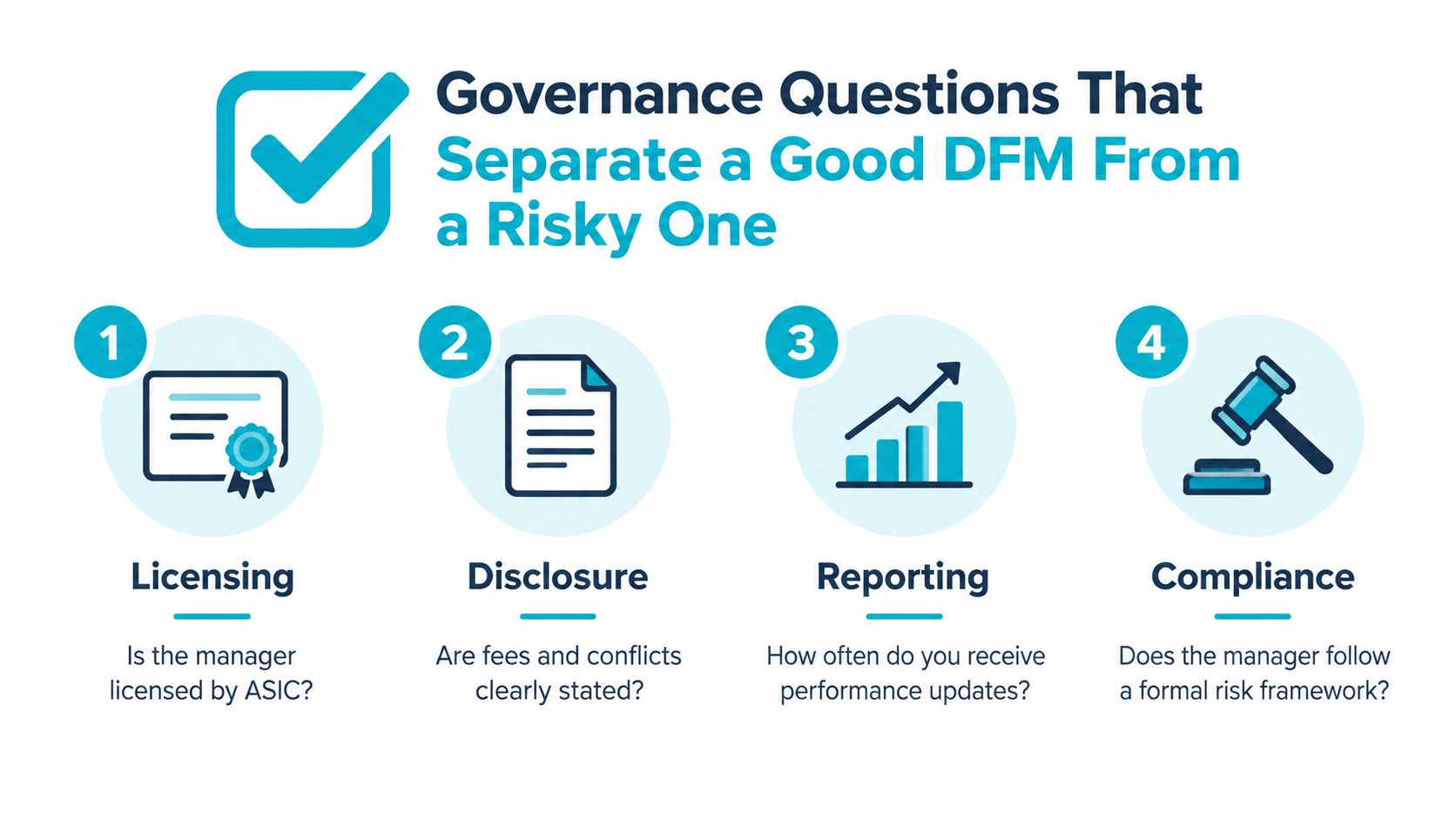
Before you sign, ask for direct answers to these questions:
- Authority: Which assets can the manager buy or sell, and what restrictions apply?
- Liquidity: How will the portfolio meet withdrawals without breaching the mandate?
- Fees: How are management fees, performance fees and other costs calculated and reported?
- Conflicts: How does the provider identify and manage conflicts of interest?
- Reporting: How often will you receive holdings, transactions, performance and cost information?
- Exit: How can you change the mandate or terminate the arrangement, and what happens to the assets?
Red flags include a vague investment program, unclear fee disclosure, unexplained conflicts or reluctance to discuss how losses and withdrawals are handled. The manager should welcome questions about process, not ask you to rely on reputation or a strong recent result. Use the same care when assessing the person advising you, starting with this guide to choosing a financial adviser.
Deciding Whether Discretionary Fund Management Fits You
A DFM is more likely to earn its cost when you repeatedly make harmful investment decisions, have a portfolio that can support the full cost stack, or lack the time or health to make decisions and maintain the portfolio yourself. It may be the wrong fit if you're comfortable with a diversified low-cost option, want direct control, or can't identify a specific problem the manager will solve.
Make the comparison after fees and tax, not from a headline return. Include advice and platform costs, the tax effect of trading, access to cash and the value of any behavioural support. If the manager's role is hard to distinguish from a simpler option, the simpler option may be the more honest choice.
A first conversation should clarify whether the right next step is discretionary management, superannuation optimisation or a straightforward investment plan. Wealth Collective's process begins with a free introductory call, followed by a structured review of your circumstances and goals.
Book a free introductory call with Wealth Collective to discuss whether discretionary management fits your retirement or investment plan. The team can review your costs, superannuation and investment needs, then help you decide whether a DFM or a simpler approach makes more sense.