Business hours
Monday to Friday (8.30AM - 5PM)
Weekend (Closed)


You're paying every minimum on time, yet the balances barely move. One card drops a little, another creeps back up after school fees, car repairs or a higher mortgage repayment, and there's no clear finish date. That's the position many Australian households are in right now, not because they're reckless, but because they're spreading extra money too thinly across every debt at once.
Two households can owe the same $25,000 across three accounts, yet one clears it in two years and the other is still paying in year six. The difference is rarely income alone. It's the strategy chosen, how well it fits cash flow and life stage, and whether the plan survives a bad month. Housing dominates the picture for most families, since the Australian Bureau of Statistics finance data reported that in 2019–20, 75% of Australian households held debt, with average household debt of approximately $203,800.
The best debt reduction strategies below aren't interchangeable. A young professional with three small cards needs momentum. A pre-retiree with a mortgage needs liquidity as well as interest savings. A small business owner with variable income needs a buffer first. Match the method to your life stage, run the simple calculation for each, and treat cash flow as the engine that makes every method work.
1. Debt Snowball Method

List your debts from smallest balance to largest, ignore the interest rates for ranking, pay the minimum on everything, and throw every spare dollar at the smallest balance. When it's gone, roll its full repayment into the next smallest. Your payment grows with each cleared account, which is where the snowball name comes from.
Say you've got a $1,200 store card, a $4,500 car loan and a $12,000 personal loan, with $300 a month spare beyond minimums. You clear the store card in about four months, then add its repayment to the $300 and attack the car loan. You won't save the most interest this way. You will close an account quickly, and for dual-income families juggling several small consumer debts, that early win is often what keeps the plan alive for 12 to 24 months.
Make the Snowball Stick
- List everything first: Record balance, interest rate, minimum repayment and due date for every debt before you start.
- Automate the minimums: Set direct debits so no account slips into arrears while you focus elsewhere.
- Roll the full amount: Redirect the entire repayment from each cleared debt, not part of it, to the next balance.
- Watch for a trap: If a small debt also carries a very high rate, the maths may favour switching methods, so compare your options for how to pay off debt faster before you commit.
Book a free 10-minute introductory call with Wealth Collective to test whether the snowball fits your cash flow and goals before you lock it in.
2. Debt Avalanche Method
If saving interest matters more to you than quick wins, rank debts by interest rate, highest first. Pay minimums on all accounts, direct extra money to the most expensive debt, then move down the list. It's slower emotionally. It's usually the cheapest path overall.

The cost of minimum repayments shows why rate order matters. ASIC's Moneysmart credit card guide gives a $3,000 balance at 16% per annum where minimum repayments take more than 19 years and cost over $3,100 in interest. Paying $200 per month instead clears it in approximately 18 months with about $370 in interest, a saving of more than $2,700.
Say you're a high earner with a credit card around 20% p.a., a personal loan at 12% and a car loan at 8%. The card gets every extra dollar first, even if its balance isn't the smallest. Use the approach in Moneysmart's credit card calculator, which defaults to a repayment amount designed to clear the debt within two years, to set a fixed payment and test it against your budget.
Practical rule: Keep a small emergency buffer before you accelerate repayments, or one broken appliance puts the balance straight back on the card you just cleared.
Revisit your ranking whenever a fixed rate ends or a variable rate moves. Book a free 10-minute introductory call with Wealth Collective to model the interest you'd save under the avalanche approach.
3. Debt Consolidation Loan
A consolidation loan pays out several debts, usually credit cards, store cards and personal loans, and replaces them with one loan, one repayment and one finish date. It works when the new rate is genuinely lower and the old accounts stay closed. It fails when it only stretches the same spending over a longer term.
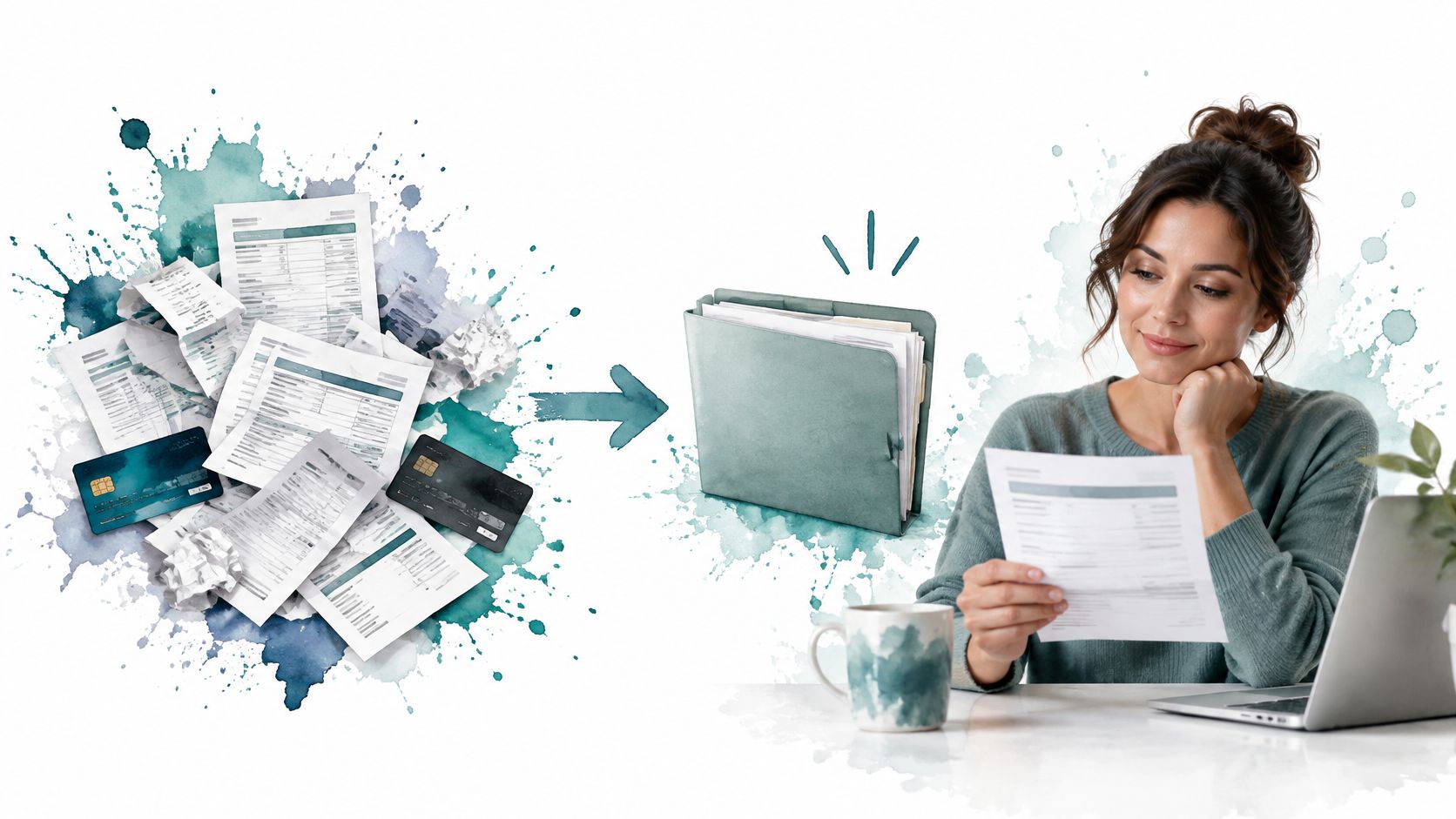
Say a couple holds three cards averaging 19% p.a. and rolls them into a lower fixed-rate personal loan cleared within five years. Their monthly outgoing becomes predictable, and there's no revolving balance steadily rebuilding. That discipline matters at a national level too, since the Australian Bureau of Statistics national accounts for December 2024 reported Australian households borrowed $37.2 billion in the December quarter of 2024, while household liabilities increased by $45.4 billion.
Check the Real Cost Before You Sign
Compare the comparison rate, not just the advertised rate, and add every fee. Calculate total cost over the full term, because a lower monthly repayment over more years can cost more overall. Confirm there are no early repayment penalties if you plan to pay extra.
Close or freeze the cleared cards where appropriate. Young professionals often like the simplicity of one payment, but simplicity without changed spending just creates room to borrow again. Book a free 10-minute introductory call with Wealth Collective to confirm whether consolidation improves your position or merely extends the debt.
4. Balance Transfer Credit Card
A balance transfer moves card debt to a new card with a promotional low or 0% interest period, usually for several months to over a year in Australia. Most providers charge a one-off transfer fee as a percentage of the amount moved. When the promotion ends, the standard purchase rate normally applies to what's left.
The calculation is simple, and you should do it before you apply. Say you transfer $6,000 at a 1.5% fee to a card offering 0% for 12 months. The fee adds $90, so you owe $6,090. Divide that by 12 and you need about $508 a month, every month, to clear it inside the window. If you can only afford $300 a month, you'll still owe roughly $2,490 when the promotional rate expires, and that remainder gets expensive fast.
Rules That Make or Break a Transfer
- Set the payoff repayment first: Divide the transferred balance plus fee by the number of promotional months, then automate that amount.
- Stop new purchases: Don't use the transfer card for spending during the promotional period.
- Read the end date: Note exactly when the promotion expires and what rate applies after it.
- Check you still come out ahead: Compare the fee and post-promotional rate against staying with your current card and paying it down directly.
This suits a disciplined borrower with one defined balance and a clear 12-month runway. It doesn't suit anyone still adding to the card. Book a free 10-minute introductory call with Wealth Collective to test whether a transfer fits your repayment timeline.
5. Debt Agreement or Formal Negotiated Repayment Plan
A household whose repayments no longer fit its income should seek help before falling behind. In Australia, a Debt Agreement under Part IX of the Bankruptcy Act 1966 is a legally binding arrangement administered by a registered Debt Agreement Administrator. It allows a person to repay an agreed portion of unsecured debts over a set period, usually up to six years, without entering bankruptcy. A less formal option is to negotiate a hardship arrangement with individual creditors.
The Reserve Bank of Australia financial stability review from April 2025 estimated that about 3% of borrowers were experiencing a cash-flow shortfall that put them at risk of falling behind. For a household with $80,000 in unsecured debts, a Debt Agreement could replace separate repayments with one agreed payment over four years. The trade-off is that the agreement is recorded on the household's credit file. A plan only works if its repayments fit the household's cash flow.
Get Independent Advice First
Call the National Debt Helpline on 1800 007 007 for free, independent guidance before signing an agreement. Check the Australian Financial Security Authority (AFSA) website for registered administrators and eligibility rules. Have statements for every debt, along with income and asset details, ready when you seek advice.
If your expenses already exceed your income, a new loan isn't a strategy. Early hardship support is.
A formal arrangement can affect your credit file, so understand the terms and consequences before committing. Book a free 10-minute introductory call with Wealth Collective to discuss how formal arrangements fit your broader financial position.
6. Offset Account or Redraw Strategy for Home Loans
An offset account is a transaction or savings account linked to your home loan. Every dollar sitting in it reduces the balance used to calculate interest, so your cash saves interest at your home loan rate without being locked away. A redraw facility instead lets you take back extra repayments you've already made on the loan itself.
The buffer effect is significant. The Reserve Bank of Australia statement on monetary policy from February 2024 reported additional payments into mortgage offset and redraw accounts increased in the second half of 2023 to approximately 2% of disposable income. Say a household keeps a $30,000 emergency fund in an offset against a $600,000 home loan. Interest is calculated on $570,000, yet the $30,000 stays available for a job loss, health cost or business downturn.
That flexibility is why I favour offset over extra principal for pre-retirees and small business owners. Money paid straight off the loan can be harder to retrieve, and lender redraw policies can restrict access. Pay your salary into the offset so it reduces interest from day one, check any account fees, and compare the benefit against a fixed rate or split loan using a clear plan to pay off your mortgage early.
Don't redraw for holidays or lifestyle spending. That extends your loan term over time. Book a free 10-minute introductory call with Wealth Collective to model how an offset or redraw strategy fits your cash flow and investment plan.
7. Cash Flow Reset
No repayment method survives sloppy cash flow. A cash flow reset maps what's really coming in and going out, finds the leaks, and turns them into a consistent surplus for debt. Without it, extra repayments get absorbed by lifestyle creep within a few months.

Say a dual-income family reviews three months of bank statements and finds $400 a month in unused subscriptions, duplicate services and convenience spending. Redirected to a credit card, that $400 is $4,800 a year off the balance before they've changed anything else. A self-employed professional does it differently, budgeting around a minimum monthly income and sending surplus months straight to debt.
Build the Buffer Before You Accelerate
Liquidity comes first, especially with variable income. The Reserve Bank of Australia financial stability review from March 2026 reported the lowest-income quartile had enough in offset and redraw balances to cover almost one year of scheduled mortgage payments in data to June. You don't need to match that benchmark immediately, but six to twelve months of essential repayments is a sound target before maximising extra payments.
- Track for 30 days: Record all spending to establish an honest baseline.
- Review monthly: Adjust for income or expense changes with structured cash flow management rather than guesswork.
- Protect the surplus: Automate the debt payment on payday so it isn't spent first.
Book a free 10-minute introductory call with Wealth Collective to build a cash flow plan that supports debt reduction, insurance and long-term wealth goals.
8. Zero-Based Budgeting
Zero-based budgeting gives every dollar of income a job before the month begins. Rent, groceries, insurance, savings and a fixed debt repayment are all allocated, leaving nothing unassigned to drift into discretionary spending. The debt amount is set first, not funded from whatever happens to remain.
Say a household brings in $9,000 a month. They allocate $7,600 to essentials and lifestyle categories, $400 to an emergency buffer and $1,000 as a fixed debt repayment, automated on payday. Income minus allocations equals zero. When a category runs out, spending in it stops or another category gives up the money consciously. For a deeper walk-through of setting categories up, see this guide to budget planning with Peaceful Mindful Pocket.
Where Zero-Based Budgeting Fits Best
It suits households whose income is adequate but untracked, which describes plenty of dual-income families and high earners. It suits small business owners less well in its strictest form, since variable income needs a minimum-income baseline with surplus months allocated separately. Track spending for at least 30 days first so your categories reflect reality, not optimism.
A useful test: If you can't say where last month's pay went within about $200, fix the budget before you change the repayment method.
Review the allocations monthly and rebuild a small emergency buffer so one unexpected cost doesn't reverse your progress. Book a free 10-minute introductory call with Wealth Collective to build a budget that supports debt reduction, insurance and long-term wealth goals together.
How the eight debt reduction strategies compare
| Item | Best for | Interest Impact | Setup Complexity | Main Risk |
|---|---|---|---|---|
| Debt Snowball Method | People motivated by quick wins | May cost more overall | Low | High-interest debts may remain longer |
| Debt Avalanche Method | Minimizing total interest | Usually lowest interest cost | Moderate | Slow early progress can reduce motivation |
| Debt Consolidation Loan | Combining debts into one repayment | Can lower interest if the new rate is lower | High | Fees or longer terms can increase total cost |
| Balance Transfer Credit Card | Paying off card debt during a low-rate promotion | Can reduce interest temporarily | Moderate | High standard rate after the promotion |
| Debt Agreement or Formal Negotiated Repayment Plan | People unable to manage current repayments | May reduce payments or interest, depending on terms | High | Credit-file impact and significant fees |
| Offset Account or Redraw Strategy for Home Loans | Homeowners with surplus cash | Reduces home-loan interest | Moderate | Easy access may encourage spending |
| Cash Flow Reset | Finding extra money for debt repayments | Indirectly helps reduce interest by freeing up cash | Moderate | Ongoing tracking may be hard to maintain |
| Zero-Based Budgeting | Assigning all income toward expenses and goals | Indirectly helps reduce interest through planned repayments | Moderate | Can feel restrictive and requires regular tracking |
Turn Your Debt Plan Into a Working Strategy
Start with one page. List every debt with its balance, interest rate, minimum repayment and due date, then separate housing debt from short-term consumer debt, because they need different treatment. The Australian Bureau of Statistics national accounts for March 2025 reported a 1.3% quarterly rise in household liabilities, including a $26.9 billion increase in housing loans and a $0.6 billion fall in short-term loans. Your own list should show the same distinction, and whether each balance is expanding or contracting month to month.
Next, test two or three methods against your actual cash flow, not the cash flow you wish you had. Run the avalanche numbers to see total interest saved, then run the snowball order to see how quickly you'd close your first account. If you're within 5 to 15 years of retirement, add a third test that keeps surplus cash in offset instead of paying it straight off the mortgage, because accessible liquidity can matter more than a small interest saving once work income stops. That pressure is real, since the Reserve Bank of Australia statement on monetary policy from November 2025 reported scheduled principal-and-interest payments were 9.8% of Australian household disposable income in the September 2025 quarter.
Choose the approach that clears debt fastest while you can realistically stick to it. A theoretically perfect method you abandon in month four loses to a slightly costlier one you follow for two years. Set the repayment as an automatic transfer on payday, keep minimums covered on every other account, and protect a starter emergency buffer so progress doesn't unravel. Then review the plan every quarter, after any rate change, income change or major expense, and re-rank your debts if the numbers have shifted.
Watch for the warning signs that mean you need help rather than a new spreadsheet. If you're relying on credit for essentials, skipping minimums, or watching expenses exceed income, contact your lender about hardship support before arrears build up. Early action preserves options that disappear once accounts fall behind. Free, independent guidance is available, and using it isn't a failure of discipline. It's part of a sound debt strategy.
If the numbers are unclear or the consequences are significant, get the modelling done properly. Book a free 10-minute introductory call with Wealth Collective to model your options side by side, confirm your next step, and build a plan that connects debt reduction with your superannuation, insurance, investment and retirement goals. You'll leave knowing which debt to attack first, how much to pay, and what finish date you're working toward.
Ready to clear your debt with a plan matched to your life stage, not a generic template? Wealth Collective's Perth and Dunsborough advisers will model your repayment options, set a realistic finish date and align your debt strategy with your super, insurance and retirement goals. Visit Wealth Collective to book your free 10-minute introductory call today.