Business hours
Monday to Friday (8.30AM - 5PM)
Weekend (Closed)


About 8 million Australians had some form of insurance through super as at 2022, across approximately 15 million Australians with accumulation-phase accounts, according to ASIC's review of insurance in superannuation. That doesn't mean they all had income protection, or that their insurance matched the bills they'd need to pay if work stopped.
Income protection insurance in super can be easy to overlook because the premium doesn't appear on your household bank statement. Understanding it means following the money: out of your retirement savings, through a claim, into your taxable income and potentially into a Centrelink assessment.
What Income Protection Inside Super Is
Say you open your annual super statement and find separate entries for death, total and permanent disability (TPD), and income protection insurance. They sit together on the page, but they protect against different events.
Income protection pays a regular benefit when illness or injury prevents you from working, provided you meet the policy's conditions. Death cover pays following death, while TPD cover addresses disability that meets the policy's permanent-disability definition.
Think of your super account as a retirement jar that also serves as the insurance collection plate. Contributions go into the jar, investments sit inside it, and insurance premiums come out. The insurer, rather than your accumulated savings, funds an eligible income protection claim.
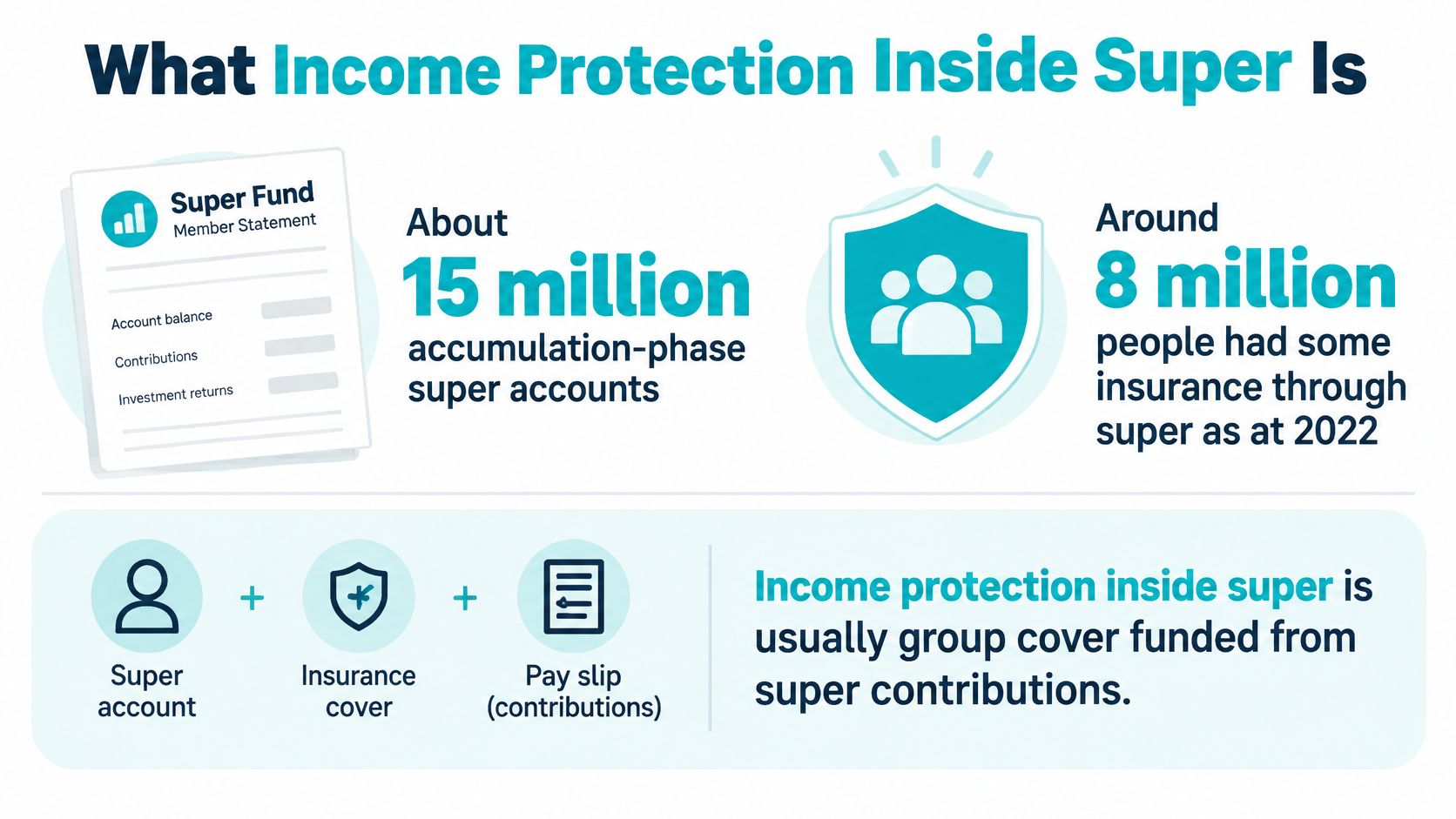
Cover may arrive with a super account rather than through a separate application. But an account's existence doesn't prove that income protection is included or currently active.
Check these points before treating it as your safety net:
- Active cover: Does the fund show income protection as insured, rather than available?
- Income replacement: What benefit could you receive?
- Payment duration: How long must you wait, and how long could payments continue?
What the Policy Pays and When
Typical income protection settings inside super
| Setting | Usual range | What to confirm |
|---|---|---|
| Income replaced | About 75% or 90% of pre-tax income | Whether the percentage applies to salary, and any monthly cap |
| Waiting period | Commonly 14 days up to two years | Whether savings or sick leave cover the full wait |
| Benefit period | Policy-specific; examples include 2 years, 5 years or to age 65 | How long a prolonged illness would still be paid |
| Premium funding | Deducted from the super balance | The annual premium and the retirement balance it erodes |
| Claim incidence | About 2.8 claims per 1,000 insured members a year | Higher than death at 1.1 and TPD at 1.3, so usefulness matters |
Moneysmart's income protection guide describes replacement levels commonly around 75% or 90% of pre-tax income and waiting periods commonly from 14 days to two years; ASIC's value-for-money analysis reported average annual claim incidence of approximately 2.8 per 1,000 insured members for income protection, compared with 1.1 for death and 1.3 for TPD.
The benefit-period examples in the table are settings to investigate, not a promise about your fund. Read the insurance schedule and product disclosure statement (PDS) together, because the statement may show a headline benefit without explaining the restrictions.
Read the benefit as gross income
For a hypothetical calculation, assume your policy replaces 75% of pre-tax monthly earnings of $8,000. That produces a $6,000 gross monthly benefit, not $8,000 of spending money.
The insured amount on your statement may also be a ceiling rather than a guaranteed payment. Check how the insurer measures pre-disability earnings, whether it applies a monthly cap, and whether other payments reduce the benefit.
This distinction matters after a pay rise, reduced working hours or a move into self-employment. A benefit selected when your circumstances were different may no longer describe what you could claim.
Match the waiting period to accessible money
Consider a hypothetical employee earning $120,000 a year whose policy has a 90-day waiting period. They need roughly three months of mortgage payments, groceries and other essentials from leave, savings or another dependable source before benefits can begin.
Don't confuse the end of the waiting period with the date cash reaches your bank account. Ask whether benefits are paid in arrears and allow for claim assessment and processing.
The benefit period answers a different question: how long payments can continue while you remain eligible. A shorter period can help with recovery from a temporary illness, but it doesn't solve the household problem of being unable to work for much longer.
Budget check: Match the waiting period to money you can access without selling investments or borrowing, then match the benefit period to how long your household would remain financially exposed.
Premiums also deserve a place in this calculation. You avoid a household direct debit, but your super balance loses both the premium and the investment earnings that money could otherwise generate.
Write down your replacement percentage, waiting period, benefit period and annual premium. Those settings give you a useful starting point for deciding whether the cover earns its place.
How Eligibility and Claims Work
A medical diagnosis doesn't automatically establish an insurance entitlement. The insurer assesses whether your illness or injury meets the policy's definition of inability to work, including at the end of the waiting period.
A partial return to work, changed duties or a different role can affect the assessment. Ask for the PDS, your insurance schedule and the claim pack, then work through the following checks.
Build the claim around the documents
- Establish the relevant cover date. Ask the fund to confirm that insurance was active when the illness or injury arose, and which policy terms apply.
- Document the waiting period. Keep medical evidence of your incapacity and records of any work performed during that time. Confirm how the policy treats interrupted periods of incapacity.
- Submit the evidence. The claim pack may require medical certificates, employer details, payslips and tax information.
- Read exclusions and restrictions. Pre-existing-condition restrictions or other exclusions may limit eligibility. Check the wording rather than assuming every illness is insured.
- Confirm payment arrangements. Get written details of the payment frequency, whether money passes through the fund, ongoing evidence requirements and the benefit end date.
Keep copies of everything submitted and record outstanding requests. Ask for an explanation of any proposed reduction or rejection against the relevant policy clause.
Claim approval also doesn't mean the payment is tax-free. Establish the gross benefit and the expected amount reaching your account before changing household spending.
Super Cover Compared with a Personal Policy
Income protection inside super versus owned personally
| Question | Held in super | Owned personally |
|---|---|---|
| Who pays | Premiums leave the super balance | Premiums leave household cash flow |
| Design | Trustee terms, often a default | Waiting period, benefit period and occupation definition can be chosen from available options |
| Effect on retirement | Premiums and lost earnings reduce the balance | Super investments are left intact |
| How easily it stops | Can end after inactivity, a fund change or leaving an employer plan | Continues while premiums are paid and policy conditions remain satisfied |
| Who it tends to fit | Employees who need cover without a new bill | People who need tailored definitions or a longer benefit |
Convenience helps explain why default insurance persists: ASIC's review of default insurance estimated that 86% of super members with insurance were on default settings. Staying with a default isn't necessarily a mistake, but it isn't evidence that someone has checked the fit.
Your fund statement shows what you hold. It won't tell you whether a differently structured policy would better protect your household.
Compare definitions, not just premiums
An occupation definition can matter as much as the benefit amount. An own-occupation test considers your ability to perform your role, while a broader work-capacity test may consider other suitable employment.
Don't assume every super policy uses the same test or that every personal policy has a more generous definition. Read what happens initially and whether the definition changes during a claim.
Personal ownership can offer more choice, but you still choose from what an insurer offers and will accept. Your occupation, health and financial evidence can affect the terms.
Decide which constraint matters most
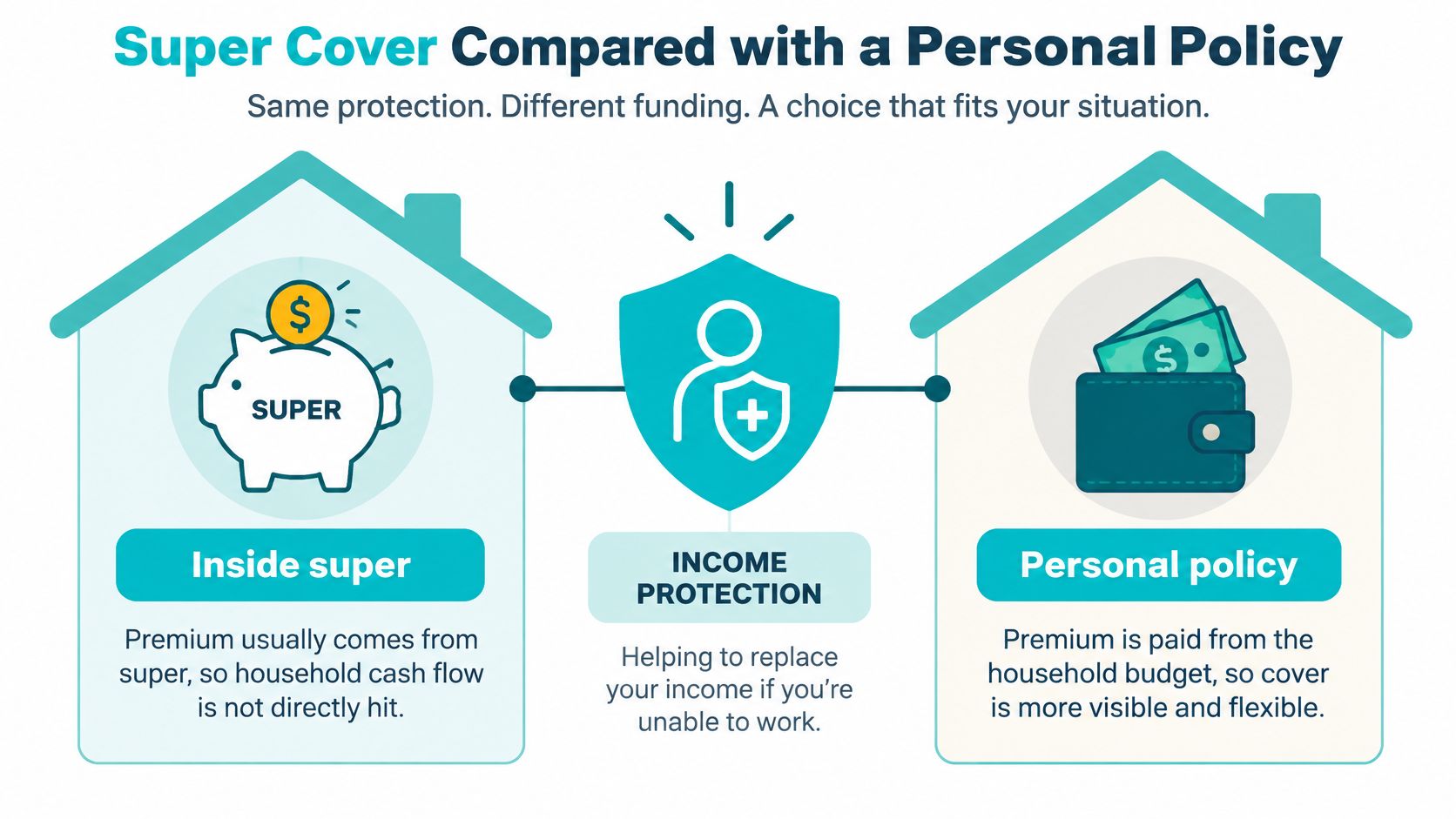
If household cash flow is tight, paying a premium personally may compete with rent, debt repayments or rebuilding emergency savings. Super-funded insurance can preserve protection while you address those pressures.
If your main concern is a long interruption to specialised work, the available definitions and benefit duration deserve greater weight. A lower premium isn't good value if the policy stops paying while the financial problem continues.
If the household can't fund a premium this month, super may be the practical home for cover. If your mortgage requires sustained protection and a particular occupation definition, choose the policy that meets those needs rather than assuming the default does.
Our guide to comparing income protection policies can help you organise the comparison around the actual contract. Include exclusions, partial-disability benefits, offsets and replacement underwriting, not just the advertised price.
If you hold cover in both places, check how the policies interact. You can't assume that separate insured amounts will automatically add together at claim time.
Tax Contributions and Centrelink
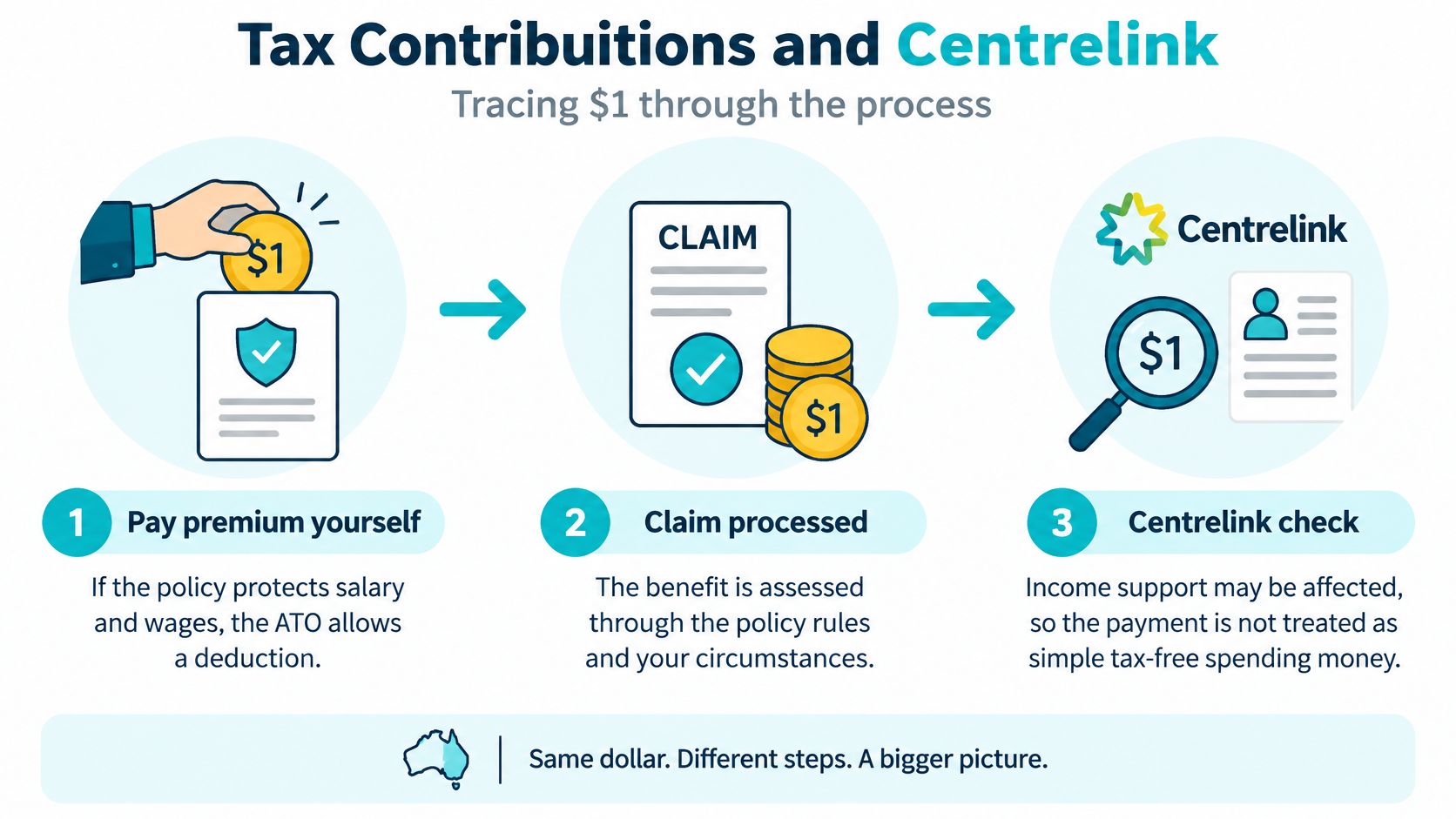
Follow the premium first. The Australian Taxation Office's income protection guidance says premiums paid personally to protect salary and wages may be deductible, but you can't claim a personal deduction where the policy is held through super and premiums are deducted from super contributions.
The distinction is who funds the premium and who claims the deduction. An insurance deduction on your super statement belongs to the fund's accounts. It doesn't become an expense you can claim again in your personal return.
Follow the benefit into your tax return
Salary-replacement payments generally belong in the recipient's tax return, whether they arrive regularly or as a lump sum. A delayed claim paid together doesn't become a tax-free capital payment merely because it lands in one deposit.
Payments for personal injury or TPD can carry a different character from replacement earnings. The policy's purpose, ownership and payment type matter more than the general label of insurance.
Our explanation of income protection insurance tax deductions helps distinguish premium deductions from the taxation of benefits. They're separate questions, and a favourable answer to one doesn't settle the other.
Treat Centrelink as a separate assessment
Income protection payments paid from a super fund may still need to be declared to Services Australia for income-and-assets assessment. Routing a payment through super doesn't place it outside Centrelink's consideration, so confirm how your specific payment is treated before you rely on it.
The tax outcome doesn't determine the Centrelink outcome. Your entitlement depends on the payment's treatment under the relevant benefit rules and your wider household circumstances.
For a pre-retiree, that means building a spending plan around the net position, not adding an expected insurance benefit to existing government support without checking. For a couple, the assessment may also involve the partner's circumstances.
Keep the documents that explain the money's path:
- Policy schedule: Shows the insured benefit and ownership arrangements.
- Super statement: Records premium deductions and the account holding the cover.
- Payment summary and claim correspondence: Explain gross payments, withholding and what the insurer paid.
Ask your tax adviser and Services Australia how the specific payment should be reported. A description such as insurance proceeds isn't precise enough to establish either assessment.
The Sixteen Month Cancellation Trap
Moneysmart's insurance-through-super guide says funds cancel insurance on accounts that haven't received contributions for at least 16 months, subject to applicable exceptions and fund rules. Default cover isn't a lifetime setting.
A job change can leave contributions flowing to a new fund while the old account still holds the insurance you rely on. Unpaid parental leave or a career break can create a similar mismatch.
Check the account that actually holds the insurance
- Follow the contributions. Compare your payslip with the fund's transaction history. Don't rely only on the employer's nominated fund name.
- Read the insurance status. Confirm income protection is active specifically, rather than seeing death cover and assuming everything remains insured.
- Record the contract settings. Save the current sum insured, waiting period and benefit period before making changes.
- Ask about preserving cover. Obtain the fund's requirements for any election or exception during a planned contribution break, including how premiums will be funded.
- Assess replacement first. Before consolidation or cancellation, establish whether replacement insurance is available and on what terms.
These checks matter even when consolidation would reduce account fees. An account transfer and an insurance replacement are different transactions, and the replacement may require a fresh assessment of your health and occupation.
Our guide to switching super funds can help you separate the investment decision from the insurance consequences. Don't assume an employer's new arrangement reproduces the old policy.
Plan the break before contributions stop
Say you take unpaid leave while your partner continues working. The household may be comfortable meeting current bills, yet still depend on your eventual return to earnings to repay the mortgage or rebuild retirement savings.
Keep enough detail to decide whether preserving the cover is worth the ongoing cost. That includes your expected return-to-work plans, remaining debts and how long you would need replacement earnings.
Before changing funds: Don't merge accounts or pause contributions until you have the insurance consequences in writing.
If cover has already ended, ask about reinstatement conditions rather than assuming a new contribution automatically restores it. Avoid cancelling an existing policy while a replacement application is still being assessed.
The right result isn't always to retain every policy. It's to make the cancellation a deliberate financial decision, not an unnoticed consequence of administration.
Which Households Should Keep, Top Up or Replace
Three household shapes show where super-held cover earns its place and where it only looks adequate on the annual statement.

Keep a workable starting point
A 29-year-old employee earning $85,000 with little spare cash faces a quiet trade-off: the premium leaves the super balance each year, but so does the risk of holding no cover at all. If the default policy replaces 75% of income after a 90-day wait and they can bridge that wait with accrued leave, keeping it may be the sensible holding position while savings build.
Statement note: Keep the super cover while building accessible savings.
Top up a long-term gap
A dual-income couple carrying a large mortgage might hold a default policy with a two-year benefit period. The debt does not end when the benefit does, and the household still depends on both earnings well past month twenty-four. The task here is extending duration: assess personal cover that runs alongside the super policy, and check how offsets between the two shrink the combined payout before assuming they stack.
Statement note: Top up the uncovered duration, not just the insured amount.
Replace an unsuitable structure
A self-employed pre-retiree with uneven earnings needs a policy whose income definition matches their business finances, and personal ownership may fit more cleanly. The cash path also differs between the two structures. Premiums paid from super buy cover whose proceeds follow super release rules: an ATO community explanation of insurance proceeds in super describes proceeds generally not being taxed on entry, with ordinary super withdrawal treatment potentially including 15% plus Medicare levy on the taxable component before age 60 and generally tax-free taxed-fund payments from age 60. A personally owned policy instead pays salary-replacement income, which is taxed as earnings and can count when Centrelink assesses household income. For broader disability-planning questions, My Policy Quote's disability insurance guide offers another perspective, though Australian policy and tax rules must govern this decision.
Statement note: Replace only after earnings definitions, net benefits and new terms are confirmed.
Decide Whether Super Cover Still Fits
Put your latest annual statement beside the household facts that determine whether the policy works:
- Essential spending: What must continue if your earnings stop?
- Accessible reserves: Can leave and savings bridge the full waiting period?
- Contribution plans: Will money keep reaching the account that holds the insurance?
If active cover pays enough and lasts long enough, retaining it can be a sound outcome. Put a review in your diary after a job change, major debt change or shift in working hours.
If the benefit ends well before your financial exposure, or premiums are depleting a small balance, redesign the arrangement rather than hoping the default is enough.
Turn the decision into a plan
Wealth Collective's Protection Plus simplifies personal insurance and superannuation, helping clients get better coverage and lower fees. Where the broader question is wealth building or retirement income, Guided Growth or Retirement Roadmap can connect the insurance decision to those goals.
Start with a free 10-minute introductory call and have your latest super statement ready. We explain the proposed plan and answer your questions; only once you're 100% comfortable with the outcomes do we handle paperwork, products if required, and end-to-end implementation.
Website information is general, not personal financial advice. Consider your circumstances and consult one of our qualified Financial Advisers before cancelling, consolidating or buying cover.
Wealth Collective helps you assess whether income protection inside super protects your household without unnecessarily reducing retirement savings. Visit Wealth Collective to book a free 10-minute introductory call, with your latest super statement ready so we can discuss what needs checking.