Business hours
Monday to Friday (8.30AM - 5PM)
Weekend (Closed)


In 2025, 45% of working Australians said they weren't financially prepared for retirement, according to UniSuper's YouGov survey of 2,004 Australian adults aged 35–75. The useful question isn't whether you've saved enough super. It's whether the income you can generate will support the life you want after work.
What a Retirement Readiness Assessment Actually Tests
A retirement readiness assessment tests whether your expected income can support your household's spending over time. Your super balance is the starting point, much like fuel in a tank. The assessment estimates how far that fuel may take you, given your income needs and choices.
Housing can change the result substantially. A renter with ongoing housing costs may need more income than a mortgage-free homeowner with similar savings. The Age Pension, tax, aged care and decisions about where to live can also affect how much income is available and what your household needs.

The questions behind the balance
A readiness assessment examines four connected questions:
- Income needed: What will your household spend, including housing and everyday costs?
- Income available: What income might come from super, investments, work and the Age Pension?
- Time horizon: How long may those resources need to last?
- Withdrawal choices: Which assets might you draw on, and how could tax affect the timing and amount?
The balance alone cannot answer these questions. An estimate is a starting point, because future spending, eligibility for government support and personal circumstances can change.
For households in Perth and regional WA, housing, transport, family commitments and access to services can all shape the budget. The useful outcome is a clearer view of whether projected income covers expected spending, where a gap may arise, and which choices could affect it.
Key Metrics and Benchmarks at a Glance
Core metrics, benchmarks and the test for each
| Metric | Benchmark | What It Tells You | How to Check It |
|---|---|---|---|
| Income replacement ratio | Treasury's Retirement Income Review uses 65–75% of disposable working-life income | Whether retirement income broadly supports your current lifestyle | Compare projected disposable income with working income, then check spending after removing work costs and mortgage repayments |
| Retirement budget | Essential plus discretionary spending for your household | Whether income covers real living costs | Build from 12 months of bank and card statements |
| Longevity risk | Model annual cash flow through at least age 90–95, consistent with the assessment approach outlined in Treasury's retirement-income paper | Whether money lasts if you live longer than expected | Run the projection to both ages with inflation-linked spending |
| Asset drawdown rate | No fixed rate; set per case against returns and inflation | How quickly withdrawals reduce capital | Test a base case plus lower returns in the first five years |
| Age Pension | A household estimate under the applicable eligibility and means tests | How much spending must be funded privately | Estimate entitlement alongside changing income and asset balances |
The statement-gathering period and early-return test above are practical modelling choices, not official standards.
What each measure tells you
Income replacement ratio compares retirement income with disposable working income. The benchmark is a starting range rather than a universal target: households don't all need the same share of their former earnings.
Your retirement budget provides the reality check. Remove costs that end, including work expenses, completed mortgage repayments and savings contributions, but retain anything you'll still pay. The ASFA Retirement Standard guide offers another reference point, not a substitute for your own spending record.
Longevity risk asks whether the projection remains workable over a long retirement. Keep future income and expenses on the same basis: mixing today's spending with inflated future income can create a misleading surplus.
Asset drawdown rate is annual withdrawals divided by the capital supporting them. Poor returns early in retirement, combined with withdrawals, can leave less capital available for recovery even when average long-term returns look reasonable.
Age Pension income belongs on its own line. That makes it easier to see how much of the budget depends on government support and how much must come from savings.
Write down your current disposable income and a personal target range. Then check whether the target covers the household budget.
How to Work Out Your Replacement Income
Use a spreadsheet with separate columns for working life and retirement. Keep a clear distinction between spending, income and withdrawals: taking money from savings creates cash flow, but it also reduces an asset.
Build a reliable starting point
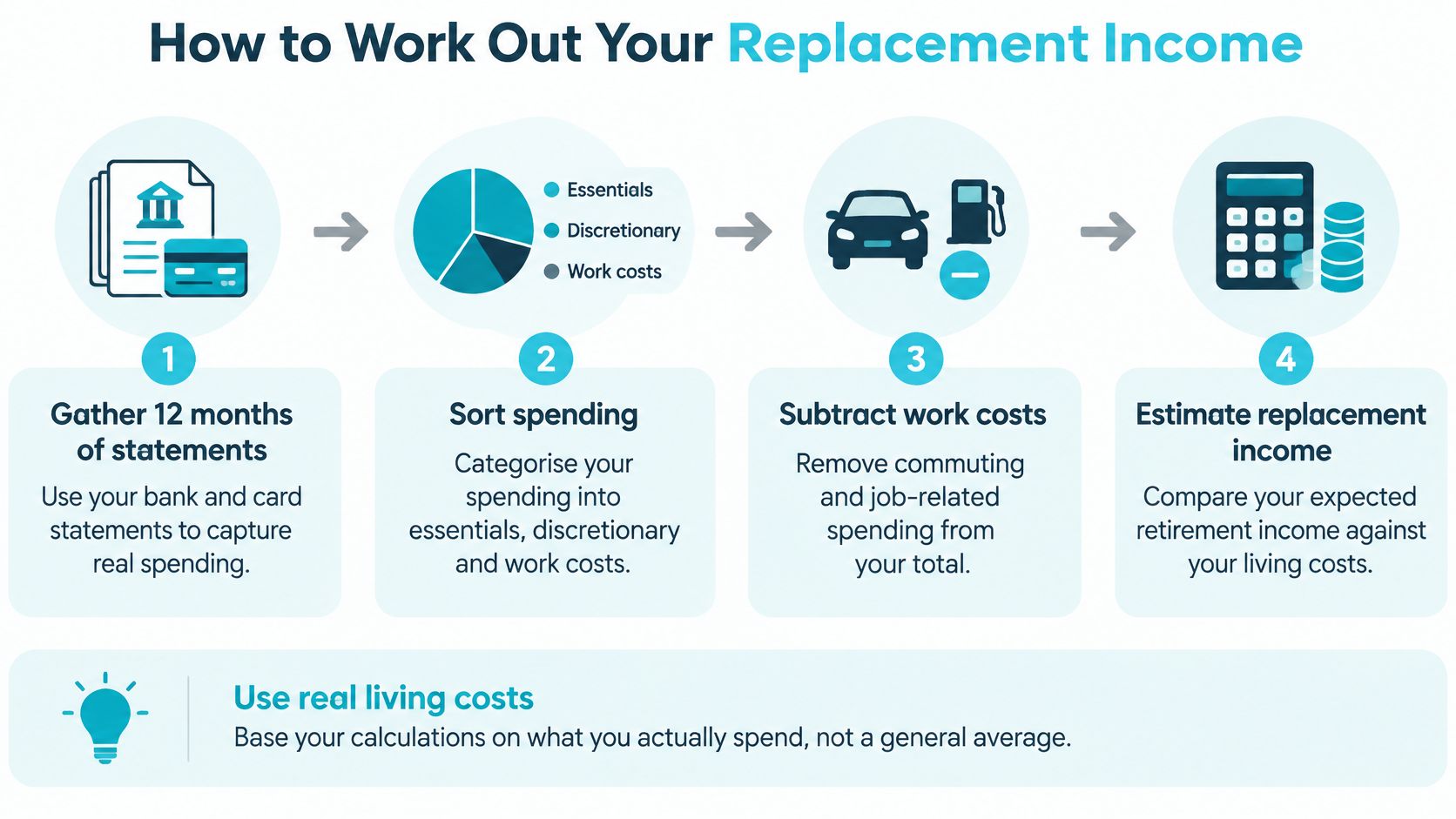
Collect actual spending. Gather 12 months of bank and card statements, then separate essentials, discretionary purchases and work costs. This practical starting period captures irregular bills; the common slip is budgeting from memory and missing annual expenses.
Remove costs that will end. Subtract work expenses, mortgage repayments only if the loan will be cleared, and savings contributions, then add planned retirement activities. Don't assume every expense falls because employment stops.
Calculate disposable working income. Use income after tax, rather than your salary package, and apply your chosen replacement range. Using gross income in the denominator while measuring retirement income after tax produces an inconsistent comparison.
Project super to your intended retirement date. Include contributions, investment returns, fees and insurance deductions, then estimate a sustainable withdrawal pattern. A frequent mistake is treating the projected balance itself as income, or overlooking the cost of keeping insurance inside super.
If you own a rental property, separate rent received from cash left after expenses, repairs and borrowing costs. Global's guide to software for tracking rental property finances can help you organise those records; gross rent isn't spendable retirement income.
Turn the inputs into an income test
Estimate government support. Assess possible Age Pension income using both income and assets information, including your partner's position where relevant. Don't insert the maximum payment as though everyone receives it.
Put everything on an annual, comparable basis. Add projected after-tax retirement cash flow, then divide it by annual disposable working income to calculate the replacement ratio. Keep monthly, fortnightly and annual amounts separate until you've converted them consistently.
Stress-test the result. Run a base case and adverse scenarios, such as hypothetically retiring three years early, earning returns two percentage points lower, or living to age 95. These are testing assumptions, not forecasts; the mistake is accepting the base case without checking what happens when circumstances disappoint.
Record the annual dollar gap. Subtract projected spendable income from planned spending and identify whether the shortfall affects essentials or optional purchases. A hypothetical $5,000 annual gap gives you something concrete to address; a percentage alone doesn't show which bills are exposed.
For help organising the inputs, use our guide to calculating retirement income.
Practical rule: Compare like with like. Use the same tax basis, time period and purchasing-power assumptions throughout.
A result above your benchmark range isn't automatic permission to retire: check sustainability and omitted costs. Below the range, investigate whether the household needs less or whether there's an unfunded lifestyle gap.
We research and model your options, then create a detailed financial plan that balances financial structure, money success and lifestyle. The calculation is the starting point for that work, not the final decision.
Sample Calculations for Three Retirement Scenarios
These hypothetical examples show the arithmetic, not personal recommendations or forecasts. Working income means annual disposable household income, and private income means spendable cash flow from super and investments.
Follow the money in each household
A single renter targets 65% of hypothetical working income of $70,000, giving a retirement target of $45,500. Private income of $25,000 plus an illustrative partial Age Pension of $20,000 provides $45,000, leaving a $500 annual gap.
A couple who own their home target 70% of hypothetical combined working income of $120,000, or $84,000. Their private income of $52,000 plus an illustrative combined pension of $29,000 totals $81,000, leaving a $3,000 gap.
A single homeowner targets 75% of hypothetical working income of $90,000, or $67,500. Assuming their assessable assets prevent any pension entitlement, private income of $60,000 leaves a $7,500 shortfall.
Illustrative replacement income gaps
| Case | Target Annual Income | Private Income (Super and Investments) | Age Pension Estimate | Gap or Surplus |
|---|---|---|---|---|
| Single renter | $45,500 | $25,000 | $20,000 | $500 gap |
| Couple, homeowners | $84,000 | $52,000 | $29,000 | $3,000 gap |
| Single homeowner | $67,500 | $60,000 | $0 | $7,500 gap |
The pension amounts are assumptions for these examples. They haven't been calculated from complete household circumstances and shouldn't be used as entitlement estimates.
Put pension estimates in context
For reference, Services Australia lists maximum fortnightly basic Age Pension rates of $1,135.40 for a single person, approximately $29,520 annually, and $855.90 per person for a couple, approximately $22,253 each annually, before means testing. These are basic-rate reference amounts, not a promise of payment; check current rates and eligibility when preparing your own assessment.
Each household has different choices. The renter could test a modest discretionary reduction while retaining room for rent increases; the couple could examine additional saving or a later retirement date; the homeowner could reconsider planned spending or the timing of major purchases.
Working longer may improve projected private income, but don't add assumed extra income without recalculating the household's position. Use your own annual target, private cash flow and assessed government support in the same arithmetic.
Readiness Checklist Beyond the Numbers
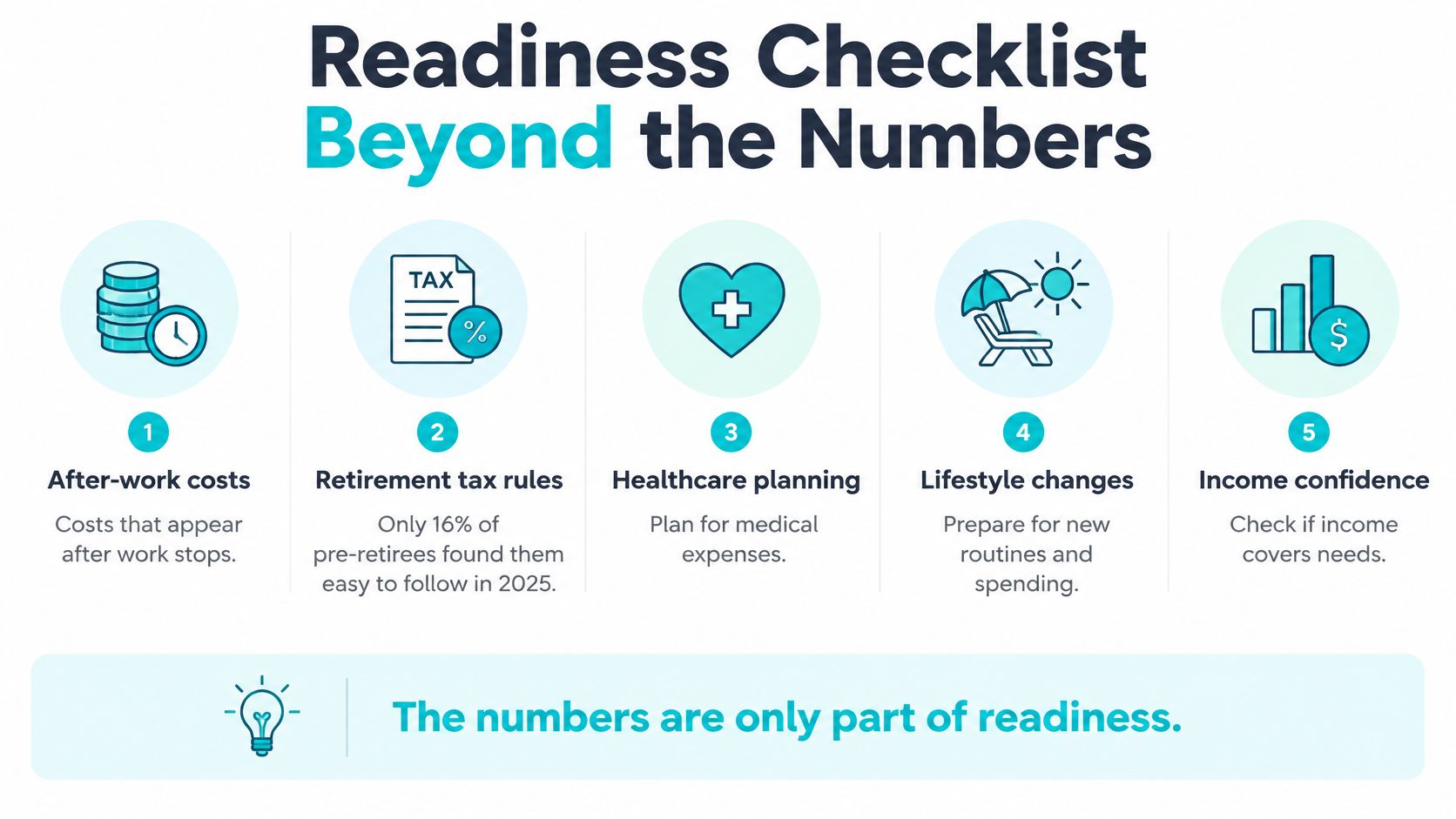
Retirement tax and care costs can be harder to understand than the super balance itself. Independent 2025 research published in the SMC retirement report found only 16% of pre-retirees found retirement tax rules easy to understand, and 17% said the same about potential aged-care costs; 54% and 48%, respectively, found those topics difficult.
The answer isn't to ignore uncertain expenses. Identify the decision, the likely cash-flow effect and what would happen if your assumption proved wrong.
Questions to put beside the projection
- Tax: How will each planned withdrawal or investment payment be treated, and what remains available to spend?
- Aged care: What accommodation, care and ongoing fees might arise, and when would you need cash to meet them?
- Housing: If you downsize, what remains after selling, buying and moving costs, and how does that compare with continuing to own or rent?
- Centrelink: Could selling assets or changing how you hold retirement money alter assessable income or assets?
- Family support: Would gifts or financial help for adult children affect pension eligibility or leave you short later?
- Health and liquidity: Can you meet medical bills, home repairs and urgent spending without selling investments at an unsuitable time?
- Debt: Which repayments continue into retirement, and what happens if interest costs rise?
- Insurance: Does your cover still match your dependants, debts and working arrangements during the transition?
- Your partner: How do their income, super and retirement timing change the household result?
A Perth homeowner planning to move closer to family faces different trade-offs from a regional renter who needs regular travel for healthcare. Neither should assume a national spending benchmark includes those choices.
For every important assumption, ask: does the plan still work if this is wrong?
Run uncertain housing, health and family-support costs through adverse scenarios. Keep the home separate from spendable assets unless you have a realistic, costed decision to release its value.
Preservation Ages and When to Get Assessed
Preservation age by date of birth
| Date of Birth | Preservation Age |
|---|---|
| Before 1 July 1960 | 55 |
| 1 July 1960 to 30 June 1961 | 56 |
| 1 July 1961 to 30 June 1962 | 57 |
| 1 July 1962 to 30 June 1963 | 58 |
| 1 July 1963 to 30 June 1964 | 59 |
| After 30 June 1964 | 60 |
The ATO's super withdrawal guidance explains access through retirement after preservation age, a transition-to-retirement income stream, or reaching 65 while still working. To access super through retirement before age 60, you generally need to stop gainful employment and intend not to return.
Preservation age is different from Age Pension age. Reaching preservation age does not, by itself, make all your super available. The conditions of release and the type of income stream affect when and how you can access it.
Useful assessment triggers
- Before access becomes possible: Use the years before preservation age to check how your expected retirement income could meet your spending needs.
- Before reducing work: Assess whether a transition-to-retirement arrangement fits your proposed hours and longer-term income needs.
- As pension eligibility approaches: Review household income and assets before including Age Pension payments in your retirement estimate.
- After a major change: Divorce, illness, a business sale or a changed retirement date can alter the assumptions behind an earlier assessment.
Our guide to when you can access your super explains how access rules differ from the question of whether your retirement income will be enough.
Early release is limited. The ATO's severe financial hardship guidance says applicants below preservation age must have received eligible income support continuously for 26 weeks and be unable to meet reasonable and immediate family living expenses.
Assessing your position before leaving work gives you more time to consider your choices. Once work has stopped, some decisions about contributions, debt and employment may be harder to change.
Options to Close a Gap
Start with the annual dollar shortfall and identify which spending is exposed. A gap affecting holidays calls for a different response from one affecting rent, groceries or essential care.
Choose a workable combination
Work longer. Continued employment can add contributions and shorten the period funded by savings. Check whether that's realistic given your health, caring responsibilities and job prospects.
Reduce hours gradually. A transition-to-retirement income stream can help replace lost wages where you're eligible. The ATO explains this access pathway, including a minimum access age of 60 for members born after 30 June 1964; model the effect of earlier withdrawals before committing.
Increase voluntary super contributions. Redirect available cash while you're earning, after checking contribution rules, tax treatment and your need for accessible savings. Don't lock away money you'll need before you can legally access it.
Reset discretionary spending. Revisit the target within your chosen benchmark range, but protect essentials first. Delaying a major trip is different from assuming you can permanently spend less on housing or healthcare.
Review housing deliberately. Compare net downsizing proceeds with replacement accommodation and moving costs. A cheaper home doesn't necessarily create enough usable capital to justify the disruption.
Recalculate government support. Test the pension outcome after each proposed change rather than assuming additional private resources translate directly into the same increase in spending capacity.
These levers interact. Paying down debt, for example, changes available cash, future repayments and potentially assessable assets.
Choose a combination you could maintain in an adverse scenario, not just one that balances the base-case spreadsheet. Model the combined outcome before implementing separate decisions.
Book an Intro Call to Test Your Readiness
You don't need a perfect spreadsheet to begin. You need a clear account of your circumstances, your goals and the questions you haven't resolved.
Wealth Collective offers a free 10-minute intro call. We start by reviewing your current situation, then work towards creating a plan that works for you and take care of the next steps.
Bring what you already know
- Your income calculation: Include your replacement ratio and estimated Age Pension.
- Your records: Bring your latest super statement and the spending records used to build your budget.
- Your timing: Note your intended retirement date and confirmed preservation age.
- Your concerns: Include checklist answers, uncertain costs and any assumptions you'd like tested.
The first conversation explores your goals, where you are now, where you want to be and what has stopped progress so far. Our advice relies on the information you provide and our professional expertise, so keep that information accurate and up to date as circumstances change.
General information on this website isn't personal financial advice. Consider your own circumstances and consult one of our qualified Financial Advisers before acting.
Book your introductory call through our website.
Wealth Collective's Retirement Roadmap brings retirement timing, super, investments, debt and income planning into a personalised strategy. Visit Wealth Collective to book your free introductory call and start testing what retirement could look like for your household.