Business hours
Monday to Friday (8.30AM - 5PM)
Weekend (Closed)



Maximising super isn't automatically the best way to build wealth in your 40s. If your employer hasn't paid what you're owed, your credit card still carries a balance or your family couldn't manage without your income, extra salary sacrifice may solve the wrong problem.
The better approach is to put your money to work in the right order. Recover missing contributions, protect household cash flow, remove expensive debt, then coordinate super and accessible investments around the date you want work to become optional.
The Wealth Order for Your Forties
Take a hypothetical Perth couple earning about $180,000 combined, with a mortgage and a school-age child. One partner has much less super after time out of full-time work. They can afford to save something each payday, but they haven't checked whether every employer contribution arrived.
Their first move isn't choosing an investment. It's finding the first unfinished job in their financial structure.
Uneven super balances aren't necessarily evidence of poor decisions. Unpaid caring work, part-time employment and missing employer contributions can all sit underneath them. Treasury's account of the super gap says women retiring in 2020 had average balances around 30% below men's, with a gap projected to remain around 15% by 2040, and cites the ATO's estimate that $6.25 billion in super went unpaid in the most recent financial-year data.
Start with the first unticked row
Catch-up hierarchy for Australians in their 40s
| Order | Move | Why it comes first | 2026 check |
|---|---|---|---|
| 1 | Confirm super was paid | Unpaid super was estimated at $6.25 billion and disproportionately affects casual and lower-paid workers | Payslips and fund receipts reconcile to 12% of ordinary time earnings |
| 2 | Hold a cash buffer | Extra super is generally locked away until a condition of release | Aim for 3–6 months of essential spending in an offset or savings account |
| 3 | Clear expensive revolving debt | Card and personal-loan interest works against the household | Credit cards and personal loans at nil before extra investing |
| 4 | Protect income and dependants | The household still relies on employment or business income | Cover sized to the mortgage, dependants and any business income |
| 5 | Use leftover concessional room | Contributions are generally taxed at 15% in the fund, often below the individual's marginal rate | All funds combined remain within the $30,000 cap, plus eligible carry-forward |
| 6 | Invest surplus or add after-tax super | Long-term investing comes after liquidity and costly debt | Non-concessional amounts checked against the $120,000 cap and total super balance |
The contribution settings in this hierarchy follow the ATO's contribution and tax guidance, while the cash-buffer range is a planning recommendation, not a legal requirement. Choose the larger buffer if income is variable, one partner carries most of the earnings or business cash flow is unpredictable.
Match payslips against transactions in every super fund, then compare them with your ATO online record. A payslip entry isn't proof that money reached your account. Investigate discrepancies and lodge an unpaid-super enquiry with the ATO where contributions remain missing.
Don't wait until every debt is cleared before checking insurance. Arrange protection while you're fixing cash flow, particularly if a mortgage or child depends on your earnings. The hierarchy sets priorities for surplus money, not permission to leave a serious exposure unattended.
Give each payday a job
For the couple, the payday split starts with bills, minimum debt repayments and necessary cover. The next allocation replenishes the offset or clears expensive debt, according to the first unfinished priority. Only once those foundations are sound does the split extend to a calculated concessional contribution and a transfer into accessible investments.
Keep school fees, planned repairs and other foreseeable expenses separate from the emergency reserve. Otherwise, every predictable bill becomes a supposed emergency and the buffer never stays intact.
Accessible doesn't mean suitable for short-term spending. Money earmarked for a near-term school bill belongs in cash or the offset, not a share portfolio that might be down when the invoice arrives.
For protection, assess income protection alongside life and total and permanent disability cover. Include mortgage obligations, care costs, the surviving partner's earning capacity and any business commitments. Read existing policy definitions before replacing cover or consolidating funds.
The ATO's personal contribution guidance is relevant when turning surplus cash into deductible contributions, but a deduction doesn't answer whether you can afford to lock the money away. That's a household cash-flow decision first.
Practical rule: Don't chase a tax saving with money you may need to borrow back later.
If you're considering borrowing to invest, understand how debt recycling works before changing loan arrangements. It isn't a substitute for clearing consumer debt or having reliable surplus cash.
This month, sit down together, mark the first row you can't confidently tick and assign someone to finish it. Start there, rather than opening another investment account.
How to Use the 2025–26 Super Caps
Your most useful super number isn't the headline cap. It's your remaining contribution room after employer payments and existing arrangements. Calculate it for each partner separately, even when you manage household spending together.
Use fund transaction records, payroll information and your ATO online account. Keep a worksheet showing contributions received, payments expected and the amount still available.
Run the contribution audit
Add every concessional contribution. Include employer Superannuation Guarantee, salary sacrifice and deductible personal contributions across all funds. The ATO's contributions-cap rules aggregate these amounts, set the 2025–26 standard cap at $30,000, and allow eligible unused cap amounts to be carried forward subject to total-super-balance rules.
Forecast employer payments still to come. The ATO's Superannuation Guarantee schedule sets the rate at 12% of ordinary time earnings from 1 July 2025, equivalent to $12,000 on $100,000 or $18,000 on $150,000 where those salaries represent ordinary time earnings.
Use only the residual. Subtract received and expected concessional contributions from your available cap. Don't instruct payroll to salary-sacrifice the entire cap on top of employer contributions. Confirm timing with payroll and the fund rather than assuming a deduction on a payslip has already reached super.
Check the actual tax outcome. ATO personal-super guidance explains that concessional contributions are generally taxed at 15%, while Division 293 may apply where income plus concessional contributions exceeds $250,000. Excess concessional contributions can enter assessable income with an associated tax offset rather than delivering the result you intended.
Assess after-tax contributions separately. Under the ATO's non-concessional contribution rules, the annual cap is $120,000 for eligible people, generally where total super balance was below $2 million on 30 June 2025; at or above that balance, the cap can be nil. Bring-forward availability turns on age, balance and prior contributions.
The limits and employer calculations above translate into the following worksheet.
Super contribution limits for 2025–26
| Contribution type | 2025–26 amount | What counts | Limit that changes it |
|---|---|---|---|
| Concessional | $30,000 | Employer guarantee, salary sacrifice and deductible personal contributions across all funds | Eligible unused cap carry-forward |
| Employer on $100,000 salary | $12,000 | 12% of ordinary time earnings | Counts towards the concessional cap |
| Employer on $150,000 salary | $18,000 | 12% of ordinary time earnings | Leaves $12,000 residual if there are no other concessional contributions |
| Division 293 | Extra 15% on relevant concessional contributions | Income plus concessional contributions | Applies above $250,000 |
| Non-concessional | $120,000 | After-tax contributions | Generally requires total super balance below $2 million on 30 June 2025 |
| Non-concessional at a high balance | Nil | After-tax contributions | Total super balance at or above $2 million |
| Bring-forward | More than one annual cap over up to three years | After-tax money, potentially from a bonus, inheritance or business sale | Age, total super balance and prior contributions |
Finish with a dollar figure
Keep account administration beside the contribution calculation, not on a separate forgotten list.
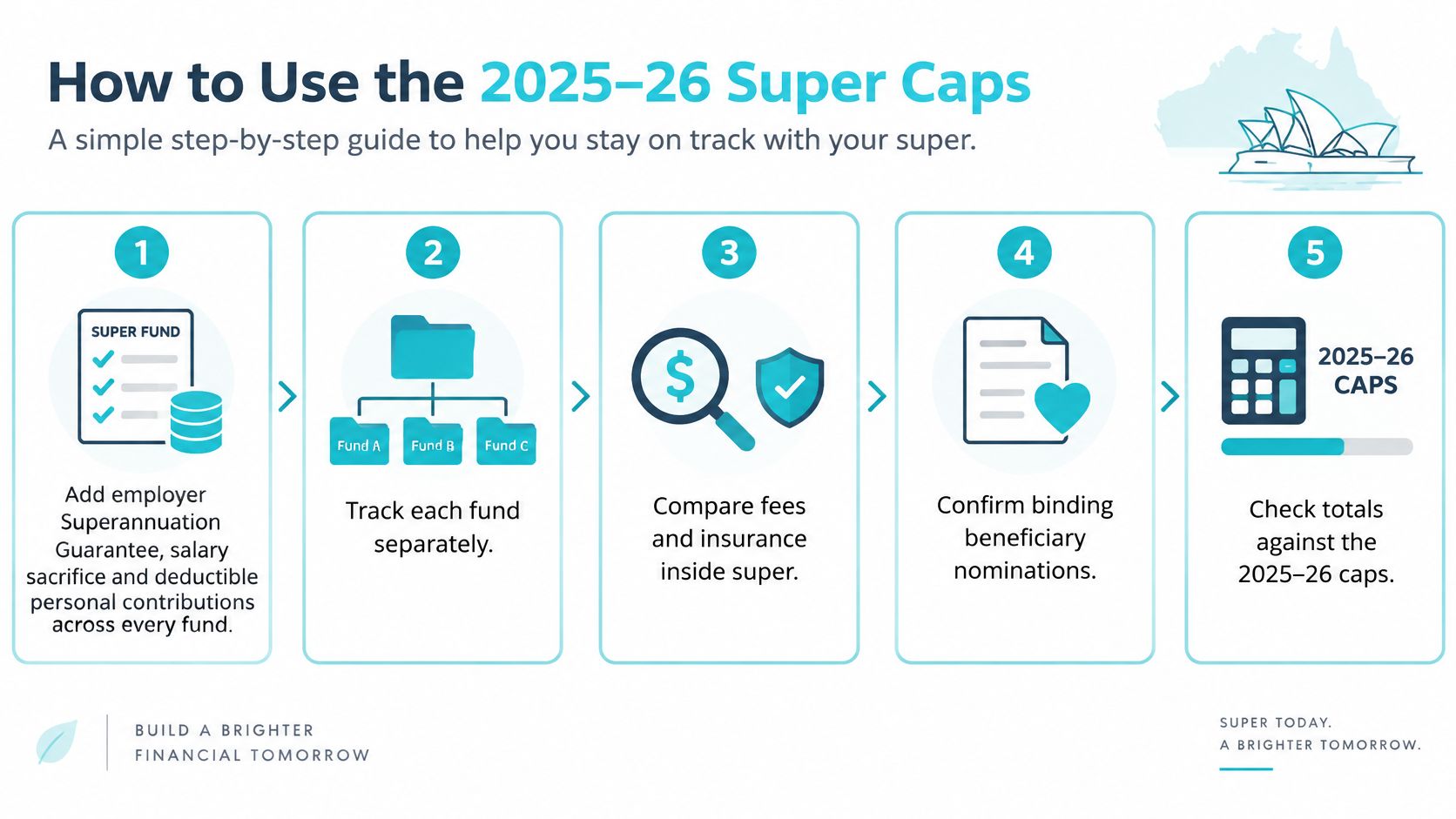
For the table's higher-salary example, the residual calculation assumes no other concessional contributions and no additional eligible carry-forward capacity. A bonus, second employer or existing salary sacrifice changes the result.
Write your own residual on the worksheet and review it quarterly. Our explanation of concessional contribution limits can help you distinguish the cap from the amount you can add. Don't leave that distinction to a rushed payroll change in June.
Build a Retirement Runway in Your Forties
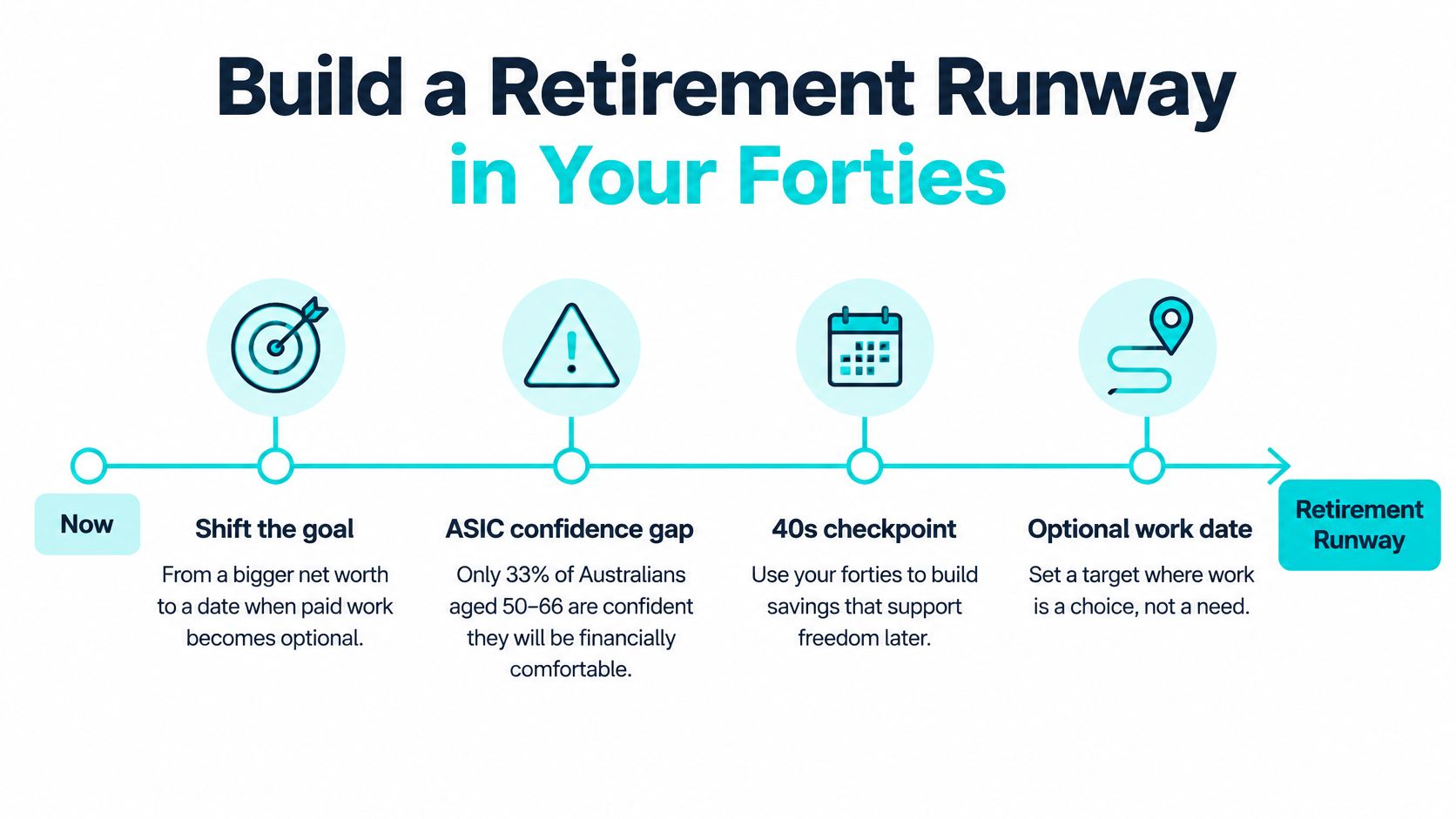
ASIC's retirement picture shows why a growing balance isn't enough: only 33% of Australians aged 50–66 were confident they'd be financially comfortable in retirement, 18% had a clear plan before retiring, and 41% felt confident managing retirement finances, alongside an estimated 2.5 million Australians expected to retire over the coming decade and super assets exceeding $4.3 trillion at 30 June 2025, as outlined through ASIC's Moneysmart retirement-planning material.
Your target should be a date when paid work becomes optional, backed by a spending plan. A larger net worth is useful only if the assets can support the life you want at the time you need them.
Model support without depending on it
Age Pension eligibility uses both income and assets tests, and couples' assets are assessed jointly. Services Australia's eligibility guidance provides the following homeowner and non-homeowner free areas and homeowner pension cut-offs; thresholds change, so treat them as planning inputs rather than promises about future entitlements.
Age Pension assets-test thresholds to model now
| Situation | Assets-test free area | Full-pension cut-off | What the test can include |
|---|---|---|---|
| Single homeowner | $333,000 | $745,750 pension cut-off, not the full-rate boundary | Savings, shares, assessable super and other assessable assets |
| Couple, homeowners, assets assessed jointly | $499,000 | $1,121,000 pension cut-off, not the full-rate boundary | Combined assessable financial assets |
| Single non-homeowner | $600,000 | Check the applicable current non-homeowner cut-off | Assessable assets, with a higher free area |
| Couple, non-homeowners | $766,000 | Check the applicable current joint non-homeowner cut-off | Joint assessable assets, thresholds subject to change |
The free area and pension cut-off aren't interchangeable. The former marks the assets-test boundary before pension reductions, while the latter concerns when pension entitlement cuts out. Super's assessability also needs to be checked against the rules applying to each partner's circumstances.
Don't reorganise your working life around today's pension thresholds. Model government support as one component of retirement income, alongside your own assets and spending flexibility.
Put the runway on one page
Write down these inputs in today's dollars:
- Annual spending: The amount you'd live on, including home maintenance, travel and irregular expenses.
- Optional-work age: When you want the freedom to reduce or stop paid work.
- Debt deadline: Which debts must be gone, and the intended mortgage-free year.
- Current investment position: Each super investment option and the assets available outside super.
This is the shift from accumulating accounts to funding a life.
Model conservative, central and stronger investment-return assumptions. Then add a disruption such as redundancy or a period of private-school fees, without assuming you'll compensate by earning more.
If the conservative case fails, identify the adjustment now: contribute more, spend less, change the work date or reduce a major commitment. Don't solve a funding gap by assuming higher returns.
A useful retirement plan tells you what to change when circumstances disappoint, not just what happens when everything goes well.
Use how much super you need to retire as a starting point for that spending-led conversation. Your one-page runway should make the next decision clearer, not merely produce an impressive final balance.
Milestones and Moves From 40 to 55
The right move changes as your household changes. Early in the decade, untidy accounts and outdated insurance may be the main issue. Later, the harder question is whether your assets, mortgage and education commitments still support your intended work date.
Use the following age bands as practical checkpoints, not deadlines you've failed if life took another route.
Ages 40–44 tidy the structure
Find stray super accounts and compare fees, investment options and insurance before consolidating. Don't cancel an account carrying valuable cover until you understand what would disappear and whether replacement cover is available on acceptable terms.
Check binding beneficiary nominations directly with each fund. Confirm whether they're valid, current and consistent with your wishes rather than assuming your will controls every super payment.
Give household administration a shared home. Keep fund statements, insurance schedules, loan details and nomination confirmations together, so either partner can find them without relying on the other's memory.

Ages 45–49 decide before the bonus arrives
After a pay rise or bonus, update the contribution worksheet before changing salary sacrifice. Review whether eligible carry-forward capacity is available and whether using it would leave the household short of accessible money.
Also inspect concentration outside the family home. Employer shares, an investment property or a narrow industry holding shouldn't become the default destination for every additional dollar merely because it's familiar.
Say our hypothetical couple receives a $40,000 cash bonus at age 47, after payroll withholding. Assume their offset needs $10,000 to reach its chosen buffer, their checked concessional residual is $12,000, and there are no outstanding consumer debts or protection gaps. One concrete allocation is:
- $10,000 to the offset: Complete the buffer before making irreversible contributions.
- $12,000 to super: Use only the verified residual, with deduction requirements checked before claiming.
- $18,000 to accessible investments: Build a diversified taxable portfolio for longer-term goals, including later education costs.
Those are scenario assumptions, not a recommended split for every bonus. If school fees are due soon, retain that portion in cash rather than exposing it to market falls. If the bonus is quoted before tax, allocate the actual proceeds, not the headline amount.
Ages 50–55 test the spending transition
Ask whether the mortgage repayment path and remaining education bills still fit the runway. Start describing how assets will pay for spending, including which accounts could fund an earlier reduction in work.
Review nominations after a separation or new partner, rather than leaving them for an annual reminder. Review contributions and cash flow quarterly, with extra checks after employment changes.
The best year is the one the control system ran, not the one with the highest market return.
Pick the checkpoint closest to your circumstances and write down one action due this quarter. Make it observable, such as obtaining nomination confirmation or updating the bonus allocation, rather than promising to get more organised.
Book the Intro Call When the Plan Stalls
Book help when the first unfinished priority remains unresolved, your contribution residual is still a guess or you can't name a credible optional-work date. Those are decisions with consequences, not administrative details to leave indefinitely.
You don't need a perfect spreadsheet before speaking with us. You need enough information to show what comes in, what must go out and what you want your money to achieve.
Bring the documents that change the decision
Gather the following before a detailed advice conversation:
- Every super statement: Include accounts you no longer actively use and details of existing contribution arrangements.
- A rough monthly surplus: Use actual spending rather than the amount you think you ought to save.
- Debt balances and interest rates: Include the mortgage, cards, personal loans and business-related commitments.
- Existing cover: Bring insurance schedules, including cover inside super, and any questions about exclusions or benefits.
- Your preferred work date: State when employment should become optional and which lifestyle commitments matter most.
If something is missing, flag it. An incomplete document list is manageable; treating an unknown as a reliable assumption is more dangerous.
At Wealth Collective, we work from Perth and Dunsborough. We research and model your options, then create a detailed financial plan that balances financial structure, money success and lifestyle. The purpose is to coordinate competing decisions, not optimise super while ignoring the mortgage or sell investments before understanding your cash needs.
Match the conversation to the unfinished job
The right starting point follows the gap. Protection Plus addresses the conversation when cover is the unticked priority; Guided Growth helps turn income and assets into a customized wealth-building engine; and Retirement Roadmap provides a clear path towards retirement financial security.
We guide you through the financial plan and answer your questions. Once you're comfortable with the outcomes, we take care of the paperwork, products if required and end-to-end implementation. We don't push products or use a hard sell.
The first step is a free 10-minute intro call to see whether your household and our firm should keep going. You can reach our team on (08) 9202 6833 or at hello@wealthcollective.co, Monday to Friday, 8:30am to 5pm. We're closed on weekends.
Don't wait for a larger balance to justify getting organised. Bring the unresolved decision, the documents you have and the lifestyle you're trying to protect. You need one sequenced plan, not another generic balance target.
Wealth Collective brings debt reduction, super, investments, protection and retirement planning into a coordinated financial plan built around your circumstances. Visit Wealth Collective to book your free 10-minute intro call and identify the next move for building wealth in your 40s.