Business hours
Monday to Friday (8.30AM - 5PM)
Weekend (Closed)


When a recession hits, how quickly does cheaper money reach your household budget?
Interest rates usually fall, but relief arrives in stages and reaches borrowers unevenly. Australia's two clearest episodes show that the trigger can differ. In the early 1990s, the Reserve Bank of Australia eased after inflation and demand had visibly weakened. In 2008, it cut rapidly while inflation remained high because risks to financial stability had become more urgent.
A rate cut works like water moving through connected pipes: pressure changes at the source first and reaches each outlet later. The cash rate moves first, lenders reprice afterward, and fixed-rate borrowers wait until their fixed term ends. Lower mortgage repayments can also coincide with less interest earned on savings. Measure the effect across every loan and account you hold rather than assuming the headline cut tells the whole story.
What Usually Happens to Rates in a Recession
If recessions bring rate cuts, why did Australia's cash rate still sit at 10.5% in June 1991? Because policy eases after the evidence lands, then moves decision by decision rather than in one jump. A recession raises the odds of cuts without setting a date.
The Reserve Bank of Australia's 1992 annual report captures that lag: real domestic expenditure was about 7% below its early-1990 peak, with residential construction and business investment contracting sharply, yet the cash rate was still 10.5% in June 1991. Five further cuts followed from September 1991 to July 1992, and easing continued into March 1993 as the recovery kept stalling.
Three episodes side by side
Read the table as a map of cumulative easing, not as a schedule you can plan around.
| Recession episode | Cash rate at start | Cumulative cut | Lowest cash rate |
|---|---|---|---|
| 1990-92 recession | 17.5% in January 1990 | Just over 12 points | 5.25% after the March 1993 cut |
| 2008-09 global recession | 7.25% at the peak | 4.25 points | 3% by April 2009 |
| 2020 COVID-19 recession | Already low, so extra tools were used | Took the cash rate to 0.1% | 0.1%, the lowest recorded level |
The speed differs as much as the size. In 2008 the RBA cut by a cumulative 425 basis points to 3% by April 2009, a new cyclical low at the time. In 2020 it took the cash-rate target to 0.1% and added government-bond purchases and a Term Funding Facility to press down longer-term rates, as the RBA's explanation of how it implements monetary policy describes.
What the table can't tell you: cumulative cuts hide the pace. Twelve points spread over roughly three years feels nothing like 4.25 points packed into eight months, and a household budget experiences that difference directly.
Treat each cut like water moving through pipes: the cash rate opens first, then deposit and loan pricing adjusts, then repayments reset where contracts allow. The household result is the sum across the whole balance sheet. A variable-rate mortgage may gain while cash savings lose income, fixed-rate debt may sit unchanged, and job security can matter more than the headline move.
Why the RBA Waits for Evidence Before Cutting
Weak growth alone doesn't move the cash rate. The RBA sets that target to balance inflation returning to its target against keeping people employed, so a slowdown is one input among several, weighed against wages, housing demand and financial conditions. That's why the first sign of trouble often produces commentary rather than relief.
The 1990s sequence is the worked example. Before the cuts came the tightening: the RBA had raised rates to very high levels to reduce excess domestic demand, curb speculative commercial-property activity and bring inflation down. Only once the economy weakened and inflationary pressure eased did the RBA's recession explainer record a run of reductions.

Look at how the steps were spaced:
- April and May 1991: one percentage point, then another, as demand fell away.
- September 1991 to May 1992: repeated 1-point cuts in September, November, January and May, four separate decisions rather than one big move.
- July 1992 and March 1993: 0.75 of a point, then 0.5, as the recovery kept stalling.
When urgency overrides inflation
The pattern isn't fixed. In late 2008 the RBA cut rapidly even though inflation was still high, because recession and financial-stability risks had become the more urgent problem, as the RBA's review of monetary and financial policy documents. When the financial system is the threat, the central bank moves first and debates inflation later.
Today's constraint looks different again. The RBA's February 2026 economic conditions update put trimmed-mean inflation at 3.4% and headline inflation at 3.6% over the year to the December quarter, above the midpoint of the 2 to 3% target range. Even with easing through 2025, when variable mortgage rates declined by around 75 to 80 basis points, scheduled principal-and-interest payments still equalled 9.8% of household disposable income in the September quarter.
Practical rule: watch the inflation reading and the labour market data, not the headlines about slowing growth. Those two decide the timing of the first cut far more than a weak retail sales number does.
How a Rate Cut Reaches Your Loan
Think of the cash rate as the first domino. It falls in the overnight interbank market, then each later domino tips more slowly, and some never tip at all. Here's the chain, stage by stage, and what each stage means for a household.
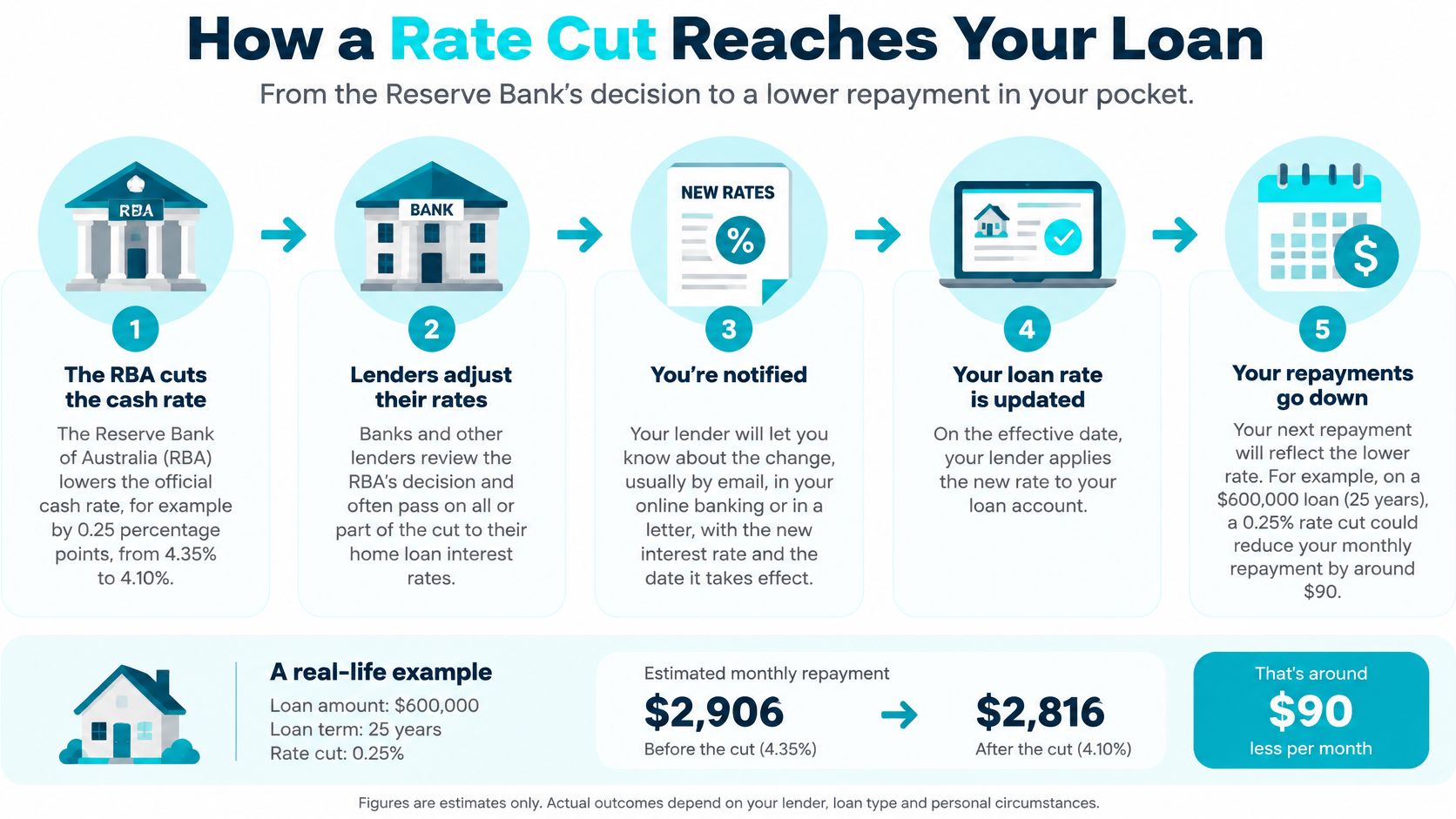
1. The RBA sets the target. The cash rate is set in the overnight interbank market, where institutions lend each other surplus balances. It anchors bank funding costs, and from there it flows into variable mortgage rates, business lending rates and asset valuations, as the RBA's guide to unconventional monetary policy explains.
2. Funding costs shift, but not one for one. Wholesale borrowing, deposits and existing bond issuance all feed a lender's cost of funds. A 25 basis point cut to the cash rate doesn't cut that cost by 25 basis points on the same day.
3. Variable rates reprice. Most lenders pass on at least part of a move within weeks. Variable-rate borrowers therefore get relief sooner than fixed-rate borrowers, whose position doesn't change until their fixed term ends.
4. Deposit returns fall. Term deposit rates and savings bonuses usually slide as easing passes through. Savers often feel the effect before borrowers do, because deposit pricing reacts quickly to expected cuts.
5. Markets front-run the decision. Bond yields and term deposit offers often move as traders price in future cuts, which means the return on your cash can drop months before the official announcement. If you're holding a large cash balance, check it against expected cuts rather than the current advertised rate.
If you're weighing up how your loan should be structured for this cycle, the comparison of fixed or variable rates explains how each choice changes your exposure to a cut and to the wait afterwards.
Where the chain breaks
The chain can stall at step two. If wholesale funding costs, credit risk or capital requirements rise during a downturn, a lender may hold or widen its margin, so the cash rate falls while your retail rate falls by less. A recession can deliver lower official rates alongside tighter credit availability, particularly for highly indebted households and small business borrowers with weaker serviceability.
Check this yourself: compare the change in your variable rate with the change in the cash rate over the same period. If the gap has widened, you've just measured your lender's margin.
Who Gains and Who Loses When Rates Fall
A rate cut lands on households the way rain lands on a garden: some beds soak it up, others sit under cover and stay dry. Lower rates get reported as good news, which holds for some households and not for others. Recent Reserve Bank of Australia analysis of household and business resilience found that lower rates reduced scheduled mortgage payments and improved real disposable incomes, yet mortgage payments remained higher as a share of household income than before the pandemic.
The same analysis points the other way for cash. Lower rates reduce interest income for retirees and households holding term deposits, while inflation keeps eroding purchasing power. A cut that helps an indebted family in its thirties can cut the income of a self-funded retiree on the same street.
| Household type | Likely effect of cuts | Main watch-out |
|---|---|---|
| Variable-rate borrower | Repayments fall, often before fixed-rate loans reprice | Relief depends on lender pass-through |
| Fixed-rate borrower | Little change until the fixed term ends | Refinancing timing matters |
| Saver or term deposit holder | Interest income falls | Inflation may erode real returns |
| Retiree on cash income | Lower interest income | Plan drawdowns against inflation |
| Investor in shares or property | Valuations may rise while earnings weaken | Recession risk can offset lower rates |
| Small business borrower | Lower funding costs possible | Credit may tighten if risk rises |
Borrowers haven't followed the textbook script either. The same analysis reported that Australian households kept making extra payments into offset and redraw accounts even after rates declined, which suggests many are rebuilding buffers rather than spending the difference. Money parked in an offset account reduces interest immediately, so the benefit is real even if the scheduled repayment barely moves.
Savers face the mirror image. Compounding works in both directions: reinvested interest builds returns over long periods, and a lower reinvestment rate slows that build. The guide to simple vs compound interest explained shows why the reinvested portion, rather than the initial deposit, drives most of the growth.
It is tempting to read a cut as a pay rise. It is closer to a repricing of everything you owe and everything you hold, and the pieces move at different speeds. A variable rate shifts when the lender reprices, a fixed rate only at expiry, and deposit income on its own schedule.
The four-line sum that settles it
Run this for your own household rather than accepting the headline claim:
- Mortgage interest saved: the monthly difference between your current repayment and the repayment after the cut you expect.
- Deposit interest lost: the annual income reduction on term deposits and cash, converted to a monthly figure.
- Inflation adjustment: what both numbers are worth after rising living costs, since a smaller repayment buys less than it looks while prices are still climbing.
- Timing: the month each change lands, including the date a fixed rate expires.
The net figure, not the headline cut, decides whether a recession helps or hurts your cash flow. For a household carrying a large mortgage and little cash, the sum usually comes out positive. For a retiree drawing on interest, it usually comes out negative, which is why the same announcement calls for a different plan in each case.
Why Credit Can Tighten Even as Rates Fall
Australian household debt is what makes recession-driven rate changes so consequential. An RBA study of household debt found the household debt-to-income ratio rose from the bottom half of advanced economies in the late 1980s to the top quartile by 2018, and it links lower real interest rates with increased household indebtedness. The same research notes Australian policy rates fell by about 10 percentage points during the 1990s recession.
That history sets up two opposing pressures in the same household budget.
- Relief: repayments on variable debt fall, freeing cash flow within weeks of a lender repricing.
- Strain: weaker employment, lower business income or reduced investment returns cut the income that services the same debt.
How lenders respond when risk rises
Lenders don't read a cash-rate cut as a signal to loosen. In a downturn they tighten serviceability assessments, apply higher margins to borrowers they consider riskier, and pull back on lending limits for heavily indebted households and small businesses. A borrower whose income is secure gets the full benefit of a cut. A borrower whose hours have been reduced may find the lower rate offset by a smaller loan offer at the exact moment they need to refinance.
Defensive move: treat any repayment saving as a buffer to rebuild, not as new spending capacity. A reserve that covers three to six months of repayments does more for a household in a recession than a slightly lower advertised rate.
Work through four checks in order, using documents rather than memory:
- Mortgage terms and fixed expiry: confirm the current rate, the comparison rate and the exact date any fixed period ends.
- Emergency reserve: total the offset balance, redraw availability and cash savings in months of essential spending.
- Insurance cover: check income protection, life and trauma cover against the income that would stop.
- Superannuation exposure: look at how the portfolio is positioned for a weaker earnings environment, not just at last year's return.
None of these steps replaces a full review. Each one, though, tells you whether a lower cash rate reaches your household or stops at the lender's margin.
Stress-Testing Your Cash Flow Before Relief Arrives
Numbers make the stakes concrete, so start with a hypothetical. Take a $600,000 principal-and-interest variable loan over 25 years, priced at 6.00% before any cut. The table shows what happens if the lender passes on the full reduction.
| Scenario | Variable rate | Monthly repayment |
|---|---|---|
| No cut from base rate | 6.00% | About $3,866 |
| Half-point cut | 5.50% | About $3,685 |
| One-point cut | 5.00% | About $3,508 |
The figures are approximate and exclude fees, and they assume complete pass-through with no change to the loan term. A half-point cut saves roughly $180 a month, a full point roughly $360. Useful money, but easily absorbed by a lost term deposit payment, a jump in insurance premiums or a higher grocery bill. That's why the size of the cut matters less than what your whole budget looks like when it lands.
Run the test in four steps
- Write down the current repayment and the fixed-rate end date, if you have one. Without the expiry date you can't tell when relief reaches you.
- Model a delayed cut and a partial cut. Assume the cash rate falls six months later than expected, and that your lender passes on only part of it. If the budget still works, the plan is solid.
- Model an income shock. Six weeks of reduced hours, a lost contract for a small business owner, or a rental vacancy. The debt stays the same while the income doesn't.
- Check the weakest case against your reserve. If the weakest scenario requires borrowing to cover repayments, the reserve needs topping up before anything else.
The point of the exercise isn't pessimism. It's that a household which can survive a delayed, partial cut is in a position to use the cut well, whether that means accelerating repayments or holding the difference in an offset account. A structured approach to cash flow management starts with exactly this kind of scenario work, using your own figures rather than an illustration.
Use your own loan balance, rate and income in every line. The illustration only shows the shape of the answer.
Confirm Your Plan Before the Next Rate Cut
Relief can arrive in stages, so confirm your position before you rely on it. A cash-rate cut may move a variable loan first, leave a fixed loan untouched until expiry, trim savings interest sooner than expected and do nothing for income risk. Measure the effect across the whole balance sheet, not from the headline cut.
That is a 20-minute conversation, not a project. Wealth Collective is a Perth and Dunsborough financial advice firm, and a free 10-minute introductory call is enough to see where you stand. The three service pillars map onto the risks in this guide: Protection Plus for personal insurance if earnings fall, Guided Growth for investment and debt-reduction decisions when rates shift, and Retirement Roadmap for pre-retirees and retirees whose interest income may drop. The process is transparent and backed by a satisfaction guarantee. If your fixed rate ends near a possible cut, a separate guide on when to refinance a mortgage can help you frame questions, while debt reduction stays part of the advice discussion.
Bring four things to that first call: your latest loan statement, the fixed-rate expiry date, your superannuation balances and any insurance policies. Ask which change reaches you first, which arrives later and which may not arrive at all. Then book the call before the next RBA announcement, not after.
Wealth Collective helps Australians see how a cash-rate decision travels through their mortgage, savings, insurance and superannuation, rather than treating a cut as universal good news. If you'd like that mapped to your own figures, with the timing of each change set out, book a free 10-minute introductory call and bring your loan statement and super balances. Visit Wealth Collective to get started.