Business hours
Monday to Friday (8.30AM - 5PM)
Weekend (Closed)



You're at the kitchen table with bank statements, an unopened super statement and a message asking who's paying the mortgage this month. An equal split sounds fair enough. But a percentage alone cannot show whether you can pay next month's bills or support yourself in retirement. Those are different tests of the same settlement.
Good financial advice when separating starts with what each person will live on in the first year and in retirement.
Start by reviewing the financial picture and checking deadlines. Before discussing any division, address safety and complete financial disclosure so negotiations rest on a shared picture. Then examine super, model what each proposed split means for income, and weigh housing, insurance and professional costs before negotiating or signing. A workable settlement needs to support life after separation.
Review Your Financial Position Before Any Decision
Say you agree to keep the house and give up a share of your super, then sign six weeks later. Afterwards you find a personal guarantee you gave for your ex's business loan, and a second super account from an old employer that nobody valued. The deal was struck on an incomplete picture, and unpicking it is much harder than pausing would have been.
Separation touches a large share of Australian households, and it rarely arrives as one clean break. Two incomes become one, debts stay in joint names, and retirement savings get divided between people who may have very different working years left ahead of them. The ABS marriages and divorces statistics count registered marriages and divorces, so de facto breakdowns and informal separations sit outside those figures entirely.
The six areas to check before you negotiate anything
A percentage split only works if the pool is complete and you know what each part is worth to you. That is why the review comes before the conversation about percentages, not after it. Each row below can change what a fair share looks like, and some of them carry risks that survive the settlement itself.
| Area | What to gather | Main risk if missed | Who to consult |
|---|---|---|---|
| Shared assets | Title deeds, valuations, bank and savings statements, vehicle and share records | Settling on an incomplete asset pool | Family lawyer |
| Superannuation | Latest statements for every fund, insurance inside super, contribution history, nomination forms | Super left out of the settlement or valued wrongly | Financial adviser and family lawyer |
| Debts and guarantees | Loan statements, credit card balances, personal guarantees, unpaid tax notices | Remaining liable for an ex-partner's debt | Family lawyer and financial adviser |
| Income and cash flow | Three to six months of bank statements, pay slips, a list of regular expenses | Unable to meet repayments on one income | Financial adviser |
| Insurance | Policy schedules, owner and beneficiary details, premium amounts | Cover lapses or old nominations pay the wrong person | Financial adviser |
| Tax | Recent tax returns, capital gains records, records of asset transfers | Unexpected tax bill after a transfer or sale | Registered tax agent or accountant |
Two of these rows deserve attention first. Super often turns out to be the largest asset in the pool once every fund is found and valued, and a guarantee can leave you paying a debt long after the relationship ends. Neither shows up in a conversation that starts with "who keeps the house".
Two actions this week:
- Build one spreadsheet listing every account, loan, policy and asset, with a balance and a date, all pinned to the separation date. Use one tab per area so nothing hides in a scroll.
- Flag each row that needs a professional check before anything is signed. A guarantee, a defined benefit super interest and a property transfer all belong in that flagged group.
Practical rule: nothing gets signed while a row on that spreadsheet still has a question mark against it.
Deadlines That Can Limit Your Claims
The rule many get wrong is where the property clock starts. For a married couple, it runs from the date the divorce order becomes final, not from the day one of you moved out. The Federal Circuit and Family Court of Australia is explicit that a divorce doesn't settle financial support, property division or arrangements for children, and that the 12-month window for financial or property applications opens once the divorce is final.
The Court's guidance on time limits sets out the deadlines that catch people out:
| Situation | Deadline or rule | What it means for you |
|---|---|---|
| Married couple, property application | Within 12 months after the divorce order becomes final | The clock starts at the final order, not at separation |
| De facto couple, property application | Within two years of relationship breakdown | Record the breakdown date now, because it sets the clock |
| Divorce eligibility | At least 12 months living separately and apart, with no reasonable likelihood of reconciliation | Financial planning should begin well before the divorce is granted |
A worked example
A couple separates in March. One moves into a rental, they split the bills informally, and 14 months later the divorce application goes in. The property clock hasn't been ticking through that year of informal arrangements. It starts when the divorce order becomes final, and from that point they generally have 12 months to lodge a property application.
De facto couples run on a different clock entirely, measured from the breakdown itself, which is why the date matters so much and why memories of "around Easter, I think" cause problems later.
If a deadline has already passed, you may need the court's permission to proceed, and the claim can be barred. A verbal understanding between two people who currently get along doesn't preserve either person's position, and it doesn't stop a clock.
Write down three dates today: the separation date, the date the divorce order is expected or was made, and the de facto breakdown date if it applies. Put each resulting deadline in your calendar with a reminder three months ahead, then ask your lawyer or adviser to confirm which one governs your situation.
Protect Your Safety Then Divide Assets Step by Step
Standard separation checklists assume two people who can safely swap statements and talk numbers. Where family violence, economic abuse or coercive control is present, that assumption breaks, and following the usual order of steps can make things worse.
Economic abuse is common enough that family law now builds it into property outcomes. The Attorney-General's Department fact sheet on the family law property changes confirms that reforms commencing 10 June 2025 require the economic effect of family violence to be considered where relevant in property and financial decisions. The same reforms place financial-disclosure duties into the Family Law Act, so each person's obligation to share information is a legal duty rather than a courtesy.
That duty cuts both ways. Transparency is not always a safe first step. Ringing an ex to ask about a missing account, or confronting them about a suspected hidden asset, can raise the risk rather than resolve it. Timing and method matter as much as the information itself.
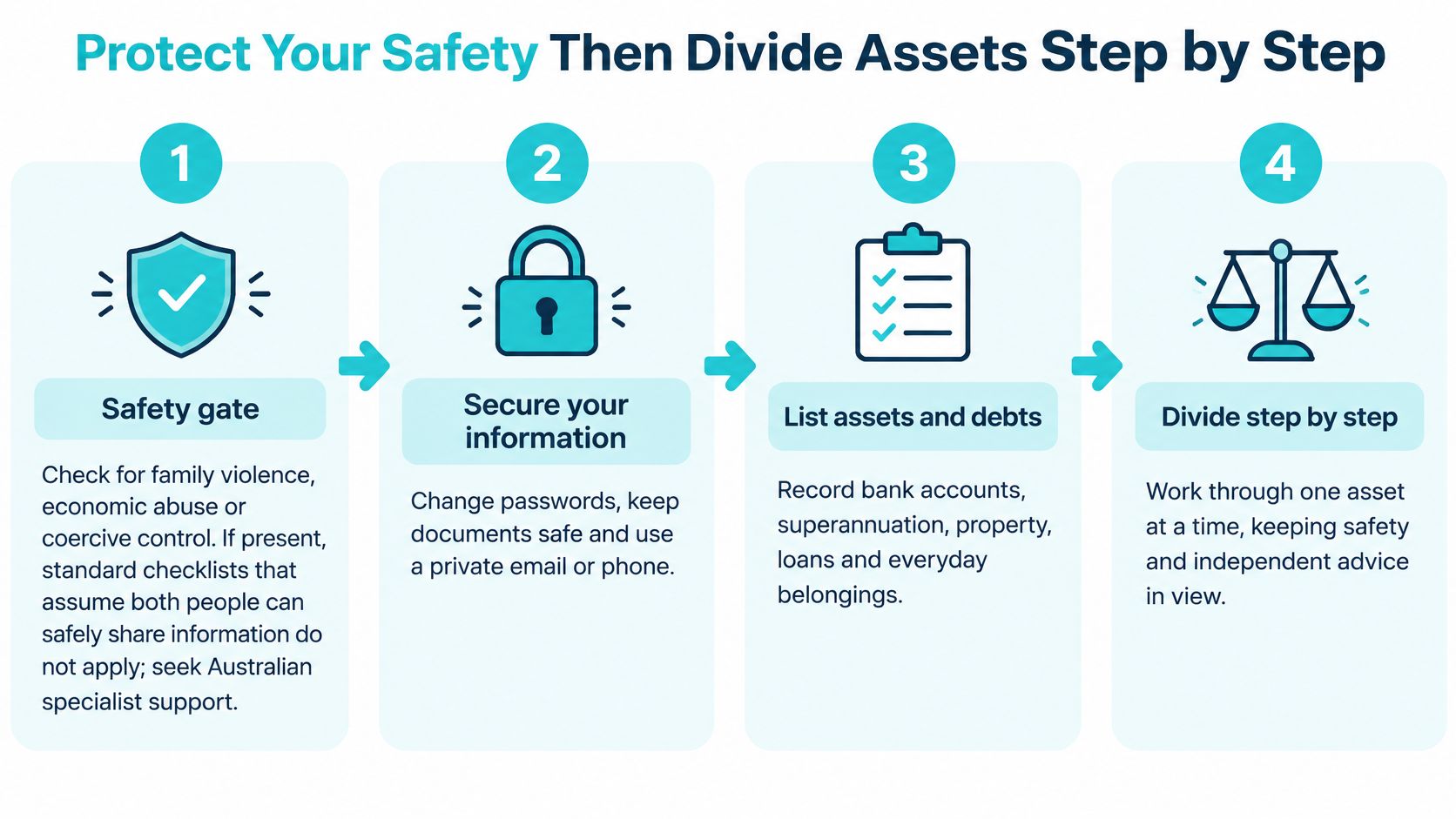
The safety gate comes first
Work through these three steps before any negotiation, and involve a family lawyer and specialist family violence support services before any step that involves the other person.
- Secure independent access to your records. Get your own bank and super logins working on a private email address and a device the other person can't reach. Change passwords and enable two-factor authentication on a phone number in your name only. Download statements as PDFs and store copies somewhere the other person has no access to, whether that's a separate cloud account or a folder held by your lawyer. Preserve evidence without announcing what you've found.
- Get legal advice before you move anything. Transferring, selling or restructuring an asset before advice can weaken your position and, in an unsafe situation, escalate it. Ask specifically about joint debts, guarantees, company interests and unpaid tax, because those liabilities often sit outside the accounts you can see.
- Plan short-term cash flow and housing separately from the final settlement. Where you sleep next month and how the groceries get paid for are interim questions. Settling them doesn't concede anything about the final division, and treating them as one negotiation is how people end up pressured into a permanent deal to solve a temporary problem. A settlement that looks fair on paper can still fail you if it leaves nothing to cover rent, repayments and living costs while it's being finalised.
In a coercive-control situation, gathering information safely is the work. Negotiation can wait.
Then divide assets, one step at a time
Once it's safe to proceed, the division itself follows a sequence. The common slip is listed beside each step.
- Confirm the separation date in writing. It shapes what counts as shared and when the shared period ends. Slip: leaving the date vague, then disagreeing later about which assets and debts fall inside it.
- Build one complete asset list. Home, vehicles, savings, shares, business interests, crypto and other digital assets, plus everyday belongings of real value. Slip: forgetting the account opened during a job change, or the loyalty points and digital wallets nobody thought to mention.
- Get a property valuation and current statements for every super fund. A council rates notice isn't a valuation, and an app screenshot isn't a fund statement. Slip: using a two-year-old estimate for the house and a live balance for super, which skews the whole pool.
- List every debt and check whose name is on each loan and title. Joint loans, personal guarantees, credit cards, unpaid tax. Releasing a guarantee usually needs the lender's consent, so an agreement between the two of you doesn't bind the bank. Slip: assuming that because your ex agreed to pay the joint card, the lender can't pursue you.
- Document the division in writing through a binding financial agreement or consent orders. Slip: relying on a verbal agreement, which protects neither person, or transferring assets to a relative to keep them out of reach, which can be unwound later.
For a closer look at how ownership, timing and documentation interact once a home is in play, the Law Office of John P. Sherman, PLLC has a useful piece on protecting your property during divorce offering practical detail on property division.
Superannuation and Super Splitting Explained
Super isn't a bank balance with a longer waiting period. It's a distinct form of property, and the Federal Circuit and Family Court's superannuation publication explains that separating partners can value their super and agree to split payments, but a split is not automatic or mandatory. A person requesting a super split must be involved in current property-settlement proceedings, so it's dealt with as part of the wider financial arrangements rather than as a standalone transaction.

Three routes, and the evidence each one needs
- A formal written agreement. Both parties document the split themselves, with independent legal advice.
- Consent orders. You agree, then ask the court to make orders reflecting that agreement.
- A court order. Used where agreement can't be reached and a judge decides.
Consent orders come with homework. The Court's consent orders application guidance requires you to attach proof of the value of the superannuation interest, calculate it using the method required by the applicable Family Law (Superannuation) Regulations where one applies, and consider the taxation consequences of the proposed order. That's why "50% of my super" is an incomplete instruction. A defined benefit interest and an accumulation account can carry the same headline number and produce very different results.
Western Australian de facto couples have a newer option. From 1 April 2025, WA de facto couples gained the ability to split superannuation when dividing property after relationship breakdown, under changes administered by the Australian Attorney-General's Department.
Why the percentage on the statement misleads
Take a 58-year-old with a super balance of several hundred thousand dollars and a partner whose balance is a fraction of that. Splitting the larger balance evenly looks generous on paper. But the amount that lands in the receiving partner's fund, the tax components attached to it, and the years each person has left to contribute all change what that number is worth. Our detailed guide to super splitting after divorce walks through the mechanics step by step.
Before your next appointment, gather:
- Statements for every fund, including old employer accounts you've stopped contributing to
- The balance date on each statement, so you're comparing the same point in time
- Any insurance inside super, because a split or account closure can end that cover
- Your current death benefit nomination, which may still name your ex
- The valuation method your adviser will use for each interest
Why an Equal Split Can Leave One Person Short
A 50/50 division of today's assets can produce two very different retirements. Age, earning capacity, career breaks and who keeps the home all pull the outcome away from the headline percentage. One person may receive a property with equity but also repayments, maintenance and selling costs. The other may receive super that looks tidy on a statement but stays locked away until a condition of release is met.
The evidence on who bears that gap is uncomfortable. Australian Institute of Family Studies research cited in the Attorney-General's Department guidance on dividing property, finances and superannuation found older divorced single women had the highest rate of experienced financial hardship at 33.3%, compared with 8.1% for married, never-divorced women. Test the outcome, not the split.
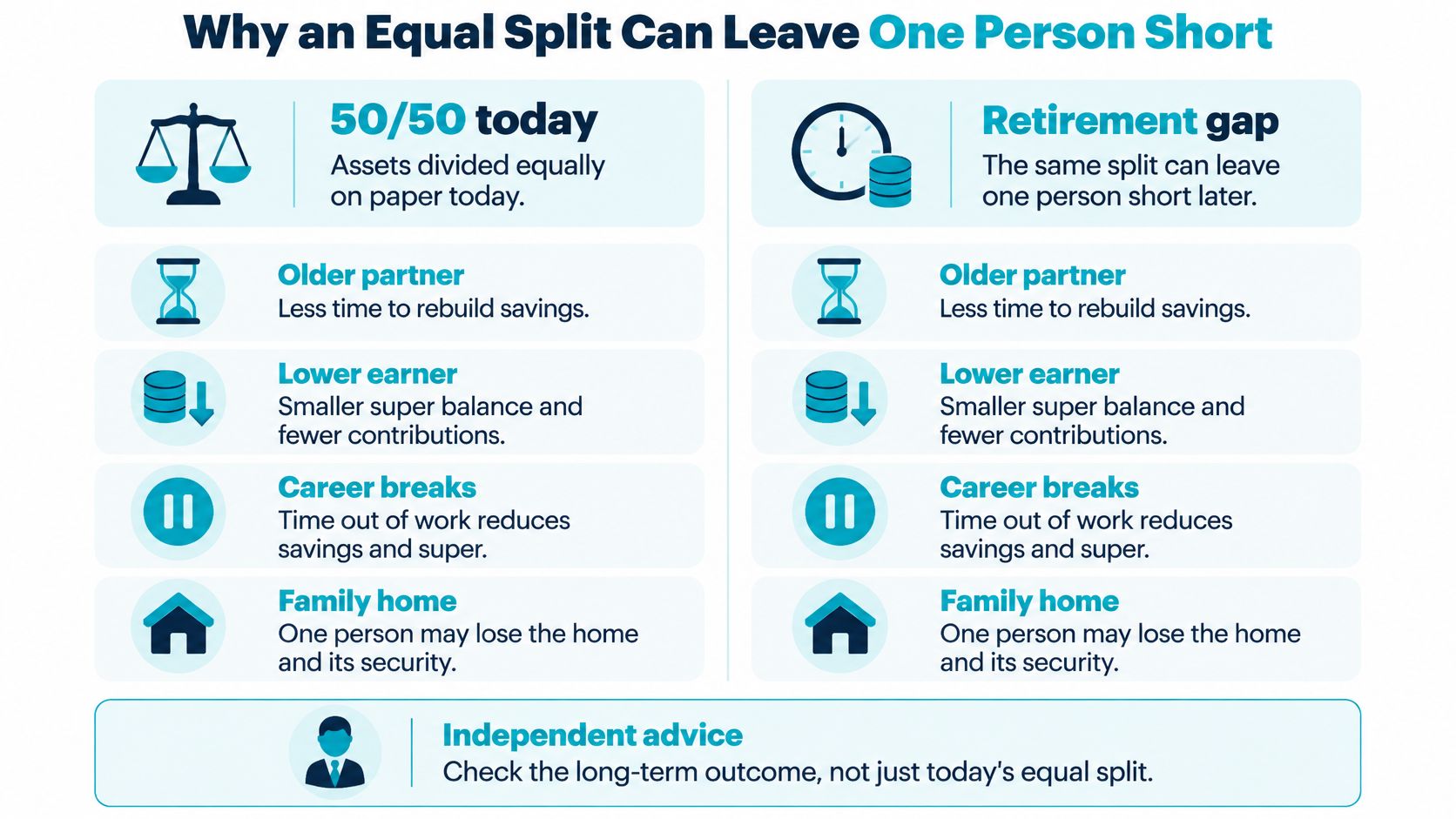
Access timing is the hidden variable
Super works like a retirement-income engine, while housing equity works more like a stored asset you may need to refinance or sell to use. That difference matters because an equal dollar split can give one person income later and the other person cash now, or no usable cash until the property changes hands. Super is generally preserved until a condition of release is met. Housing equity may be usable straight away, but it carries mortgage repayments, maintenance and transaction costs.
Swap one for the other and you've changed both liquidity and long-term income, even when the dollar figures match. A home can stop a rent bill, yet it can also concentrate your wealth in one asset and leave little spare cash. Super can support retirement income, yet it may not help with a deposit, legal costs or a roof repair this year. The right comparison asks what each asset can do, when it can do it and what it costs to hold.
| Option | Cash available now | Retirement access | Main risk |
|---|---|---|---|
| Keep the home, give up a share of super | Little or none, unless the home is refinanced | Super stays preserved and housing equity is tied up in the property | Repayments on one income |
| Keep super, sell the home | Sale proceeds after selling costs and any tax | Super stays preserved, cash can rebuild savings | Loss of housing security |
| Split home equity and super | Partial cash from a sale or refinance | Access is balanced across housing and super | Needs both valuations and tax checks before agreeing |
How to model each option properly
Convert every proposed division into after-tax, accessible and retirement-stage cash-flow projections. Six inputs do most of the work:
- After-tax income in retirement, not the balance at the settlement date
- Contribution history, which shows what each person can realistically rebuild
- Insurance inside super, and what it costs to replace outside
- Investment risk each person can carry given their new single-income budget
- Expected drawdown period, including the age gap between you
- The replacement cost of lost employer or salary-sacrifice contributions
Then run a liquidity stress test on both sides. Can the person keeping the home meet repayments and essential expenses on one income if hours are cut? Can the person without the home rebuild a deposit while still contributing to super? If either answer depends on everything going smoothly, the split needs more work.
Check tax and ownership consequences with the Australian Taxation Office before any transfer, and confirm valuation and splitting orders with a qualified family-law professional. General information helps you ask better questions, but it does not replace advice based on your circumstances, goals and priorities. Advice should reflect the information you provide and be grounded in professional expertise, especially where super, tax, insurance and property all interact.
Compare projected retirement income under each option. The headline percentage is the least informative number in the room.
Cash Flow, Insurance and Housing in the First Year
More separations come undone on a Tuesday afternoon at the supermarket than at the settlement table. Say one parent has two children, a rent increase and a car loan. On a single income, with child support arriving on a cycle that doesn't match the rent cycle, the household budget runs short most weeks even though the eventual settlement looks reasonable.
A 12-week cash flow forecast shows that gap while you can still act on it. Build it in a spreadsheet, one column per week:
- List all net income and any support payments, dated to when they land.
- List fixed costs: rent or mortgage, utilities, insurance premiums, debt repayments, school costs, fuel and groceries.
- Mark the weekly shortfall or surplus, then carry the running balance forward so you can see the week it turns negative.
- Decide the interim housing arrangement and write down who pays which bill from which account.
- Confirm every existing policy continues without a gap in cover.
Our approach to cash flow management uses the same rolling structure, because a budget that only works on average isn't a budget that works.
Insurance is where quiet damage happens
Policies are often owned by one person, and premiums lapse when that person stops paying. Life cover inside super can end when an account is closed or split. A nomination naming your ex may still be valid until you change it.
Review trauma, income protection and life cover against your new dependants and debts, and do it before anything is cancelled. Reapplying after a separation can be harder or more expensive if your health or circumstances have changed, so keeping existing cover in force is usually the cheaper path.
Two things to finish this week: complete the forecast and name a plan for any shortfall (a payment arrangement, a temporary redraw, a change to the interim housing split), and confirm each policy's owner, beneficiary and premium payer in writing with the insurer.
Choosing the Right Professional and Costs
Separation usually needs three professionals, and their jobs don't overlap as much as people assume.
- Family lawyer: binding agreements, consent orders, deadlines, disclosure obligations and any family violence issues. They tell you what's enforceable.
- Financial adviser: models super, settlement options, cash flow and insurance, and translates each option into retirement income. They tell you what's liveable.
- Registered tax agent or accountant: checks capital gains, transfer consequences and unpaid tax before anything is signed. They tell you what it costs the ATO.
Ask all three the same questions before you engage them. How are you paid, fixed fee or hourly? What won't you advise on? Will you coordinate with the other two, and who leads? Fees for drafting consent orders or a binding financial agreement can differ widely from fees for advice, so request a written estimate rather than a verbal range. Our breakdown of financial advice fees in Australia explains how advice fees are structured and what should be disclosed to you upfront.
On licensing, you don't need to guess with us. Wealth Collective is a Corporate Authorised Representative of Wealth Collective Adviser Services Pty Ltd (AFSL 538833), and we're based in Western Australia. Ask any adviser you're considering for the equivalent detail, and ask whether their recommendations depend on products they sell.
Request a written scope before you hand over your full asset list. Then keep one shared file of statements, valuations and dates so the lawyer, adviser and accountant are all working from the same numbers. Mismatched balance dates cause more disputes between professionals than disagreements about strategy do.
Book Your Initial Call Before You Sign Anything
The order of work matters more than the speed of it:
- Review every financial area and build the dated spreadsheet
- Confirm your deadlines and calendar them
- Model super and each settlement option on retirement income, not percentages
- Stabilise cash flow, housing and insurance for the first year
- Protect your safety and complete disclosure before negotiating
A settlement signed before super values and cash flow are modelled can lock in an outcome that's difficult to reverse. Once orders are made and a property has transferred, the options narrow sharply. An extra fortnight of modelling is cheap compared with years of living with the wrong structure.
We research and model your options and build a detailed financial plan that balances financial structure, money success and lifestyle. Our advice covers personal insurance, superannuation, investment, debt reduction, retirement planning and strategic financial advice, which is exactly the combination a separation demands. You can book a free 10-minute introductory call, and from there we take care of the rest.
Two boundaries worth stating plainly. The information here is general and isn't personal financial advice, so consider your own circumstances and speak with one of our qualified Financial Advisers before acting on it. Legal orders and property transfers should be coordinated with a family lawyer, and we work alongside yours rather than around them.
Bring the review spreadsheet you built in the first section, with its flagged rows and separation date, to a free 10-minute introductory call with our team. We'll model what each settlement option means for your cash flow this year and your income in retirement, then coordinate the numbers with your lawyer and accountant so nothing gets signed on an incomplete picture. Visit Wealth Collective to book your call and start the review before you agree to anything.