Business hours
Monday to Friday (8.30AM - 5PM)
Weekend (Closed)


The most popular advice about bring-forward concessional contributions is to use as much unused cap as possible before it expires. That can be sensible, but an available cap isn't a target: the right amount depends on your income, contributions already made, cash needs and the tax you'll save.
The rule can help you put more into super in a high-income year, but it doesn't make every extra contribution worthwhile. Start by identifying which unused amounts are still available, then test the tax result and make sure the fund receives any contribution in the correct financial year.
How Carry-Forward Concessional Contributions Work
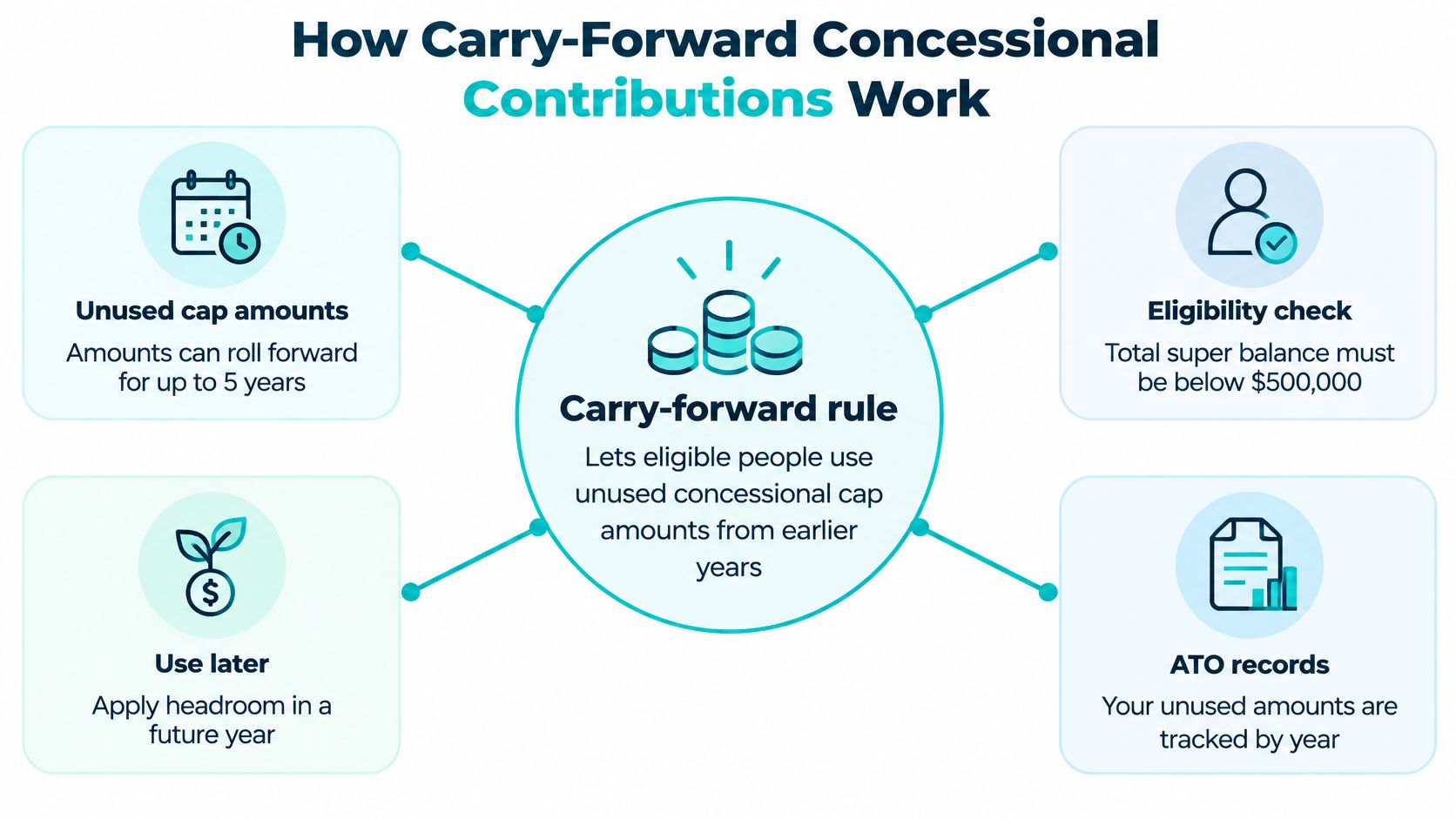
What many Australians call bring-forward concessional contributions is formally the carry-forward arrangement. It lets eligible people use unused portions of their concessional contribution cap from earlier years, potentially making a larger deductible or employer contribution in a later year. The Australian Taxation Office's concessional contributions guidance says the arrangement began on 1 July 2018, with unused amounts first available to use in 2019–20. Amounts from 2018–19 or earlier can't be carried forward.
A concessional contribution is money that receives concessional tax treatment in super. It includes your employer's super guarantee contributions, salary sacrifice and personal contributions you claim as a tax deduction. These contributions share the same cap, so an employer contribution uses some of the room that might otherwise appear available for a personal top-up.
Think of each year's unused cap as leave that rolls over. You can use it later, but it doesn't stay available indefinitely: each unused amount expires after a maximum of five years. The ATO applies the oldest unused amount first, so an amount from 2020–21 is used before one from 2021–22. That ordering matters when an older amount is nearing its expiry.
Practical rule: Check which financial year each unused amount came from, not just the total available. The total can hide an entitlement that's about to expire.
This rule is different from the non-concessional bring-forward arrangement. That separate rule concerns after-tax contributions, not unused concessional caps, and its eligibility and limits work differently. Mixing them up can lead to the wrong contribution type or an unexpected tax outcome.
The carry-forward eligibility gate is your total superannuation balance at 30 June of the previous financial year. It must be below $500,000 to use carry-forward amounts. You can check the ATO's record of your unused amounts through ATO online services under Super, Information, and Carry forward concessional contributions.
If you're also weighing up regular salary sacrifice, this guide to how much salary to sacrifice into super can help you think through the ongoing contribution amount alongside a one-off top-up. The next table sets out the cap years and the last year you can use each unused amount.
Your Unused Caps and When They Expire
| Financial year unused amount arose | Concessional cap that year | Last year the unused amount can be used |
|---|---|---|
| 2019–20 | $25,000 | Expired after 2024–25 |
| 2020–21 | $25,000 | Expired after 2025–26 |
| 2021–22 | $27,500 | 2026–27 |
| 2022–23 | $27,500 | 2027–28 |
| 2023–24 | $27,500 | 2028–29 |
| 2024–25 | $30,000 | 2029–30 |
| 2025–26 | $30,000 | 2030–31 |
| 2026–27 | $32,500 | 2031–32 |
Each row identifies the financial year an unused amount arose, the concessional cap that applied that year and the last financial year in which you can use that amount. For example, unused cap from 2021–22 is available only through 2026–27. It's therefore the oldest amount still available in that year, and the one to examine first.
The five-year expiry rule and oldest-first order mean that a newer unused amount doesn't save an older one from expiring. If you make a contribution in a year when carry-forward is available, the ATO applies the oldest unused cap first. The ATO's published rates and cap information lists the concessional cap as $30,000 in both 2024–25 and 2025–26, and says it is scheduled to rise to $32,500 from 1 July 2026 through indexation linked to average weekly ordinary-time earnings.
That expected increase applies to the new financial year's annual cap. It doesn't increase your available limit for the current year or extend the expiry of an older unused amount. Likewise, an unused amount from 2019–20 or 2020–21 has already expired after the years shown in the table. Check the year attached to each balance rather than assuming every figure displayed in an older record remains usable.
For a broader reference on annual caps and how they interact with unused amounts, see Wealth Collective's concessional contribution limits guide. Before making a plan, confirm each amount and its expiry year in ATO online services. Your own ATO record is the practical starting point for checking the available headroom.
Check Eligibility and Balance Before You Contribute
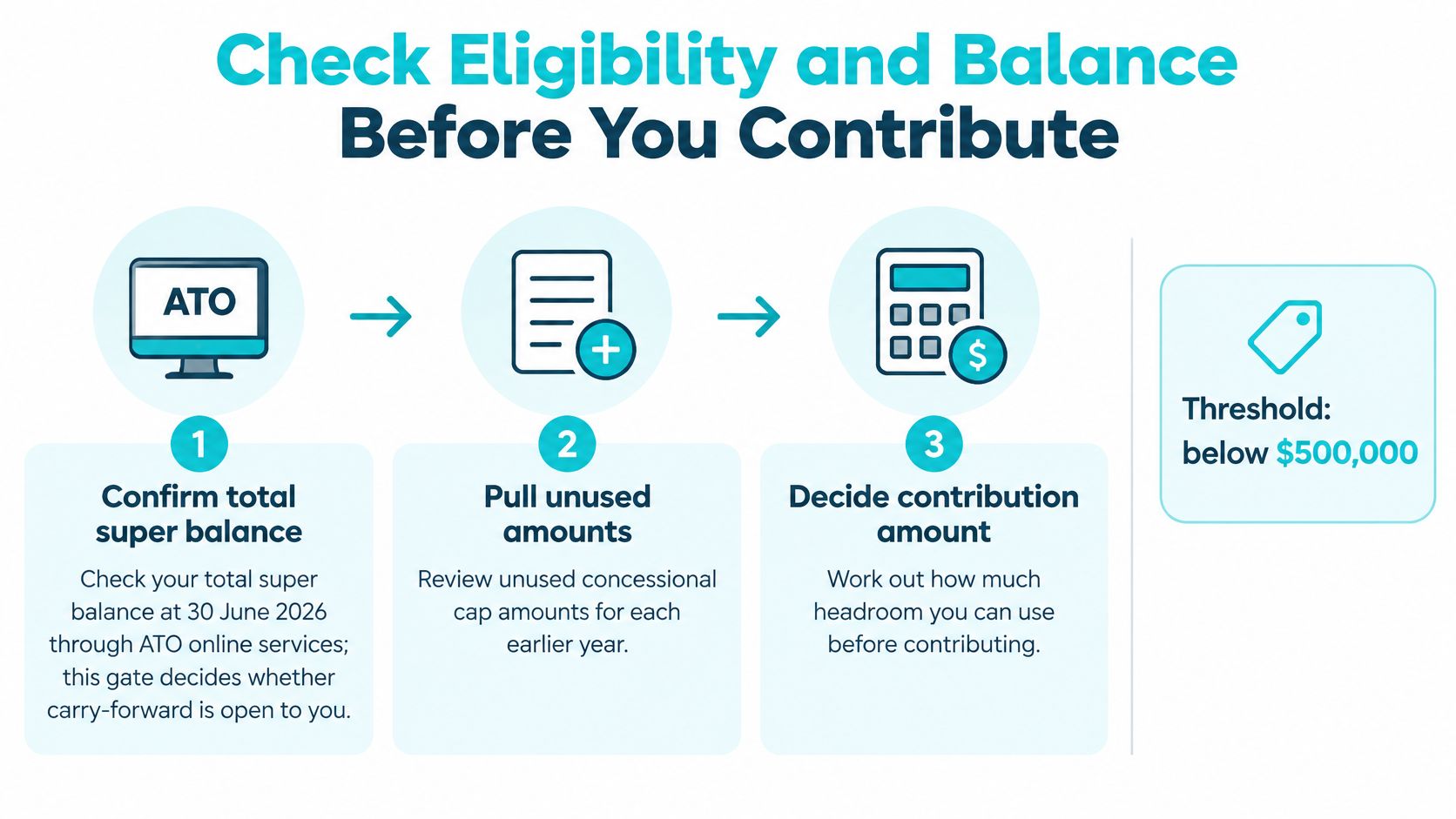
Use this sequence to turn the ATO record into a contribution amount. Each check catches a different source of error, especially the common mistake of forgetting that employer contributions use the same cap.
Check the relevant balance. For a contribution in 2026–27, confirm through ATO online services that your total super balance at 30 June 2026 was below $500,000. This is the eligibility gate. A current balance estimate doesn't replace the balance measured at the relevant 30 June.
Review unused amounts by year. Pull your available concessional amounts from 2019–20 onward and note the oldest one still usable. Don't rely only on a combined total: an amount can be available now but close to expiry.
Add contributions already made. Include employer super guarantee and salary sacrifice received in 2026–27, along with any personal contributions that count as concessional. Leaving out employer contributions overstates the remaining room, sometimes by a substantial amount.
Calculate the remaining headroom. Start with the $32,500 annual cap, add usable carry-forward amounts, then subtract concessional contributions already received by your fund. The result is a potential maximum, not a recommended amount.
Check when the fund will receive the money. For a contribution intended for 2026–27, it must reach the fund by 30 June 2027. The relevant timing is receipt by the fund, not the day you make a payment or give an instruction, so leave room for processing.
Complete the deduction notice process if needed. If you're making a personal contribution you plan to claim as a deduction, lodge a notice of intent with your fund and receive its acknowledgement before lodging your tax return or changing your investment choices. Without the required steps, you may not be able to claim the deduction as planned.
Write down your figures and update them. Record your balance test, each year's unused amount, contributions received and expected income. Recheck after a bonus or pay change, because either can alter the tax calculation or how much cap remains.
If the fund will receive the contribution on or before 30 June 2026, rerun the same checks for 2025–26 instead. The balance test then uses your total super balance at 30 June 2025, the annual cap is $30,000, and employer contributions and salary sacrifice already received that year reduce the remaining headroom. Any unused amount from 2020–21 expires on 30 June 2026, so the ATO applies it first; calculate headroom using that year's cap plus still-usable unused amounts, less contributions already received.
A plan is ready to act on only when eligibility, the ATO's year-by-year record, employer contributions, tax treatment and fund receipt timing all line up. If any one of those figures is uncertain, pause and confirm it before sending money.
How Division 293 Changes the Tax Saving
Not necessarily. Using every available carry-forward amount isn't automatically the best decision. A concessional contribution is generally taxed at 15% in the fund, so the immediate tax benefit depends on how that compares with your marginal tax rate. For some higher-income earners, Division 293 reduces that gap.
The Australian Treasury's Division 293 explanation says individuals whose combined income and concessional contributions exceed $250,000 may face an effective 30% tax rate on affected concessional contributions through Division 293. That additional tax can make a contribution less attractive than a simple comparison with the standard 15% contributions tax suggests.
| Taxable income excluding super | Marginal rate including Medicare | Tax on concessional contribution | Approximate saving per $1 contributed |
|---|---|---|---|
| $90,000 | 32% | 15% | 17 cents |
| $150,000 | 39% | 15% | 24 cents |
| $260,000 combined income and contributions | 47% | 30% (Division 293) | 17 cents |
The table shows why the gross amount of a deduction doesn't tell you the net benefit. At the lower income levels shown, the difference between the marginal rate and contributions tax produces the approximate saving per dollar. At the higher level, Division 293 narrows that difference, even though the marginal rate is higher.
Your result also depends on whether employer contributions have already used some of the annual cap, whether the proposed contribution would exceed the cap plus usable carry-forward, and whether your total super balance passes the relevant eligibility test. If you want a plain-language explanation of the additional tax, Wealth Collective's Division 293 tax guide is a useful companion.
Timing can change which annual cap applies. A contribution the fund receives by 30 June 2026 is tested against the $30,000 cap for 2025–26; one received on or after 1 July 2026 is tested against the $32,500 cap for 2026–27. The new cap doesn't increase unused amounts from earlier years, so in 2026–27 you should account for any 2021–22 unused amount before it expires on 30 June 2027.
If contributions exceed the current cap plus usable carry-forward, the excess is included in assessable income. A 15% offset recognises contributions tax already paid in the fund, and the member can elect to release the excess from super. That's a reason to calculate the room before contributing, not after.
Model your marginal tax, contribution timing and retirement cash flow together. The cap is a limit you may be able to use, not a target you must fill.
Worked Example for an Irregular Income Year
Sam is a business owner whose profit changes from year to year. They haven't used all of their concessional cap in earlier years, and now have a stronger business year in which a larger contribution may be practical. The question isn't just whether the ATO record shows unused room. Sam needs to establish that the proposed amount fits the cap, eligibility and household cash flow.

Sam's facts are:
- Unused cap: $5,000 from 2021–22 and $7,500 from 2022–23.
- Total super balance: $380,000 for the relevant 2026–27 eligibility check.
- Ordinary taxable income: $150,000.
- Planned total concessional contributions: $45,000 in 2026–27.
For this illustration, assume Sam meets the eligibility test and has confirmed the unused amounts and contribution total against ATO and fund records. The available headroom is the $32,500 cap for 2026–27 plus $12,500 of unused amounts, giving total room of $45,000. Sam uses the $5,000 from 2021–22 first, because it expires before the amount from 2022–23.
At a 15% contributions tax rate, a $45,000 concessional contribution would incur $6,750 in contributions tax inside super. If the same $45,000 were instead taken as salary taxed at a 39% marginal rate, the tax would be $17,550. On those assumptions, the difference is $10,800.
For this example, adding the contribution to Sam's ordinary taxable income gives $195,000, below the $250,000 Division 293 threshold. The calculation is illustrative: an individual's actual Division 293 position depends on the income and concessional contribution amounts used for that test, so Sam should check the complete figures rather than treating this simple comparison as a tax assessment.
The apparent saving isn't the whole decision. Once contributed, the money is subject to super's preservation rules, so Sam can't treat it as working capital for the business. If the next year is weak, a smaller cash buffer could be more valuable than the tax benefit from making the full contribution now.
A strong income year can create room to contribute more. It doesn't remove the need to protect cash for business costs, tax bills and personal needs.
For Sam, the sensible contribution is the amount that fits both the tax plan and a realistic cash-flow forecast. That could be the full amount, a smaller top-up, or no additional contribution if liquidity is the priority.
Which Strategy Fits Each Client Cohort
| Cohort | Best use of unused cap | Main watch-out |
|---|---|---|
| Pre-retirees (roughly 55 to 67) | Lift balance before retiring using amounts that expire soon | Total super balance must stay below $500,000; check when money is accessible |
| High earners | Use headroom in a lower-income year or to offset a bonus | Division 293 applies when income plus contributions exceed $250,000 |
| Business owners | Use profit years for employer or personal deductible contributions | Cash flow in weak years; lodge a notice of intent for personal contributions |
| Career breaks and returners | Catch up with unused amounts when earnings rise | Headroom is lost once amounts expire; track each year separately |
For pre-retirees, an expiring unused amount can offer a chance to increase super while employment income still makes a deduction valuable. The trade-off is that the amount must meet the balance test, and the money may not be available when you want it. Check how a contribution fits your retirement date and access plans, rather than focusing only on the size of the potential deduction.
High earners may use carry-forward room when income is lower or when a bonus lifts taxable income. Before contributing, test the effect of Division 293 alongside the ordinary tax comparison. For a straightforward explanation of ongoing contributions through payroll, read about what salary sacrifice into super means.
A business owner may find it easier to contribute after a profitable year than to commit to a regular amount that could strain cash flow later. Personal deductible contributions need the required notice of intent and fund acknowledgement, while employer contributions still count towards the cap. Leave enough outside super to meet business obligations and maintain working capital.
For people returning from a career break, unused caps can help build super when earnings rise again. The key is to check each year separately: an unused amount that expires can't be recovered later. Keep a year-by-year record, and don't assume a larger combined balance is available indefinitely.
The right approach differs because income, balance and timing differ. A contribution that suits a high-income year may be unsuitable for someone who needs accessible cash or won't pass the balance test.
Book Your Carry-Forward Review Before 30 June 2027
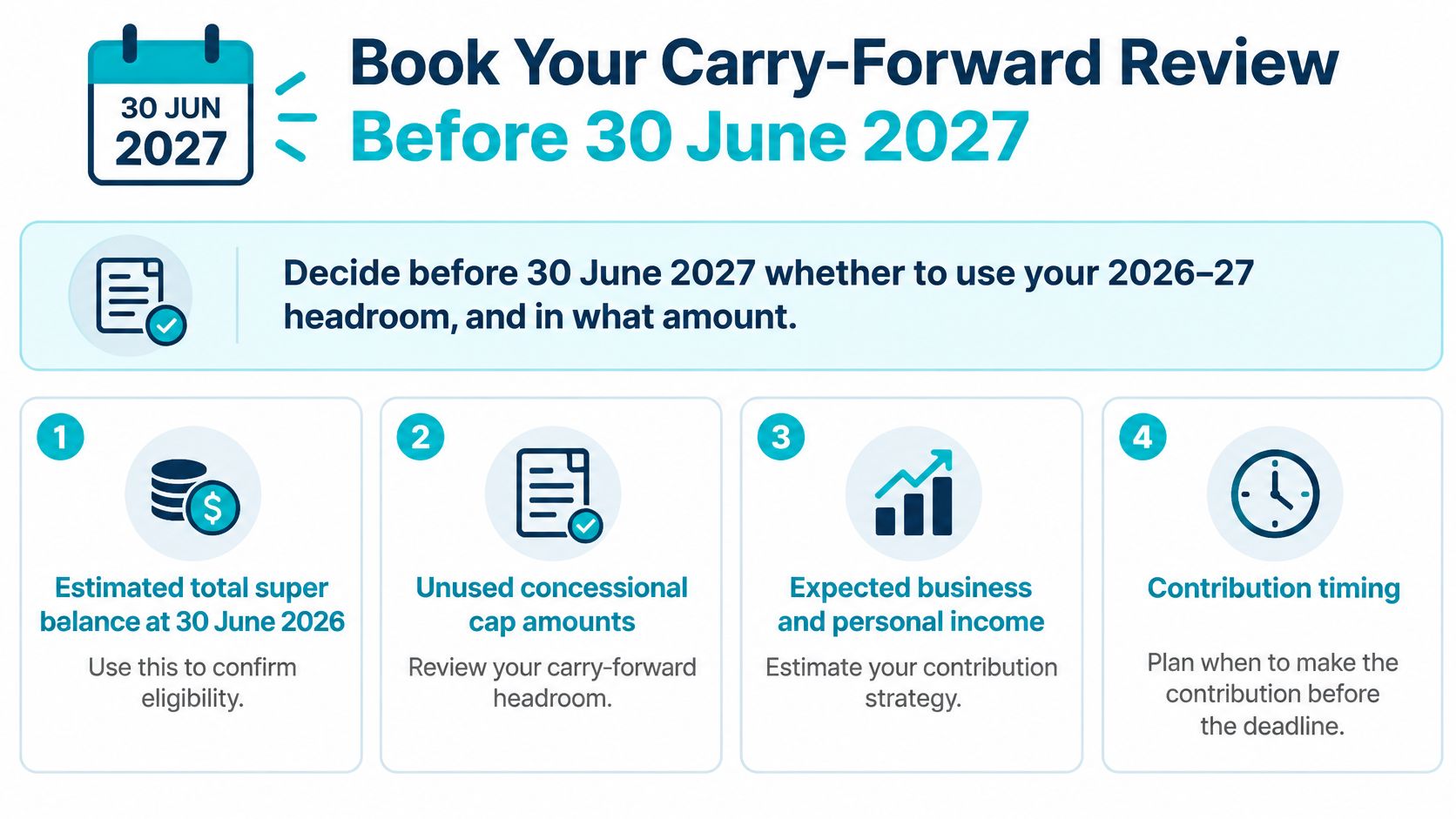
Decide before 30 June 2027 whether to use your 2026–27 headroom, and how much to contribute. An early review gives you time to confirm the oldest unused amount, estimate your total contributions and assess whether the tax benefit justifies locking money away.
Bring these figures to the conversation:
- Estimated total super balance at 30 June 2026, to assess eligibility.
- Unused concessional amounts by year from ATO online services, including their expiry years.
- Employer contribution schedule for 2026–27, including expected super guarantee and salary sacrifice.
- Forecast taxable income, including any expected bonus or business profit.
- Personal contributions you plan to claim, so the deduction and notice process can be considered.
With those details, a review can show whether a contribution uses expiring amounts first, whether Division 293 may apply, and how much cash you can reasonably afford to place in super. Wealth Collective's Guided Growth and Retirement Roadmap advice covers superannuation optimisation and retirement planning.
A carry-forward decision is most useful when it's tied to a clear outcome: reducing tax in a suitable income year, strengthening retirement savings, or both. If the figures don't support the contribution, retaining cash can be the better choice. General information on the website isn't personal financial advice, so consider your circumstances and consult one of the qualified Financial Advisers before acting.
Wealth Collective can help you review carry-forward eligibility, expiring caps, tax trade-offs and retirement cash flow through its Guided Growth and Retirement Roadmap advice. Book a free 10-minute intro call with Wealth Collective to discuss whether a contribution before 30 June 2027 fits your plan.