Business hours
Monday to Friday (8.30AM - 5PM)
Weekend (Closed)


Commonwealth Seniors Card eligibility starts with Age Pension age, 67 for most Australians, plus the residence rules, no Centrelink or DVA income support payment, and annual gross taxable income below $101,105 for singles or $161,768 for couples. If you're close to retirement and think your super balance alone decides the answer, you're looking at it the wrong way.
I see this mistake all the time with Western Australian pre-retirees. They assume the card is about assets, then discover the actual gatekeeper is taxable income, and that's where well-off retirees can still miss out while people with substantial super can sometimes qualify.
Why the Commonwealth Seniors Health Card Matters for Self-Funded Retirees
A lot of Western Australians reach retirement with a healthy super balance and assume that alone tells them where they stand. Then they start looking at concessions and realise the Commonwealth Seniors Health Card can cut day-to-day costs without pushing them into an income support payment.
That card sits outside the Age Pension system. It is for people who are past pension age, live in Australia, and fund retirement from private income rather than Centrelink or Veterans' Affairs support. Services Australia's official Commonwealth Seniors Health Card eligibility page makes the structure plain, including the rule that you cannot already be receiving a payment from Centrelink or the Department of Veterans' Affairs, and that there is no assets test. The card should be assessed as part of a proper financial planning for retirees process, because the income rules change the result more often than the asset position does. Services Australia's CSHC guidance
For self-funded retirees, that is the trap. A couple can hold substantial superannuation and still qualify if their taxable income stays under the limit. A retiree with fewer assets can still fail the test if taxable income is too high. The balance sheet does not decide this card on its own.
Practical rule: treat the card as an income-structure test, not an asset test. That approach cuts false assumptions, saves wasted applications, and leads to better retirement decisions.
The value shows up in the household budget. The card can reduce medicine costs, improve access to bulk billing where it is available, and open the door to state and local concessions. In Western Australia, that can make a significant difference to the cash flow of a retiree who wants to keep the budget steady without trimming every line item.
Age and Residency Requirements You Must Meet
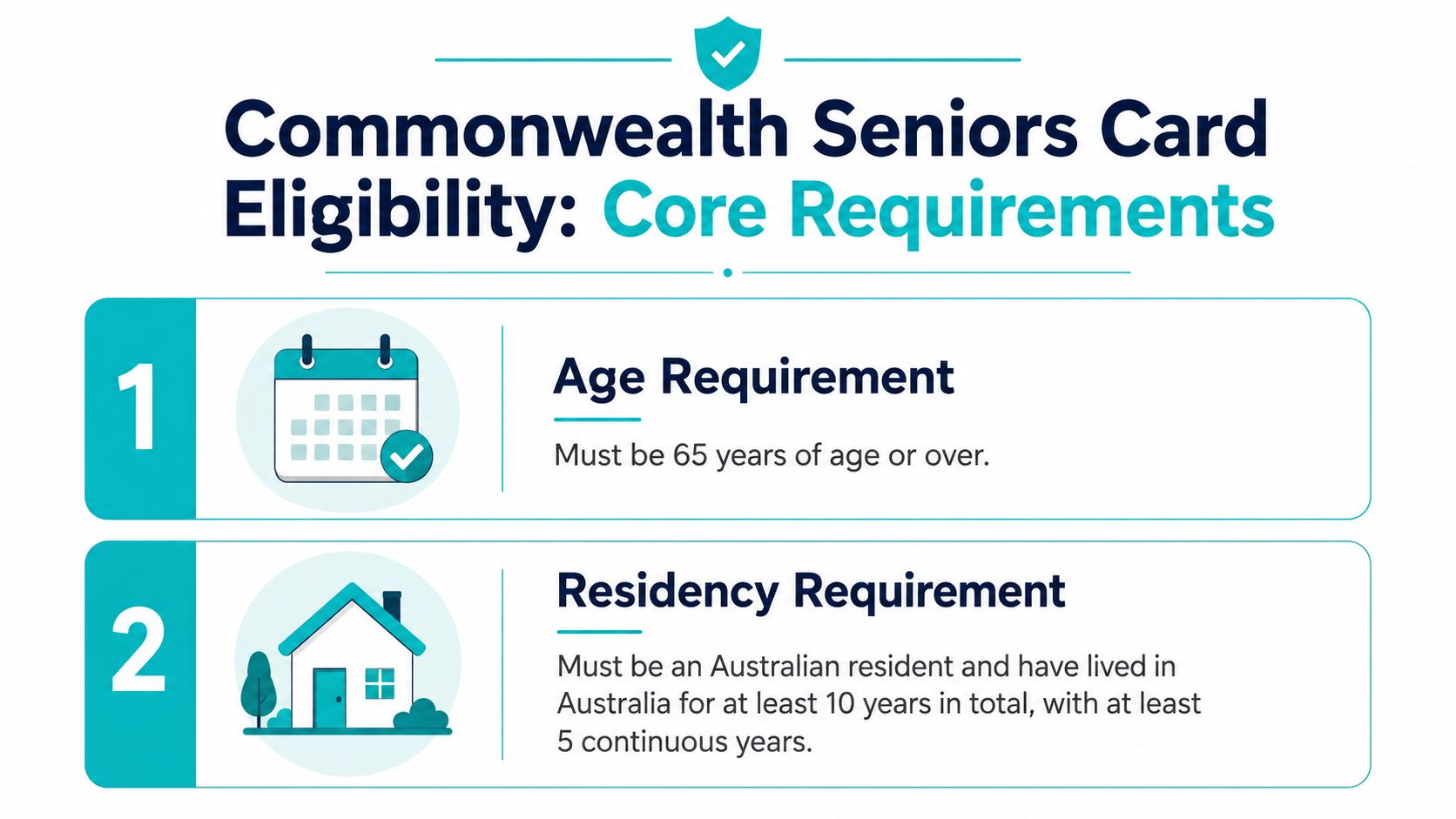
Start with the basics. If you have not reached Age Pension age, you do not qualify for the Commonwealth Seniors Health Card. For most Australians, that means 67 years. You also need to be in Australia and physically present here when you lodge the claim. Services Australia's age and card overview confirms that rule, and it stops a lot of rushed applications that were never going to succeed.
The residency rule is stricter than many people expect
Your legal status matters as well. Services Australia requires you to be an Australian citizen, hold a permanent visa, or hold a Special Category visa. People often mix up residence status with the simple fact of living here, but for this card you need both the right status and the right location at claim time.
Timing is where people trip over the rule. A move back to Australia does not create a problem on its own if you satisfy the other conditions, but you still need to be physically in Australia when you submit the claim. The same warning applies if you have been travelling or spending long stretches overseas. Lodge from outside Australia and you create delay for no benefit.
Claim it from overseas and you waste time. Get your documents ready, wait until you are physically in Australia, then lodge properly.
What to check before you claim
Use this as a simple readiness check before you apply:
- Age confirmed: You have reached 67 if you are in the most common Age Pension age group.
- Presence confirmed: You are physically in Australia on claim day.
- Residency status confirmed: You hold citizenship, a permanent visa, or a Special Category visa.
- Payment status confirmed: You are not already receiving a Centrelink or DVA payment that rules you out.
For veterans and war widows or widowers, the Department of Veterans' Affairs follows its own pathway, but the same practical test applies. You still need the right status, and you still need to be eligible on the day you claim. If that is your situation, check the veteran-specific rules on the DVA Commonwealth Seniors Health Card eligibility page.
One more point for self-funded retirees in Western Australia. Age and residency get you through the first gate, but they do not protect you from the income test. If you are planning around the card, sort out your taxable income early. A practical place to start is how to reduce taxable income in Australia, because the wrong income structure can knock out a retiree who assumed assets alone would carry the day.
Income Test Thresholds and the No Assets Test Advantage
Most self-funded retirees get it wrong. The Commonwealth Seniors Health Card is not decided by how much super you've accumulated. It's decided by annual gross taxable income, and that changes the entire conversation.
The current thresholds are $101,105 for a single person, $161,768 for a couple, and $202,210 for a couple separated by illness, respite care, or prison. Each child in care adds $639.60 to the threshold, and Services Australia says these limits are indexed annually on 20 September in line with CPI. Services Australia's income test page sets out the current figures and the annual indexation rule.
The no assets test is the real structural advantage
The card has no assets test, which is why retirees with large super balances can still qualify if their taxable income is low enough. That's a major difference from many other age-based concessions. It also means you can't eyeball your eligibility from your net worth and assume you know the answer.
Here's the useful way to think about it. If your retirement wealth is sitting in structures that don't flow through to taxable income in a large way, you may be fine. If your taxable income is being pushed up by the way your assets are invested or drawn down, the card can disappear even though your spending is fairly modest.
| CSHC Income Test Thresholds 2024-25 | Annual Income Limit | Additional Per Child |
|---|---|---|
| Single person | $101,105 | $639.60 |
| Couple | $161,768 | $639.60 |
| Couple separated by illness, respite care, or prison | $202,210 | $639.60 |
For planning, the indexation point matters just as much as the dollar thresholds. Because the limits move each year, a retiree who is slightly over today may not be over after the next adjustment, and a retiree who is comfortably inside the line today can drift towards the edge if their taxable income rises. That's why your retirement income plan needs to track the card, not just your super balance. The taxable income reduction approach is the right kind of thinking if you're trying to keep eligibility open without making rushed decisions.
Taxable Income Traps That Catch Self-Funded Retirees
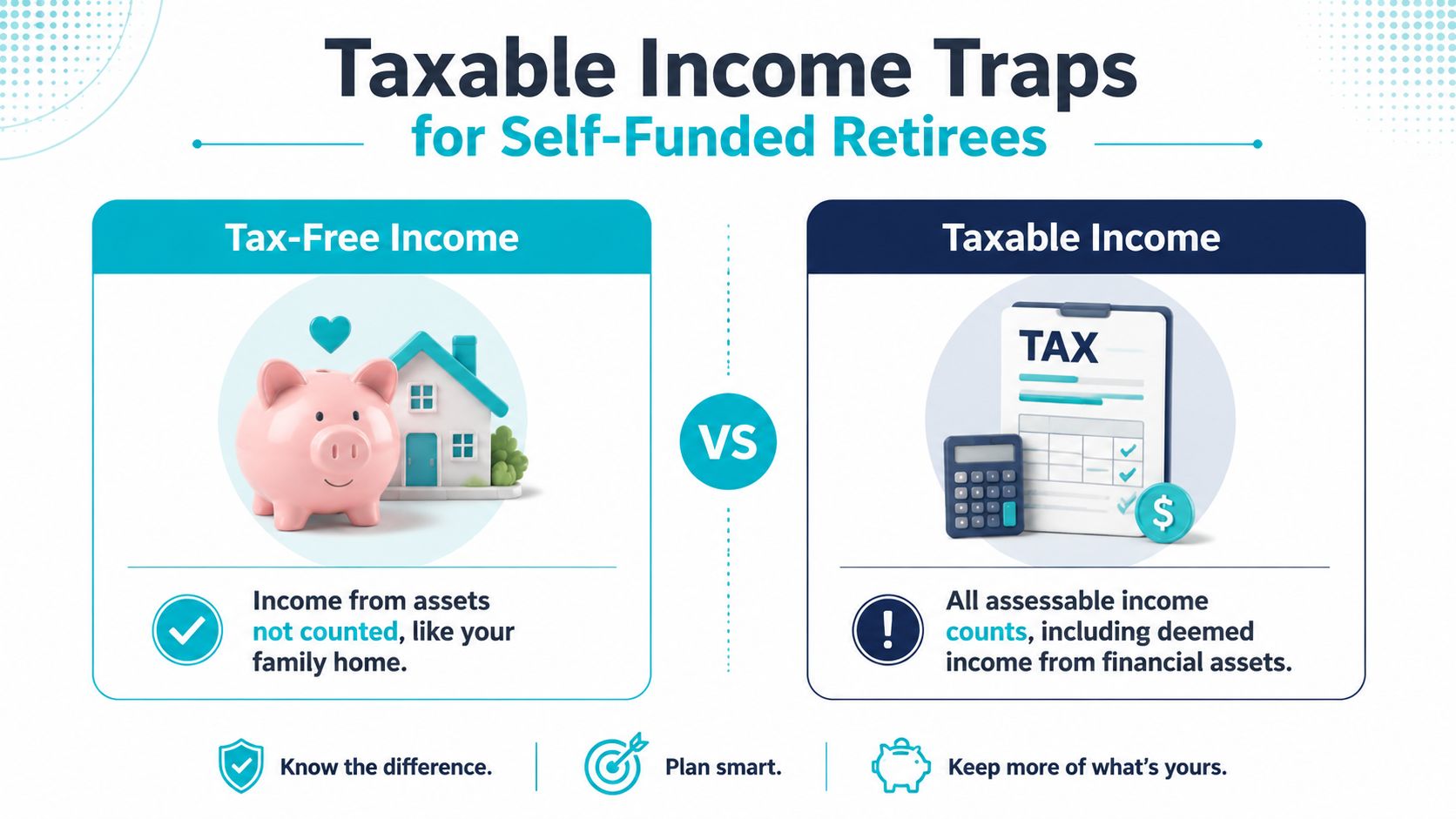
The biggest trap is assuming cash flow and taxable income are the same thing. They're not. The CSHC tests annual gross taxable income, so a retiree can spend conservatively and still miss out if the way income is structured pushes the number over the threshold.
That's why account-based pensions and investment income deserve proper attention. A person can have a large super balance and still qualify if their taxable income stays low. Another person can have a smaller portfolio and still fail the test if assessable income from their arrangements lands too high. This is exactly the sort of issue that gets glossed over in consumer guides, and it's the reason a written retirement roadmap is useful before you start making drawdown decisions that affect concessions.
The structure of the income matters more than the lifestyle
A retiree often says, “I don't spend much, so I should be fine.” That's the wrong question. The right question is whether the income flowing into the tax system leaves your annual gross taxable income under the card threshold.
That becomes a problem when people treat retirement as a spending exercise instead of a tax design exercise. If your drawdowns, investment income, or other assessable income are arranged badly, you can blow past the cap without changing your lifestyle at all. On the flip side, someone with a more substantial super position can still qualify if the taxable income profile is kept under control.
Don't ask whether the portfolio looks wealthy. Ask what the tax return will say when the card is assessed.
The WA angle is obvious once you've seen a few real cases. Many Western Australians plan around property, super, and dividends, then discover the card doesn't care how comfortable they feel, it cares what lands in the taxable income column. That's where planning beats guesswork, especially if you're close to the line and want to stay eligible when the threshold shifts each year.
For that reason, I'd treat the CSHC as part of your broader tax planning work, not a standalone health card conversation. The taxation and tax planning approach is the right lens when you want to reduce the chance of a bad surprise at tax time.
The rule of thumb that saves people from avoidable mistakes
If the income is assessable, assume it matters. If it's only a household spending pattern and doesn't show up as taxable income, it probably doesn't help or hurt the card test in the same way. The distinction sounds simple, but it's where a lot of retirees get blindsided.
How to Apply and What Documents You Need
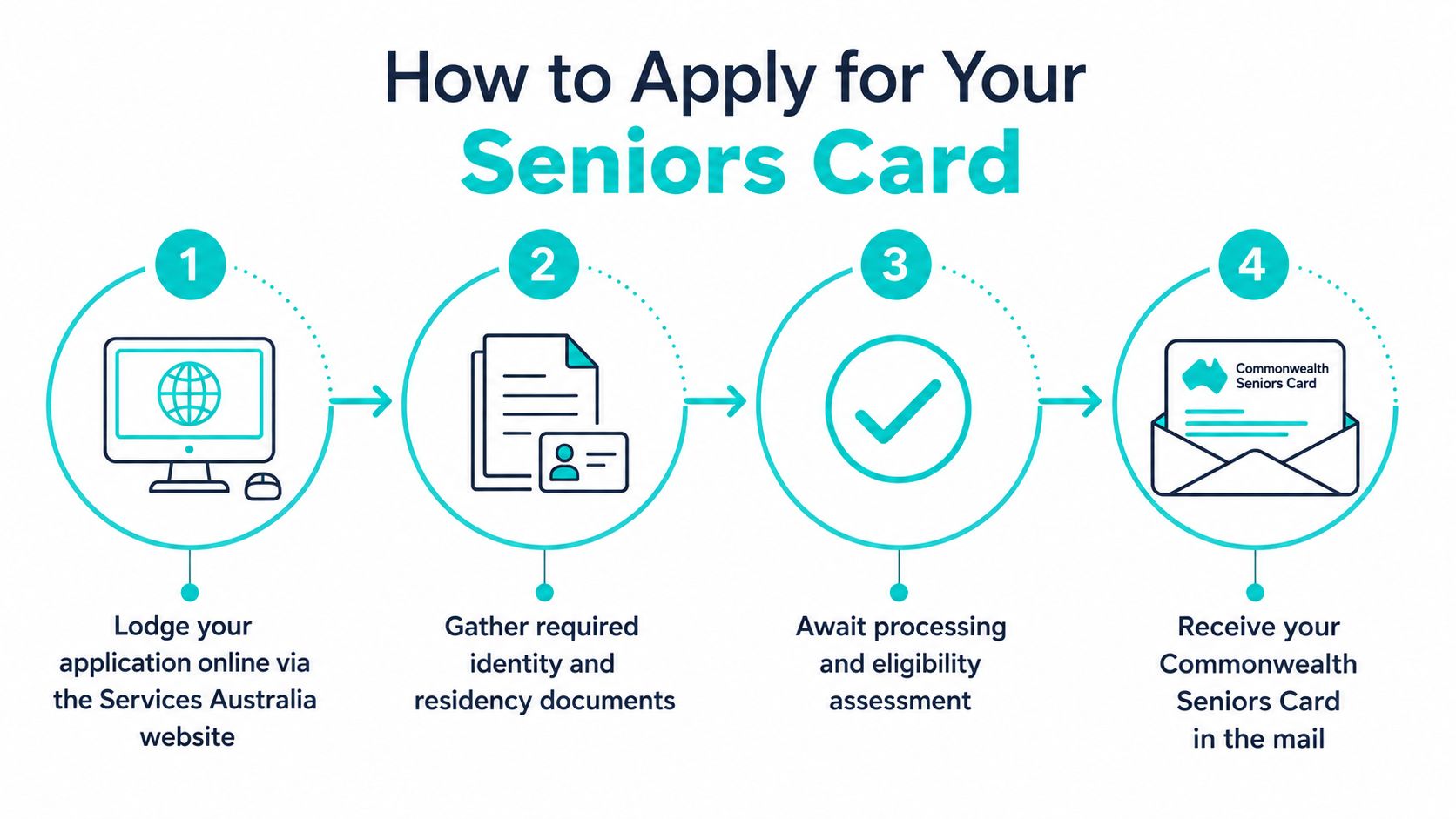
Apply through Services Australia once your age, residency, and income position are already in order. If you leave the paperwork until the last minute, the claim usually stalls on identity or residence checks, and that delay can hold up concessions you could be using.
Have your identity details ready, along with your tax file number information and the documents that prove your residence and presence in Australia. Services Australia also expects you to meet the other eligibility rules at the time you claim, so there is no value in lodging while you are still under age or not physically in Australia. Services Australia's claim guidance sets out the age, residence, no-payment, identity, and income-test requirements.
What to have ready before you lodge
- Identity details: Check that your personal details match across every document.
- Residence evidence: Keep the right visa or citizenship information ready if it is needed.
- Tax file number information: Be ready to provide it if asked.
- Income records: Have your most recent tax position clear before you claim.
Don't ignore timing. The card is indexed each year on 20 September, so your eligibility can change when the new thresholds take effect. If you are close to the line, that date matters, but it does not replace the need to lodge a complete and well-supported claim.
Veterans follow a separate DVA pathway. It applies to Australian, Commonwealth or allied veterans with qualifying service, Australian and allied mariners of World War 2 with qualifying service, and war widows or widowers. DVA also requires eligible people to be of pension age, or qualifying age for a war widow or widower, be an Australian resident, and not receive a service pension, income support supplement, age pension, or other excluded payments. DVA's eligibility rules set out that pathway clearly.
The cleanest application habit
Lodge only when your file is ready. Missing paperwork causes delays, and delays mean you wait longer for concessions you may already be entitled to use.
Worked Examples to Assess Your Eligibility
A good eligibility rule means nothing until you test it against real-life retirement patterns. These examples are the ones I'd use across the desk with a WA client who wants to know whether the card is realistically in reach.

Example one, a single retiree with large super but controlled taxable income
This person is over 67, lives in Perth, and has a sizeable super balance. The balance itself doesn't decide anything, because there's no assets test for the card. What matters is whether the person's annual gross taxable income stays below $101,105. If the drawdown and other taxable amounts remain under that ceiling, the card is still possible.
That's the classic trap. People see the super total and assume it's too large to qualify. It isn't necessarily. If the tax profile is managed carefully, the assets can be substantial and the card can still be there.
Example two, a couple whose taxable income nudges over the line
This couple has reasonable savings, sensible spending, and no interest in government income support. But their combined annual gross taxable income lands just above $161,768. Under that outcome, they miss out even though their lifestyle may not feel extravagant.
That's the key lesson. The test doesn't care that the couple lives modestly. It cares that the income figure crossed the threshold. If their planning had kept assessable income a little lower, the result could have been different.
Example three, a couple separated by illness
Now take a couple in a separated-by-illness situation. The threshold moves up to $202,210, with $639.60 added for each child in care. In this case, the couple's income sits under that higher limit, so the card remains available.
This is the one where the rule really shows its usefulness. The higher threshold recognises a different living arrangement, and the outcome depends on which threshold applies, not just on whether the couple looks financially comfortable. That's why people shouldn't guess. They should check the correct household type first, then compare the taxable income figure against the right limit.
Connecting the Card to Your Broader Retirement Strategy
The Commonwealth Seniors Health Card is useful, but it's not the retirement plan. It's one part of the picture, alongside superannuation strategy, tax planning, investment structure, and the concessions you can access in Western Australia.
WA retirees should also check the practical add-ons that sit outside the card itself. State and local government support can include things like utility rebates, public transport concessions, and local government rate relief, and those benefits can make a real difference when you're living on private income. The card often acts as the key that opens those doors, so losing eligibility has consequences beyond the health system.
The right approach is to review eligibility every year, not once. Income changes, thresholds index, life circumstances shift, and a retirement structure that worked last year can be wrong this year. That's why I treat the card as a living planning issue, not a one-off application task.
If you want the card to work for you instead of against you, fit it into the full retirement roadmap. The clients who do best are the ones who review their income structure early, check the eligibility rules properly, and make adjustments before the tax year closes.
Wealth Collective helps Western Australians make sharper retirement decisions, from superannuation and tax structure to income planning and concessions. If you want a clear view of whether commonwealth seniors card eligibility fits your situation, visit Wealth Collective and book an initial call so your retirement income strategy can be tested against the rules, not assumptions.