Business hours
Monday to Friday (8.30AM - 5PM)
Weekend (Closed)


You're probably reading this because life is already moving faster than your paperwork. Maybe you've got a partner, a mortgage, super, a business interest, or children who still rely on you, and the idea of “sorting the will” keeps sliding down the list. In Australia, that delay is common, and it's risky, because 60% of Australians, about 12 million people, did not have a will in the Finder survey cited in the Australian estate-planning research base, with the broader share without a current will commonly placed at roughly 58% to 60% statistics on wills in Australia.
That's why estate planning in Australia starts with a better question than “Do I have a will?”. The better question is, which of my assets does my will control? Once you answer that, the rest becomes a mapping exercise, house by house, account by account, structure by structure. That matters even more now, with the projected $4.9 trillion to $5.4 trillion intergenerational wealth transfer across Australian generations, and with older Australians still often underprepared for how that wealth moves legacy planning research.
What Estate Planning Really Means in Australia
A family member dies, and the will gets treated like it should answer every question. Then the executor finds the home was held jointly, the superannuation sits outside the will, the family trust has its own rules, and the adult children are already asking who gets what. That is the point where many families see the gap. A will is one part of a wider plan, not the whole thing.
Think of it as a coordinated system
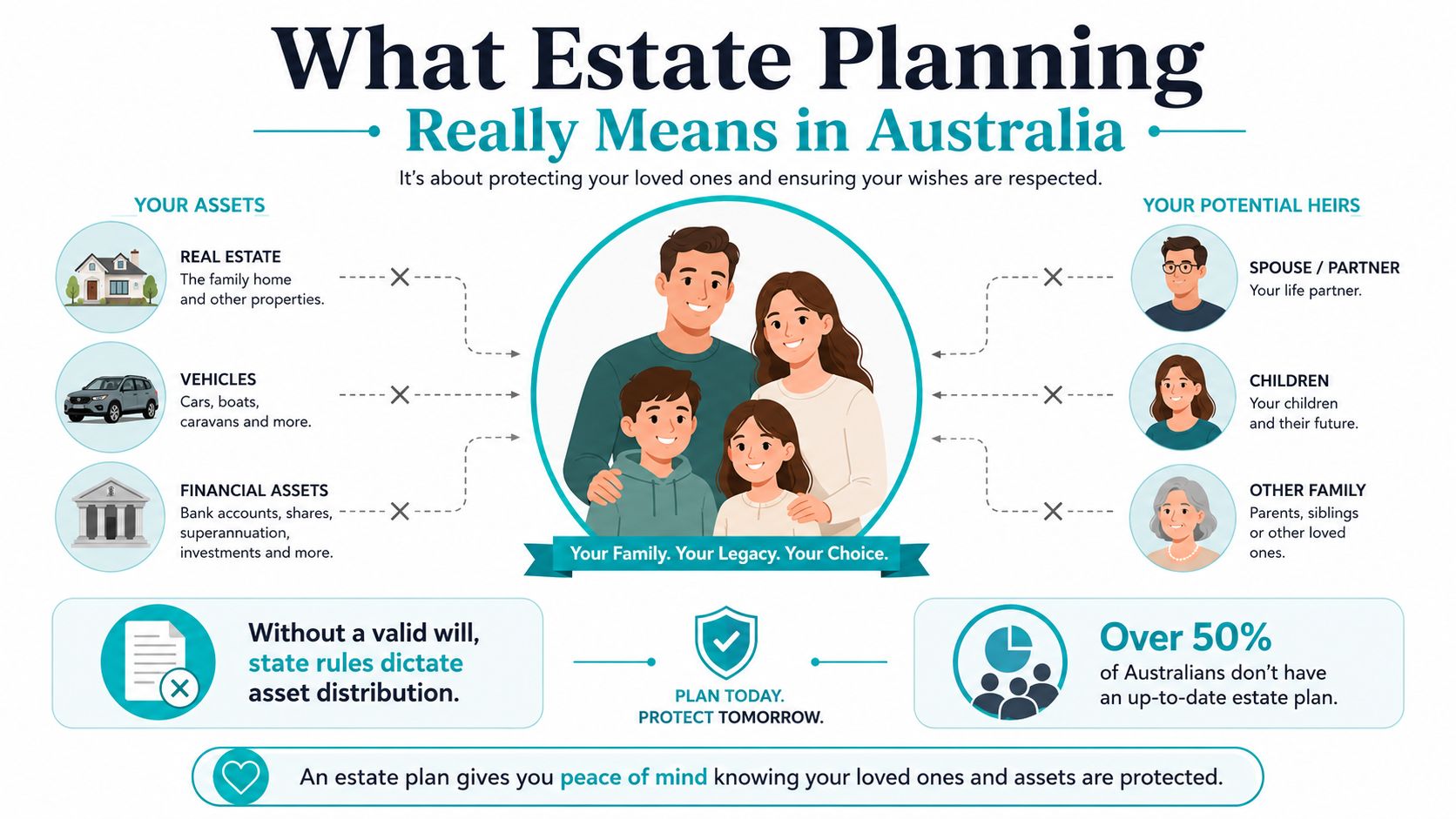
Estate planning is the set of documents, ownership choices, nominations, and succession decisions that decide what happens to your assets if you die or lose capacity. MoneySmart describes an estate plan as what you want to happen to your assets after death, and the ATO's privately owned groups guidance makes the same point from a governance angle, because ownership and control changes matter just as much as the wording in the will MoneySmart estate planning guidance, ATO estate planning guide.
That means your plan has to deal with more than distribution. It also has to deal with decision-making, guardianship, superannuation, trust control, and the practical question of who can act when the right person can't. A useful way to picture it is as a set of instructions that sit beside the assets themselves. The right document needs to match the right asset, otherwise the pieces do not line up.
Practical rule: if an asset has a title, trust deed, nomination form, or company role attached to it, do not assume the will controls it.
A simple example helps. A bank account in your own name can usually be dealt with under the will, but a super fund balance may be handled by the trustee under the fund rules and any valid nomination, while a trust asset follows the trust deed. One family can own all three and still need three different legal pathways.
Why this is urgent now
The urgency is not abstract. Australian research cited in the source base shows only 35% of people under 30 had a will, while 93% of people over 70 did, and about 64% of Australians with minor children didn't have a will. That matters because minor children cannot inherit outright in the same way adults do, so guardianship and trust planning often need to sit alongside the will.
It also matters because intestacy rules, where the law decides the distribution, can land very differently from what a family intended. Blended families, dependent children, and mixed asset structures can all create friction if the documents do not match the ownership. If your circumstances have changed through marriage, divorce, a new child, a major asset purchase, or the death of an executor or beneficiary, the plan needs another look estate planning checklist and review triggers.
The Core Concept Mapping Assets to Legal Instruments
The quickest way to get estate planning wrong is to treat everything like it sits under one document. It doesn't. Different assets are controlled by different legal mechanisms, and the job is to line them up so they don't fight each other. That's the part many people miss, especially when they think a standard will is enough.
Which asset follows which rule
| Asset or holding | Governed by | What this means for your plan |
|---|---|---|
| Personally owned assets | Will | Your will directs who receives these assets after death. |
| Superannuation | Super nomination and trustee process | Your will may not control it unless the benefit is paid to your estate. |
| Jointly held property | Joint ownership rules | The survivor may take automatically, so the will may not decide it. |
| Trust assets | Trust deed and control documents | The trust deed, not the will alone, often decides control and benefit. |
| Company shares and control | Constitution, shareholders' arrangements, director succession | Shares and control need separate succession planning. |
That table is the foundation. Once you see the separation, the rest of the planning stops feeling vague. Personally owned items, like your own bank account or the half of the home you own as a tenant in common, can flow under the will. Other assets may be sitting in a separate legal bucket altogether, which is why what happens to super when you die deserves its own attention.
Why the structure matters more than the document count
A family can have a polished will and still have a badly aligned plan. If the super nomination is out of date, the trust deed doesn't match the intended successor, or the company constitution still points to the wrong controller, the practical outcome can drift away from the written wish. The point isn't to collect documents. The point is to connect the right document to the right asset.
A useful test is to ask, “Who actually controls this asset today, and who controls the transfer after death?”
That question leads naturally to the inventory you need to build. Once you've mapped the asset classes, you can match each one to the legal instrument that works.
Key Legal Documents Every Australian Plan Needs
A family can have the right intentions and still leave the wrong document in charge of the wrong asset. The useful question is not just whether a will exists, but which assets it can control, which ones sit outside it, and which document takes over when capacity, death, or trust control becomes the issue.
The will and the documents that sit beside it
A will controls distribution of personally owned assets after death. A simple example is a bank account held in your sole name, or your share of property held as tenants in common. If you leave those assets to two children, the will is the document that can say so clearly. Wills are generally confidential while you're alive, and access is tightly controlled unless a valid legal process applies wills confidentiality and access rules.
An Enduring Power of Attorney handles financial and legal decisions if you lose capacity. If you're in hospital and can't manage the mortgage, the attorney can step in. An Enduring Guardian or Advance Care Directive covers healthcare and lifestyle decisions, so the person you choose can make medical decisions that reflect your wishes. Those documents matter because capacity loss doesn't wait for a convenient time estate planning document roles.
A simple way to sort the confusion is to separate ownership from control. Ownership tells you whose name is on the asset. Control tells you who can sign, decide, or direct what happens next. A will speaks mainly to the first group after death, while the attorney and guardian documents speak to the second group during life or incapacity.
Superannuation nominations and storage
Superannuation is different again. The fund's trustee follows the nomination rules and the trust deed, so a valid nomination can matter more than the will. A nomination might direct benefits to your spouse, your estate, or another eligible dependant, depending on what the fund allows and what your plan needs.
The storage issue is easy to overlook. A document only works if the right person can find it when it's needed. Keep originals safe, tell your chosen attorney and guardian where they are, and make sure the executor knows what exists and where it's stored. If the person who needs to act can't locate the paper trail, the plan stalls before it starts.
Practical rule: if a document won't be found, it may as well not exist.
A complete inventory for an adviser conversation should include the will, powers of attorney, guardianship or medical directive documents, and current superannuation nomination forms. It should also cover trust documents and company records where those structures exist, because those papers can control who steps in even when the will does not. For families setting up a trust, trust creation with Coveredly is one way to keep the setup process organised. If your plan uses a testamentary trust, a clear guide such as what a testamentary trust is in Australia can help you see how that structure fits beside the will rather than inside it. That is the minimum toolkit before any proper review.
Superannuation, Trusts and Testamentary Trusts in Practice
Super and trust structures are where many otherwise sensible plans go off the rails. The reason is simple. People assume the will reaches everything, but superannuation and trust assets often follow their own rules. Once you separate those rules, the outcome becomes much easier to control.
A superannuation example that shows why nominations matter
Take a couple with two adult children. One spouse dies, and their super sits in a fund with an old non-binding nomination naming the estate. If the trustee has discretion, the payment path can still become slow or awkward, especially if the family paperwork hasn't been kept clean. By contrast, a binding nomination gives the trustee a clear instruction, if the nomination is valid under the fund rules and the trust deed.
That's why super planning deserves its own review, not a quick glance in the annual statement. The tax outcome can also shift depending on who receives the benefit. The main point here is not to chase a one-size-fits-all answer, because the right choice depends on the family structure, the beneficiary type, and the rest of the estate plan.
Testamentary trusts in a family setting
A testamentary trust is created by the will and comes into effect after death. If a parent wants to leave assets for young children, the trust can hold those assets until a chosen age and can give the trustee flexibility to manage distributions in a tax-aware way. That's why many families use what is a testamentary trust in Australia as part of their broader plan, not as a standalone product.
A second, more complex example is a blended family. A direct gift can create tension if one spouse wants to provide for a surviving partner while also protecting children from a first relationship. A testamentary trust can help separate control from benefit, which gives the will more precision than a simple outright gift ever could.
For families exploring trust setup more broadly, a practical external resource like trust creation with Coveredly can help illustrate how trust structures are documented, but the key point is still the same. The trust deed and control rules have to match the estate objective.
Not every family needs a testamentary trust, but every family with children, a blended structure, or meaningful tax sensitivity should at least ask whether one belongs in the plan.
Probate Administration and CGT Considerations
When someone dies, the estate doesn't move from “legal” to “finished” in one clean step. First, the legal authority to act has to be established. Then the assets are gathered, debts are paid, and only then do the remaining assets move to beneficiaries. Probate sits right at the start of that chain, and tax can shape the rest of it.
Probate, letters of administration, and the practical sequence
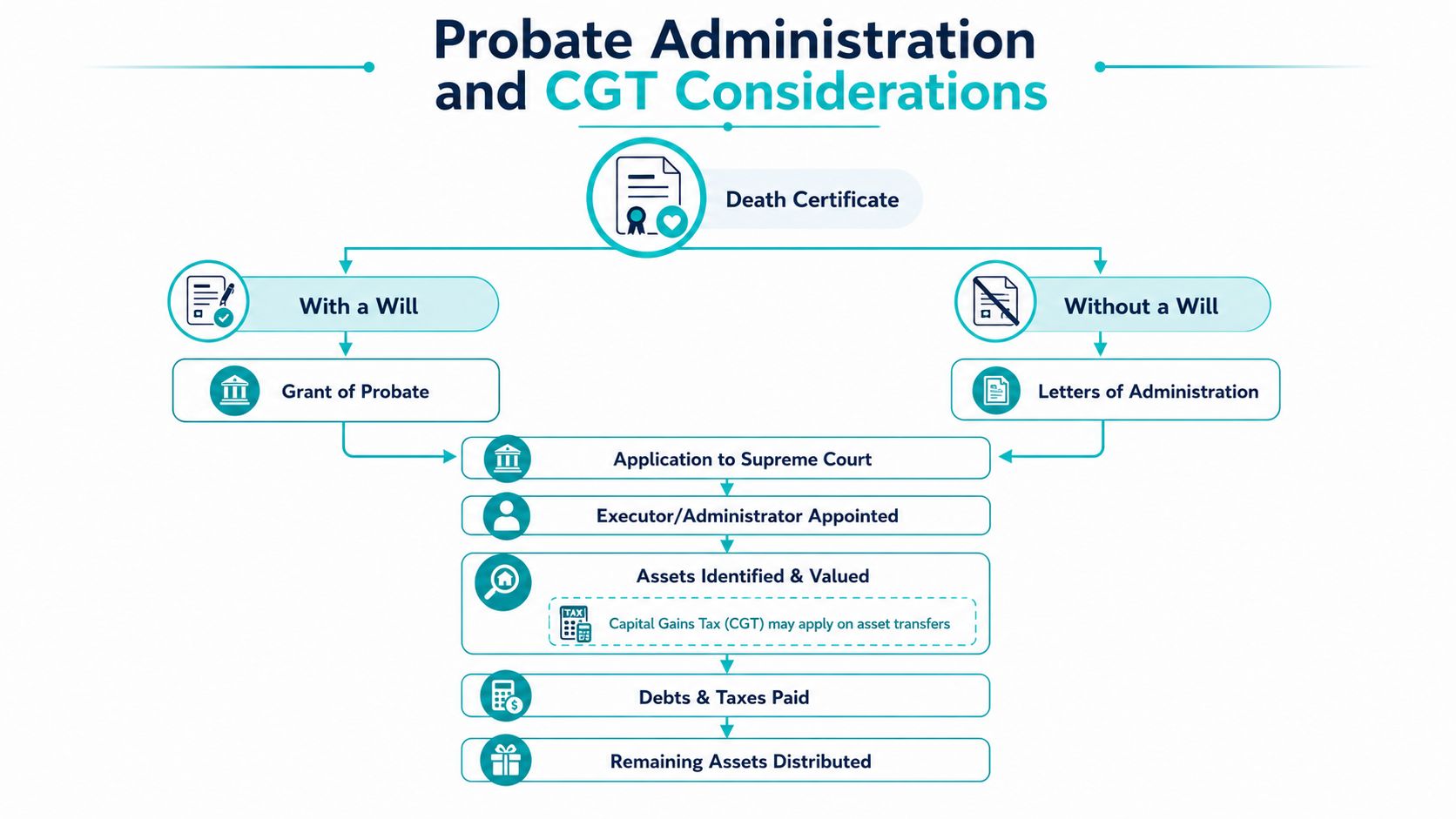
Probate is the Supreme Court's confirmation that the will is valid and that the executor can deal with the estate. Letters of administration are used when there's no valid will, or no executor able to act. The difference sounds technical, but in real life it decides who gets authority and how the administration starts.
The sequence is usually straightforward in concept. A death certificate is obtained, the legal authority is confirmed, assets are identified and valued, debts and taxes are paid, and the remaining assets are distributed. If the estate is contested, asset-heavy, or tied up in different structures, the process can take longer and become more document-driven. That's one reason the executor choice matters so much before death.
CGT on death and the asset structure link
Capital gains tax is another place where planning decisions echo later. The ATO's estate-planning guidance makes the point that estate planning includes ownership, super, trusts, powers of attorney, and succession in private groups, because those structures affect outcomes after death ATO estate planning guide. The tax result depends on what the asset is, who owns it, and what happens next.
In some estates, the family home can fall within the main-residence exemption rules for a period after death. For assets held at death that pre-date CGT, the cost base treatment can be different again. In a business context, eligible small-business CGT concessions can also matter. The detail belongs in advice, but the principle is clear. Asset ownership and beneficiary structure directly shape the tax bill the beneficiaries inherit.
CGT and deceased estate considerations is where this tax layer gets more detailed, but the planning lesson is simple. If you know how the asset is owned, you can ask sharper questions before the estate is ever opened.
Common Mistakes Australians Make With Estate Plans
A good estate plan starts with a sharper question than “Do I have a will?” The better question is, which of my assets does my will control, and which assets are controlled by something else? That split matters because many families only discover the answer after a death, when every document has to work at once and there is no room to tidy things up.
The failures advisers keep seeing
Outdated wills after life changes are a classic problem. Marriage, divorce, a new child, a major asset purchase, or the death of a named executor or beneficiary all justify a review. If the document still names the wrong people, the plan can become harder to administer than it should be.
Missing or non-binding super nominations create another weak point. If the super trustee has discretion, the family may wait longer than expected, and the result can differ from what the person thought they had arranged. DIY wills that don't match the ownership structure are just as risky, because the wording may look tidy while the asset title says something else.
That mismatch is where a lot of confusion starts. A bank account in joint names, super held in a fund, a family trust interest, and company shares do not all pass the same way, even if they sit inside the same household balance sheet. A will can only direct what falls into the estate, so the first task is to identify which assets it controls.
Blended families deserve special care. In the Australian research base, 86% of contested will matters involved immediate family, with 63% involving children and 23% involving spouses. The same body of research found 74% of examined claims were successful, with an average estate cost of $11,900 and some disputes reaching $500,000 contested will research. NSW data also shows family provision claims rising from 878 in 2019 to 968 in 2023, about a 10% rise NSW claim trend.
The practical lesson is simple. If the structure is unclear, the result is often contested, delayed, or both. Families dealing with a deceased estate often need help from deceased estate specialists Gregory Property Agents because the paperwork, asset titles, and family expectations all have to line up before anything can move.
The real consequence
A forgotten digital asset, an old executor appointment, or a poor ownership choice does more than create annoyance. It can slow administration, add cost, and turn a straightforward inheritance into a family dispute at exactly the wrong time.
One clean question cuts through most of the confusion. Which assets does my will control?
That question is the best filter for the rest of the plan. Once you know the answer, you can see where the gaps are, and where another document, title structure, or nomination has say.
A Step-by-Step Checklist to Build or Update Your Plan
A good estate plan starts with one practical question. Which assets does my will control? A house held in your sole name may sit in the will's path, while superannuation, jointly owned property, and some trust interests may follow a different legal route. Once you sort that out, the rest of the plan becomes easier to line up.
A clean order to follow
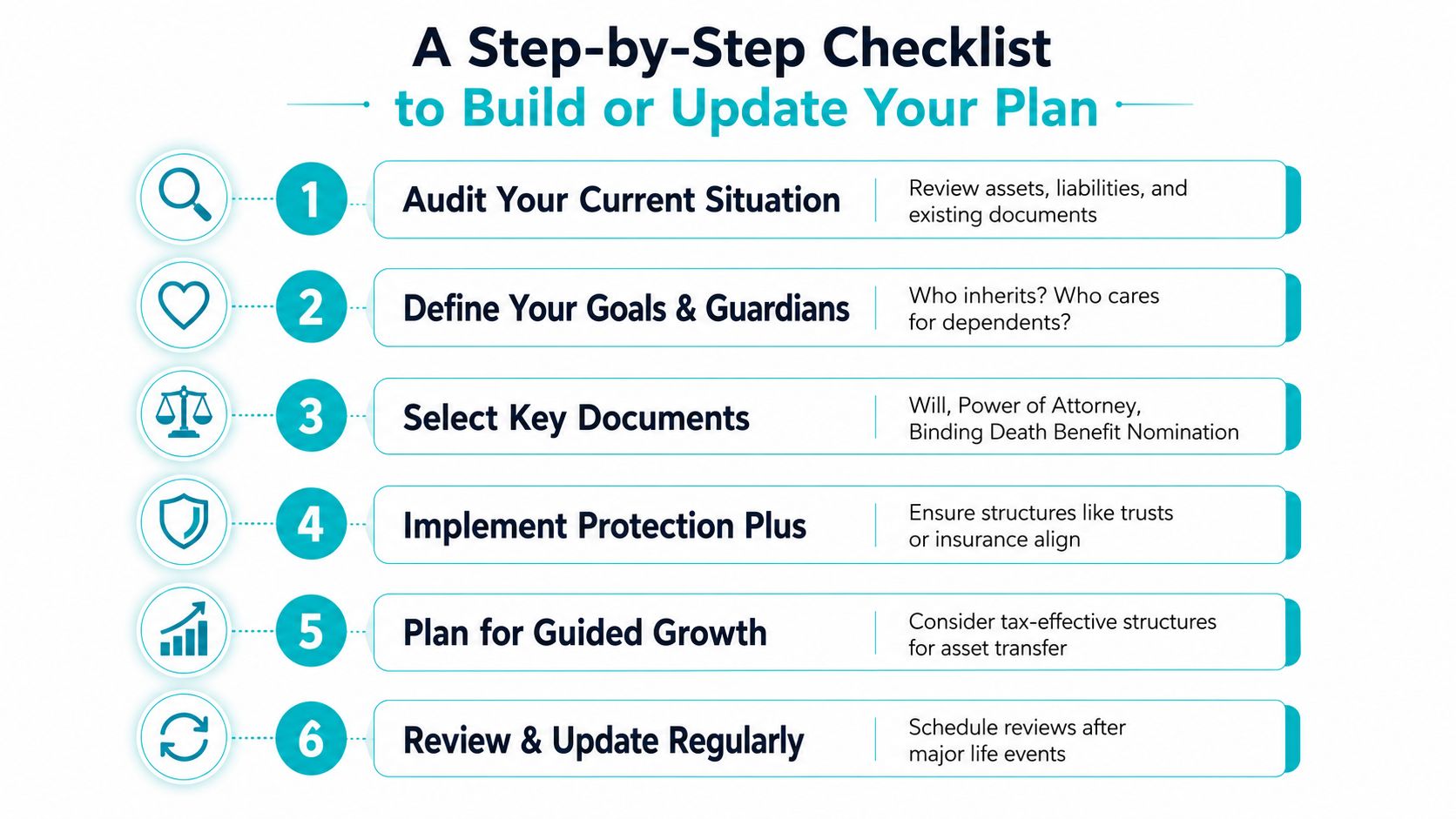
Audit your current situation. List property, super, investments, trust interests, company roles, insurance, debts, and digital assets. Wealth Collective's Protection Plus pillar fits here because the first job is working out what needs to be protected and what document or title already controls it.
Define goals and guardians. Decide who inherits, who cares for dependants, and who should act if you lose capacity. Family structure, not just assets, begins to shape the plan at this point, because a child's needs, a partner's rights, and an executor's role can all pull in different directions.
Select the key documents. Put the will, Enduring Power of Attorney, Enduring Guardian or Advance Care Directive, and super nomination forms side by side so they do not contradict each other. It helps to treat them like separate switches on a control panel, each one handling a different part of your affairs.
Align protection structures. Check whether trusts, insurance ownership, and company control match the outcome you want. A trust deed can direct one asset, a policy owner can control another, and a company constitution may affect who steps in if something changes.
Plan the transfer logic. Use the estate structure to think through tax, liquidity, and the timing of transfers. Guided Growth and Retirement Roadmap style thinking helps here, because the plan has to make sense on paper and still work when money needs to move, bills need to be paid, and family members need access to funds.
Review after major life events. Marriage, divorce, a new child, a significant asset purchase, or the death of an executor or beneficiary are all estate plan review triggers. A will that suited your life five years ago can be a poor fit after a major change, even if nothing looks broken on the surface.
The actual consequence
A forgotten digital asset, an old executor appointment, or the wrong ownership choice does more than create annoyance. It can slow administration, add cost, and turn a straightforward inheritance into a family dispute at exactly the wrong time.
If you want the process checked by an adviser who can coordinate the moving parts, Wealth Collective offers a structured first conversation, then helps you work out what needs legal, tax, or insurance support. That is often the fastest way to turn a messy folder into a plan you can trust.