Business hours
Monday to Friday (8.30AM - 5PM)
Weekend (Closed)

Responsible investment now makes up 36% of Australia's total investment market, or $1.3 trillion in assets under management, up from $633.2 billion in 2015, and 88% of Australians expect their money to be invested ethically according to ABC's coverage of 2024 RIAA research.
That changes the conversation. Ethical investing in Australia isn't a fringe preference for a small group of idealists. It's become a mainstream expectation, and for many investors it now sits alongside the usual questions about growth, risk, tax, fees, and retirement planning.
The hard part isn't deciding whether values matter. The significance of values is already clear. The hard part is working out the specific holdings of an “ethical” fund, how super funds apply their screens, and whether the label on the front matches the portfolio underneath. That's where many investors get stuck.
The Rise of Ethical Investing in Australia
Australians have moved well beyond the old idea that ethical investing means sacrificing performance or accepting a niche product range. The market's growth suggests something more durable is happening. Investors want their capital to reflect how they live, vote, spend, and plan for the future.
That's particularly relevant in a country where big national themes, energy transition, mining, agriculture, housing, and superannuation, shape both returns and ethical debates. If you're trying to understand why ethical investing Australia has become such a central topic, it helps to look at the broader systems around it, including changing energy infrastructure. For context, Connect VPP on Australia's energy landscape offers a useful overview of how distributed energy is reshaping part of that picture.
Why this matters to ordinary investors
Typically, ethical investing isn't about creating a perfect portfolio. It's about reducing obvious misalignment.
You might want to avoid tobacco, weapons, or gambling. You might prefer businesses with stronger labour practices or lower carbon exposure. You might want your superannuation to support companies that are at least moving in the right direction. All of those are reasonable goals, but they sit on a spectrum.
Many investors don't want a portfolio that is “morally pure”. They want one that is more intentional, more transparent, and easier to defend when they look at what they own.
The market is broader than many people assume
Australia now has ethical managed funds, ethical ETFs, responsible super options, and impact-style strategies across different risk profiles. That means ethical investing can be part of a growth strategy, a balanced portfolio, or a retirement income plan.
The key shift is psychological as much as financial. Investors are no longer asking, “Can I invest ethically?” They're asking, “How do I do it properly without falling for glossy marketing?”
That's the right question.
Understanding the Core Models ESG SRI and Impact
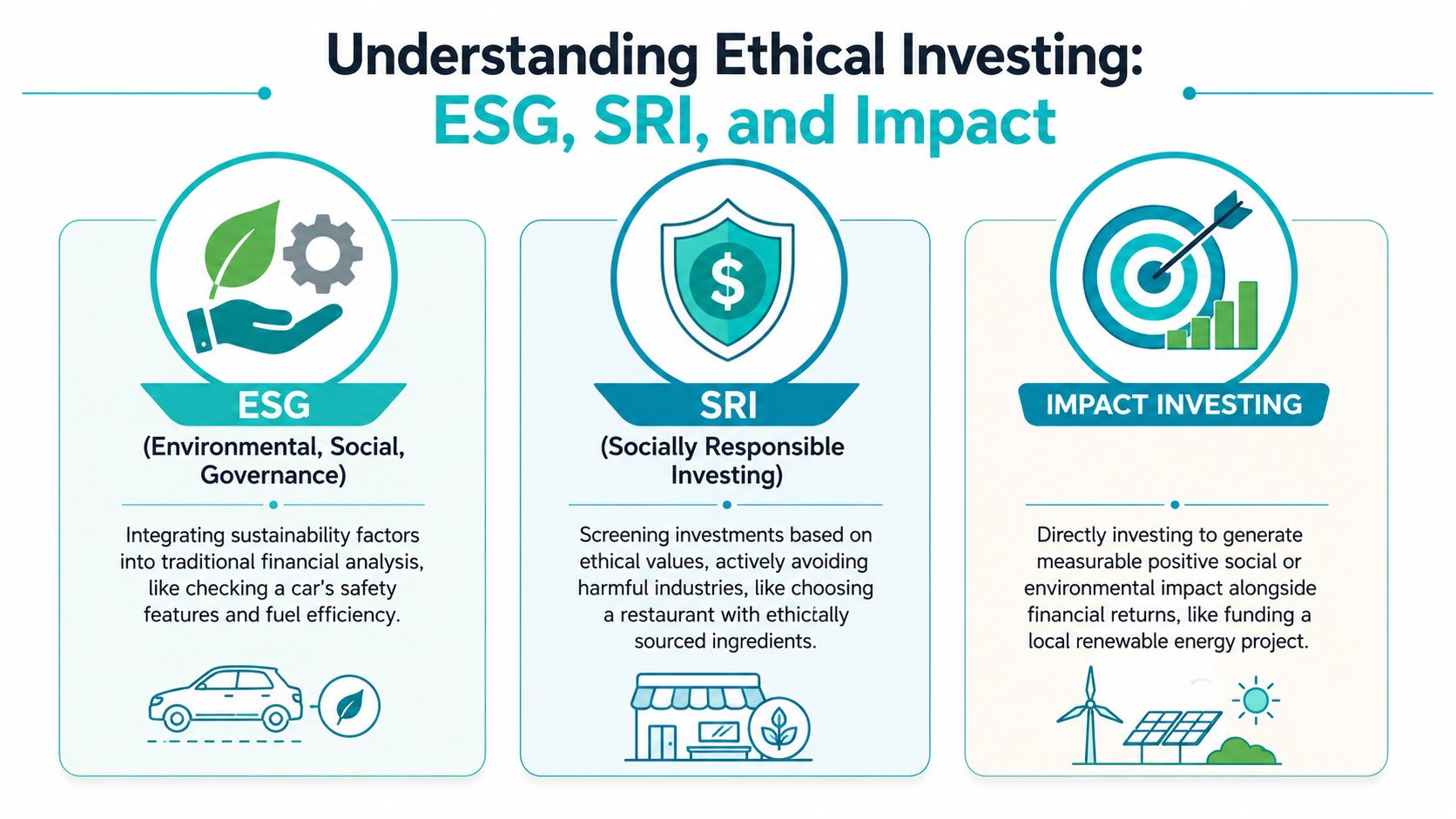
People often use ESG, SRI, and impact investing as if they mean the same thing. They don't. They overlap, but they solve different problems.
A simple way to think about them is this:
- SRI is about what you leave out.
- ESG is about how you assess what stays in.
- Impact investing is about what positive outcome you're deliberately trying to create.
SRI as the exclusion method
Socially Responsible Investing, or SRI, is the oldest model many Australians recognise. Its approach is comparable to a diet that removes foods you don't want to eat. The focus is screening out sectors or companies that breach your values.
In practice, an SRI fund might exclude weapons, tobacco, gambling, or fossil fuels. The main strength of this approach is clarity. If something is clearly inconsistent with your values, it doesn't go in the portfolio.
The limitation is that exclusion alone doesn't tell you what the fund prefers instead. Two funds can both avoid the same industries and still look very different once you examine the actual holdings.
ESG as the best-in-class method
Environmental, Social, and Governance investing takes a broader view. Instead of avoiding “bad” companies, it often tries to identify businesses that manage sustainability risks and opportunities better than peers.
A practical analogy is buying a car. SRI says, “I refuse to buy models with known safety failures.” ESG says, “Among the acceptable options, which manufacturers have better safety systems, lower fuel use, and stronger reliability?”
That means an ESG fund may still own companies in contested sectors if the manager believes those businesses are improving, engaging with shareholders, or outperforming industry peers on governance and sustainability factors.
Impact as the proactive method
Impact investing goes a step further. It aims to direct money toward activities intended to generate a positive social or environmental outcome alongside financial returns.
That could mean investments connected to renewable energy, social housing, healthcare access, or community development. The key difference is intent. Impact investors usually want a clearer line between their capital and a specific real-world effect.
Practical rule: If your main question is “What does this fund avoid?” you're probably thinking like an SRI investor. If it's “How does this fund choose the better companies?” you're closer to ESG. If it's “What change does my money help create?” you're thinking about impact.
Performance and the Australian context
Some investors still assume ethical investing means giving up returns. The Australian evidence doesn't support that blanket view. The Reserve Bank of Australia notes that ethical funds have delivered an average annual return of 9.2%, compared with 9% for other funds, and that the sector dates back to the 1980s. It also notes that more than 70 new ethical funds were launched in the past five years, showing how quickly choice has expanded in the local market, as outlined in the RBA's discussion of green and sustainable finance in Australia.
If your ethical choices sit inside super, it also helps to compare the broader menu of investment options available. This guide to best super investment options is a useful starting point before you narrow your shortlist.
Australian Regulations and Your Superannuation
Australia gives investors a stronger framework than many people realise. Ethical claims aren't supposed to be vague aspirations. In many cases, they're meant to be disclosed clearly enough that you can test them.
That matters most in superannuation, because for many Australians, super is their largest investment pool. People often spend more time researching a share tip than reviewing the values settings of the fund receiving compulsory contributions year after year.
Why the PDS matters
Under Section 1013DA of the Corporations Act, issuers must explain in the Product Disclosure Statement, or PDS, exactly how labour standards or environmental, social, and ethical considerations are taken into account when selecting, retaining, or realising investments, as discussed in this explanation of Section 1013DA and disclosure obligations.
In plain English, the PDS should tell you more than “we care about sustainability”. It should show how the fund applies that claim.
Look for language that answers practical questions such as:
- What industries are excluded. Coal only, or all fossil fuel producers?
- How strict the screen is. Total exclusion, revenue threshold, or case-by-case review?
- What happens after purchase. Does the manager engage with companies or solely hold them?
- How often holdings change. A policy matters less if it's weakly enforced.
What this means for super members
Super funds often offer multiple investment options under one umbrella. One option might be labelled ethical, sustainable, socially aware, or responsible, while other options in the same fund are not. Investors sometimes confuse the brand of the fund with the mandate of the specific option they hold.
That's why you need to check the exact investment option, not just the fund name.
A short review process helps:
| What to check | Why it matters |
|---|---|
| Option name | Ethical features usually apply to a specific option, not the entire super fund |
| PDS wording | This is where the screening and inclusion rules should be set out |
| Holdings information | It helps confirm whether the portfolio reflects the written policy |
| Stewardship approach | It shows whether the manager votes and engages on issues you care about |
A super option can sound aligned and still be broader, looser, or more compromised than you expected. The wording matters.
If you want to understand how super works before evaluating ethical options inside it, this explainer on what superannuation is in Australia provides a clear base.
The practical takeaway
Australian regulation doesn't remove the need for judgment. It does, however, give you documents to examine and standards to rely on. That's important because ethical investing should be auditable. If a fund makes a promise, you should be able to trace how that promise is applied.
How to Evaluate Funds and Avoid Greenwashing
A polished website isn't evidence. A leaf icon isn't evidence. A “responsible future” slogan isn't evidence either.
When a fund markets itself as ethical, green, or sustainable, you need to move from branding to proof. ASIC's INFO 271 guidance says funds using terms like “ethical” or “green” must substantiate those claims with specific evidence and define what exclusions apply, which is central to avoiding greenwashing, as outlined in this Australian ESG and ethical investing guide discussing ASIC INFO 271.
A practical review framework
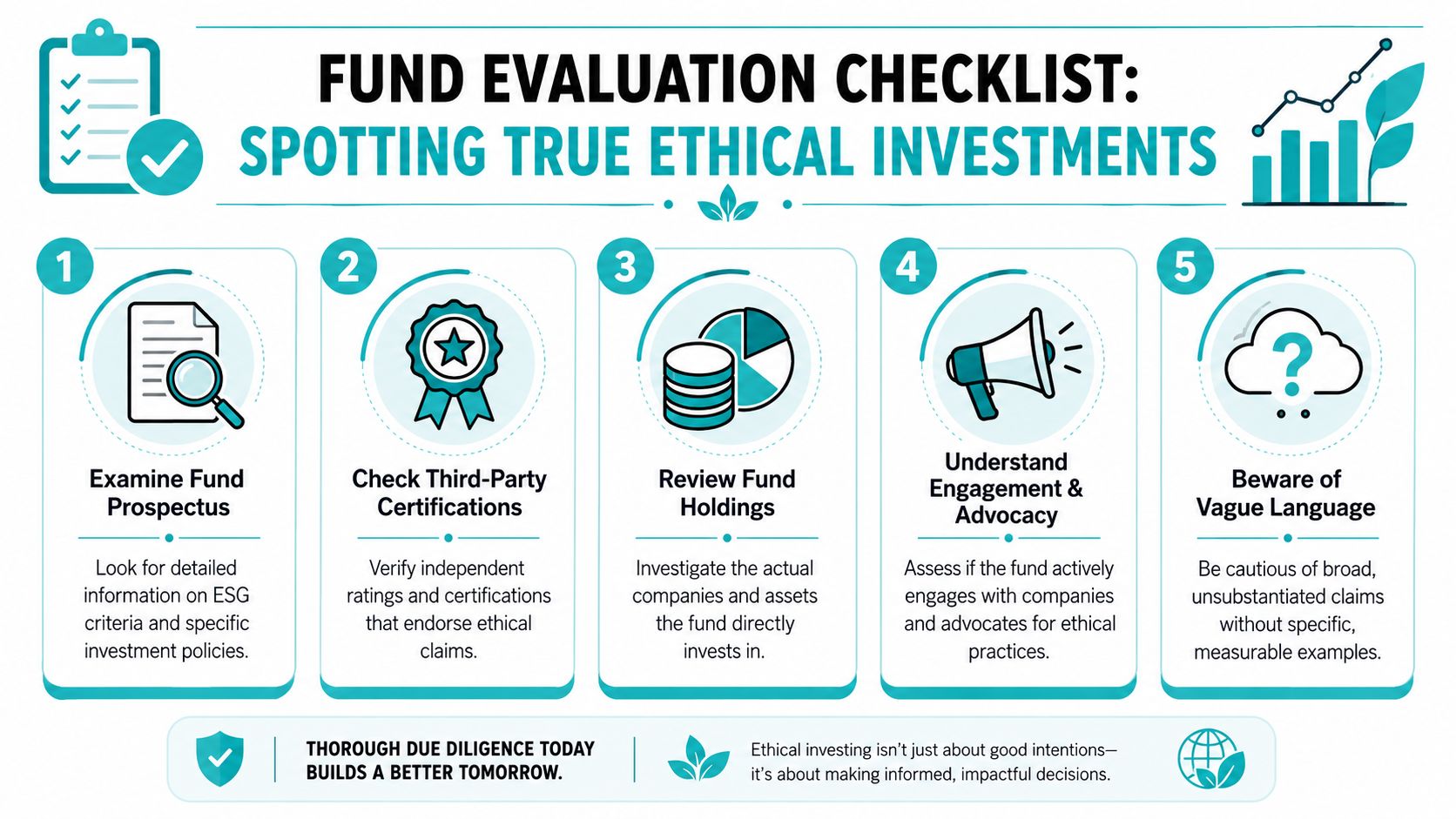
Use this process when comparing funds, ETFs, or super options.
Read the promise carefully
Start with the headline claim. Is the fund saying it excludes harmful sectors, selects ESG leaders, funds measurable impact, or some mix of all three? If the language is broad, treat that as a prompt for more work, not reassurance.Check the PDS or fund disclosure
You're looking for definitions. If the fund excludes fossil fuels, does that mean thermal coal only, or the entire fossil fuel chain? If it says it considers ESG issues, what role do those issues play in security selection?Review actual holdings
For listed ETFs especially, holdings data can be one of the fastest ways to test whether the fund does what it says. If a product excludes an industry but the portfolio includes a company that appears inconsistent with that claim, that deserves explanation.Look for stewardship evidence
Ethical investing isn't only about what a manager avoids. It can also be about how they vote, engage, and escalate concerns. If a fund says it influences companies for the better, ask what that looks like in practice.Use independent filtering tools
The Responsible Investment Association Australasia offers a Responsible Returns tool that lets investors choose themes they want to support and issues they want to avoid, then view matched providers. Canstar also notes that RIAA members are often used as a useful benchmark because they must meet standards for disclosure and reporting, which you can read about in Canstar's overview of ethical investing tools and RIAA's Responsible Returns.
Questions worth asking any fund manager
- What is excluded outright, and what is merely limited?
- Do you use negative screening, positive ESG integration, or both?
- Can I see recent holdings?
- How do you assess overseas supply chains and offshore operations?
- Do you publish proxy voting or engagement records?
- What would cause you to sell a company on ethical grounds?
Why vague language is a warning sign
Terms like “sustainable mindset” or “better future investing” may sound appealing, but they don't tell you much. Good disclosure is specific. It tells you what the fund does, where the boundaries sit, and how the manager handles edge cases.
If you want a broader primer on reporting language and the way ESG concepts are often presented by organisations, Global Governance Media's ESG analysis is a useful companion read.
Due diligence test: If you still can't explain the fund's rules after reading its material, the issue may not be your understanding. The issue may be that the fund hasn't explained itself properly.
For investors comparing retirement-focused options, this roundup of best superannuation funds in Australia can help narrow the field before you apply your own ethical screen.
Building Your Values-Aligned Investment Portfolio
A strong ethical portfolio isn't built by exclusion alone. It's built by combining values with diversification, time horizon, liquidity needs, and risk tolerance.
That's where many well-intentioned investors make a wrong turn. They find one fund with an appealing label, put too much weight on a single theme, and assume the job is done. A portfolio built that way can drift into concentration risk or an asset mix that doesn't suit the investor's actual goals.

Match the portfolio to your stage of life
A younger professional might be comfortable with more growth exposure and a higher allocation to funds that target sustainability themes or emerging technologies. A pre-retiree usually needs a different balance. Capital preservation, income reliability, and sequencing risk matter more when withdrawals are getting closer.
The ethical lens should sit on top of those fundamentals, not replace them.
Here's a practical way to approach this:
- Early career investors often focus on long time horizons, super contributions, and growth assets. They may tolerate more volatility if the portfolio remains diversified.
- Mid-career families usually need a balance between growth, debt management, insurance, and flexibility. Ethical investing has to fit around competing financial priorities.
- Pre-retirees and retirees tend to care more about drawdown risk, stable income sources, and whether their super pension holdings still align with their values.
Avoid unintentional concentration
Some ethical portfolios naturally lean toward sectors like technology, healthcare, or renewable energy. That can be fine, but only if you're choosing it knowingly.
The problem arises when investors think they're buying a broad ethical strategy and end up with narrow exposure. If too much of the portfolio depends on one theme, one region, or one style of company, short-term volatility can become sharper than expected.
A useful mindset comes from looking at sustainability through the capital allocation lens, not just the exclusion lens. Unitism's guide to sustainable growth is a thoughtful resource on how capital formation and long-term value creation can intersect.
A balanced framework
A values-aligned portfolio usually works best when it answers four questions together:
| Portfolio question | Ethical investing question |
|---|---|
| What is this money for? | Which values matter most? |
| When will I need it? | Which compromises am I willing to accept? |
| How much volatility can I handle? | Do I prefer exclusion, ESG selection, or impact? |
| How diversified is the portfolio? | Am I overexposed to a single ethical theme? |
The strongest ethical portfolio is one you can hold through a rough market, explain in plain language, and keep aligned with your goals over time.
Common Pitfalls of Ethical Investing
The biggest mistake in ethical investing isn't always buying the “wrong” fund. Often, it's assuming the label answers every question.
One of the most important blind spots is the jurisdictional ethics gap. That happens when an Australian ESG fund holds exposure to global companies whose offshore practices may clash with the investor's values, even though the fund still presents as ethical in local marketing. This gap is discussed in Star Investment's guide to the Australian ethical investment landscape.
Where investors get caught out
A fund might screen out certain Australian industries but still hold multinational businesses with complex overseas supply chains, labour issues, or fossil fuel exposure through subsidiaries. Unless you look beneath the top-line categories, that can be hard to spot.
This doesn't automatically make the fund dishonest. It does mean “ethical” can be narrower, more local, or more selective than you assumed.
Other common issues include:
- Theme concentration. Portfolios can end up too exposed to a narrow set of sectors.
- Definition mismatch. Your view of ethical may differ from the manager's methodology.
- Reporting gaps. Some funds explain exclusions but say little about stewardship or voting.
- Fee complacency. Investors sometimes accept higher costs without checking whether the process is actually more rigorous.
Performance can still be uneven
Long-term evidence in Australia has been broadly reassuring, but short-term results can still diverge. The review cited in the verified data notes that the Ethinvest Environmental Index recorded a -12.9% slide compared with the broader market's -8.87% decline in one period, and attributes that kind of short-term weakness to thematic concentration and sector cycles rather than a permanent flaw in ethical screening, as outlined in this review of ethical investment performance and sector-specific volatility.
That's a useful reminder. Ethical investing doesn't remove market risk. In some cases, it can increase short-term volatility if a strategy leans heavily into a popular theme.
A fund can be ethically sincere and still be a poor fit for your risk tolerance, time frame, or need for diversification.
A better standard to use
Instead of asking whether a fund is perfectly ethical, ask better questions.
Is the methodology clear?
Are the trade-offs explained?
Can you see how the rules are applied in practice?
Does the portfolio still work for your broader financial life?
That standard is more realistic, and far more useful.
Start Your Ethical Investing Journey Today
Most investors don't need more slogans. They need a short list of next steps.
Start with the assets you already have, especially your super. Read the investment option name carefully, then review the disclosure, holdings, and exclusions. Write down the issues you most want to avoid and the themes you'd prefer to support. If you can't explain your current portfolio in plain language, that's the first problem to solve.
Keep your approach simple:
- Define your strict criteria so you know what must be excluded.
- Choose your preferred model if you lean toward SRI, ESG, impact, or a blend.
- Check the paperwork before you trust the branding.
- Review the whole portfolio so your ethical choices don't create hidden risk.
For many Australians, the missing piece isn't motivation. It's implementation. It takes time to compare super options, audit fund claims, and fit values-based investing into a broader strategy for debt reduction, family goals, tax efficiency, and retirement planning.

If you want a portfolio that reflects your values without losing sight of performance, structure, and long-term planning, a personalised advice process can save a lot of false starts. That's especially true if you're weighing super choices, building wealth through a Guided Growth plan, or preparing for retirement with a Retirement Roadmap approach.
If you'd like help turning these ideas into a practical strategy, Wealth Collective offers a clear starting point. Their advisers work with Australians who want better super decisions, smarter investment strategy, and more confidence about retirement. A free, no-obligation 10-minute call is a simple way to talk through your situation and see whether an ethical investing plan suited to your needs makes sense for you.