Business hours
Monday to Friday (8.30AM - 5PM)
Weekend (Closed)



For the 2025–26 financial year, you can generally contribute $30,000 in concessional, before-tax contributions and $120,000 in non-concessional, after-tax contributions. Those are starting points, not universal maximums, because your age, total super balance and unused cap amounts can change what you personally may contribute.
You're probably asking because your payslip shows employer super, your accountant has mentioned salary sacrifice, or you're approaching retirement and want to move more savings into super before 30 June. The frustrating part is that the answer isn't one number. Two people on the same income can have different contribution capacity because their employer contributions, super balances and contribution history differ.
The right approach is to separate concessional contributions from non-concessional contributions, check the relevant balance tests, then calculate what's already been contributed before making another payment.
Understanding Super Contribution Caps in 2026
You see $30,000 on a website, your employer is already paying super, and you want to add more before 30 June. The right answer starts with one fact. Super contribution caps do not work as a single personal limit. They work by contribution type, and your age and total super balance can expand or shut down options quickly.
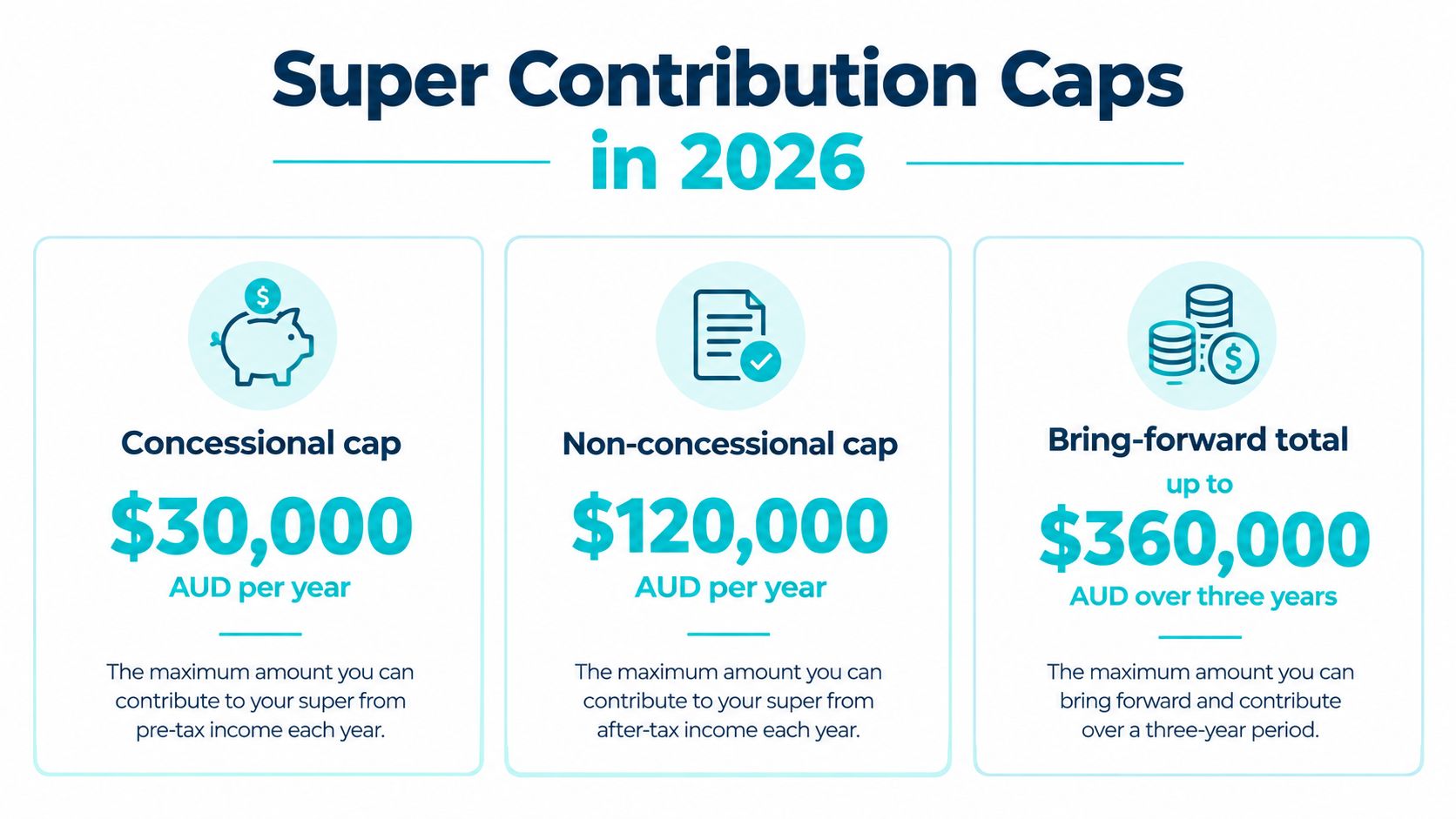
For 2025–26, the standard caps are:
- $30,000 for concessional contributions, which are generally before-tax contributions.
- $120,000 for non-concessional contributions, which are generally after-tax contributions, if the relevant total super balance test is met.
- Eligible people may use the bring-forward arrangement to contribute up to $360,000 over three years, subject to age, balance and prior-contribution rules. Australian Taxation Office guidance on the non-concessional cap
The three questions that determine your answer
- What type of contribution are you making? Before-tax and after-tax contributions use different caps and different tax rules.
- What has already entered your super fund? Employer payments count, even if you did nothing beyond staying employed.
- What was your total super balance at the relevant test date? That figure can limit non-concessional contributions and affect whether larger strategies are available.
This is the part many guides gloss over. Two people can earn the same income and still have very different contribution room because one has higher employer contributions, a larger super balance, or prior unused amounts.
Practical rule: Do not rely on the headline cap. Check fund records, confirm the timing of employer payments, measure your total super balance, then calculate what is still available. If you are close to a threshold or planning a large contribution, get personal advice before the money goes in.
Concessional Contributions Explained
A common mistake is assuming your concessional cap is fully available for extra contributions. It is not. Concessional contributions are generally before-tax amounts paid into super, and the same cap covers employer Superannuation Guarantee payments, salary-sacrifice contributions, and personal contributions for which you claim an income-tax deduction. For 2025–26, the standard cap is $30,000. (ATO personal super contributions instructions)
Start with what is already going in.
If your employer contributes $18,000 during 2025–26, you have $12,000 of the standard concessional cap left for salary sacrifice or deductible personal contributions. That is the number that matters when you set payroll instructions or decide whether to claim a deduction. If you ignore employer contributions, you can exceed the cap without meaning to.
What counts toward the same cap
- Employer contributions: Superannuation Guarantee payments count automatically.
- Salary sacrifice: amounts redirected from salary into super before tax.
- Deductible personal contributions: personal amounts you contribute and then claim as a tax deduction.
Contribution type, age thresholds, and total super balance start to intersect. The cap itself applies across these contribution types, but your available strategy does not depend on the cap alone. If you are planning deductible personal contributions or considering whether unused concessional amounts may matter later, check the wider rules before acting. A practical summary is in Wealth Collective's concessional contribution limits guide.
Concessional contributions are ordinarily taxed in the super fund at 15%. High-income earners may also face Division 293 tax when income plus concessional contributions exceeds $250,000. That changes the tax cost, not the cap.
Use this order. Estimate employer contributions for the full year. Add salary-sacrifice amounts already processed. Add any personal contributions you intend to deduct. Then compare the total with your available concessional cap. If you are close to the limit, or your age and super balance affect the strategy you want to use, get personal advice before the contribution is made.
Non-Concessional Contributions and After-Tax Savings
Non-concessional contributions are after-tax amounts you add to super without claiming a tax deduction. They matter when you have already filled your concessional cap and still want to move personal wealth into super, for example from an inheritance, surplus cash, or the sale of an asset.
For 2025–26, the standard non-concessional cap is $120,000. Your eligibility turns on more than income. Under ATO rules, a total super balance of $2 million or more at 30 June 2025 reduces the cap to $0 for the financial year. That balance test is the point many people miss, especially if they focus only on how much cash they have available to contribute.
This is why contribution planning needs to combine contribution type, age position, and total super balance. A client with strong income and a modest super balance may still have after-tax capacity. Another client with substantial super may have none, even if they have cash ready to invest.
When after-tax contributions make sense
After-tax contributions can be effective if you want more of your long-term money inside super's tax environment and you do not need immediate access to it. Before you contribute, review liquidity, your investment mix, and when you expect to retire. Large after-tax contributions are usually sensible only when those three pieces line up.
They also need to fit the wider plan. A business owner preparing for an eventual sale should coordinate super contributions with cash flow, sale timing, and retirement funding. Guidance on maximising business value at sale can complement that discussion.
If your balance is near the threshold, small changes can affect the outcome. Confirm your total super balance at 30 June 2025 before you commit any after-tax contribution. For a practical overview, see Wealth Collective's non-concessional contributions cap guide. If you are considering a large contribution, get personalised advice first.
Bring-Forward Rules for Non-Concessional Contributions
A large after-tax contribution can go wrong fast if you focus only on the headline number. The bring-forward arrangement can let an eligible person use up to three years of the standard non-concessional cap at once, which means up to $360,000 over three years. That outcome depends on age, total super balance, and whether a bring-forward period has already started.
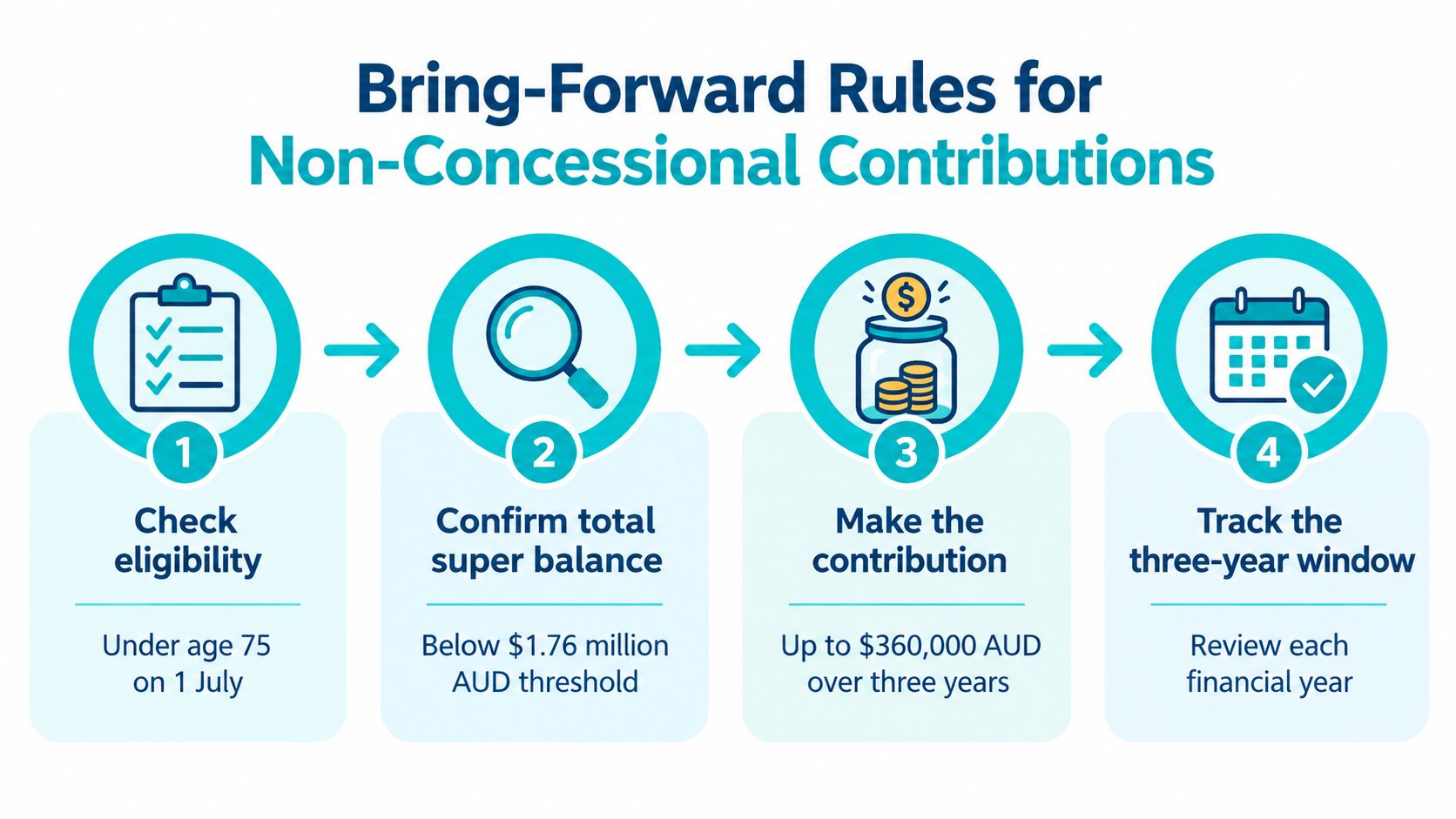
The part many guides miss is the interaction between contribution type, age threshold, and total super balance. You are not assessing a contribution in isolation. You are testing whether an after-tax contribution made now will trigger a multi-year cap, and whether your balance at the relevant 30 June point cuts that cap down or removes it altogether.
Here is the practical way to think about it. Start with your age position and the timing of the contribution. Then test your total super balance. Then review contribution history to see whether a bring-forward period is already running. If you skip that last step, you can overcontribute even when your current balance looks fine.
A simple example shows why this matters. Suppose you are eligible for the full arrangement and have not triggered it in an earlier year. You may be able to contribute $360,000 under the three-year limit. If your balance sits near the threshold, or prior after-tax contributions have already used part of your capacity, the amount available can be lower. In some cases, there is no bring-forward capacity at all.
That is why I want clients to confirm the exact position before any money leaves the bank account.
Before transferring a large amount, ask your adviser to confirm the remaining capacity in writing. A bank transfer can be easy to make and difficult to unwind cleanly if the contribution exceeds your personal limit.
Also track the financial year carefully. The start and end of the bring-forward window matter, and so do your fund's processing cut-offs. A payment you make just before 30 June may be counted later if the fund receives or processes it after year-end. If you are contributing a large amount close to a threshold, get advice before you press send.
Catch-Up Carry-Forward Rules for Concessional Contributions
You can have plenty of cash ready to contribute and still get the strategy wrong. Carry-forward rules only help if the contribution type, your total super balance, and the age of the unused cap amounts all line up.
Since 1 July 2018, people with a total super balance below $500,000 at 30 June of the previous financial year have been able to use unused concessional cap amounts from up to five earlier financial years. The first year those unused amounts could start accumulating was 2019–20, and each amount expires after five years. If you leave old capacity sitting there for too long, you lose it.
A practical carry-forward calculation
Use a strict order. Start with the current-year concessional cap. Add any eligible unused amounts from earlier years, starting with the oldest amount still available. Then subtract all concessional contributions expected for the year, including employer contributions, salary sacrifice, and any personal deductible contribution.
Here is the kind of calculation that matters. Say you have $10,000 of unused concessional cap from 2022–23 and $5,000 from 2023–24. That gives you $45,000 of total concessional capacity for 2025–26 before any employer payments. If your employer will contribute $18,000 during the year, your remaining room is $27,000. That is the figure to work from if you are considering a deductible personal contribution.
That is where clients slip up. They see an unused amount on record and assume it is fully available, even though a prior 30 June balance test or expiry rule can cut it down. The ATO may track unused concessional amounts, but you still need to match that record against your fund reporting, expected employer SG, salary sacrifice arrangements, and the date the fund receives your contribution.
Carry-forward capacity should be used deliberately, especially when you are close to the $500,000 balance threshold or trying to time a deductible contribution near year-end.
The general concessional cap is projected to rise to $32,500 from 1 July 2026. If you are planning around 30 June, apply the cap for the financial year in which the fund receives the contribution, not the year you intended it to count toward.
| Contribution type | Standard cap for 2025–26 | Age eligibility | Balance threshold | Tax treatment |
|---|---|---|---|---|
| Concessional | $30,000 | Subject to the applicable super rules | Below $500,000 at the relevant prior 30 June for carry-forward access | Generally taxed in the fund at 15% |
| Non-concessional | $120,000 | Subject to age and contribution rules | Below $2 million at 30 June 2025 for the standard cap | Generally after-tax, with no personal deduction |
If you want the mechanics set out step by step, review Wealth Collective's carry-forward concessional contributions guide. If the amount is large or your balance is close to the threshold, get advice before lodging the deduction notice.
Age and Total Super Balance Thresholds
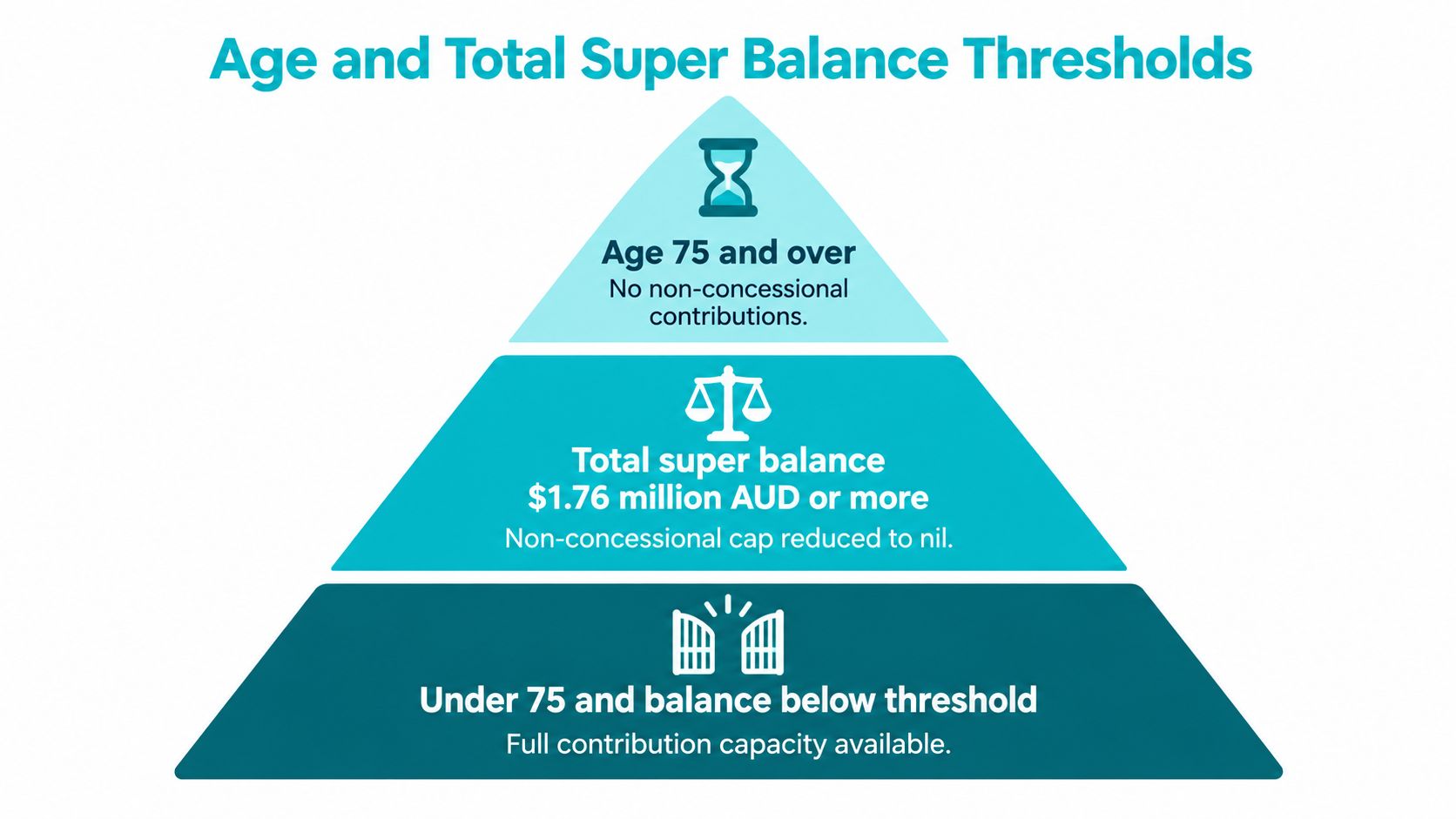
Age and balance work together. Neither one should be checked in isolation.
The key balance tests are different:
- Below $500,000 at the previous 30 June: This can determine whether eligible unused concessional amounts may be carried forward.
- Below $2 million at 30 June 2025: This is the condition for the standard $120,000 non-concessional cap for 2025–26.
- At least $2 million at 30 June 2025: The general non-concessional cap is ordinarily $0 for 2025–26.
The bring-forward arrangement adds another layer. The available amount depends on the applicable balance threshold, age and whether you have already triggered a bring-forward period. Don't rely on a generic online calculator unless you've entered your complete contribution history.
Use the relevant test date
Your 30 June total super balance matters because it can determine the contribution rules for the following financial year. Check all super interests, including accounts you may no longer actively use, before deciding whether to make a non-concessional contribution.
Age also matters more as you approach the upper contribution limits. The bring-forward arrangement has age eligibility conditions, and the ability to make a contribution isn't the same as the ability to access the full multi-year amount.
A professional review becomes particularly important when your balance is close to a threshold, you've changed funds, or you've made contributions across multiple accounts. Small differences in timing can produce a different result from the one suggested by a general rule.
Worked Examples and Calculation Scenarios
You are usually one calculation away from getting this wrong. The fix is simple. Separate concessional contributions, after-tax contributions, age rules and your 30 June total super balance before you move any money.

Scenario one, employer contributions and carry-forward capacity
A client expects employer contributions of $18,000 in 2025–26, plans to salary sacrifice $4,000, and has $9,000 of unused concessional cap available from earlier years. Start with the current-year cap of $30,000. After employer contributions and salary sacrifice, $8,000 remains under the standard cap. Add the $9,000 carried forward and the total available room becomes $17,000.
That gives a clear planning number. If the client wants the largest deductible personal contribution for the year, the target is $17,000, assuming they remain eligible to use carry-forward amounts under the balance test and the unused amounts have not expired. This is the kind of calculation that helps. It combines all moving parts instead of stopping at the obvious $12,000 gap created by employer contributions alone.
My advice is practical. Confirm payroll timing first, then make the personal contribution, then keep the deduction paperwork aligned with the fund acknowledgement and tax return treatment.
Scenario two, a large after-tax contribution
A pre-retiree wants to contribute $360,000 after tax and has a total super balance below $2 million at 30 June 2025. That headline number means nothing on its own. The key question is whether the person meets the age conditions, has not already triggered a bring-forward period, and still has the full amount available under the relevant threshold.
Mistakes happen. People see $360,000 and assume they can transfer it immediately. A better approach is to check prior non-concessional contributions, confirm whether any earlier bring-forward period is still running, and make sure the fund can receive the amount in the intended year. Keep enough cash outside super as well. Locking away too much can create a separate planning problem.
Scenario three, a high-income earner
A high-income earner has employer contributions, salary sacrifice and a planned deductible personal contribution. Add all three before making the final payment because they use the same concessional cap. If income plus concessional contributions exceeds $250,000, Division 293 tax may apply.
The right decision is not just about whether a deduction is available. It is about whether the contribution still fits, what the extra tax cost looks like, and whether the strategy improves the client's overall position. If those numbers are close, get advice before the payment is made.
Common Mistakes and Excess Contribution Risks
The most dangerous assumption is that your personal contribution limit is separate from your employer's. It isn't. Employer payments, salary sacrifice and deductible personal contributions all use the concessional cap, so double-counting employer payments is a common route to an excess.
Errors that deserve a pre-payment check
- Ignoring processing dates: A contribution may count in the year the fund receives it, not the date you initiate the payment.
- Missing the balance test: The relevant total super balance date can determine whether after-tax or carry-forward strategies are available.
- Forgetting prior activity: A previous bring-forward period can reduce current capacity.
- Treating ATO records as real-time: Fund reporting and payroll timing may mean the displayed information doesn't reflect every recent transaction.
Contributions above the applicable cap can trigger additional tax and administrative work. The cost can be significant, and fixing the position may require elections, release arrangements or other corrective steps. Don't make a large contribution first and ask how to correct it later.
Personal deductible contributions also require care. If you make the payment but fail to satisfy the requirements for claiming the deduction, the tax treatment may not match your original plan. Keep the notice of intent process, fund acknowledgement and tax return treatment aligned.
The cleanest excess-contribution strategy is prevention. Reconcile every source of contributions before the money leaves your bank account.
Quick Reference Decision Framework
Use this sequence whenever you're deciding whether to make an additional contribution.
- Classify the payment. Decide whether it's before tax, salary sacrifice or an after-tax contribution.
- Collect the numbers. Obtain employer estimates, salary-sacrifice instructions, personal payments and current fund records.
- Calculate concessional capacity. Compare the total with the standard cap, then check eligible unused amounts and expiry dates.
- Test non-concessional eligibility. Review your total super balance at the relevant 30 June and consider whether the standard cap is available.
- Check bring-forward history. Confirm whether a multi-year period has started and how much remains.
- Check timing. Confirm the fund's processing cut-off before 30 June.
- Stress-test the plan. Ask whether the contribution leaves enough accessible cash for tax, debt repayments and unexpected costs.
Book advice before acting if your balance is near a threshold, you've changed funds, you've made contributions through more than one employer, or you're considering a large bring-forward payment. Those are the situations where a standard online answer is least reliable.
Next Steps and When to Seek Professional Advice
You should seek advice when the calculation involves several contribution types, a changing income, a business sale, multiple super funds or a balance close to a threshold. The same applies if you're approaching retirement and want to coordinate super contributions with pension planning, investment risk and cash-flow needs.
Wealth Collective structures its advice through Protection Plus, Guided Growth and Retirement Roadmap. Protection Plus can connect super decisions with personal insurance and family risk. Guided Growth addresses superannuation optimisation, investment strategy and debt reduction. Retirement Roadmap focuses on turning contribution decisions into an income and retirement plan.
Young professionals may need help setting a sustainable salary-sacrifice approach. Dual-income families need to coordinate two contribution records and two balance histories. Pre-retirees may need a carefully timed after-tax contribution, while business owners may need to align super with an eventual sale and broader financial planning and insurance.
Wealth Collective offers a free 10-minute introductory call for Perth and Dunsborough residents. Use that conversation to bring your current super balances, employer contribution details, salary-sacrifice arrangements and any planned personal payment. A good initial call should clarify which records are missing, which rules matter and whether a full advice engagement is appropriate.
Don't wait until the final days of the financial year if you're considering a contribution that depends on a threshold or bring-forward calculation. Get the numbers checked while there's still time to change the amount, adjust payroll or delay the payment.
Wealth Collective helps Australians calculate available concessional and non-concessional capacity, coordinate super contributions with tax and retirement objectives, and build a practical advice plan. Visit Wealth Collective to arrange the initial conversation and turn your contribution question into a clear next step.