Business hours
Monday to Friday (8.30AM - 5PM)
Weekend (Closed)


Most Australians should start by targeting roughly 70% of pre-tax income in income protection, but that figure is a ceiling, not an automatic recommendation. Your real target is the monthly shortfall between essential household expenses and the income, savings and employer benefits already available.
You may be earning well, paying a mortgage and carrying insurance through super, yet still have no clear answer to the question, “How much income protection do I need?” A default policy can look reassuring until you check its waiting period, benefit period, tax treatment and definition of disability.
The right approach is practical. Work out what your household must keep paying, identify the buffers you could use during a claim, then test whether your policy can cover the remaining cash-flow gap. That matters because Australian income protection is generally designed to cover core living costs, not every discretionary purchase, extra debt repayment or long-term investment contribution. APRA's post-2021 income protection changes shifted product design towards more sustainable benefit limits, so salary replacement is no longer a simple promise to insure your wage in full.
Why the Standard 70 Percent Answer Falls Short
A Sydney professional earning $130,000 might assume the income protection attached to their default super fund will cover the risk. That assumption can fail. The advertised percentage may be reduced by benefit caps, the insurer's earnings definition, the waiting period, tax treatment and other benefits paid during a claim.
The standard benchmark remains a useful boundary. APRA's post-2021 design rules generally limit new retail disability income policies to 90% of reckonable earnings during the first six months and no more than 70% thereafter, based on TAL's income protection calculator assumptions. Treat that figure as the maximum available, not an instruction to insure that percentage.
Treat 70 percent as a ceiling
A 70% benefit can leave a 30% to 40% income shortfall where the household is trying to maintain its previous spending, as discussed in the Australian income protection benchmark discussion. The gap can widen if the policy excludes overtime, bonuses, superannuation contributions or business income.
Disability can also reduce earning capacity well below pre-disability levels. The Australian Institute of Health and Welfare reported median gross personal income of $575 per week for working-age people with disability in 2022, compared with $1,055 for people without disability. The difference was $480 per week. Its AIHW income data also records a median gross income gap of $511 per week in 2018.
Practical rule: Insure the household bills that would still arrive if your salary stopped, rather than starting with a salary percentage.
Start with the household, not the policy
Partner income, paid sick leave, accessible savings and investment income all change the benefit you need. A household with low debt and two strong incomes may require less cover than a single-income family carrying a large mortgage, even where that sole income is lower.
Your answer has two parts. The policy ceiling sets the upper limit the insurer may offer. Your household budget sets the benefit you should seek. Size the cover around that cash-flow gap, then check whether the policy's definition, waiting period and payment rules support the calculation.
Building Your Essential Expense Budget First
Expense-first sizing avoids the common mistake of reverse-engineering cover from salary. Use four steps, and keep the calculation grounded in the bills your household can't easily pause.
- List fixed essentials. Include mortgage or rent, utilities, groceries, existing insurance, transport, medical costs, school fees and minimum debt repayments.
- Remove discretionary spending. Exclude holidays, restaurant spending, optional subscriptions, extra mortgage repayments and investment contributions unless you deliberately want the policy to fund them.
- Subtract reliable buffers. Account for paid sick leave, partner income, accessible savings and employer benefits. Don't count an investment you wouldn't realistically sell during a difficult claim.
- Set the monthly benefit target. The remaining monthly shortfall is your starting benefit. Multiply it by twelve to understand the annual amount, then test it against policy limits and tax treatment.
Worked household example
Consider a Melbourne family with two children in private school and $25,000 in an offset account. Their essential monthly budget might look like this:
| Expense Category | Monthly Amount (AUD) | Notes |
|---|---|---|
| Mortgage | $2,300 | Required repayment |
| Groceries and household costs | $850 | Basic food and essentials |
| Utilities and communications | $320 | Electricity, water, internet and phones |
| Insurance | $280 | Core personal and household policies |
| School fees | $450 | Ongoing education cost |
| Transport and medical costs | $0 | Excluded from this simplified example |
| Total essential budget | $4,200 | Starting monthly requirement |
The family shouldn't automatically insure $4,200. First, ask how much partner income and paid leave would continue, then decide how much of the offset should act as a short-term reserve. The offset is useful, but spending it down may increase mortgage interest and reduce resilience later.
The budget also deserves a cost-cutting pass before you insure the gap. Practical tools for bill negotiation and debt automation can help identify recurring costs and organise repayments, but reducing a bill doesn't remove the need to model it accurately while deciding on cover.
Build a claim budget, not a lifestyle budget
A claim budget should preserve housing, food, education, utilities and insurance first. It doesn't need to preserve every pre-disability habit. If the household wants to continue retirement contributions or accelerate debt reduction during a claim, those goals should be listed separately and tested against the policy's actual benefit limit.
How APRA Caps and Stepped Benefits Shape Your Cover
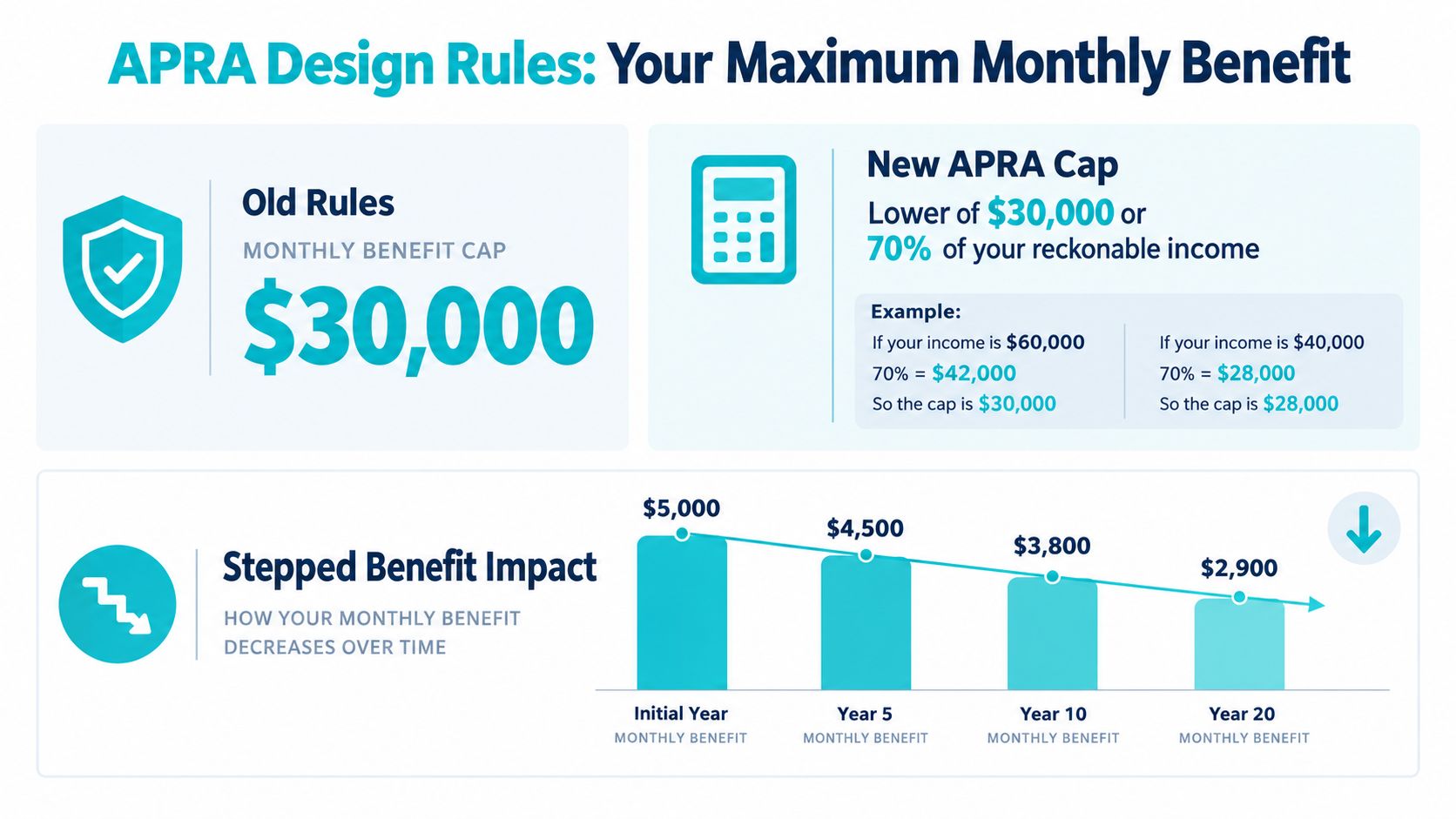
A $180,000 income does not automatically produce a benefit equal to 70% of salary. APRA's post-2021 design rules can apply stepped formulas, such as 70% on the first $240,000 of income, 50% on the next $240,000 and 20% above that. The policy wording controls the result, not the headline percentage. This disability earnings limit overview explains why the permitted benefit must be checked against actual earnings.
The calculation changes as income rises
A simple 70% calculation for an earner on $180,000 gives $126,000 a year, or $10,500 a month, before policy limits. A monthly-band illustration uses 70% of the first $25,000, 50% of the next $16,666 and 20% above that. Applying those bands as an illustration produces approximately $9,200 a month, not the full headline target. Check the product disclosure statement because insurers may apply different formulas.
That shortfall matters for high-income professionals. Build the protection plan around the household's uncovered cash-flow need, then consider personal income protection alongside super-linked cover, savings, debt reduction, business expense cover or other assets. The goal is not to force every dollar through one policy. It is to identify the gap and decide how much of it the household can carry.
Policy dates also matter. Policies issued before October 2021 may have different terms, so comparing an older policy with a new quote by percentage alone can mislead you. Check the benefit formula, earnings definition, maximum payment and indexation before replacing or reducing existing cover.
Use income protection policy comparisons to compare wording, limits and policy features. A policy that looks generous on page one can deliver a lower effective replacement rate after stepped bands apply. That is the figure to test against your net household budget, not the advertised percentage.
Choosing Waiting Periods and Benefit Periods That Fit
The waiting period is the time you fund the household yourself before the benefit starts. The benefit period is how long the insurer may continue paying if you remain unable to work. These choices often matter more than small differences in the advertised percentage.
Australian product materials commonly include waiting periods of 14, 30, 60 and 90 days, as well as one or two years, while benefit periods can range from two years to age 65 or 70, according to AIA's income protection product FAQs.
| Waiting Period | Benefit Period | Premium Impact | Buffer Required | Best Fit |
|---|---|---|---|---|
| 14 days | 2 years | Usually higher | Small cash reserve | Employees with limited leave and urgent cash-flow needs |
| 30 days | 2 years | Moderate | Enough to cover the first month and claim delays | Households with some paid leave or accessible savings |
| 60 days | 5 years | Often lower than a short wait | Larger emergency reserve | Stable earners with stronger liquidity |
| 90 days | To age 65 or 70 | Can reduce the premium | Substantial accessible savings | Households able to self-fund the early period and seeking longer protection |
Match the wait to real liquidity
For a 38-year-old professional earning $120,000, moving from a 30-day waiting period to a 90-day waiting period can reduce the premium substantially, but the household must fund the additional time without a benefit. If the required bridge is $15,000, that money must be accessible. Home equity, an illiquid investment or a credit limit isn't the same as cash savings.
Longer waits suit people with employer sick leave, strong savings or reliable partner income. Shorter waits suit households whose mortgage and care costs leave little room for disruption. Don't choose a waiting period based only on premium.
Protect the long claim
A short waiting period paired with a short benefit period can leave a family exposed if recovery takes longer than expected. Younger professionals may find a benefit period to age 70 attractive because they have many working years ahead, but the choice still needs to fit the budget and policy definition.
The premium trade-off should be tested against the cost of a prolonged claim. Saving a little today isn't useful if the policy stops paying while the mortgage and family obligations continue.
Cover Considerations for Business Owners and High Earners
Business owners can't size cover by looking only at personal drawings. A sole trader, partnership principal, shareholder and high-income employee each face different risks, even when their personal income appears similar.
Separate personal income from business overheads
A sole trader may need personal income protection for household expenses, plus business expense cover for rent, equipment finance, accounting, utilities or essential staff costs. Those are different risks and should be modelled separately.
A partnership principal should check what happens if they can't work but the business continues. The partnership agreement may address replacement labour or ownership, but it won't automatically pay the family mortgage. A shareholder or small business owner also needs to examine key-person exposure and any buy-sell agreement. Personal income protection can support the individual, while a separate ownership or business continuity arrangement may address the company's needs.
Self-employed professionals should review income protection insurance for self-employed Australians with particular care because fluctuating drawings, retained profits and business expenses can complicate the income figure used by the insurer.
Inside super versus outside super
Tax positioning changes the affordability calculation. The Australian Taxation Office guidance, summarised in this income protection tax deduction explanation, says premiums paid to protect salary and wages are deductible when the policy is held personally, while premiums paid through super are generally not deductible to the individual because the fund claims the deduction.
That doesn't make one ownership structure automatically better. Cover inside super may be funded through the fund, but benefits and policy terms need careful review. Personally owned cover is paid with after-tax dollars, and the tax outcome on benefits depends on the policy and circumstances. Ask for the net cash-flow comparison, not just the premium.
High earners face another trap. Tiered formulas can reduce the effective replacement rate as income climbs, with some product illustrations applying 50% to an additional income band and 20% above a higher band, as shown in Australian income protection product materials. A $250,000-plus professional should never assume that applying 70% to the full salary produces the payable benefit.
Your Policy Checklist and When to Bring in an Adviser
A policy recommendation is sound only when you can explain what it pays, when payments start and which conditions can reduce or stop them. Check these points before accepting the quote:
- Own occupation or any occupation: Does the definition assess your ability to perform your specific profession, or only any suitable work?
- Exclusions: Are mental health, recurring conditions, hazardous duties or medical issues excluded or restricted?
- Stepped or level premiums: Will premiums generally rise as you age, or does the policy use a more stable structure?
- Indexation: Does the benefit keep pace with inflation, and what happens to premiums when indexation applies?
- Rehabilitation support: Does the policy provide practical assistance during a staged return to work?
- Portability: Can you retain the policy after changing employer, occupation or business structure?
- Worldwide cover: Will the policy respond while you work or travel outside Australia, subject to its terms?
- Claims record: Can the insurer explain its claims process and assessment approach clearly?
- Agreed value or indemnity: Is the benefit based on an agreed amount, or must you prove income when claiming?
Three reasons to pay for advice
Bring in an adviser when combined insurance premiums and super contributions exceed 30% of gross income, using this as a practical affordability rule of thumb in your advice planning. That level of commitment can crowd out other financial goals, so test the full household budget rather than judging the premium alone.
Advice also matters when personal drawings and business profits are tangled. The insurer's income definition may differ from the figure used for tax or household cash flow, particularly where business expenses and retained profits affect what you receive.
Seek advice when your calculated cover exceeds the APRA cap. The solution may require combining existing policies, changing ownership, building liquidity or accepting a deliberate protection gap. An adviser can compare policy wording with your household budget and show the tax and cash-flow consequences, rather than treating the application form as the whole strategy.
Putting Your Cover Number to Work
The expense-first method becomes useful when it produces a number you can test. Start with essential monthly costs, subtract dependable income and buffers, then compare the target with the policy's stepped formula, waiting period and benefit duration.
Three household tests
Dual-income household: Essential expenses total $5,200 per month. If the other earner's reliable income and available leave cover part of the budget, the required policy benefit is the remaining shortfall, not automatically $5,200. A 30-day wait and two-year benefit period may suit a household with accessible savings, but the premium band depends on age, occupation, health and policy structure.
Single earner with mortgage: Essential expenses total $6,800 per month. With no second wage to absorb the bills, the target monthly benefit may need to be close to $6,800, subject to the insurer's income limits and any other benefits. A two-year benefit period should be tested against the mortgage term and the household's capacity to recover or restructure if the claim continues.
Parent with childcare costs: Essential expenses total $7,400 per month. Childcare and school costs can be difficult to reduce quickly, so the family should separate essential care from optional spending and then set the benefit around the remaining shortfall. A 30-day wait and two-year benefit period is only a starting structure, not a recommendation without testing savings and employer leave.
The income protection tax deduction guide can help you understand the ownership and tax questions to raise, but it doesn't replace a household cash-flow calculation. Premiums should be judged against the after-tax cost and the benefit the policy can deliver.
Your cover number should come from bills, buffers and policy mechanics, not a salary multiple copied from a calculator. Book a free initial call with a Wealth Collective adviser to review your existing cover, household cash-flow risk and protection gap, then visit Wealth Collective to start the conversation.
Wealth Collective helps Australians review personal insurance, superannuation and broader financial protection through a clear advice process. Bring your current policy schedule, income details and essential household budget to an initial call so the recommendation can be built around what your family would need during a claim.