Business hours
Monday to Friday (8.30AM - 5PM)
Weekend (Closed)



If you’ve ever wondered how to quickly put a number on your life insurance needs, you’re not alone. The most common rule of thumb you’ll hear is to get cover worth 10 to 15 times your annual income.
So, for an Australian on a $120,000 salary, that’s a policy somewhere between $1.2 million and $1.8 million. It’s a simple, effective way to get a ballpark figure and a great place to start the conversation.
Your Quick Guide To Life Insurance Needs
While that 10-15x rule is a handy benchmark, think of it as a first glance, not the final word. The right amount of cover is deeply personal, and it has to match your unique financial world.
The whole point of this quick estimate is to ensure your loved ones have a safety net if you’re no longer there. A payout of this size is typically designed to:
- Replace your income for a significant number of years.
- Clear major debts like the mortgage or car loans.
- Fund big future expenses, such as your children's education.
Ballpark Figures Based On Income
To put this into perspective, let's look at what these multipliers mean for some typical Australian incomes.
Life Insurance Rule Of Thumb Calculator
This table gives you a quick-reference guide based on the 10x and 15x income rule. It’s a simple way to see how your income translates into a basic or more comprehensive level of cover.
| Annual Income | Basic Cover (10x Income) | Comprehensive Cover (15x Income) |
|---|---|---|
| $80,000 | $800,000 | $1,200,000 |
| $120,000 | $1,200,000 | $1,800,000 |
| $180,000 | $1,800,000 | $2,700,000 |
| $250,000 | $2,500,000 | $3,750,000 |
As you can see, the numbers scale up quickly. A high-income earner in Perth on $150,000 a year would be looking at $1.5 million to $2.25 million in cover. This becomes particularly important in a city where the median house price is nudging $600,000 and the average mortgage sits around $500,000. A smaller payout could easily leave a family underinsured and struggling to stay afloat.
Why A Personalised Calculation Is So Important
A quick-rule estimate is a fantastic starting point, but it can’t see the whole picture. It doesn't factor in how many kids you have, the true size of your debts, or any legacy you want to leave behind.
Your true life insurance need is the precise amount required to fill the gap between your family's future financial obligations and the assets you already have in place.
This is exactly why a detailed needs analysis is the cornerstone of what we do at Wealth Collective. We go far beyond simple multipliers to build a plan that accounts for every detail of your life, ensuring the protection you get is exactly what your family would need. For a deeper dive into how the policies themselves function, you might find our guide on how life insurance works helpful.
The next step is to move past the estimates and find the figure that gives you genuine peace of mind.
Getting to Your Real Number: A Personalised Coverage Calculation
Those quick rules of thumb are a decent starting point, but they're not your number. True peace of mind comes from a life insurance figure that’s built around your family, your debts, and your specific goals. To get there, we need to move past the simple multipliers and do a proper needs analysis.
At its core, the process is simple: add up all the financial support your family would need, then subtract the assets they could draw upon. The gap that’s left is the amount of cover you’re really looking for. This detailed approach is exactly how we build a strategy in our Protection Plus service, because a solid plan must be built on facts, not guesswork.
This is a great visual for the back-of-the-napkin "multiply your income" method.
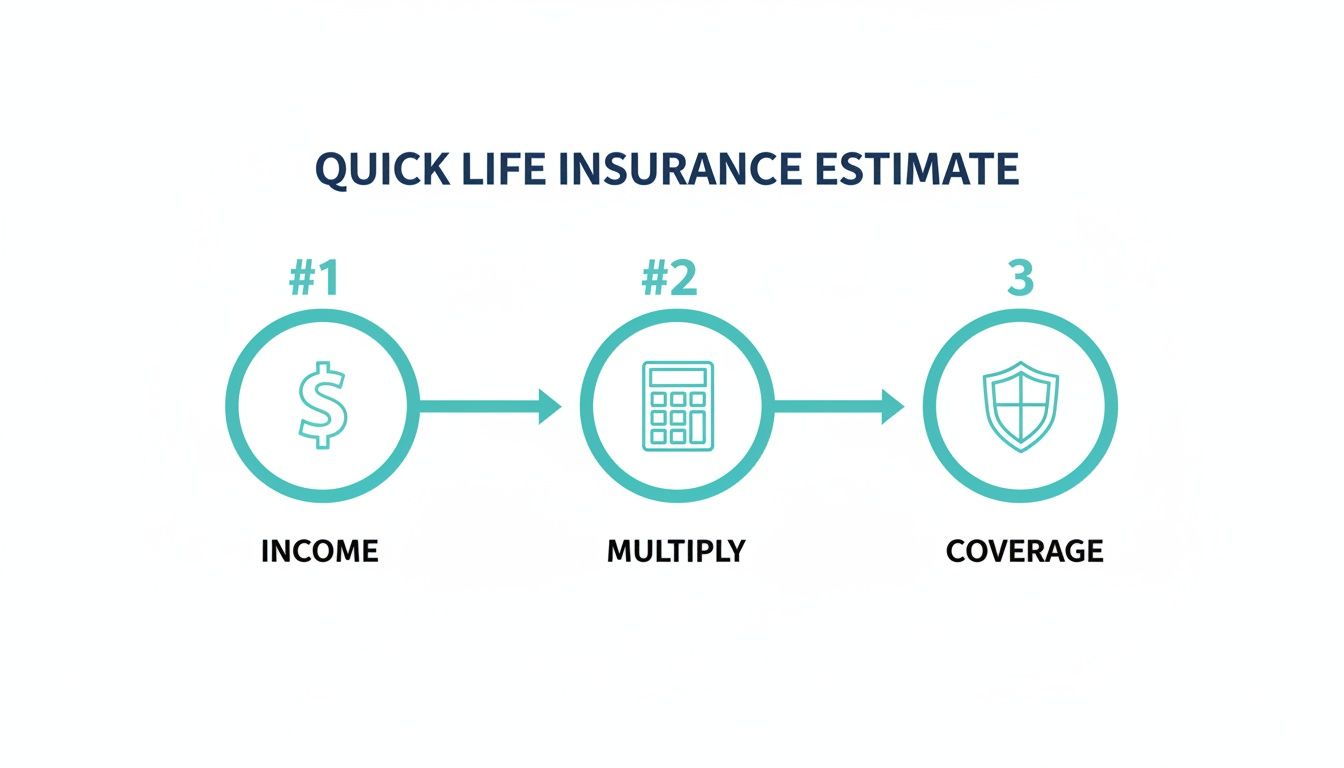
While helpful for a ballpark figure, a calculation you can truly rely on needs a much deeper look at your personal finances.
Adding Up Your Family's Future Needs
First, let's look at the "outgoings" column. This is where we calculate the total amount your family would need to stay on their feet financially if you were gone. A useful way to think about this is by expanding on the old DIME method (Debts, Income, Mortgage, Education) to cover all the bases.
Wiping the Slate Clean (Debts): Tally up all non-mortgage debts. We’re talking car loans, credit card balances, personal loans, and even those Afterpay accounts. The goal here is to clear these completely, so your family starts with a clean slate.
Replacing Your Income: This is usually the biggest piece of the puzzle. How much of your annual after-tax income does your family need to maintain their current lifestyle? And for how long? A good target is often until your youngest child is through university and standing on their own two feet, which could be 15 or 20 years.
Securing the Home (Mortgage): Write down the exact remaining balance on your mortgage. For most families, lifting this weight is the single most powerful thing a life insurance payout can do.
Funding Future Goals (Education): Map out the expected costs for your children's education. Are you planning for private schooling? University degrees? Don't forget to factor in accommodation and living costs. These days, it’s not uncommon for a single degree to cost well over $50,000 per child.
Covering Final Expenses: It’s an uncomfortable thought, but you need to budget for funeral expenses and other end-of-life costs. A realistic figure is anywhere from $10,000 to $20,000.
When you add all this up, you get your "total obligation". It can be a confronting number, but it’s better to know exactly what you’re planning for.
Factoring in What You Already Have
Next, we look at the "incomings" column. What financial resources would your family already have to meet those obligations? These are the assets we can use to reduce the total amount of cover you need to buy.
A crucial point here: we only count ‘liquid’ assets. These are funds that can be accessed quickly without major hurdles. Your family home doesn’t count, because selling it would defeat the purpose of providing security.
Here’s what to subtract from your total obligations:
- Cash and Savings: Any money in your bank accounts or term deposits.
- Investments: The current market value of your shares, managed funds, or any investment properties you’d want your family to sell.
- Your Superannuation: Your current super balance is a major asset. And don't forget to include the value of any life insurance you already hold inside your super fund.
- Other Insurance Policies: If you have any existing life insurance policies outside of super, add their payout value here.
By subtracting what you have from what you need, you'll land on a life insurance figure that’s truly your own.
Total Obligations (Debts + Income + etc.) – Total Liquid Assets = Your Life Insurance Need
This isn't just an estimate; it's a calculated safety net designed to protect your family’s specific future.
The Power of a Proper Plan
Walking through this exercise yourself brings incredible clarity. It turns the vague, stressful question of "how much is enough?" into a concrete number you can act on.
This process highlights the value of the detailed financial planning we live and breathe at Wealth Collective. While you can absolutely map this out on your own, having an adviser in your corner helps ensure no stone is left unturned and that your cost forecasts are realistic. Getting this number right is the foundation of a financial strategy that will genuinely protect the people you care about most.
Real-World Scenarios: Putting The Numbers To Work
Theory and calculations are one thing, but the real test is seeing how these figures play out in lives that look a lot like yours. When it comes to the question of "how much life insurance do I need?", there's simply no one-size-fits-all answer. Your financial world is unique, and your protection plan should be too.
This is where our work as financial advisers really begins—translating your life, your debts, and your dreams into a clear, concrete plan. Let's walk through a few detailed scenarios, reflecting the kinds of people we help at Wealth Collective every single day. You’ll see just how different incomes, debts, and goals create vastly different insurance needs.

Case Study 1: The Perth First-Home Buyers
Meet Liam and Chloe, both 32. They’ve just taken the plunge and bought their first home in a Perth suburb, with plans to start a family in the next year or two. They have a combined income of $160,000 and a new mortgage of $650,000.
Their main worry is a common one: if one of them were to pass away, the other would struggle to manage the mortgage and other bills alone. Their goal is to ensure the surviving partner can stay in their home and have a financial buffer while raising a future family.
Let's break down their needs:
- Clear The Mortgage: $650,000
- Replace Income: To give the surviving partner a five-year cushion to adjust and raise a young child without rushing back to full-time work, they need to replace one partner's income ($80,000) for five years. That's $400,000.
- Child-Raising Fund: A modest fund of $100,000 to cover initial costs like childcare and education before school starts.
- Clear Other Debts: They have a $25,000 car loan and $5,000 in credit card debt, totalling $30,000.
- Final Expenses: A standard allowance for funeral costs is about $15,000.
Their total need comes to $1,195,000. After we factor in their $70,000 in existing savings and superannuation, they land on a target of roughly $1.125 million each in life insurance cover.
Case Study 2: The Sydney Family With School Fees
Now let's look at Mark and Sarah, a dual-income family in Sydney in their mid-40s. They earn a combined $350,000 and have two children, aged 10 and 12, in private school. Their remaining mortgage sits at $800,000.
For them, the absolute priority is seeing their children finish their education at their current school and go on to university without financial stress. Maintaining their family's lifestyle is, of course, a close second.
This scenario shows how future goals, like private education, can dramatically increase the required cover. It's not just about today's debts; it's about securing tomorrow's opportunities.
Here's how their calculation unfolds:
- Mortgage Repayment: $800,000
- Private School Fees: At $35,000 per year per child, with the youngest having 8 more years to go (including pre-uni prep), this comes to roughly $560,000.
- University Costs: A $100,000 fund to help both kids through their degrees.
- Income Replacement: To maintain their lifestyle until the youngest is independent (about 10 years), they'd need to replace $150,000 of the lost income each year. Total: $1,500,000.
- Other Debts & Final Expenses: $50,000
Their total obligation is a staggering $3,010,000. Even with $300,000 in existing super and investments, they each need around $2.7 million in cover. For a more detailed look at protecting your loved ones, check out our guide on life insurance for families.
Case Study 3: The Pre-Retiree In Regional WA
David is 61 and lives in regional WA with his partner, Susan, who is 58. With retirement just four years away, their focus shifts from income replacement to ensuring Susan is secure and their estate is protected.
For pre-retirees, the calculation changes. It becomes about clearing final debts and leaving a clean slate. A good rule of thumb is 5-10 times annual expenses or enough to cover all debts and future care. For David and Susan, this means planning for potential aged care costs, which average $300k-$500k in WA and have been rising by 10% yearly. With Aussies living to an average age of 83 and having a $1M home, they also want to ensure they can pass it on tax-efficiently. You can discover more insights about the Australian life insurance market on ibisworld.com.
Here’s their straightforward plan:
- Clear Final Mortgage: $150,000
- Final Expenses & Estate Costs: $50,000
- Aged Care Fund: A conservative $400,000 to give Susan choices down the track.
- Legacy for Children: $400,000
Their total need is $1 million. This amount ensures Susan can live debt-free, has a fund for any future care, and their wishes for their children are fulfilled.
Case Study 4: The Small Business Owner
Finally, imagine a small business owner whose personal and business finances are completely intertwined. A life insurance payout here needs to do double duty: protect the family and give the business a fighting chance to survive.
The calculation must account for business debts, the cost of replacing a key person, and funds to allow for an orderly sale or wind-down. This is a complex scenario where professional advice isn't just helpful—it's absolutely essential.
These examples clearly show there is no magic number. Your ideal coverage is a direct reflection of your life. It’s a personalised figure that brings true peace of mind, which is exactly what we aim to build for every Wealth Collective client.
Choosing Your Cover: It's More Than Just a Number
So, you’ve worked out the big number—the amount of cover you need. That’s a huge step. But getting the number right is only half the battle. Now comes the crucial part: building that protection with the right tools.
Think of it like this: you wouldn't use a sledgehammer to hang a picture frame. In the same way, different insurance policies are designed to solve very different financial problems. Answering "how much cover do I need?" is deeply connected to asking, "what kind of cover do I need?"
In Australia, a solid financial safety net is typically woven from four core types of personal insurance. Let's break down what each one does so you can understand how they fit together to protect your family.

A Closer Look At The Four Core Policy Types
Each of these policies is designed to pay out under different circumstances. Getting the mix right is what creates a truly robust plan that works in the real world when you need it most.
To make it easier to see how they differ, here’s a quick comparison of the main personal insurance products available.
Types Of Personal Insurance Cover
| Insurance Type | What It Covers | Best For… |
|---|---|---|
| Term Life Insurance | Pays a lump sum if you pass away or are diagnosed with a terminal illness. | Clearing large debts (like a mortgage) and replacing your future income to secure your family's lifestyle. |
| Total & Permanent Disability (TPD) | Pays a lump sum if you become totally and permanently disabled and can't work again. | Covering major medical costs, home modifications, eliminating debt, and providing a long-term income stream. |
| Trauma (Critical Illness) | Pays a lump sum if you suffer a specified serious medical event (e.g., cancer, heart attack, stroke). | Giving you financial breathing room to recover without stress. It covers medical bills and lost income while you're off work. |
| Income Protection | Pays a monthly benefit, usually up to 70% of your income, if you can't work due to illness or injury. | Covering your regular bills and living expenses while you focus on getting better. It’s your financial lifeline. |
As you can see, these policies work together. Term Life provides for your family if you're gone, while TPD, Trauma, and Income Protection are all about protecting you and your family’s finances while you're still here, but unable to earn an income.
You can dive deeper into how these policies create a complete strategy in our guide to the main types of life insurance cover.
Inside Or Outside Super? A Key Decision
Another critical piece of the puzzle is deciding where to hold your insurance. You can have it inside your superannuation fund or outside of it, held personally. Each path has real-world consequences for your cash flow, the quality of your cover, and how easily a claim can be paid.
Holding Cover Inside Super:
- The upside? Premiums are paid directly from your super balance, so you don't feel the hit to your take-home pay. It can also be an easier way to get a basic level of cover with minimal fuss.
- The downside? Your options are limited. You generally can't get comprehensive Trauma insurance inside super. Payouts can also be harder to access due to strict 'conditions of release', and you may face tax on TPD lump sums.
Holding Cover Outside Super:
- The upside? You get access to the full market of policies with much more comprehensive definitions, especially for TPD and Trauma. Payouts go directly to you or your beneficiaries, tax-free and without delay. You own and control the policy outright.
- The downside? You have to pay the premiums from your bank account, which directly impacts your household budget.
Australia's life insurance market is substantial, with the life segment alone projected to reach $23.6 billion in 2025. While the group life market within superannuation is growing quickly, these 'one-size-fits-many' policies often lack the specific Trauma or TPD features that high-income earners or those with unique risks truly need.
From our experience at Wealth Collective, the best strategy is often a hybrid one. For many of our clients, we recommend holding basic Death and TPD cover inside super to manage cash flow, while taking out more comprehensive Trauma and Income Protection policies personally. This gives them the best of both worlds.
Common Mistakes To Avoid When Buying Life Insurance
Getting your life insurance right is one of those big financial decisions that truly matters. A well-thought-out plan can secure your family’s future, but a few common missteps can unfortunately leave them exposed when they need protection the most.
Over the years at Wealth Collective, we’ve seen the same well-intentioned mistakes pop up time and again. The good news is they are all avoidable. By understanding what can go wrong, you’re already on the path to getting it right.
Mistake 1: Relying Only on Your Super
It's a huge trap to assume the default life insurance bundled with your superannuation is enough. While it's a fantastic safety net to have, this "one-size-fits-all" cover is rarely tailored to your actual life.
Think about it—your super fund has no idea you have a $700,000 mortgage, that you want your two kids to go to university, or what your family truly needs to maintain their lifestyle. Relying solely on default cover almost always leads to a massive insurance shortfall, leaving a financial gap your loved ones would have to figure out how to fill.
- What to do instead: See your super insurance as a foundation, not the whole house. Run the numbers with a proper needs analysis (like the one we outlined earlier) to find your real coverage figure. From there, you can simply 'top up' your super cover with a separate, more flexible policy.
Mistake 2: Choosing a Policy Based on Price Alone
In the world of insurance, cheaper is rarely better. It’s tempting to just grab the policy with the lowest premium, but that can be a very expensive mistake down the track. Insurers don't just compete on price; they compete on the quality of their definitions, their track record for paying claims, and the support they offer during a crisis.
A cheaper policy might have far stricter definitions that make it incredibly difficult to make a successful claim. This is especially critical when it comes to Total and Permanent Disability (TPD) insurance.
The difference between an 'any occupation' TPD definition and an 'own occupation' one is huge. An 'any occupation' policy will only pay if you’re deemed unable to perform any job you’re suited for. 'Own occupation' is much better—it pays out if you can't do your specific job, offering far greater protection for skilled professionals.
Mistake 3: Forgetting to Review and Update Your Cover
Life insurance is not a "set and forget" purchase. Your life is dynamic, and your policy needs to keep up. The cover that was perfect for you as a single renter is almost certainly not enough now that you’re married with a mortgage and a new baby on the way.
We see this happen all the time, and it’s a completely avoidable risk. Certain milestones should be an automatic trigger for you to pick up the phone and review your cover.
Key review triggers include:
- Getting married or divorced
- Having a child
- Buying a home or increasing your mortgage
- Receiving a significant pay rise
- Starting a business
Failing to update your cover can leave you just as underinsured as if you’d chosen the wrong policy from the start.
Navigating policy definitions and knowing when to adjust your strategy is exactly where good advice makes all the difference. The Wealth Collective process is designed not just to set up the right protection for you today, but to ensure it remains the right protection as your life unfolds.
Ready for the Next Step?
You’ve done the hard work of running the numbers and getting a clearer idea of your family’s needs. But the final piece of the puzzle is turning those calculations into a rock-solid plan you can truly feel confident in.
It’s natural to wonder if a policy will actually pay out when you need it most. Thankfully, the numbers tell a very positive story. Across Australia, insurers pay out an impressive 96.9% of life insurance claims. Some, like Resolution Life/AMP, have an even higher rate at 98.8%. You can see the data for yourself over at Insurance Watch.
The real question isn't whether your policy will pay out, but whether the amount you’ve chosen is truly enough to protect everything—and everyone—you love.
Let’s Build Your Confidence with a Complimentary Call
This is where a quick chat can make all the difference. We invite you to book a complimentary initial call with a Wealth Collective adviser. It's a no-obligation chance to talk through your situation with an expert, get clarity on the figures, and build complete confidence in your plan.
Our goal is to make the process simple and stress-free. We translate the complexities into clear, actionable guidance, ensuring the decision you make is the right one for your financial life.
Taking this final step moves you from just being informed to being fully prepared. A simple conversation is all it takes to put a financial safety net in place, giving you and your family lasting peace of mind.
Your Top Life Insurance Questions Answered
After going through a detailed needs analysis, it's completely normal for a few extra questions to bubble up. We get it. Here are the answers to some of the most common things people ask us when we first sit down to talk about their life insurance strategy.
How Often Should I Review My Life Insurance Cover?
Think of your policy as a living document, not a "set and forget" purchase. We recommend a quick check-in every 1-2 years, and a more thorough review after any significant life change.
Life moves fast. Getting married, welcoming a new baby, upgrading the family home with a bigger mortgage, or even getting that long-awaited promotion all change your financial picture. A quick review ensures your cover is still doing its job, protecting you from being underinsured as your life and responsibilities grow.
Is The Life Insurance Inside My Super Enough?
This is a big one. For the vast majority of Australians, the answer is a firm no. The default cover offered inside your superannuation fund is usually a bare-bones, one-size-fits-all amount. It’s a starting point, but it rarely reflects what your family would actually need.
Relying solely on your default super cover is one of the biggest financial risks we see people take. It should be seen as just one piece of the puzzle, not the entire picture.
What Is The Difference Between Stepped And Level Premiums?
This choice makes a huge difference to what you'll pay over the life of your policy.
- Stepped premiums start out cheaper but increase every year with your age. They can feel affordable at first but often become incredibly expensive just when you need the cover most.
- Level premiums cost more initially but are designed to remain stable for the long haul. If you plan on holding your policy for many years—which most people do—a level structure can save you an enormous amount of money over time. It’s something we always model out for our clients so they can see the difference for themselves.
Will My Health Affect My Life Insurance Application?
Yes, absolutely. Insurers look closely at your current health and lifestyle habits (like smoking) when you apply. This is all part of the underwriting process, where they assess your personal risk and calculate your premium.
It is vital to be completely upfront and honest in your application. Hiding a pre-existing condition might seem tempting, but it can give the insurer grounds to deny a claim down the track—which defeats the whole purpose of having the policy in the first place.
Getting these details right is what separates a basic policy from a robust financial safety net. The team at Wealth Collective is here to cut through the complexity and make sure your plan is perfectly aligned with your life.
Ready for some clarity? Book a complimentary, no-obligation call with us today.