Business hours
Monday to Friday (8.30AM - 5PM)
Weekend (Closed)


Standard income protection insurance does not cover redundancy. It generally replaces part of your income, often up to 75% or 90% of pre-tax earnings, only when illness or injury stops you working, unless a separate unemployment benefit is explicitly included.
That distinction can leave a household with insurance premiums coming out and no benefit coming in after a job disappears. For Australians searching for income protection insurance redundancy cover, the useful starting point isn't the product name. It's the event the insurer has agreed to cover.
The Short Answer on Redundancy Cover
Losing your job and losing your capacity to work are different insurance events. An employer can make your position redundant while you're healthy and capable of doing the same work elsewhere. Ordinary income protection doesn't pay just because your salary stops.
ASIC's review of insurance in superannuation describes income protection, also called temporary disability or salary-continuance cover, as protection against income lost because of injury or sickness, and records consumers asking funds whether they could claim after being stood down or losing work. The confusion is understandable, but the financial consequences are significant.
A redundancy payout, stand-down or voluntary resignation isn't, by itself, an insured event under an ordinary income protection policy. The insurer needs evidence of the event defined in the contract, not just evidence that your employer has stopped paying you.
Separate the risks before choosing a solution
A practical household protection plan separates these risks:
- Redundancy: You're able to work, but your job has ended. Accessible savings, employment entitlements, government assistance if eligible, and any explicitly defined unemployment benefit are the relevant resources.
- Illness or injury: A medical condition prevents you working. Income protection may replace part of your earnings while you meet the policy definition.
- Permanent incapacity: Your ability to work may be permanently affected. Total and permanent disability cover requires a separate assessment of its definition and potential benefit.
These risks can overlap without becoming interchangeable. Someone may receive a redundancy payment while also being medically unable to work, but any disability claim must stand on its own medical and contractual grounds.
Practical rule: Ask what stopped you earning. A missing job and a medical inability to work need different responses.
Four assumptions that can derail a claim
Having insurance through super doesn't mean redundancy is covered. Open the product disclosure statement, or PDS, and find the insured-event definition. Then check your insurance schedule to confirm you hold that cover, rather than relying on a general description on the fund's website.
Redundancy-related stress doesn't automatically qualify. Financial distress is real, but a claim needs a diagnosed condition that prevents work under the policy's disability definition. Speak with your treating practitioner about your health, and keep medical assessment separate from the employment dispute or redundancy process.
Buying unemployment cover after an announcement usually won't solve the problem. Such cover generally needs to be arranged before the event becomes known or imminent. Check exclusions for announced restructures, foreseeable job loss and circumstances you already knew about when applying.
The income protection waiting period doesn't start just because your job ends. Its starting point is tied to the disabling condition and the policy's requirements. Record when symptoms affected your duties, when you stopped work and when you sought treatment, rather than assuming the redundancy date controls everything.
For someone healthy enough to seek work, practical job-search support belongs alongside the cash-flow plan. Remote First Jobs' fresh listings for burned-out job seekers can be a useful place to explore remote opportunities, without confusing the search for replacement employment with an insurance claim.
Don't dismiss a possible medical claim just because redundancy happened first. A later illness could still support a claim if cover remains active, the unemployment provisions permit it, and the condition meets the disability definition. Employment status, earnings assessment and policy continuation rules need checking before you rely on that possibility.
Income Protection and Unemployment Cover Side by Side
Ordinary income protection is a health-event policy. Involuntary unemployment cover is a job-loss policy, and it's far less common in Australia. Similar marketing language doesn't mean the products offer similar protection.
Start with the benefit recipient as well as the trigger. Some unemployment cover is consumer credit insurance attached to borrowing, so an accepted claim may pay the lender rather than put unrestricted cash into your household account.
Income protection and involuntary unemployment cover compared
| Feature | Income protection | Involuntary unemployment cover |
|---|---|---|
| Main trigger | Illness or injury that stops you working | Involuntary job loss such as redundancy |
| Medical evidence | Required from a doctor | Not required for the job-loss trigger |
| Typical payout | Up to 75% or 90% of pre-tax income | Fixed monthly benefit or loan repayment amount |
| Waiting period | Commonly 14, 30, 60 or 90 days | Commonly 30 to 90 days |
| Benefit period | The maximum payment term stated in the schedule, subject to continuing eligibility | Usually 3 to 12 months |
| Availability in Australia | Common through super or direct | Less common; often consumer credit insurance or a specialist add-on |
| Redundancy payout | Does not trigger a claim | May reduce or delay benefits |
| Voluntary redundancy | Not covered on its own because there is no illness or injury | Usually excluded |
| Key exclusions | Policy-specific pre-existing conditions, self-inflicted injury and fraud | Voluntary resignation, misconduct, contract completion and insufficient service |
| Best use | Protecting income if illness or injury stops work | Protecting loan repayments or cash flow after unexpected job loss |
Treat these as comparison prompts, not promises about a particular contract. Availability, eligibility and payment terms must be confirmed against the actual product offered to you.
An accepted claim still needs a cash bridge
For the year ending 31 December 2024, InsuranceWatch's published industry claims figures put Australia's average income protection claims acceptance rate at 95.0%, with an average acceptance time of 1.6 months. That supports the value of the product for eligible claims, not an expectation that redundancy claims will be accepted.
Acceptance time also isn't the same as a policy waiting period or a guarantee about when money reaches your account. A household needs accessible money while the insurer obtains evidence, assesses eligibility and arranges payment.
A strong claims acceptance rate doesn't broaden the insured event. It tells you nothing about whether an uninsured redundancy will produce a benefit.
For unemployment cover, ask how redundancy pay affects the first benefit. A policy that delays payment until employment entitlements are exhausted may provide less immediate help than you expect. Also check whether a loan repayment benefit leaves groceries, utilities and school costs entirely unfunded.
Choose by the problem you're solving. If you're concerned about becoming medically unable to earn, assess income protection. If you're concerned about an employer cutting positions, prioritise savings, entitlements and the exact terms of any separate unemployment cover.
Buying both can still leave gaps. Premiums reduce the money available to build reserves, and a narrowly defined loan benefit may duplicate protection you don't need while leaving essential household spending exposed. Compare the usable benefit against the premium and exclusions, not just the headline monthly amount.
Why Income Protection Stops at Illness or Injury
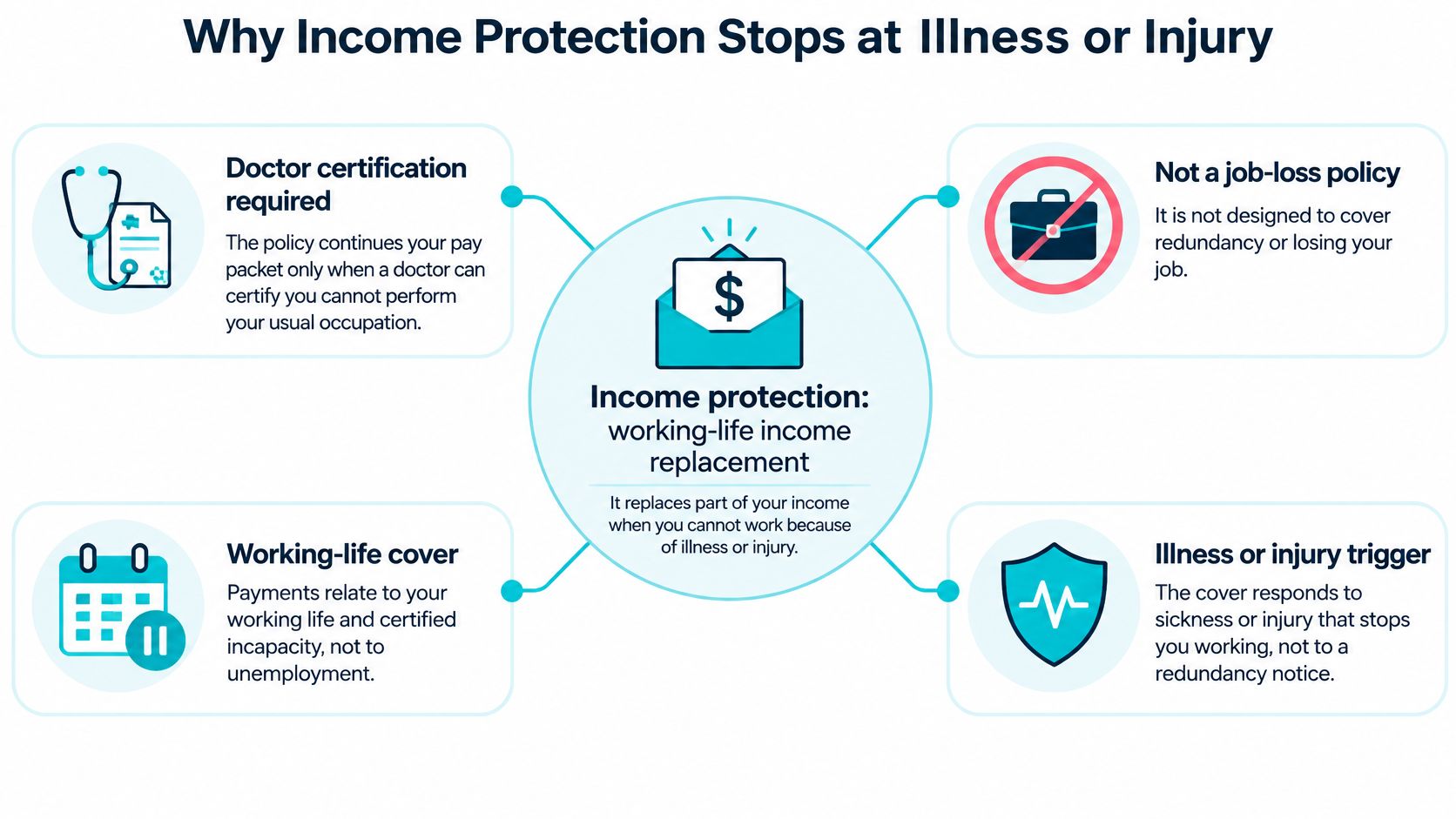
Think of income protection as a partial continuation of your pay packet when your health prevents you working. A doctor's certificate supports the claim, but the insurer still assesses whether your condition meets the contract's definition.
Moneysmart's income protection guide explains that benefits replace part of pre-tax earnings when illness or injury prevents work, commonly using income from the 12 months before the disabling event, with limits often around 75% or 90%. Your insured amount isn't necessarily the amount ultimately payable.
The distinction between medical incapacity and unemployment is the central boundary.
Your duties matter as much as your diagnosis
Under an own-occupation definition, the assessment focuses on your ability to perform the duties of your occupation, subject to the precise wording. An any-occupation definition can assess your ability to undertake other work suited to your education, training or experience.
That difference matters for a resources worker whose injury prevents physical site duties but doesn't prevent suitable office work. A diagnosis alone doesn't answer which duties remain possible, whether reduced hours are feasible or whether partial benefits apply.
Ask your treating practitioner to describe functional restrictions clearly. The insurer may need evidence about lifting, concentration, travel, attendance or other relevant duties, rather than a certificate that merely names the condition.
Waiting periods and payment duration do different jobs
The waiting period is the initial period you must satisfy before benefits become payable. The benefit period is the maximum payment duration, provided you continue meeting the eligibility requirements.
Choosing a longer wait may reduce premiums, but it shifts more early costs onto your savings. Choosing a shorter benefit period may also reduce premiums while leaving you exposed if recovery takes longer than the cover allows.
- Check your actual arrangement: Default insurance through super isn't universal, and account membership doesn't prove you hold income protection.
- Check earnings treatment: Ask how overtime, commissions, allowances and fluctuating business income enter the benefit calculation.
- Check medical requirements: Confirm who must provide evidence and whether ongoing assessments are required.
Redundancy, voluntary resignation and business failure sit outside the medical trigger unless an additional benefit explicitly covers them. For anyone already unemployed when illness begins, ask which incapacity definition applies and how the insurer assesses lost earnings. Don't assume the same calculation applies as it would to someone still receiving a regular salary.
Policy Terms That Decide Whether a Claim Is Paid
Read the PDS and policy schedule together. The PDS describes the contract; the schedule identifies your selected cover, insured amount and any individual terms. Neither a comparison headline nor a premium quote substitutes for them.
Begin with the insured event and disability definition. There's little value in optimising the waiting period if the event you're worried about isn't covered.
Policy terms to check before relying on cover
| Term to check | What to confirm | Why it matters |
|---|---|---|
| Insured event | Sickness or injury only, or is unemployment named? | If redundancy isn't named, the policy won't respond to job loss alone |
| Disability definition | Own occupation, any occupation, or activities of daily living? | A restrictive definition can prevent payment despite a genuine health problem |
| Waiting period | Is it 14, 30, 60 or 90 days from the disabling event, and how is continuity assessed? | A long wait needs cash reserves |
| Benefit period | The maximum payment term and any age-based end date in your schedule | Short cover may end before recovery |
| Benefit calculation | Is it 75% or 90% of pre-tax income, and which 12 months are assessed? | Bonuses, overtime and commissions may be excluded |
| Pre-existing conditions | What must be disclosed, and when? | Incomplete or inaccurate disclosure can jeopardise a claim |
| General exclusions | Check for self-inflicted injury, fraud, war, illegal acts and normal pregnancy | The actual exclusions are policy-specific |
| Unemployment benefit | Is redundancy or involuntary unemployment explicitly named? | A generic income protection policy doesn't include it |
| Redundancy payout offset | Does redundancy pay reduce or delay benefits? | An offset can leave an unexpected cash-flow gap |
| Employment eligibility | Continuous employment requirements, age limits and occupation class | Changing jobs can affect cover |
| Cover tied to employment | Does cover end or convert when employment ends? | Employer-linked cover may stop when your job does |
| Claim evidence | Medical certificates, employer forms and financial records | Missing evidence can delay assessment or prevent approval |
| Cover while unemployed | Does cover continue, and what happens if premiums stop? | Premium holidays and cancellation terms need checking |
Test the amount you'll actually receive
Offsets reduce a benefit because another specified payment is being received. Don't assume redundancy pay, unused leave and Centrelink payments are treated identically, or that every policy offsets them.
Ask for each payment to be assessed separately against the wording. Then calculate the household's available cash after any offset, rather than adding every possible payment together.
Also confirm whether your insured benefit includes a component directed to super rather than your everyday bank account. A total benefit figure can otherwise overstate the amount available for mortgage repayments and living costs.
Before changing cover: Confirm the replacement policy is accepted, active and suitable before cancelling existing insurance.
The application stage deserves attention. ASIC's direct life insurance review found 54% of income protection applications were admitted, 14% declined and 32% withdrawn; its consumer research also found only 39% of income protection buyers obtained the level of cover they expected or wanted.
Those are historical direct-market findings, not your probability of approval. They demonstrate why an application, acceptance letter and final schedule deserve more attention than the initial quote.
Get answers that survive a claim
Set aside a short review session and highlight every definition, exclusion and offset that could affect your situation. Write down unresolved questions beside the relevant clause and request written clarification from the insurer.
Our guide to comparing income protection policies provides a useful starting point for organising those comparisons. We can help assess how the wording fits your occupation, household commitments and broader financial position.
Before finishing, check who owns the policy and what happens when employment ends. Employer-arranged cover may require a continuation or conversion decision, while other arrangements have their own premium and eligibility conditions. Knowing whether protection survives redundancy is just as important as knowing what initially triggers it.
What Redundancy Looks Like for Three Households
Consider a FIFO resources worker in Western Australia whose role disappears while the mortgage remains. They're fit for work, so their immediate task is to turn confirmed entitlements and accessible savings into a spending runway, then begin looking for replacement employment.
A dual-income family faces a different problem when cancer prevents a parent working for six months. Here, the medical definition, waiting period and benefit cap determine whether income protection helps, while the family still needs money for early bills and costs outside the insured income benefit.
For a small business owner, the collapse of a main client can stop revenue without creating either an employee redundancy entitlement or a medical claim. Diversifying clients, maintaining reserves and controlling debt commitments address that commercial exposure more directly.
Three household scenarios and what responds
| Household | Trigger | What responds | Gap to plan for |
|---|---|---|---|
| FIFO worker in resources | Redundancy with a mortgage | Redundancy pay, savings, new job search and government support if eligible | Income protection doesn't respond because there's no illness or injury |
| Dual-income family | Cancer stops one parent working for six months | Income protection after the waiting period, subject to definition and benefit cap | Emergency fund covers the waiting period and non-income costs |
| Small business owner | Main client collapses and income stops | Cash reserves, debt reduction and a business contingency plan | No employee redundancy entitlement in this scenario; income protection only responds to illness or injury |
These are hypothetical situations, not benefit guarantees. In each, the household needs to identify the event before deciding which resource to use.
Plan beyond the first replacement pay packet
Jobs and Skills Australia's displaced-workers factsheet reports 585,800 Australians aged 15–64 were displaced in the year to February 2025, that 74% of workers displaced by redundancy in 2022–23 were employed a year later, and that those who returned had a median real earnings loss of 6% one year after redundancy. Re-employment doesn't necessarily restore the previous household budget.
For WA households tied to resources, construction or a small employer, test the budget against a lower-paid replacement role, not just a period without work. Avoid committing the entire redundancy payment to extra mortgage repayments if doing so leaves insufficient accessible cash.
Employment records help establish earnings and organise applications. StoryCV's guidance to track down old pay stubs can help when reconstructing your work history, while our explanation of the tax treatment of redundancy can help you identify questions about the amount available to spend.
Match the solution to the event. Savings provide flexibility, debt reduction lowers future commitments, and insurance addresses defined risks. None is a complete substitute for the others.
Review Your Cover Before the Next Pay Packet Is at Risk
Make the next step specific to your main concern. If redundancy is the risk, total your essential spending, confirm employment entitlements and build an accessible cash buffer. Review fixed repayments before directing spare cash into investments or extra debt payments that may be difficult to access later.
If you consider separate unemployment insurance, require explicit redundancy wording and workable offset rules. For a career change, HiredBySkill's quiz matching skills to jobs can help generate roles to investigate, alongside checking qualifications, local opportunities and likely pay.
Bring the policy and the budget together
If illness or injury is the risk, review cover inside and outside super for definitions, waiting periods, payment duration, exclusions and affordability. Our guide to superannuation income protection can help you prepare the relevant questions.
At Wealth Collective, Protection Plus simplifies personal insurance and superannuation, helping clients get better coverage and lower fees. Our advice also covers investment, debt reduction, retirement planning and strategic financial advice, so insurance decisions can fit the wider plan.
- Start with an initial call: Bring your concern, current policy details and household commitments so we can discuss the appropriate review.
- Proceed when you're comfortable: Once you're fully comfortable with the outcomes, we handle the paperwork, products if required, and end-to-end implementation.
This is general information, not personal financial advice. Your occupation, health, existing cover and financial commitments need individual consideration before you act.
Wealth Collective helps you assess personal insurance, superannuation and cash flow together, so you can distinguish redundancy exposure from illness or injury risk. Visit Wealth Collective to book an initial call and discuss whether your current cover and financial plan protect the pay packet your household depends on.