Business hours
Monday to Friday (8.30AM - 5PM)
Weekend (Closed)



A genuine redundancy payment generally doesn't attract compulsory superannuation, even though the Superannuation Guarantee rate is 12% from 1 July 2025. Payment in lieu of notice is different, and super is generally payable on that component.
That distinction catches people out because a redundancy package usually arrives as one lump sum, while the law treats it as several separate payments. The label on the payslip matters, but the underlying reason for each payment matters more. If your employer has bundled redundancy, notice, leave and wages into one vague line, you need to get the breakdown before you decide what to do with the money.
The Super and Redundancy Relationship
The blunt answer to “is superannuation paid on redundancy payments?” is generally no, not on the genuine redundancy component itself. The Australian Taxation Office excludes genuine redundancy payments, severance pay and compensation for loss of a job from ordinary time earnings, which means they usually sit outside the employer's Superannuation Guarantee calculation. The ATO's guidance on when a worker leaves a business confirms that termination-related payments need to be classified rather than treated as ordinary wages.
That doesn't mean your entire final payment escapes super. A redundancy package isn't one legal payment just because it arrives in one bank transfer. It can contain ordinary wages, payment in lieu of notice, accrued leave, redundancy compensation, bonuses and other termination amounts, each with separate treatment.
The practical rule: never ask whether “the redundancy” attracts super until you've separated every line in the final payslip.
Why the label matters
A genuine redundancy payment is made because the employee's job is abolished and employment ends. It isn't payment for ordinary work performed during the employment relationship, so it generally doesn't form part of ordinary time earnings.
Payment in lieu of notice has a different character. The ATO classifies it as ordinary time earnings and qualifying earnings, so super is generally payable on that amount. That's why two parts of the same separation package can produce different super outcomes.
The distinction is important at any age, but it becomes sharper when you're rebuilding a retirement plan after involuntary job loss. A missing contribution can affect your long-term position, while locking too much cash into super can leave you short of accessible money during a job search.
For a clear explanation of the wider system, Wealth Collective's guide to what superannuation is in Australia is a useful starting point. The right question isn't whether your employer paid “super on redundancy”. It's whether each component was classified and paid correctly.
Breaking Down Your Redundancy Package
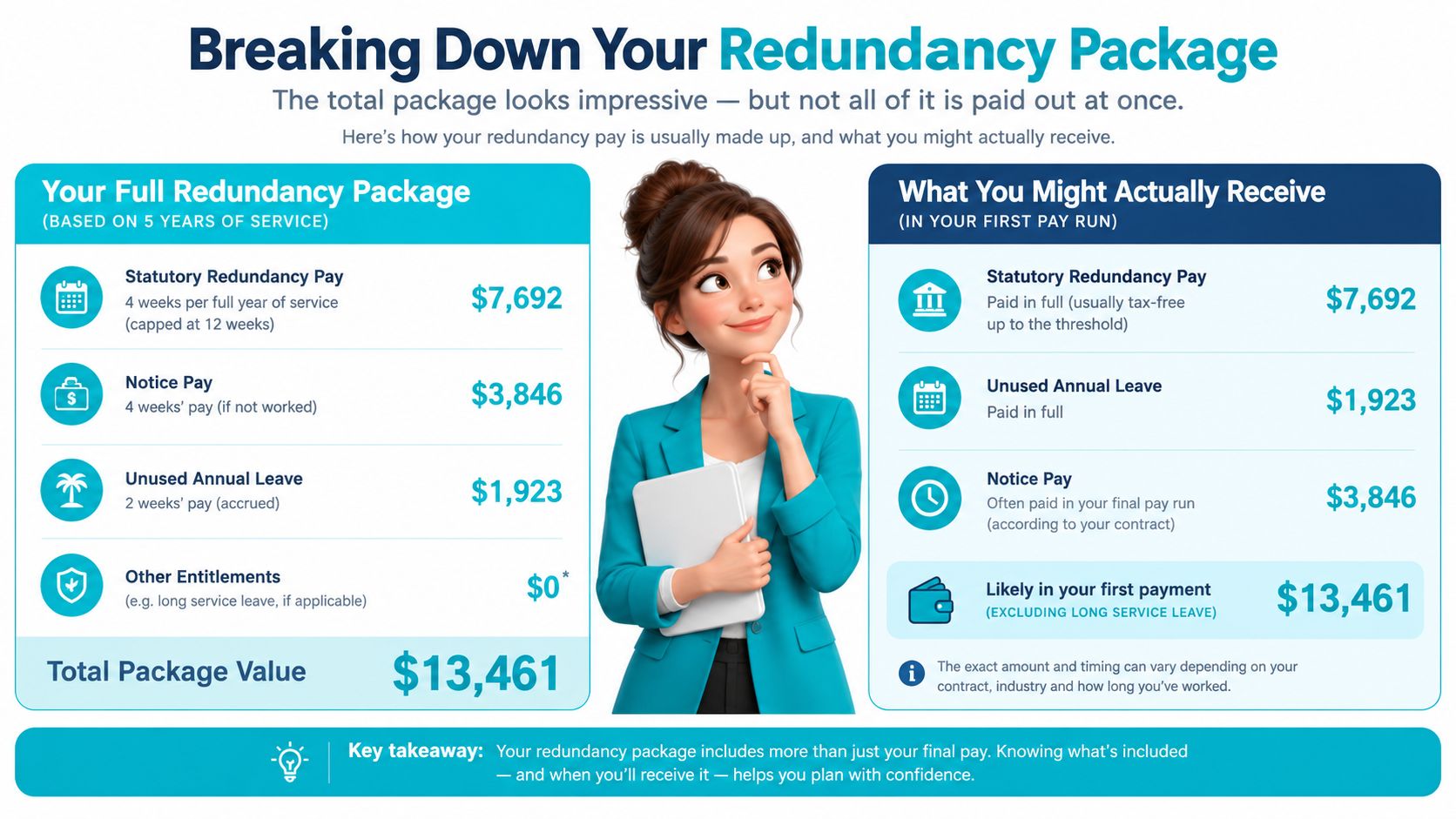
Your final payslip should make the payment components visible. If it doesn't, request a written breakdown from payroll before signing a settlement or accepting that the calculation is correct.
The components to check
Ordinary wages cover work performed up to the employment end date. They're ordinary earnings, so the normal super rules generally apply.
Payment in lieu of notice is the line most often missed. The ATO treats it as ordinary time earnings and qualifying earnings, so your employer generally needs to calculate super on it. Don't assume the employer can avoid that obligation by paying notice as part of a larger termination lump sum.
Genuine redundancy compensation is generally excluded from ordinary time earnings. It's compensation because the role has ended, not salary for ongoing ordinary work.
Unused annual leave and personal or carer's leave are generally excluded from ordinary time earnings when paid on termination. Most other termination payments are also outside the super contribution base, although unusual wording or contractual arrangements deserve review.
Bonuses and other amounts need their own classification. A final payment can contain amounts earned before termination alongside compensation paid because employment ended. Those categories shouldn't be blended.
Use the employment documents, not just the payslip
Under the National Employment Standards, an eligible employee generally receives redundancy pay after at least 12 months of continuous service, with the entitlement calculated in weeks of base pay. The schedule starts at 4 weeks for at least 1 but less than 2 years, rises to 6 weeks for 2 to less than 3 years, reaches 10 weeks for 5 to less than 6 years, and reaches 16 weeks for 9 to less than 10 years, before reducing to 12 weeks at 10 or more years because long-service-leave arrangements can affect the calculation. These figures and the base-rate rules are set out by Fair Work in its notice and redundancy guidance.
The redundancy calculation uses base pay for ordinary hours. Bonuses, overtime, penalty rates, loadings and monetary allowances generally don't form part of that base. A worker with 5 years of service has a minimum entitlement of 10 weeks of base pay, but compulsory super is generally not added to that redundancy amount.
Ask payroll to identify:
- Ordinary earnings: Confirm the final period's wages and the super amount attached.
- Notice pay: Check whether payment in lieu is separately stated and included in the super calculation.
- Redundancy compensation: Confirm the service period and base-rate calculation.
- Leave balances: Check annual leave, personal or carer's leave and any applicable long-service entitlement.
- Other payments: Identify bonuses, allowances, settlement amounts and anything described as representing super.
A vague payslip is not a minor administrative inconvenience. It makes it harder to identify an underpayment and harder to model your after-tax position.
Navigating the Tax-Free Limits
Super treatment and tax treatment are separate questions. A genuine redundancy can be outside the super contribution base while still qualifying for a tax concession, provided it meets the ATO's conditions.
For the 2025–26 income year, the tax-free genuine redundancy limit is $13,100 plus $6,552 for each completed year of service with the employer, as set out in the ATO's employment termination payment thresholds. The limits are indexed annually, so the relevant income year matters.
Apply the formula to the genuine redundancy component
An employee with 10 completed years of service could have a tax-free limit of $78,620, calculated as:
$13,100 + ($6,552 × 10) = $78,620
That result only applies if the payment satisfies the ATO's genuine-redundancy conditions. It doesn't automatically apply to every amount an employer calls redundancy, and it doesn't convert notice pay, wages or other components into tax-free redundancy.
Amounts above the tax-free genuine redundancy limit generally move into employment termination payment treatment. For 2025–26, the ETP cap is $260,000, while the whole-of-income cap is $180,000 and isn't indexed. The ATO explains the relevant treatment in its 2025–26 tax table guidance. Amounts above the applicable cap can be taxed at the top marginal tax rate.
Why the component split changes your decision
Suppose your employer offers a package described only as “redundancy”. You can't calculate its real value until you know how much is genuine redundancy, how much is notice pay, how much is leave and how much may be an ETP. The same gross cheque can produce a different tax result depending on the classification.
That's also why you should model the payment before signing. A discussion of how retirement year taxes change can help explain why a single high-income year deserves separate planning, particularly if you're considering contributions or debt reduction.
Wealth Collective's tax treatment of redundancy is relevant here because the tax concession and super rules need to be considered together, not as one blended calculation. Don't sign a settlement that uses broad wording when a line-by-line schedule is available.
Industry Fund Payments vs Statutory Redundancy
An employer-paid redundancy and a payment from an industry redundancy fund may look similar in your bank account. They aren't automatically identical for tax purposes.
The distinction matters in construction and other industries that use portable entitlement schemes. A worker may receive money from an industry redundancy or employee-entitlement fund even when the employer's paperwork describes the departure as a resignation or termination by agreement. The source of the money, the employment agreement and the actual reason employment ended all matter.
Compare the payment source
| Payment source | Main question | Why it matters |
|---|---|---|
| Employer-paid redundancy | Was the job genuinely abolished and employment ended for that reason? | It may qualify for genuine-redundancy treatment if the ATO's conditions are met. |
| Industry redundancy fund | What do the fund rules say the payment represents? | The fund payment may be assessed differently from statutory redundancy. |
| Termination by agreement | Was the departure genuinely involuntary? | The label may not support concessional treatment if the facts point to voluntary termination. |
A 2026 Administrative Review Tribunal decision found that a payment from an industry redundancy fund didn't qualify for concessional genuine-redundancy treatment because it wasn't more than the amount reasonably expected on voluntary termination. That decision doesn't mean every portable-fund payment receives the same treatment. It means you shouldn't assume the tax-free redundancy limit applies merely because a fund uses the word “redundancy”.

Get the evidence before you decide
Request the fund rules, payment statement, employer termination letter and any agreement you signed. Check whether the payment was triggered by the abolition of your job, an industry entitlement, voluntary departure or a negotiated exit.
This area is receiving regulatory attention, including ASIC consultation about future licensing and relief arrangements for employee redundancy funds. That's a sign that fund-based redundancy payments deserve careful review rather than a quick payroll assumption.
Keep these documents together: fund rules, payment statement, termination notice, employment agreement and final payslip.
The super question still turns on classification. A fund payment isn't automatically subject to super merely because it's paid when employment ends, and it isn't automatically exempt merely because it's called redundancy. If the payment is unusual, get tax advice before spending it or building a contribution strategy around it.
Why You Cannot Simply Roll Over Your Payout
The ATO's position is clear: employment termination payments cannot be rolled over into superannuation. The ATO distinguishes an ETP from a superannuation benefit paid by a super fund or retirement savings account, so you can't direct the termination payment straight into your fund as though it were an ordinary super rollover. The rule is set out in the ATO's guidance on employment termination payments.
That doesn't prevent you from using some of the cash for a personal super contribution. It means the money must first be paid to you, then you decide whether an ordinary contribution suits your circumstances and applicable contribution rules.
Separate a rollover from a contribution
A rollover moves an eligible super benefit from one super environment to another. A redundancy payment isn't treated as that kind of benefit.
A personal contribution is a new payment you make to your super fund from money you already own. Once the redundancy proceeds are in your bank account, you may consider a contribution strategy, but ordinary eligibility and contribution rules still apply.
The distinction sounds technical. It has a real consequence: money transferred into super is generally preserved until you meet a condition of release. If you've just lost your job, you may need that cash for rent, mortgage repayments, healthcare, retraining and the gap before your next income arrives.
Use the right order of decisions
- Confirm the payment breakdown. Don't plan from the gross lump sum.
- Protect accessible cash. Keep enough outside super for living costs and uncertainty.
- Check contribution capacity. Review your existing super balance, contribution history and relevant caps.
- Consider tax advice. A deductible personal contribution may have different consequences from an after-tax contribution.
- Confirm fund acceptance and timing. Ask the fund how and when it must receive the contribution.
Before moving any money, understand when you can access your super. A contribution can be useful for surplus capital, but it's a poor place for your emergency reserve.
Taking Control of Your Exit Strategy
A redundancy is a financial planning event, not just a payroll event. The decision that protects you most may be refusing to make a fast decision with the lump sum.
Start with the documents. Compare the employment agreement, redundancy letter, enterprise agreement if applicable, fund statement and final payslip. The figures should tell one consistent story.
Run this checklist before signing
- Payment categories: Is the package separated into wages, notice, leave, redundancy, bonus and other amounts?
- Super calculation: Has super been calculated on ordinary wages and payment in lieu of notice where required?
- Redundancy entitlement: Does the service period and base-rate calculation match the applicable employment rules?
- Tax treatment: Is the genuine redundancy component clearly identified, and has the relevant tax-free limit been tested?
- ETP classification: Has any taxable excess been separated from the tax-free redundancy amount?
- Fund payment: If an industry fund is involved, have you obtained its rules and payment statement?
- Cash reserve: Can you cover your foreseeable living costs without relying on preserved super?
- Contribution plan: If you're considering a personal contribution, have you checked your capacity and the fund's acceptance requirements?
- Advice sequence: Have you received advice before signing an agreement or transferring money?
A five-year employee, for example, may be entitled to 10 weeks of base pay under the minimum redundancy schedule, while payment in lieu of notice may attract super separately. Those amounts should not be combined just because the employer processes them in one payroll run.
For Perth and Dunsborough clients, Wealth Collective can assess the payment breakdown alongside superannuation optimisation, debt reduction and retirement planning. Its Retirement Roadmap is relevant when redundancy changes your retirement timing, while Guided Growth can help assess how surplus cash might be allocated after liquidity and tax have been addressed.
Ask before you sign: “Which part of this package attracts super, which part is tax-free, and which part will remain accessible after payment?”
The best strategy depends on your age, cash reserves, debt, next employment prospects, super balance and retirement timetable. Don't let an employer's label decide your financial future. Get the components separated, check the calculations and choose what to do with the surplus only after you know what must remain available.
Wealth Collective can review your redundancy package, check the super and tax treatment of each component, and build a practical plan for your cash flow and retirement position. Book an initial conversation through Wealth Collective before you sign the paperwork or move the money.