Business hours
Monday to Friday (8.30AM - 5PM)
Weekend (Closed)


You've entered your current super balance into a retirement calculator, chosen an age to stop work and watched a projected balance appear. It looks precise, but it can hide the questions that matter most: when you can access your super, how much income you'll need before other support begins, and how sensitive the result is to fees and investment returns.
Use a retirement plan calculator as a way to test assumptions, not as a prediction. The aim is to build a few realistic scenarios, see what changes the outcome and identify the decisions that need a closer look.
Inputs That Decide Your Retirement Result
Start by gathering the figures below. The records beside each input are more reliable than estimates from memory, and the “why” column shows how each assumption affects the projection.
| Input | Where to find it | Why it changes the result |
|---|---|---|
| Date of birth | ID documents or super fund records | Sets preservation age and access dates |
| Current super balance | Latest super statement or fund app | Starting point for every projection |
| Employer contributions | Payslips and fund statements | The Superannuation Guarantee is 12% of ordinary-time earnings |
| Extra contributions | Salary sacrifice and personal contribution records | Even $200 a month changes the projected balance |
| Number of super accounts | ATO online services or fund statements | Each account carries its own fees and insurance |
| Fund fees | Product disclosure statement | Fees reduce the final balance |
| Investment option | Fund's investment menu | Sets the default return assumption |
| Target retirement age | Your own plans | Sets years of saving and years of drawdown |
| Annual spending | Budget or bank statements | Sets the income your super must support |
| Other income | Age Pension estimate, rent or part-time work | Reduces how much super must provide |
Employers generally must contribute 12% of ordinary-time earnings under the Superannuation Guarantee. Include any salary sacrifice or personal contributions separately, rather than assuming they're already reflected in your employer contribution; ASIC's Moneysmart super guide also illustrates how additional contributions can affect a projection.
Start with the inputs that compound
Your balance, contributions, investment option and fees have a direct effect on the estimated amount available at retirement. Contributions matter particularly when they continue over many years: a change that seems modest month to month can build into a meaningful difference, especially if your work or earnings are irregular.
The Australian Taxation Office's super account information reports that just under 14 million people, approximately 78% of the superannuation population, had only one account at 30 June 2024. Fewer than 5% held more than three. If you have several accounts, add each balance and account-specific fees, and check whether you're paying for insurance in more than one fund. The ATO also reported that compliance activity led to $932 million in previously unpaid super reaching the accounts of 797,000 employees during the year to November 2024, a reminder to check that contributions have arrived.
Use a realistic retirement age and spending target. If you're not sure about your spending, separate regular essentials from discretionary costs before entering one annual figure. For a starting point on the broader decisions involved, these practical retirement planning tips can help you organise the questions to consider. You can also compare your budget with the ASFA retirement standard, while remembering a benchmark won't capture your household's full circumstances.
Before opening the calculator, collect statements and payslips from the last financial year, plus a recent household budget. That way, each figure comes from a record rather than memory.
When Your Super Can Actually Be Accessed
Don't assume that stopping work makes your entire super balance available. Your preservation age is based on your date of birth, and reaching it is only one part of the access rules.
| Date of birth | Preservation age |
|---|---|
| Before 1 July 1960 | 55 |
| 1 July 1960 to 30 June 1961 | 56 |
| 1 July 1961 to 30 June 1962 | 57 |
| 1 July 1962 to 30 June 1963 | 58 |
| 1 July 1963 to 30 June 1964 | 59 |
| From 1 July 1964 | 60 |
The ATO's preservation-age guidance explains that you generally need to meet a condition of release as well as reach your preservation age. Moneysmart notes that super can generally be accessed at 60 after stopping work or leaving a job, and from 65 regardless of employment status.
Work out whether you need a bridge
Say you were born in 1965 and plan to stop work at 58. Your preservation age is 60, so you can't assume super will fund the first two years after you finish work. You'll need to model another source for that period, such as cash savings, other investments or income from part-time work, or test a later retirement date.
This gap can make a basic projection misleading if it starts super withdrawals the moment your salary stops. Put your birth date and intended work status into the calculator first, then check whether your planned retirement date lines up with access rules. The guide to when you can access your super is a useful reference when you're mapping out those dates.
How to Run Your Base Case and Stress Tests
A useful calculation is a repeatable process, not a single balance on a screen. Work through the inputs in order and keep a record of the assumptions used.
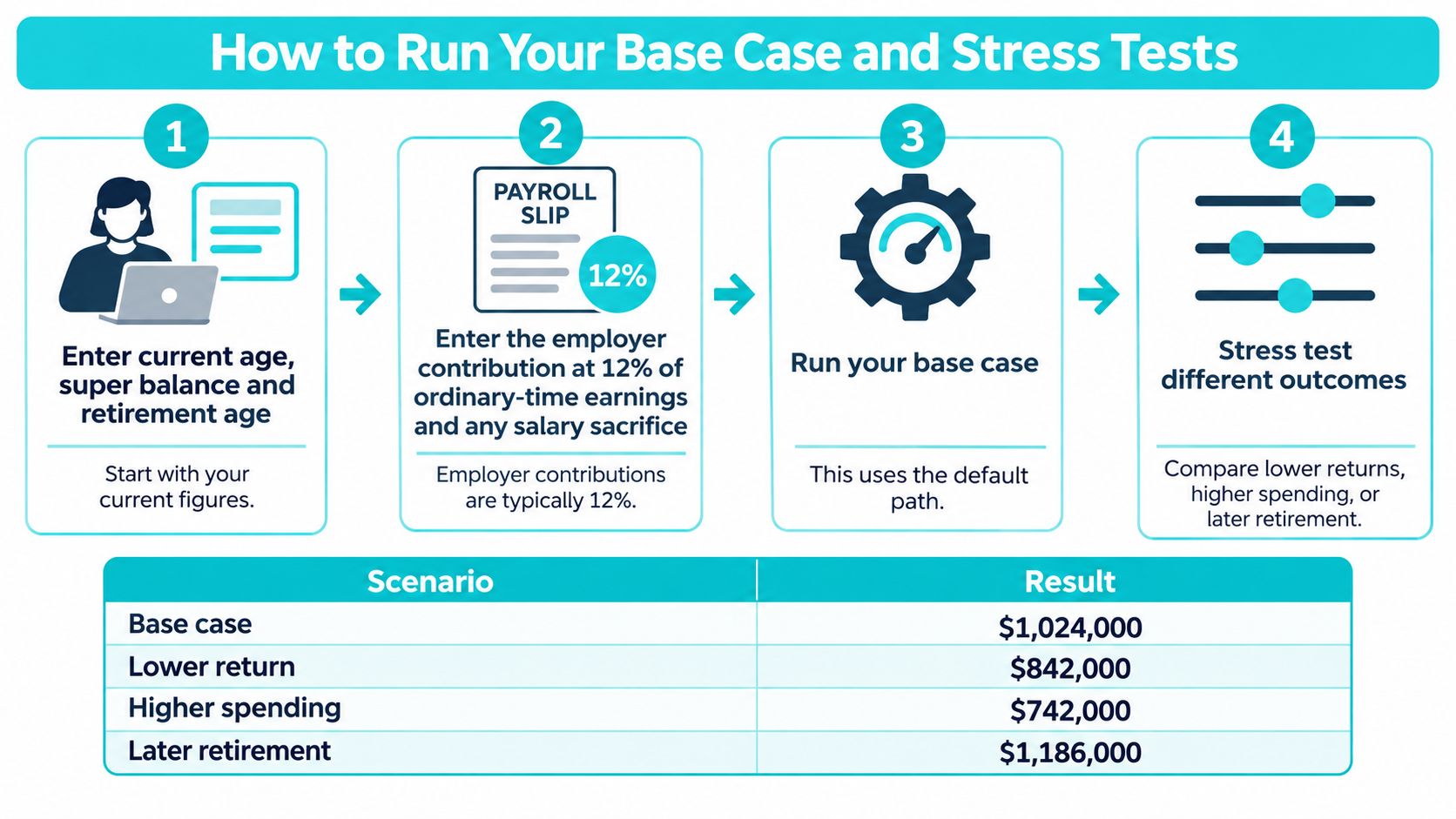
Enter your age, balance and retirement age. Use your date of birth and latest super statement, then set the age you want to stop work. This establishes the time available to build savings and the point at which withdrawals may begin.
Enter employer and extra contributions. Use your employer contribution at 12% of ordinary-time earnings, then add salary sacrifice or personal contributions separately. Don't count the same contribution twice.
Choose your investment option. Match the calculator's default return to the option you hold, unless you have a clear reason to use a different assumption. A return chosen without regard to your investment mix makes the result harder to interpret.
Check how fees are treated. Record whether the displayed balance is gross or net of fees and tax. If the tool lets you change fee assumptions, include the charges shown in your fund documents.
Run and label the base case. Save the assumptions with the result and call it an estimate, not a prediction. Your personal circumstances and investment returns can change.
Keep the numbers comparable. Use the same dollar basis for income and spending throughout. If the calculator shows future dollars but your spending target is in today's dollars, check how it adjusts for inflation before comparing them.
ASIC's Moneysmart superannuation calculator assumptions include employer and voluntary contributions increasing with inflation. Its default annual return assumptions are net of tax and investment fees:
| Investment option | Default annual return, net of tax and fees |
|---|---|
| Cash | 3.7% |
| Conservative | 5.0% |
| Moderate | 5.8% |
| Balanced | 6.2% |
| Growth | 6.6% |
| High growth | 7.0% |
Stress-test the assumptions
Run the base case, then move your planned retirement age two years earlier and two years later. Reduce the return assumption by one to two percentage points and run another version with extra contributions removed. These tests show whether your plan relies on a particular investment outcome or on contributions continuing exactly as planned.
A common modelling error is mixing nominal salary growth, which includes inflation, with spending targets stated in today's dollars. That mismatch can distort the balance you think you need. Also test fees explicitly, because leaving them out can make the final balance look stronger than the net amount available to you.
A useful result is a base case plus a range of outcomes, not one number.
Turning Your Balance into Retirement Income
A projected balance matters only alongside the income it can provide. Separate the spending you need to cover from costs you could reduce, then test how much must come from super after other income is counted.
Start with essential and discretionary spending as separate amounts. That distinction shows where you could adjust withdrawals if returns are lower than expected or costs rise. Model super withdrawals separately from any Age Pension estimate, part-time work or rental income. Each income source changes how much your savings need to provide.
Check whether the calculator reports figures in today's dollars and whether its investment assumptions are gross or net of fees. The Moneysmart account-based pension calculator expresses results in today's dollars and uses different return assumptions from an accumulation calculator. Compare the assumptions before carrying a projected return from one stage into another.
A withdrawal plan should cover the full period you want to model, not just the first years of retirement. Compare the result under lower returns, higher inflation and different spending levels. That makes the trade-off clear: higher withdrawals can support more spending now, but leave less invested to provide income later.
Use benchmarks as a comparison, not a verdict
Comfortable-retirement benchmarks vary by household type and homeownership. Treat them as a reference, not as a required spending target or a prescribed super balance. Your housing costs, health spending, debt, other assets and preferred lifestyle all affect the amount you may need.
A paid-off home may reduce the income needed from super, while other circumstances may call for more. If housing equity is part of your thinking, you could explore reverse mortgage borrowing estimates, but assess that borrowing separately from your Australian retirement income. For an overview of ways retirement income can be structured, see retirement income streams.
Worked Example Bridging Age 62 to 67
Consider Sam, born in 1970, who plans to stop work at 62 with a projected super balance of $500,000. Sam wants to spend $60,000 a year in today's dollars. The figures below are illustrative assumptions, not a forecast or entitlement.
Set the pre-pension income need. From age 62 to 67, assume no Age Pension is received, so super and any other available resources must cover the full $60,000 annual target. The Australian Government's retirement income explainer states that the Age Pension is generally available from age 67.
Calculate the five-year bridge. Five years at $60,000 is $300,000, or 60% of Sam's projected $500,000 balance, before any pension income begins. That simple total doesn't account for investment returns, fees or changes in spending, so the calculator needs to model those too.
Add an illustrative Age Pension estimate. If Sam enters an assumed $25,000 a year from age 67, super would need to provide the remaining $35,000 a year against the $60,000 spending target. The $25,000 is a scenario input, not a benchmark or an estimate of Sam's actual entitlement.
Run the full drawdown. Extend the projection to age 90 and compare the remaining balance with the income needed each year. A result that bridges the gap but runs out later doesn't meet the full goal.
Test a lower return and earlier retirement. Cut the return assumption by two percentage points and rerun the calculation. Then test retirement at 60: seven years at $60,000 totals $420,000 before the assumed pension begins, making the bridge materially larger.
This method makes the timing visible: when work income stops, when super becomes accessible, and when other income may start. Replace Sam's assumptions with your own figures and keep the alternative runs so you can compare them.
Reading Your Result and Avoiding Costly Errors
A projected balance can look reassuring while hiding a gap in the first years of retirement or a shortfall later on. Treat the result as a scenario, then check the income path year by year rather than judging the plan by its final balance alone.
The ABS retirement and retirement intentions report found that the government pension was the main income source for 47% of retirees in 2022–23, while superannuation was the main source for 33%. That's a reason to check how government support is represented in your household projection, not to assume a particular person will qualify for a particular payment.

Check the projection in a fixed order
First, confirm that income covers essential spending from the first year you retire. Then check whether the balance lasts to your planning age of at least 90 or 95. Review the Age Pension as a separate line from age 67, and compare the base case with your stress tests. If the base case only just meets spending, the plan may have little room for an adverse outcome.
| Pitfall | Effect on the projection | Fix |
|---|---|---|
| Mixing nominal salary growth with real spending targets | Required balance can be far off | Use one basis, either nominal or today's dollars, for all inputs |
| Leaving out fund fees | Final balance looks higher than it will be | Enter fees and compare gross and net outcomes |
| Assuming the full balance is available at retirement | Income gap before preservation age and condition of release | Enter birth date and work status first |
| Running a single scenario | Creates false precision | Test retirement age, returns and spending |
| Ignoring Age Pension eligibility | Overstates or understates income need | Model Age Pension from 67 separately |
| Treating a defined-benefit scheme like an accumulation account | Wrong income projection | Use the scheme's own estimate for the benefit |
| Forgetting duplicate super accounts | Double fees and insurance go unnoticed | Consolidate accounts or enter each one separately |
Three habits make comparisons unreliable: stopping after one run, treating a calculator estimate as a guaranteed entitlement, and changing assumptions between runs without recording them. Save the assumptions with each result so you can tell whether a difference came from a changed retirement date, contribution, fee, return or spending target.
A result that only works under one set of assumptions is a warning sign, not a plan.
General information on the Wealth Collective website isn't personal financial advice. Consider your own circumstances and consult a qualified Financial Adviser before acting on it.
Book an Initial Call to Turn Your Estimate into a Plan
A calculator can show what happens under chosen assumptions, but it can't weigh your super structure, insurance, debt and household spending together. That matters because a retirement decision often affects more than the balance in one account: it can change how you draw income, manage risk and organise other parts of your financial life.
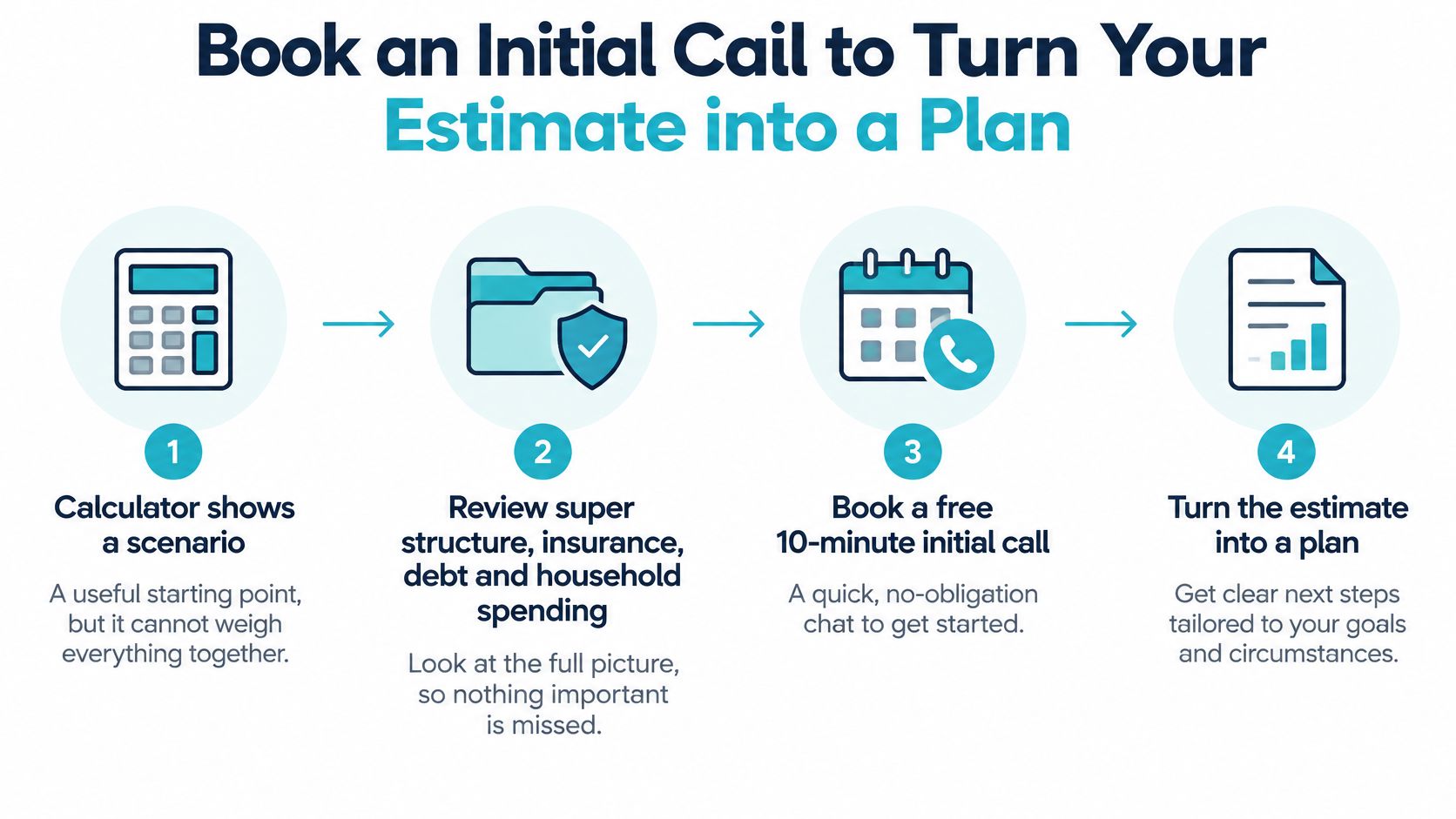
Wealth Collective's three services are Protection Plus, Guided Growth and Retirement Roadmap. The Retirement Roadmap simplifies retirement planning into a clear path to financial security, while Guided Growth tests income and assets against your goals. The process starts with a free 10-minute intro call to review your situation and build a plan that works for you. At the plan presentation, an adviser walks through the financial plan and answers your questions before anything is implemented.
Bring a short, organised set of information:
- Your starting figures: super statements, employer and extra contributions, fees, investment option, spending target and other income.
- Your access details: date of birth, intended retirement age and work status.
- Your test results: base case plus scenarios with changed retirement timing, returns and contributions.
That gives the discussion a useful starting point. The calculator helps you identify what to ask; a full plan can bring those assumptions together with your actual circumstances.
Book a free 10-minute intro call with Wealth Collective to review your retirement assumptions and turn your estimate into practical next steps. Bring your completed calculator run and stress tests, then visit Wealth Collective to get started.