Business hours
Monday to Friday (8.30AM - 5PM)
Weekend (Closed)



You've got both super statements on the kitchen table, a mortgage you'd like gone, and slightly different ideas about when work should stop. One of you wants more time now. The other wants another few years of wages before making the leap. You're both asking the same question: can we afford it?
Retirement planning for couples needs one household strategy, without pretending you're interchangeable. Start with what your money must do together. Then deal deliberately with the differences in your balances, ages, health and family responsibilities.
Why Retirement Planning for Couples Starts With One Plan, Not Two
Two healthy super balances don't automatically make a workable retirement plan. You still need to know who stops earning first, which account can fund spending, and what happens if the assumptions change.
The Australian Treasury's Retirement Income Review reported that around 70% of people are in a couple when they start retirement, and that couples generally experience lower poverty and financial stress, higher home ownership and greater wealth than single retirees, as outlined in ASIC's discussion of household retirement planning. That's an advantage, not a substitute for planning.
Agree on the household decisions
Start with the decisions you share: where you'll live, whether you'll clear debt, how much travel matters, and what support you're prepared to give adult children. These choices determine the income you need, not the balance printed on either statement.
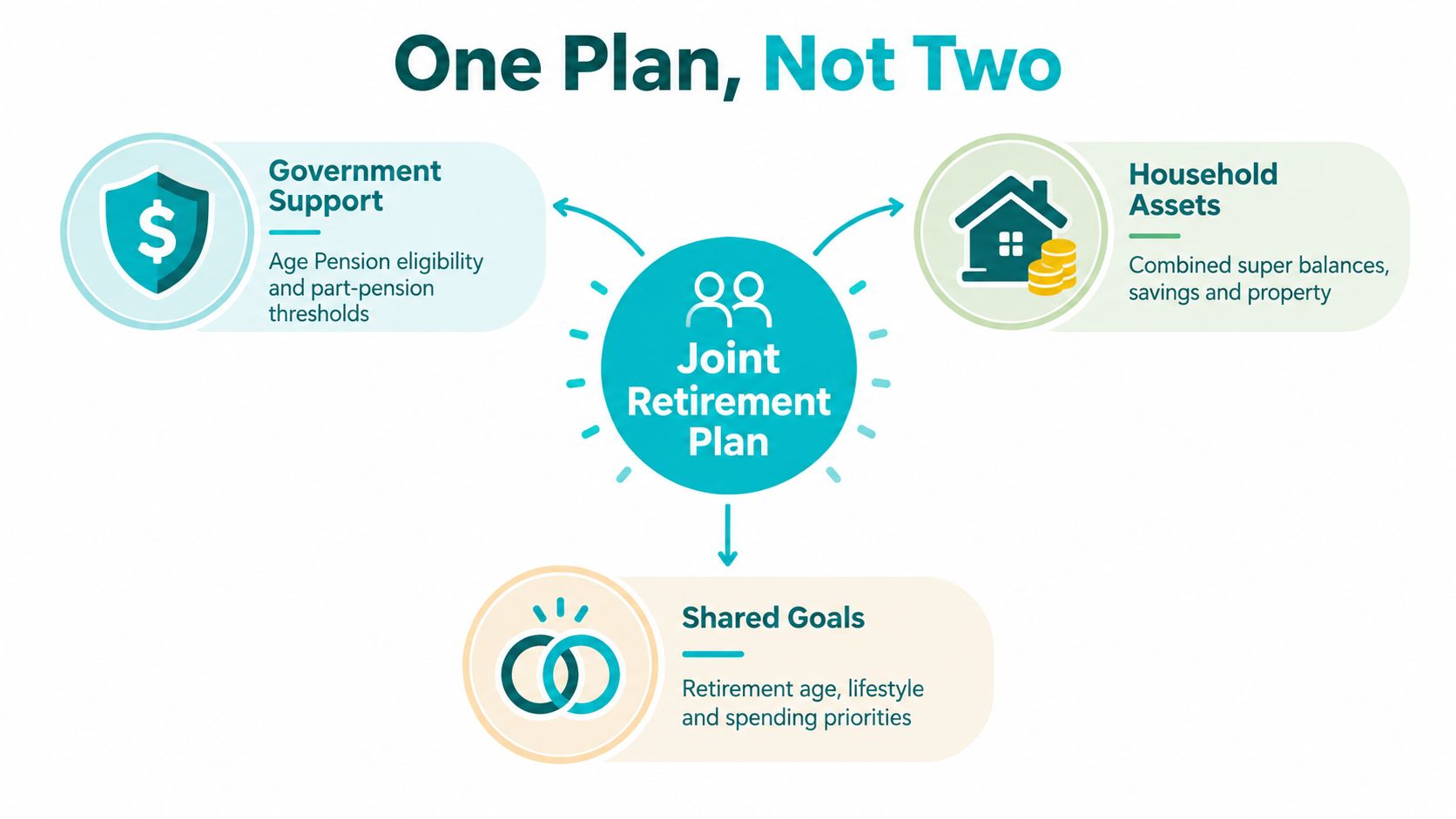
Separate plans can each look reasonable while leaving the household short. One partner might assume their wages will cover the mortgage while the other assumes those wages will fund holidays. Unless you reconcile those expectations, you haven't agreed on retirement.
Practical rule: Agree on what the household must fund before deciding what either partner should do with their super.
A joint plan should also distinguish shared objectives from individual preferences. You don't need identical retirement dates or hobbies. You need an affordable arrangement that gives both partners a say.
Keep the rules Australian
For couples with US retirement interests, Federal Benefits Sherpa's guide to plan retirement benefits as a couple provides a separate resource on married-couple Social Security planning. Don't import that system into an Australian plan.
Here, household pension assessments sit alongside individual super access, contribution and tax considerations. The right starting point for a Retirement Roadmap is therefore a joint strategy with each partner's circumstances clearly identified, not two disconnected projections stapled together.
Keep account ownership visible. Planning together doesn't mean combining everything legally or surrendering financial independence. Both partners should understand the assets, the spending commitments and the decisions that could affect their future security.
Build the Joint Cash-Flow Model First
Don't start by choosing an investment option. Start by working out what retirement will cost, using your actual spending rather than a round number that sounds comfortable.
Put both partners' financial information in one worksheet. Record super, bank accounts, investments, property, debts and insurance, while retaining separate columns for ownership and access. Include irregular expenses such as home maintenance, replacement vehicles and family assistance.

Build a budget you can defend
Separate spending into categories that support decisions:
- Essentials: Housing, utilities, food, healthcare, insurance and unavoidable debt repayments. These need dependable funding.
- Lifestyle choices: Travel, dining, hobbies and gifts. Decide together which expenses you'd reduce if necessary.
- Irregular commitments: Repairs, major purchases and care costs. Keep these visible rather than assuming ordinary spending covers them.
Shared housing and household expenses mean a couple does not need exactly twice a single person's resources. However, sharing costs won't rescue a budget that omits the things you intend to do.
The cited retirement research records life expectancy at birth of 81.1 years for Australian males and 85.1 years for females, alongside an estimate of around $640,000 in super at retirement, in today's dollars, for a couple seeking an ASFA Comfortable lifestyle, in the ASFA and State Street retirement savings research. Treat that balance as a benchmark, not a personalised target or guarantee.
Test the retirement you might actually experience
Life expectancy at birth isn't a deadline for someone already approaching retirement. My recommendation is to test the household's assets through the longer-lived partner's 90s, rather than stopping the projection at an average.
Build conservative, baseline and adverse scenarios. Allow for inflation, weaker investment returns, healthcare, aged care and changes in government support. Show what you would change under each scenario, not just whether the spreadsheet finishes with money left.
Then compare expected wages, pension income and other reliable income with spending. The difference is what your savings must fund. If that gap looks uncomfortable, change an assumption you control: spending, debt, retirement timing or saving.
Review the model annually and after a material market, health, employment or relationship change. Keep actual spending beside the original forecast so you can see whether the plan still describes your life.
How the Age Pension Treats Couples Differently
A low balance in one partner's name doesn't mean that partner will automatically qualify for the Age Pension. Services Australia assesses a couple's income and assets together, so you need to model the household rather than the person with less money.
The income test and assets test ask different questions. One examines assessable income; the other examines assessable wealth. A planning decision can change one without delivering the result you expected under the other.
Age Pension thresholds for couples at a glance
| Test | Couple (homeowner) | Couple (non-homeowner) |
|---|---|---|
| Income test, combined fortnightly free area and cut-off | $396 free area; $4,128 cut-off | Same combined thresholds |
| Assets test, combined threshold shown | $499,000 | $766,000 |
The income figures above are the combined thresholds listed in Services Australia's Age Pension income test; above the free area, each person's pension reduces by 25 cents for every dollar of excess combined income. The homeowner and non-homeowner asset figures are listed in Services Australia's Age Pension assets test.
Check the applicable thresholds when making a decision. Don't treat an assets-test threshold as a universal ceiling for receiving any pension, or assume passing one test settles your entitlement.
Compare the whole outcome
The principal home is generally treated differently from assessable financial assets. That means couples with similar total wealth can have different pension outcomes depending on how much sits in their home versus investments, cash and other assessable assets.
But a larger home won't pay the grocery bill. Don't spend accessible savings merely to chase a pension result without examining liquidity, maintenance costs and whether the housing choice suits you.
- Keeping investments: Preserves accessible capital, but assessable assets and income may affect pension eligibility.
- Reducing debt: Can lower household spending needs. Compare the interest saved with the liquidity you give up.
- Changing work patterns: Alters wages and may change pension outcomes, but the pension effect isn't the only consideration.
Use the Age Pension eligibility guide to prepare the information an adviser will need.
A useful Retirement Roadmap comparison shows spending capacity after each decision, including pension income, withdrawals and remaining accessible capital. The aim isn't the largest pension payment. It's a sustainable household income with enough flexibility to handle an unexpected expense.
Coordinating Super and Drawdowns Across Both Partners
Drawing the same percentage from both super accounts looks tidy. It isn't necessarily sensible. Different access dates, tax positions and investment exposures can make equal withdrawals the wrong choice.
Work backwards from the spending gap established in your cash-flow model. Decide which source should fund it, then check the consequences before moving money.
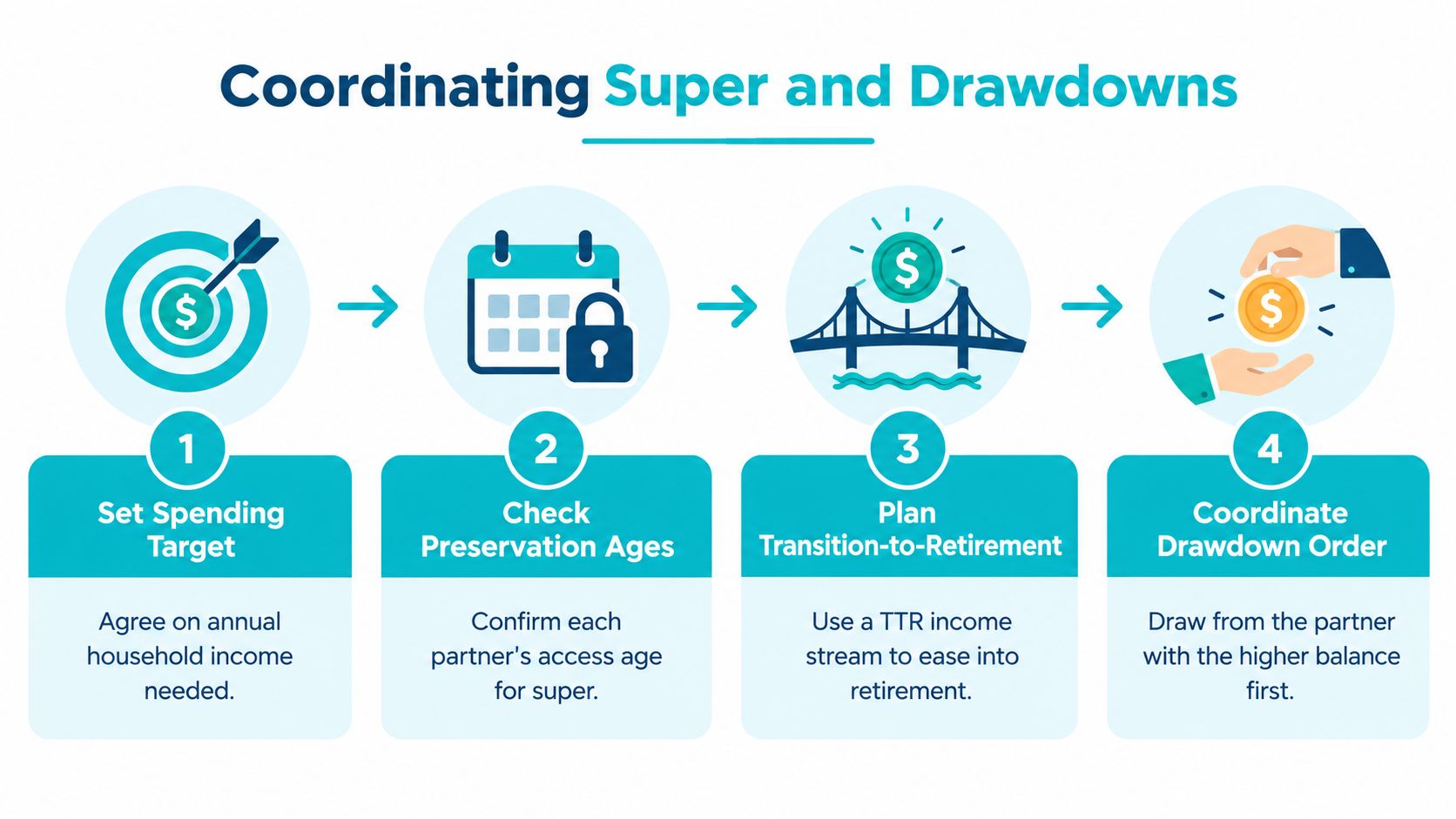
The higher-balance account is a candidate for withdrawals, not an automatic first choice. Account size alone doesn't tell you which order will produce the strongest household result.
Check access before promising income
Preservation ages range from 55 for people born before 1 July 1960 to 60 for people born after 30 June 1964, and access depends on meeting a condition of release; an eligible transition-to-retirement income stream generally has a maximum annual payment of 10% of its opening financial-year balance, under the ATO's super conditions of release.
A transition-to-retirement strategy can help an eligible partner reduce paid work while drawing income, provided the fund permits it. It still needs a household calculation. Taking money out while putting money back in isn't automatically worthwhile once tax, contributions and cash needs are considered.
From 1 July 2026, the general concessional contribution cap is $32,500 for all ages, including employer contributions, salary sacrifice and personal deductible contributions, according to the ATO's contribution caps. Each partner has an individual cap.
Before increasing salary sacrifice, subtract expected employer contributions and check any available carry-forward capacity. Also ask whether locking away more cash is sensible while the household still needs accessible funds.
Protect withdrawals without abandoning growth
Sequence-of-returns risk is the risk of poor returns occurring when you're withdrawing money. Selling investments after a fall leaves fewer assets available for a later recovery.
Don't turn every retirement dollar into cash because you're worried about next year. Separate near-term spending needs from money intended for later life.
My preference is to assess a liquidity reserve for essential spending alongside a diversified allocation for the longer term. That isn't a promise of better returns, and the appropriate mix depends on your capacity to tolerate losses.
Coordinate withdrawals using tax, pension means tests, access rules and account-based pension minimums. Recalculate using actual spending and portfolio performance rather than repeating last year's instructions by habit.
Unequal Super, Different Retirement Dates and the Carer Risk
A combined balance can conceal an uncomfortable truth: one partner may have far less financial independence than the other. Retirement planning for couples should address that directly, not dismiss it because the total looks adequate.
AustralianSuper reported median balances of $101,231 for men aged 40–44 versus $74,066 for women, with the gap reaching $57,580 at ages 55–59, in its Equal Pay Day discussion of the gender super gap. Those differences deserve attention before retirement, particularly where career breaks have benefited the whole family.
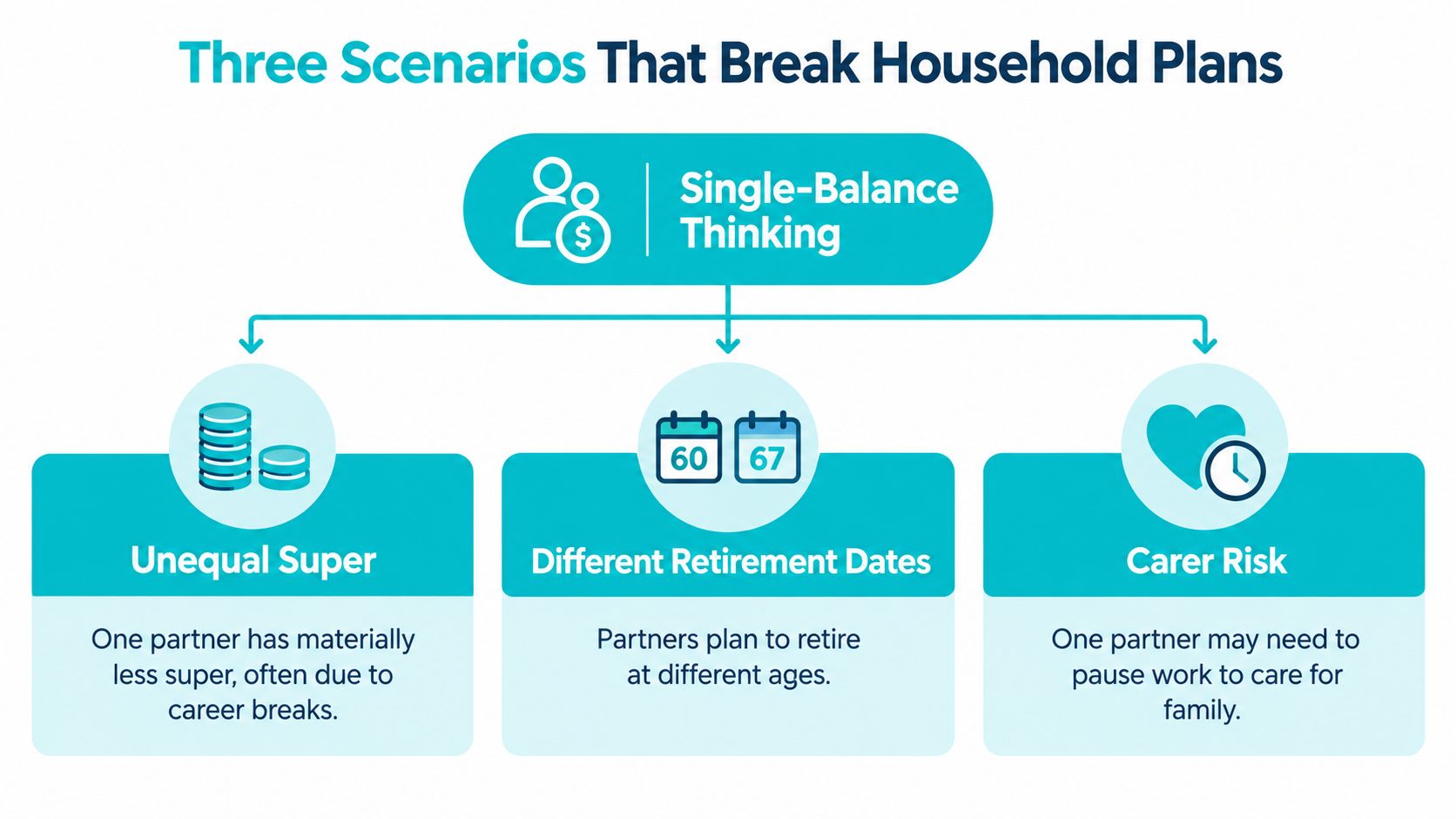
Unequal balances need an explicit response
Discuss contributions to the lower-balance partner, eligible contribution-splitting arrangements and who controls financial decisions. The spouse superannuation contributions guide is a useful starting point for that conversation.
Don't confuse fairness with forcing identical balances. Check eligibility, tax consequences, access timing and the cash you need outside super. A contribution holiday for the higher earner may redirect household resources, but don't give up a useful tax outcome without comparing alternatives.
Different retirement dates require separate phases
Model the period when both partners work, the period when one works, and the period when neither works. The working partner's income shouldn't become an unlimited commitment to fund the other partner's retirement preferences.
Agree on the trade-off in writing: what reduced work buys you, which spending changes, and when you'll revisit the arrangement. Working longer can strengthen finances, but it costs time that the couple may value more than additional savings.
Caring is a household financial risk
Carers Australia findings recorded 70.5% of carers accumulating less super because of caring responsibilities, up from 58.6% in 2024, as discussed in the report on older women's economic security in retirement. Don't assume unpaid care will fit around the existing retirement plan.
- Preserve accessible cash: Allow for reduced wages, direct care expenses and replacement care.
- Review protection: Examine insurance before changing work, including what existing cover does and doesn't provide.
- Plan the recovery: Decide how contributions could resume when care demands ease, or whether the other partner might work longer.
A Joint Super Review within Guided Growth or Retirement Roadmap is an appropriate point to examine these competing priorities. Protection Plus can support the insurance review. Both partners should attend, especially if one usually leaves money decisions to the other.
Estate, Beneficiary and Contingency Planning for Two
Your retirement plan needs instructions for the day one partner can't manage it. A list of assets isn't enough if the other partner doesn't know where the accounts are, whom to contact or how essential bills will be paid.
Separate the death scenario from the incapacity scenario. They require different decisions, and neither should depend on the more financially confident partner being available.
Review documents as a connected set
Ask your adviser, solicitor and super fund to check how the arrangements work together:
- Super nominations: Review each account's beneficiaries, whether a binding nomination is appropriate, and the fund's requirements.
- Income continuity: Ask whether an available continuing-income arrangement or lump sum better suits the survivor's needs.
- Wills and authority documents: Review wills, enduring powers of attorney and relevant medical directives with qualified legal advice.
- Accessible information: Keep an organised record of accounts, contacts and essential payments that both partners can locate.
Use the guide to what happens to super when you die to prepare questions. Don't assume a will alone resolves every super benefit decision.
The surviving partner needs a revised income plan, not a transfer of the existing budget. Ask how benefit payments, ownership changes and the survivor's circumstances could affect tax, pension eligibility and the money available for everyday spending.
Write the contingency decisions down
Contingency test: Could either partner explain how essential expenses would be paid if the other couldn't make financial decisions?
Decide whom you'd contact after a serious diagnosis, how you'd fund immediate expenses, and which discretionary commitments you'd pause. Include a practical aged-care discussion: who could provide care, what outside help might be needed, and whether the home remains suitable.
Different retirement dates also mean partners may have different periods of dependence on investments. Don't assume the person who retires first necessarily bears every risk, but do examine their longer withdrawal period and potential care needs separately.
My recommendation is to review nominations, wills and authority documents every two to three years, and promptly after a material change in health, employment or relationship status. Have the legal documents checked professionally, then make sure the financial plan reflects the decisions they contain.
Your Next Steps and How Wealth Collective Can Help
You don't need to settle every retirement decision before speaking with an adviser. You do need enough information to identify what matters and where you disagree.
Start with a short preparation list:
- Bring the spending picture: Use actual household costs and identify the lifestyle choices you want to protect.
- Gather both partners' records: Include super statements, investments, debts, insurance and proposed retirement dates.
- Identify the difficult scenario: Unequal balances, caring responsibilities, early retirement or survivor security.
- Locate estate documents: Flag anything missing, outdated or poorly understood.
If business ownership is part of your retirement funding, distinguish business value from money available to spend. The Owner's Shortlist resource on planning your business-tied wealth is relevant background for owners considering how business wealth fits their wider financial arrangements.
Choose advice around the decision you face
A Retirement Roadmap suits couples who need to connect retirement timing, investments, super and sustainable income. Guided Growth is relevant when accumulation, debt reduction and super optimisation remain the immediate priorities.
An introductory conversation should help you clarify the advice you're seeking and whether the service fits. It's a starting point, not a personalised strategy delivered before anyone has examined your circumstances.
Bring both partners into that conversation. The objective is a written plan you both understand, with clear choices about money and time, rather than reassurance based on a combined balance.
Wealth Collective offers Retirement Roadmap advice to help couples coordinate super, retirement timing and household income. Visit Wealth Collective to book a free 10-minute introductory call, and bring your preferred retirement dates and the financial question you most want answered.