Business hours
Monday to Friday (8.30AM - 5PM)
Weekend (Closed)


You can do a lot right financially and still feel exposed.
You build your income. You take on a mortgage. You start directing money into super, school fees, renovations, travel plans, or the business. From the outside, life looks organised. Then a specialist appointment turns into a diagnosis, and the pressure starts immediately. Not just treatment decisions, but time off work, disrupted cash flow, extra transport, more help at home, and the quiet fear that savings meant for the future may need to cover today.
That's where serious illness insurance matters. In Australia, people usually know it as trauma cover. It's designed for a specific problem that many families underestimate until they face it. A major diagnosis can derail the financial plan long before it becomes a long-term disability or a life insurance claim.
Protecting Your Future from Life's What Ifs
A lot of financial risk doesn't look dramatic at first. It looks like a normal week that suddenly isn't normal anymore.
A couple with young children might have a mortgage, two incomes, and a clear sense of direction. One diagnosis changes the rhythm of everything. One parent reduces work. The other takes more leave. Childcare arrangements change. Appointments multiply. Out-of-pocket costs start appearing in places they hadn't budgeted for. The issue isn't only the medical event. It's the financial interruption that follows.

That's why I think of serious illness insurance as protection for momentum. It's there to help preserve the life you were already building when health takes an unexpected turn. The right policy can give a household room to breathe at exactly the point when decision-making is hardest.
The financial shock usually goes beyond treatment
People often assume private health cover or Medicare is the main answer. Those can be important pieces, but they don't solve every problem a family faces after a serious diagnosis.
The pressure often comes from practical costs such as:
- Income disruption: One person may stop work temporarily, or both may work less.
- Household commitments: Mortgage repayments, rent, school costs, utilities, and groceries don't pause.
- Care logistics: Childcare, transport, accommodation near treatment, and recovery support can all add strain.
- Plan disruption: Money earmarked for other goals can get redirected to short-term survival.
Serious illness insurance isn't about replacing medical systems. It's about giving your household cash flow options when normal life is interrupted.
This is the same reason people look for ways to protect assets from unexpected legal or ownership issues. If property is part of your wealth strategy, it's also worth understanding how to protect your property with title insurance so one hidden problem doesn't undermine years of work.
Why families act before there's a crisis
The best time to assess cover is usually when things are stable. You can compare wording calmly, work out what level of cover fits your goals, and decide how this sits alongside your broader protection strategy.
Serious illness insurance isn't a prediction. It's a buffer. For many Australians, that buffer can be the difference between staying on track and having to unwind years of progress under pressure.
What Is Serious Illness Insurance in Australia
A cancer diagnosis at 38 does not just raise medical questions. It can also force urgent money decisions about the mortgage, school fees, business cash flow, or whether one parent can step back from work for six months. Serious illness insurance is designed for that moment.
In Australia, this cover is usually called trauma insurance or trauma cover. It pays a lump-sum benefit if you are diagnosed with a covered condition that meets the policy definition, such as cancer, heart attack, or stroke, as outlined in RGA's reflection on critical illness insurance.
How the payout works
The insurer does not usually reimburse bills one by one. If the medical event meets the wording in the policy, the agreed amount is paid directly to you.
That flexibility is the point. Young families might use the money to cover repayments and childcare while treatment takes priority. Business owners may need it to stabilise the business, fund a temporary replacement, or reduce personal debt tied to the company. Pre-retirees often use it to protect superannuation plans and avoid selling assets at the wrong time.
A useful overview for people comparing product basics is this 2026 critical illness insurance guide. For an Australian view of how trauma cover fits with other personal risk policies, it also helps to review the main types of life insurance.
Why the product matters
Trauma cover started as a narrower product focused on a smaller set of major illnesses. Policies have widened over time, and many now include a broader range of specified medical events and partial benefits for less severe conditions. That change matters because financial pressure rarely arrives in a neat, textbook form.
In practice, the value of trauma cover is not the label on the policy. It is whether the definitions match the risks you want covered, whether the benefit amount reflects your actual commitments, and whether the policy would give your household room to make sound decisions under pressure.
What trauma cover is really for
Ultimately, trauma cover exists to protect your choices.
Without access to cash, a serious diagnosis can push a family into poor timing and expensive compromises. Savings set aside for a home upgrade, school costs, succession planning, or retirement can disappear into immediate expenses. A well-structured trauma policy gives you funds to absorb the shock and keep the future you are building intact.
Trauma Cover vs TPD and Income Protection
Confusion around personal insurance usually starts here. People hear “illness”, “disability”, and “income replacement” and assume these products overlap more than they do.
They don't. Each one is built for a different trigger.
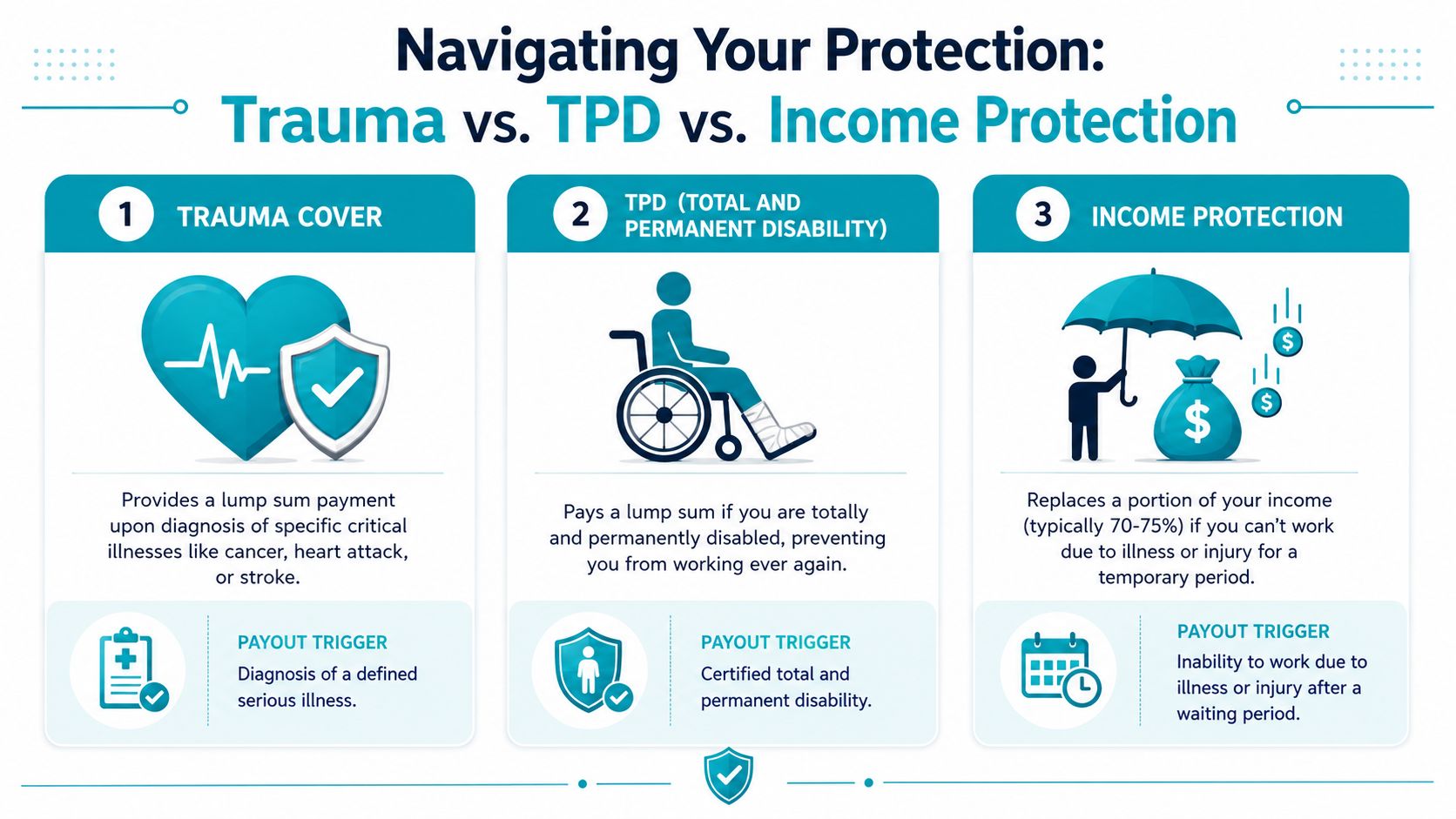
The key difference is the claim trigger
Trauma cover pays on diagnosis of a specified medical event. TPD generally focuses on permanent inability to work. Income protection is designed to replace part of your income when illness or injury stops you working for a period.
That distinction sounds simple, but it changes everything in real life. Someone can suffer a serious medical event that qualifies for trauma cover and still recover well enough that they never meet a TPD definition. Another person may be off work for months and need income protection, even though they never trigger a trauma policy.
As noted in the CCPC explanation of serious illness insurance, trauma cover is an event-defined lump-sum benefit, and whether a claim is paid depends on the policy's exact definition, severity thresholds, exclusions, and related wording.
Personal insurance at a glance
| Insurance Type | What It Covers | How It Pays | Primary Purpose |
|---|---|---|---|
| Trauma Cover | A defined serious medical event that meets the policy wording | Lump sum | Provide immediate capital after diagnosis |
| TPD | Total and permanent disability under the policy definition | Lump sum | Support long-term financial needs if you can't return to work |
| Income Protection | Inability to work due to illness or injury | Ongoing monthly benefit for a period set by the policy | Replace part of lost earnings during recovery |
Where people get this wrong
The common mistake is buying one policy and assuming it solves every risk.
- Trauma alone isn't enough: It won't usually replace ongoing monthly income in the same way income protection is designed to.
- TPD alone is too narrow for many health events: A person can be seriously unwell without being permanently unable to work.
- Income protection doesn't create a capital buffer: Monthly benefits help, but they don't always solve debt reduction, treatment travel, or immediate family costs.
For business owners, this distinction can spill into business risk as well. If the business depends heavily on one person's health, it's useful to understand related cover through resources like the Schneider and Associates key man guide.
Why the wording matters so much
With trauma cover, the event has to match the contract. That's the point many people miss. A policy can list a condition, but the diagnosis still has to satisfy the insurer's exact criteria.
If you want a closer look at how trauma insurance works in an Australian advice context, this overview on what trauma insurance is gives a useful foundation.
If the trigger is narrow, the cover can look strong on paper and disappoint at claim time.
Understanding Policy Features and Exclusions
The biggest mistake I see isn't people ignoring trauma cover. It's people assuming two policies with similar names do the same thing.
They don't. Policy design decides whether a claim is straightforward, delayed, reduced, or not paid at all.
The payout trigger problem
A major gap in consumer understanding is what some advisers call the payout trigger problem. A policy may say it covers cancer, stroke, or another listed illness, but that doesn't mean every diagnosis with that label will qualify.
As explained in this piece on understanding and using critical illness insurance, the difference between insurers often comes down to exact definitions. That can matter most in borderline or staged diagnoses, where one policy may pay and another may not.
The headline list of illnesses is only the starting point. The legal definition is what the claim team reads.
Features that deserve close attention
When reviewing trauma cover, I'd focus less on brochure language and more on the mechanics.
- Severity thresholds: Some policies only pay if the diagnosis reaches a specified level of seriousness.
- Survival periods: Some contracts require you to survive for a set period after diagnosis before the full benefit is payable.
- Partial benefits: Some policies include partial payments for less severe presentations.
- Exclusions: Pre-existing issues, related conditions, or particular circumstances may be carved out.
- Definitions of listed events: Two insurers can use the same condition name but define it differently.
What works in practice
Good policy selection usually comes down to matching wording to the risks most relevant to your life stage, family situation, and employment pattern.
For example:
| What to review | Why it matters |
|---|---|
| Definitions of common claim events | They determine whether a diagnosis actually qualifies |
| Partial payment options | They can improve support where the event is less severe |
| Exclusions and limitations | They reveal what the policy won't do |
| Ownership structure | It affects how the cover fits within the broader financial plan |
What doesn't work
What doesn't work is choosing on premium alone, or comparing policies only by the number of illnesses listed. A longer list can still hide narrow definitions.
Another trap is assuming “covered” means “covered in all forms”. That's rarely how insurance contracts work. This is one area where careful comparison pays for itself, because the difference between adequate wording and weak wording only becomes obvious when the household is already under stress.
Who Really Needs Serious Illness Cover
Not everyone needs the same amount of cover. But plenty of people who don't think they need trauma insurance are carrying the exact risks it's built for.
The common thread is simple. If a serious diagnosis would force you to draw on savings, sell assets, reduce business activity, or compromise a goal you care about, this cover deserves attention.

Young families protecting momentum
For young families, the risk is rarely just treatment cost. It's the pile-up of everything else.
One parent may need time away from work. The other may need flexibility to manage appointments, school runs, and care. Mortgage repayments still arrive. Childcare may need to increase in one season and disappear in another. Savings that were meant for a home upgrade or future school fees can start covering day-to-day pressure.
A market summary notes the core value here is flexibility. The benefit is paid as a lump sum and can be used for medical bills, lost income, and other necessary expenses, and one insurer example shows that a $20,000 policy results in a $20,000 check on diagnosis of a covered condition, which illustrates how direct the payout can be according to this critical illness insurance market summary.
Business owners protecting continuity
Business owners often underestimate how personal health risk becomes business risk.
If the owner drives revenue, manages staff, handles client relationships, or signs off key decisions, illness can interrupt both household income and business stability. A lump sum can help cover urgent needs while decisions are made. It may fund temporary support, reduce pressure on personal cash reserves, or stop the family from pulling money out of long-term investments at the wrong time.
Trauma cover and salary continuance insurance often need to be considered together rather than in isolation.
Pre-retirees protecting accumulated wealth
Pre-retirees usually have more assets than younger households, but they also have less time to recover from financial setbacks.
A major diagnosis late in working life can create awkward choices. Do you draw down on investments early? Delay retirement? Use money set aside for lifestyle goals to cover short-term disruption? Trauma cover can help preserve retirement capital for retirement, rather than letting a health event consume it just before the finish line.
The closer you are to a major goal, the less forgiving financial disruption becomes.
Who should take a closer look
This cover tends to be most relevant when any of these apply:
- You have dependants: Children, a partner, or parents rely on your income or support.
- You carry fixed commitments: Mortgage repayments, school fees, rent, or business expenses need funding regardless of health.
- Your savings have a job already: You've allocated money to retirement, debt reduction, or future family goals.
- Your work drives household cash flow: If illness would immediately reduce what comes in, you've got a live risk to manage.
How Policy Costs Are Determined
The price of trauma cover isn't random. Insurers generally assess the likelihood and potential scale of a claim based on your personal profile and the structure of the policy.
That means cost is usually shaped by a mix of your age, health history, smoking status, occupation, sex, and the amount of cover you apply for. The policy design matters too.
The main cost drivers
Some factors are straightforward. More cover usually costs more than less cover. Older applicants are often assessed differently from younger applicants. Occupations with different risk profiles may be treated differently as well.
The practical point is this. You can often improve affordability by adjusting structure rather than abandoning the cover entirely.
- Cover amount: Start with the financial gap you're trying to solve, not an arbitrary figure.
- Ownership and integration: The way trauma cover sits beside your other policies can change what amount makes sense.
- Medical disclosures: Accurate underwriting matters. Cutting corners here creates problems later.
Stepped and level premiums
This is one of the most important planning decisions.
Stepped premiums usually start lower, then rise as you get older. They can suit people who want lower upfront cost or expect to review cover more frequently.
Level premiums are generally designed for more stability over time, although policy terms still matter and you need to understand how each insurer applies them in practice. They can suit people who expect to hold cover for the long term and want a more predictable path.
What works when budget is tight
A sensible approach is usually to protect the biggest vulnerability first. That might mean setting a realistic cover amount, prioritising quality wording, and making sure the premium fits comfortably inside your cash flow.
What doesn't work is buying a policy that looks cheap but becomes unsustainable, or cancelling useful cover because the original structure was never matched to your plan. Cost should be managed deliberately, not reactively.
Build Your Financial Shield with Wealth Collective
A serious diagnosis rarely arrives at a convenient time. A young family may be midway through paying down a mortgage. A business owner may be carrying staff wages and lease commitments. A pre-retiree may be close to finishing work and least willing to drain investments built over decades. Serious illness insurance has value when it is tied to those real-world pressures.
The practical question is simple. If a covered condition were diagnosed this year, what would need to be paid for straight away, and which asset would you use if no insurance payout were available?
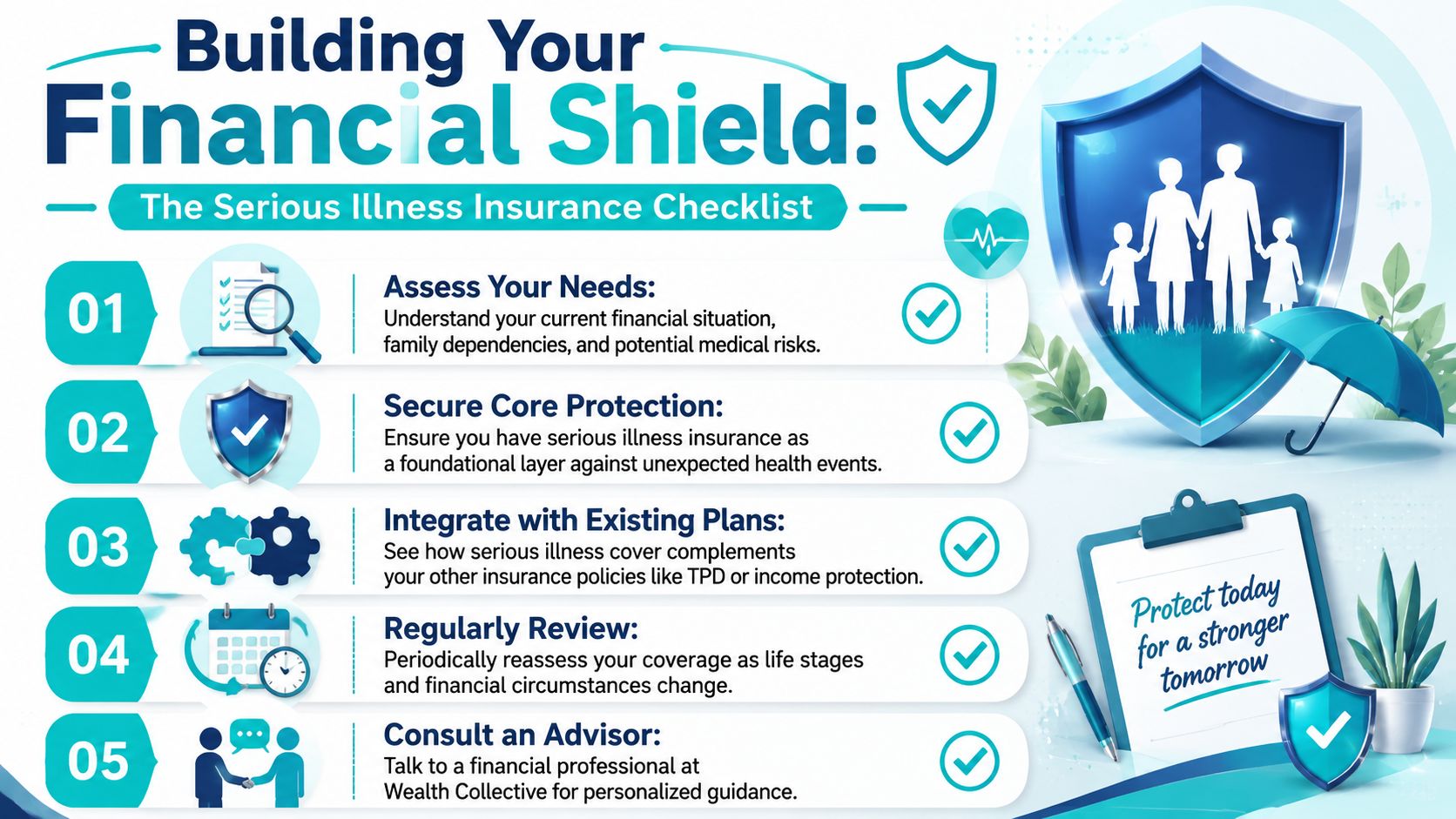
A simple checklist
- Check your household exposure: Would a serious illness reduce income, increase care costs, or force you to spend savings meant for other goals?
- Review your current cover: Do you already hold life insurance, TPD, or income protection, and are you relying on them for risks they may not cover?
- Look at your fixed commitments: Mortgage repayments, rent, school fees, and business overheads usually continue.
- Read definitions, not just summaries: The value of trauma cover sits in the policy wording and claims definitions.
- Match the structure to the goal: Cover amount, premium pattern, ownership, and how the policy fits with your broader plan all affect whether it will hold up when needed.
Where advice helps
Product comparison on its own rarely solves this well. The actual task is deciding what needs protection first, how much risk you can carry personally, and whether the premium remains sustainable alongside everything else you are funding.
That is where broader advice earns its keep. For Australians reviewing personal protection as part of a wider financial plan, Wealth Collective's Protection Plus service is one option. It focuses on personal insurance policy management within an ongoing advice relationship, which helps when trauma cover needs to be considered alongside debt, super, investment strategy, business commitments, and retirement timing.
Good cover should support the future you are building. It should not sit off to the side as a product you bought years ago and never properly tested.
If this article has raised questions about your own cover, the next step can be straightforward. A short conversation with Wealth Collective can help you assess whether serious illness insurance suits your situation, identify any gaps, and set up cover around the goals you want to protect.