Business hours
Monday to Friday (8.30AM - 5PM)
Weekend (Closed)


The profit has landed in the business account, and June is close enough to make a lump-sum transfer look tidy. You are a sole trader, so nobody is paying super for you, and a personal contribution looks like the clean way to cut this year's tax. Then you remember the next business activity statement, the PAYG instalment, and the wages you still have to cover. Super contributions for sole traders only work when the cash can leave the business without starving the next quarter.
The useful question is not whether retirement saving is worthwhile. Over a working life, it is. The useful question is how much can leave now, whether a deduction is even the right tax treatment, and whether the fund will hold both the money and the paperwork before you lodge.
Super Limits for Sole Traders at a Glance
The caps tell you the most you can move into super this year. Cash flow tells you how much of that room to use. Write the limits down before you pick an amount, then size the payment from what is spare once business tax and any staff super are covered.
| Rule | 2025-26 |
|---|---|
| Concessional (deductible) contributions cap | $30,000 |
| Non-concessional (after-tax) cap, balance under $2 million | $120,000 |
| Age limit for personal deductions | Under 75 |
What the concessional cap actually limits
The Australian Taxation Office concessional contributions cap sets the standard concessional contributions cap at $30,000 for 2025-26. Concessional contributions include personal contributions you claim as a tax deduction, employer contributions and salary-sacrificed amounts. For a sole trader, the usual mix is the deductible personal contribution plus any concessional amounts the fund has already received, often from a second job.
That second-job point trips people up. A few months of employed work can eat into the cap before you have contributed a dollar of your own, leaving far less deductible room than the headline figure suggests.
Those contributions are generally taxed in the fund at 15%, and exceeding the cap can bring additional tax. A strong profit year does not lift the cap, so a bumper season cannot be tipped into super at the concessional rate just because the bank balance is high. Our guide to concessional contribution limits is the place to line the cap up against money already counted for the year.
Readers who also look at UK pension rules can compare the idea with tax relief on pension contributions from Stewart Accounting Services. The relief concept is familiar. The Australian caps, the fund tax and the notice you must lodge are not the same, so that UK explainer is a contrast, not a template you can follow here.
What to record before any of these numbers apply
Unused concessional cap can sometimes be carried forward and used in a later year, but only where the eligibility rules are met. Check the fund's contribution history and any available carry-forward amount before a large end-of-year payment. That cap-and-tax check is the sort of coordination built into Guided Growth, which turns your income and assets into an engine for building wealth based on your goals and life circumstances, rather than a single June transfer.
Practical rule: Do not apply a cap figure until you have this year's contributions and your total super balance in front of you.
Before you model a payment, write down two figures from the fund:
- Total super balance: Take the balance the fund reports at the prior 30 June, because after-tax room is tested against that balance, not against today's estimate.
- Concessional contributions already in: Add employer amounts, salary sacrifice and any personal contribution you plan to claim. The deductible piece has to fit in what is left.
Employee super is a separate legal bill from your own cap, and a personal deduction is only available while you are still under 75. Those two constraints decide whether a payment is even on the table. The dollar caps above decide the size, and the cash left after reserving tax and staff obligations decides how much of that size you can afford to use.
Cash Flow Rules Before You Contribute
A regular personal contribution is not always the right first move. Plenty of owners set a monthly transfer because it feels disciplined, then discover in April that the money was the GST and the staff super. Locking cash into super before those bills are covered is how a sensible retirement habit becomes a cash-flow problem.
The legal split is easy to miss. The ATO's rules on deductions for salaries, wages and super contributions put it this way: a sole trader generally does not owe super guarantee for themselves, but must meet super obligations for eligible employees and certain contractors. That split matters more as the super guarantee rate reaches 12%, and as Payday Super is scheduled to require employee super payments each payday from 1 July 2026.

Why the usual monthly transfer fails
Most writing on this topic starts with the owner's personal contribution and skips the operational risk of mixing retirement saving with payroll. If you employ eligible workers, their super has to be paid. From 1 July 2026 that payment is timed to each payday, so the old quarterly float disappears. PAYG instalments and GST have the same character. They are not optional leftovers. They are money that was never really yours.
I would not send a personal contribution until tax and employee super are sitting in a separate account. A transfer you cannot reverse is a poor place to park money you will need for a BAS.
The other failure mode is the opposite one. If you delay personal contributions indefinitely, nothing compulsory is accruing for you. Employees build a balance because the law forces the payment. You do not. A buffer that never gets spent on super becomes a permanent hole in retirement savings.
A reserve order that survives a weak quarter
Use a fixed order, then let the personal amount move with profit. Our guide to small business cash flow management sits beside this, because the reserve accounts are what make the super decision possible.
- Pay employee super on every payday. Treat it as part of wages, not as a quarterly tidy-up. Payday Super raises the cost of leaving it late.
- Move PAYG and GST aside as income arrives. A separate account stops you spending tax that the next BAS will call in.
- Hold a cash buffer for business expenses. Pick a number of months you can fund, and refill it before you increase super.
- Set the personal contribution as a percentage of quarterly profit left after those reserves. Strong quarters pay more. Weak quarters pay less, or nothing.
- Review structure and contractors once a year. A new employee, or a contractor who is eligible for super, changes what you must pay before any personal amount.
Say a quarter shows $25,000 of profit. You set aside $6,000 for tax and $3,000 for employee super. That leaves $16,000 to split between the buffer and a personal contribution. If the buffer is already full, more of the $16,000 can go to super. If a quiet month is coming, most of it should stay in the business. The split is a rule you choose, not a rate the law sets for the owner.
A variable percentage beats a fixed monthly promise. The percentage falls when profit falls, so you are not borrowing from the ATO to fund a deduction.
Personal Deduction or After-Tax Contribution
The question most owners ask is simple. Should this payment reduce this year's taxable income, or should it go in after tax with no deduction?
| Criterion | Personal deduction | After-tax contribution |
|---|---|---|
| Income tax deduction | Yes, in the year you contribute | No |
| Cap it counts toward | Concessional cap | Non-concessional cap |
| Notice of intent to the fund | Required before lodging the tax return | Not required |
| Best when | Profit is high and concessional cap has room | Cash is available but no deduction is needed, or concessional cap is used |
How the two routes split
A personal deduction lowers taxable income in the year you contribute. It suits a year where profit is strong and there is still room under the concessional cap. An after-tax contribution gives no income-tax deduction. The ATO contribution caps state that personal contributions you do not claim as a deduction count towards the non-concessional cap instead. For 2025-26 that annual cap is $120,000 where total super balance on 30 June 2025 is below $2 million, and the individual cap can differ with balance and circumstances. The same ATO thresholds list $120,000 for 2024-25 and 2025-26, and $130,000 for 2026-27.
That is two planning decisions, not one product. You either contribute for a current-year deduction under the concessional rules, or you contribute after tax without a deduction under the non-concessional rules. We look at those alternatives next to business cash reserves, debt reduction, investment objectives and retirement income needs, rather than treating the payment as a tax trick on its own. If the after-tax route is the one with room, read what non-concessional contributions are before you pay, so the fund receives the amount on the correct basis.
Two owners, two sensible answers
Take a sole trader with $160,000 of net profit who still has concessional room. A $30,000 deductible contribution brings taxable income down to $130,000. The deduction is doing real work because the profit is there and the cap is not already full.
Now take a sole trader with $60,000 of profit who still has to fund PAYG and GST out of that profit. A deduction looks attractive on a calculator and poor in the bank. If cash is tight, the right contribution may be smaller, later, or after tax once the reserves are safe. If the concessional cap is already used by employer amounts from other work, a further deductible claim is the wrong tool even when profit is high.
The trap is double counting. A personal contribution you claim as a deduction uses concessional cap. An employer contribution from a second job uses the same cap.
Check the fund's contribution history, and any unused carry-forward, before you pick the route. Choosing the deduction on a guess, then finding the cap was already full, is how a planned tax cut becomes extra tax.
Make a Deductible Super Contribution Without Errors
Voluntary does not mean casual. The ATO's guide for sole traders and partnerships confirms you are not required to pay Superannuation Guarantee for yourself, because you are not treated as your own employee. You can still make voluntary personal contributions to a complying super fund or retirement savings account from business income, and claim a personal tax deduction for eligible contributions until you turn 75, subject to the notice and contribution rules. Because the payment is voluntary, it is the last claim on your cash: PAYG, GST and any employee super are reserved first, and the contribution is sized from what is left. If you hire eligible employees, their super is compulsory even though yours is not.
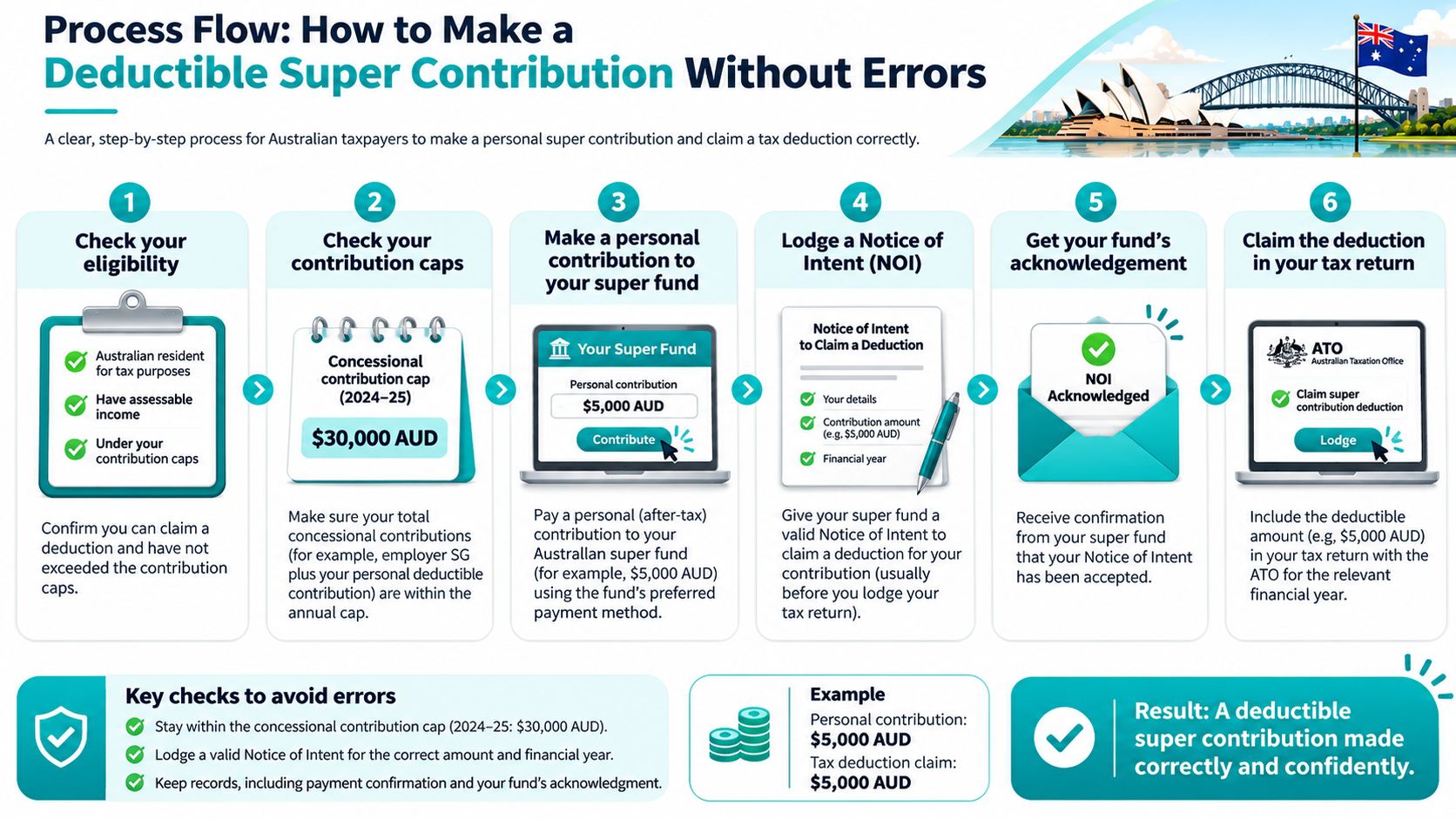
The working order is: estimate income and cash flow, decide the tax treatment before you pay, check the concessional total, get the money to the fund by 30 June, then lodge a notice of intent and hold the written acknowledgement before you lodge the tax return. For 2025-26 the standard concessional cap is $30,000, and deductible personal contributions count toward it. Unused cap amounts may be carried forward where you are eligible.
Before the money leaves the account
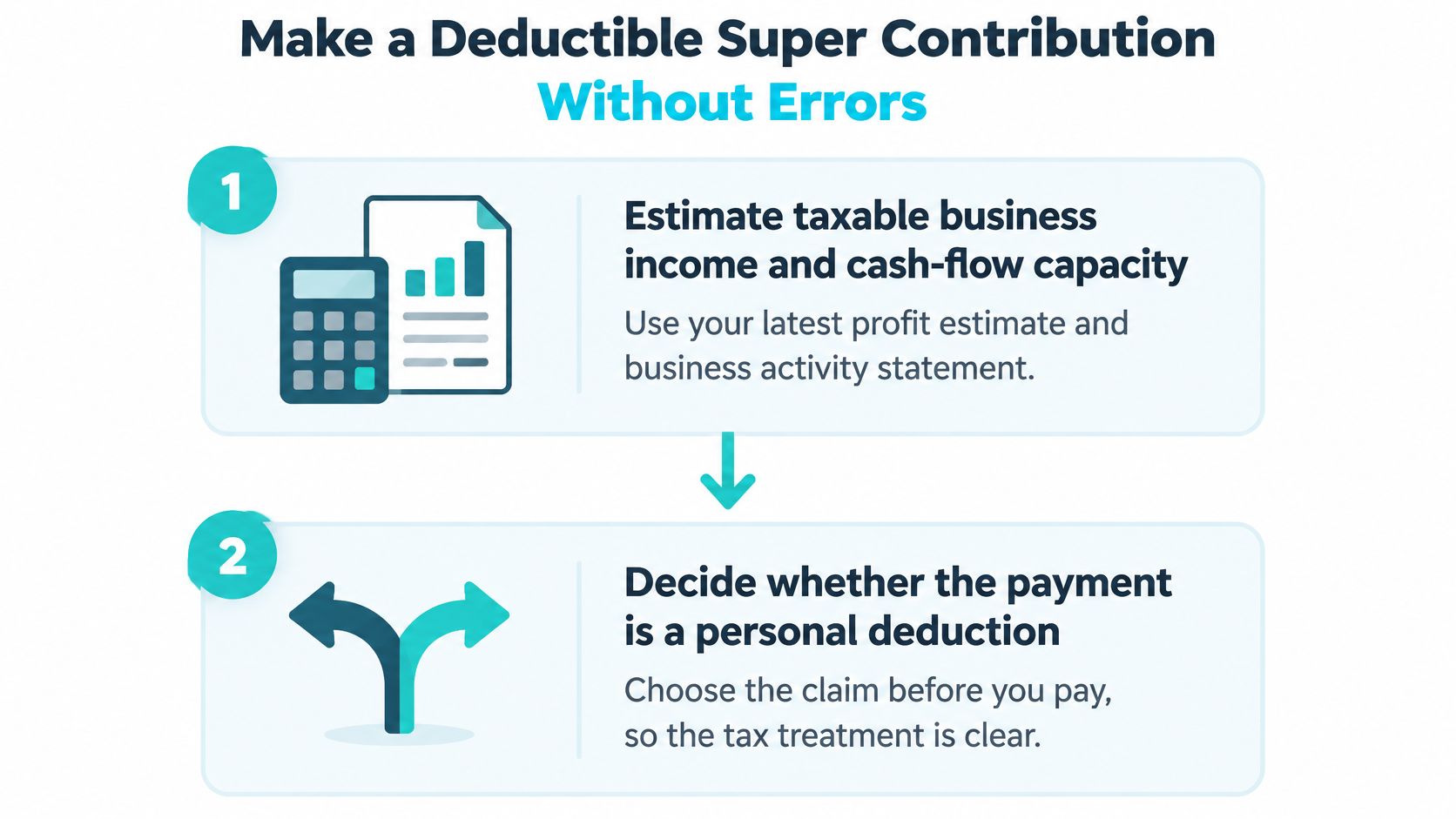
1. Estimate taxable business income and cash-flow capacity. Use the latest profit estimate and the business activity statement, not last year's return and not a hopeful invoice that has not been paid. The ceiling for your contribution is profit minus the tax already spoken for and any staff super accrued, not profit alone.
The pitfall is estimating from turnover. Turnover is not profit, and profit is not spare cash. If the BAS already shows a GST shortfall, that shortfall comes off the amount you can contribute before a single dollar moves.
2. Decide whether you will claim a personal deduction. Make that choice before you transfer, based on which route your cap room and cash position support. The fund does not guess your tax treatment. You do.
The pitfall is paying first and deciding later. A contribution you meant to claim, then leave unclaimed, lands in the after-tax bucket. A contribution you claim when you had no room creates a cap problem. The decision belongs on paper before the transfer.
3. Check every concessional dollar, including other jobs. Add employer contributions and salary sacrifice from any employment to the personal amount you plan to deduct. Then test the total against the cap, and against any carry-forward you are eligible to use.
The pitfall is looking only at what you pay from the business. A part-time employer may already have paid several thousand into the same fund. That money counts.
Getting the fund to hold the contribution
4. Pay early enough for the fund to receive the money by 30 June. A bank transfer started on 30 June is not a contribution on 30 June. The contribution counts when the fund receives it. Pay by BPAY or the fund's stated method with enough clearing time, then confirm the credit on your member statement or the fund's transaction list.
The pitfall is treating an intention, a note in the accounts, or a transfer that is still pending as enough. It is not. If the money arrives on 1 July, it is next year's contribution, and this year's deduction is gone.
5. Give the fund your tax file number before you pay. The fund should hold the member's tax file number. Without a TFN, contributions may attract an additional 32% tax, the fund may reject the payment, and you may miss a government co-contribution.
The pitfall is assuming a fund you joined years ago still has the TFN on file. Log in and check. Wealth Collective will not adopt a client's TFN as its own identifier, so for contribution purposes the number needs to sit with the fund, which is the body that applies this rule.
The notice that makes the deduction real
6. Lodge a valid notice of intent and wait for written acknowledgement. Do this before you lodge the tax return. The notice is due by the earlier of the day you lodge the return or the end of the following income year. Claiming the deduction before the fund has acknowledged the notice can invalidate the claim, and you then face an amended return plus a cash-flow mess you thought the contribution had solved.
The pitfall is lodging the tax return on the same afternoon you email the notice. Acknowledgement is a document from the fund, not a sent-items folder. Save it with the BAS and the member statement.
7. Claim the deduction only after that acknowledgement, and confirm the contribution on the statement. The return should match the acknowledged amount. The statement should show the same contribution in the same year. If the two disagree, fix the mismatch before you lodge, not after an assessment arrives.
A correct outcome is boring, which is what you want. You hold a written acknowledgement, the fund shows the contribution as received by 30 June, and the deduction on the return equals that acknowledged amount. Anything short of those three is a draft, not a completed contribution.
Book a Call to Confirm Your Contribution Plan
A contribution plan holds up when the paperwork proves three things: the business tax is funded, staff super is covered, and the personal amount still fits inside the cap after those reserves come off the top.
Bring four things to the first conversation so the numbers are yours, not averages.
- Latest profit estimate and business activity statement: These show what the business has earned and what tax is already spoken for.
- Fund statements for this year: These show concessional and non-concessional amounts already received, which is the only reliable cap check.
- Total super balance: This is the figure that sets after-tax room.
- Payroll figures if you employ anyone: Employee super at the going rate has to be reserved before a personal amount is sized.
That order matters. Set aside PAYG, GST and employee super first, then size the contribution from the cash that remains. A deductible amount can look tidy on a draft return and still strain June wages if the reserve was skipped. If a statement export fails while you are gathering documents, get in touch with support and replace the file before the call rather than arriving with gaps.
You can book a free 10-minute intro call, and we take care of the rest. On that call we line up cap room and any carry-forward, compare a deduction with an after-tax contribution, and set the cash reserve so the business can still pay tax and staff super. Guided Growth is the service that turns that income and those assets into a plan built for your goals, not a generic contribution rate.
Once you are 100% comfortable with the outcomes, we take care of the paperwork, any products that are required, and the end-to-end implementation. Your own circumstances decide the amount, so confirm it with one of our qualified Financial Advisers before you act. The practical deadline is the fund's receipt date. Book early enough to pay, receive acknowledgement, and still lodge with the paperwork in hand before 30 June.
Wealth Collective helps sole traders decide how much to contribute, whether the payment should be deductible, and how to keep tax and wages funded while the balance grows. Protection Plus, Guided Growth and Retirement Roadmap cover insurance and super, the wealth-building plan, and the path into retirement, so super contributions for sole traders sit inside a wider plan rather than a last-week transfer. Visit Wealth Collective and book the intro call while there is still time for the fund to receive this year's payment.