Business hours
Monday to Friday (8.30AM - 5PM)
Weekend (Closed)


You're probably here because your super feels important, but not clear.
Maybe you've got a few accounts from old jobs. Maybe your insurance sits inside super and you're not sure if it's helping or steadily draining the balance. Maybe retirement is close enough to feel real, but still far enough away that you keep putting the bigger decisions off. That's normal. I see it all the time with people in Perth, Busselton, Dunsborough, and right across WA.
The problem isn't that you're careless. The problem is that super is technical, heavily regulated, and tied to tax, insurance, investment risk, retirement income, and estate planning. A member statement can tell you what exists. It usually doesn't tell you what to do next.
That's where a good superannuation financial advisor earns their keep. Not by waving around a “top fund” list. By helping you turn a pile of accounts, rules, and half-made decisions into a plan you can use.
Is Your Super Ready for Your Future
A lot of people hit a point where the question changes.
It stops being “How's my super going?” and becomes “Will this fund the life I want?”
That moment often arrives. You're at the kitchen table in Perth after work, or on the deck in Dunsborough with a coffee and your latest statement open. You can see the balance. You can see the investment option. You can see fees, insurance premiums, and contributions. But you still can't answer the only question that matters. Are you on track?

That uncertainty gets worse near retirement, but it doesn't start there. I've seen it with young professionals deciding whether extra super contributions beat mortgage repayments. I've seen it with business owners juggling lumpy cash flow. I've seen it with pre-retirees who realise they've built a decent balance but still don't know how to turn it into reliable income.
The statement isn't the strategy
Your super statement is a snapshot. A proper plan looks at whether your contributions, investment setting, insurance, and fees are working together.
For 2024 to 2025, the concessional contributions cap is AUD 30,000 and the non-concessional cap is AUD 120,000, so any advice around salary sacrifice or after-tax top-ups has to be tested against those hard limits. The same analysis should also account for carry-forward concessional rules, Division 293 tax exposure, and total super balance thresholds, because those details can change whether a strategy helps or just creates extra tax or penalties, as outlined in this super advice workflow guide.
Super becomes useful when it answers a life question, not when it simply reports a balance.
If you're trying to work out whether your current balance is enough, this guide on how much super you need to retire is a sensible place to start. Then get advice that connects the number to real decisions.
What a Superannuation Specialist Actually Does
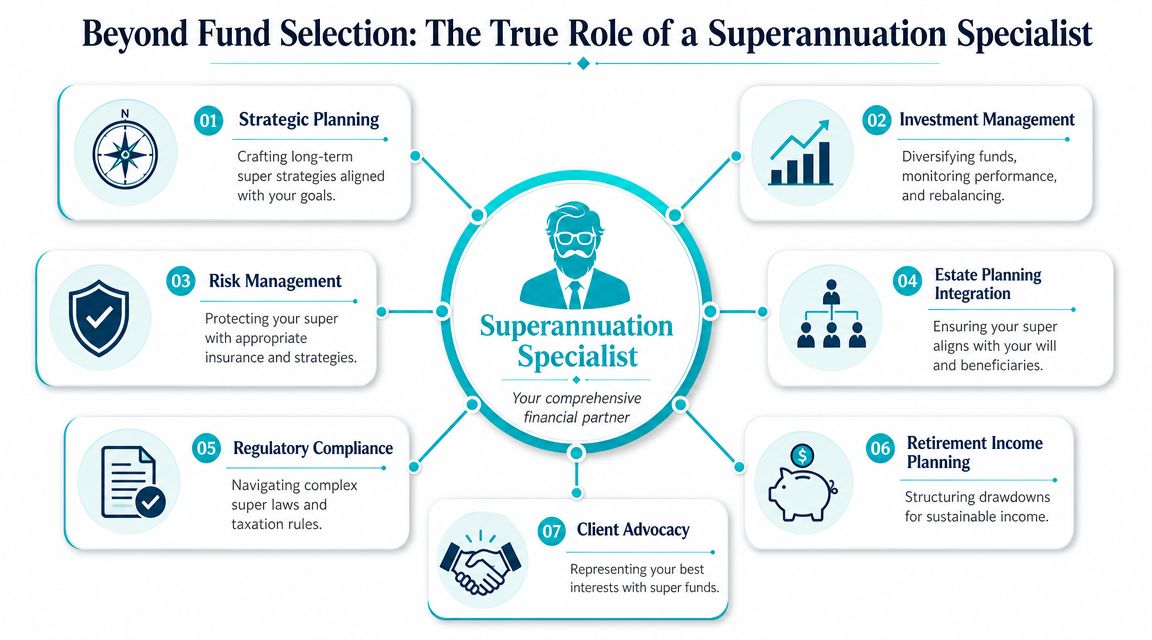
It is frequently misunderstood. Many believe a superannuation financial advisor mainly picks a fund.
That's too narrow, and frankly, it misses where the value sits. The better question is whether the advisor can pull your super, tax, insurance, retirement income and estate planning into one workable plan. The Society of Actuaries makes that point clearly in its retirement advice research paper. Scope matters more than branding.
Optimisation means fixing what's already there
A good specialist starts with the moving parts you already have.
They'll check whether you've got multiple accounts that should be consolidated. They'll review whether insurance inside super still suits your life stage. They'll look at your contribution pattern, your employer payments, your fee structure, and whether your investment option matches your timeframe and risk tolerance.
This is practical work. It's not glamorous. It matters.
Strategy is where advice becomes valuable
Once the basics are cleaned up, strategy starts.
That can include:
- Contribution planning that fits the rules and your cash flow
- Investment positioning that matches your timeline instead of your emotions
- Insurance coordination so you're not overpaying for cover you no longer need
- Retirement income planning so your super supports spending, not just accumulation
- Estate planning alignment so beneficiary arrangements don't contradict your broader wishes
If you're comparing firms, look for one that can handle this whole chain. For example, some advisers only provide narrow investment help. Others work across broader planning areas such as super optimisation, insurance, debt reduction and retirement strategy. That broader model is far more useful when life gets messy.
Coaching is the part people underestimate
The market drops. Headlines get ugly. Your fund underperforms for a period. You feel the urge to change something fast.
That's exactly when a specialist earns trust. They stop you making a rushed decision that damages a long-term plan. They also help you act when action is required, because doing nothing can be just as costly as overreacting.
A practical filter: ask whether the advisor helps you make better decisions in bad markets, not just whether they can explain good markets.
If you like using technology to organise complex financial documents before a meeting, an AI finance compliance advisor can be a useful prep tool. It won't replace personal advice, but it can help you sort records and questions before you sit down with a human adviser.
Screening Advisors Your Non-Negotiable Checklist
The advice market has tightened. That changes how you should search.
IBISWorld reports that adviser numbers in Australia fell from over 26,000 in 2019 to less than 16,000 in January 2025 in its financial planning and investment services industry profile. A smaller pool doesn't mean you should settle. It means you need a sharper filter.
Start with the basics and don't skip them
Use this checklist before you book anything substantial:
- Check they're properly registered: Confirm they're licensed or authorised to provide the advice you need.
- Look for super and retirement depth: Plenty of advisers say they “cover super”. That's not the same as specialising in contribution strategy, retirement income, insurance inside super, and beneficiary planning.
- Test for client fit: Ask whether they regularly work with people like you. A young Perth professional, a couple with school-aged kids, a FIFO worker, and a pre-retiree in the South West often need very different advice.
- Review how they explain things: If they hide behind jargon in the first conversation, it won't get better later.
- Ask how they work with accountants and lawyers: Super decisions often spill into tax and estate planning. If they operate in a silo, that's a problem.
Then move to the commercial questions
People often get shy here. Don't.
- How are fees charged? If you don't understand the fee model, pause.
- What is and isn't included? Ongoing service should be clear, not implied.
- How often will they review your position? Super strategy shouldn't sit untouched for years.
- Who does the work? Some firms have a team model. That can be useful if it improves responsiveness and technical depth.
If you want a plain-English breakdown before you speak to anyone, read this guide on financial advice fees in Australia. It'll help you spot fuzzy answers fast.
The first job of screening is elimination. You're not looking for someone impressive. You're looking for someone competent, clear, and relevant to your life stage.
Red flags that should end the conversation
Some signs aren't minor concerns. They're reasons to walk away.
- They talk products before goals: That's backwards.
- They can't describe their process clearly: Good advice has a repeatable structure.
- They avoid discussing scope: If they won't define what they do, expect confusion later.
- They make you feel rushed: Trust doesn't grow under pressure.
A solid advisor should leave you feeling better informed after the first meeting, even if you never hire them.
The Advisor Interview Questions That Reveal True Value
A first meeting should tell you more than fees and credentials. It should show you how the advisor thinks.
That matters because technical competence alone isn't enough. Research cited by the Financial Planning Association suggests around 3.1% per year of advisor value can come from behavioural coaching, such as helping clients avoid poorly timed decisions during market stress, within a broader average value of 5.2% per year attributed to advised clients, as discussed in this FPA journal article. In plain English, a meaningful part of the value is how they help you behave.
Ask process questions first
Start here:
- How do you assess whether my current super setup is working?
- What happens in the first ninety days if we work together?
- How do you decide whether I need limited advice or broader planning?
- What information do you need before making recommendations?
Good answers are structured and concrete. Weak answers sound vague, generic, or salesy.
Ask how they handle market stress
You separate portfolio talk from real advice at this point.
- What do you do when a client wants to switch investment options after a market fall?
- How do you coach clients to stay on plan when headlines get noisy?
- What triggers a portfolio review versus a reminder to stay disciplined?
- How do you explain risk in plain English?
If they only talk about performance, keep looking. Behavioural coaching is part of the job.
A calm advisor with a clear process is worth more in a rough market than a flashy one with strong opinions.
Ask questions about scope
These tell you whether they're thinking broadly enough.
- Do you advise on insurance inside super?
- Will you coordinate with my accountant if contribution or tax issues come up?
- Can you help me think about retirement income, not just accumulation?
- How do you factor debt reduction, cash flow, and estate planning into super advice?
A strong superannuation financial advisor should be able to connect those dots.
Ask how they measure success
This is one of my favourite filters because few inquire about it.
- What does success look like for a client like me after one year?
- What gets reviewed regularly?
- How do you know when the plan needs to change?
- What would make you tell me not to proceed with a strategy?
You want an advisor who can describe outcomes in practical terms. Better cash flow. Cleaner structures. Stronger protection. More confidence around retirement timing. Fewer avoidable mistakes.
Use this fee table to decode the answer
| Fee Model | How It Works | Best For |
|---|---|---|
| Fee for service | You pay a set fee for specific advice work or a defined plan. | People who want clarity on cost and a clearly scoped piece of advice. |
| Asset-based fee | The fee is linked to the amount managed or advised on. | People seeking ongoing portfolio and strategy support where investment oversight is part of the service. |
| Hybrid | A mix of upfront project work and ongoing service fees. | People who need a substantial initial plan and regular reviews afterward. |
The final interview question
Ask this near the end.
If I become a client, what will you help me stop worrying about?
That question cuts through brochure language. A good answer sounds human and specific. It tells you whether the advisor understands your real problem.
From First Call to Final Plan The Client Journey
Many delay getting advice because they assume the process will be awkward, expensive, or overloaded with jargon.
A good process feels the opposite. It should feel organised, calm, and easy to follow.
Industry SuperFunds points out that members can access professional advice for specific needs at any stage through fund-based channels in its guide to financial advice options through super. That matters because advice isn't only for retirees. Younger professionals, couples, and business owners often need help long before retirement.
What the journey should feel like
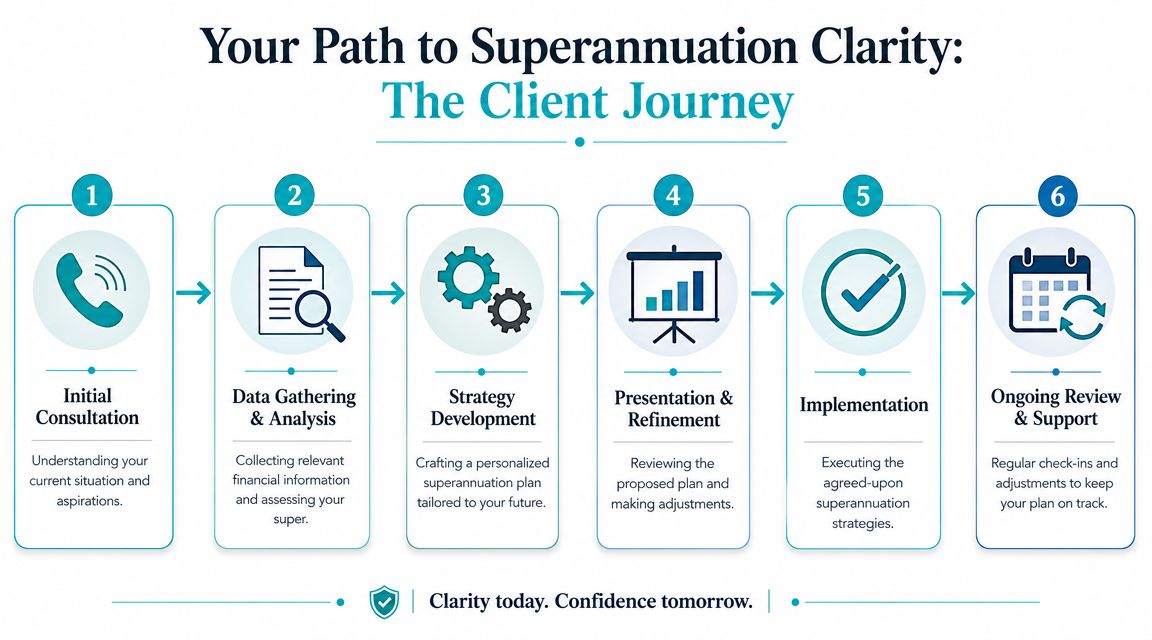
A typical path looks something like this.
First, you have a short introductory call. Not to solve everything. Just to work out fit. You explain where you are, what's worrying you, and what sort of help you think you need.
Then comes the fact-find, during which the advisor gathers your super details, income, debts, insurance, family situation, goals, and existing structures. If they're thorough here, that's a good sign.
Strategy should be tailored, not templated
After the information gathering, the advisor builds recommendations around your life stage.
For a young professional in Perth, that might centre on contribution habits, insurance needs, and balancing debt reduction with long-term wealth building. For a couple in their fifties, it may focus on retirement timing, super catch-up opportunities, and cleaning up outdated insurance. For a business owner, it often involves coordinating personal and business cash flow decisions.
At this point, some firms use service frameworks to organise the work. That can be useful if it helps you understand what sits under protection, wealth building, and retirement planning rather than turning the process into a sales script.
The right process reduces confusion. It doesn't add another layer of it.
Implementation is where plans usually fail
Plenty of people receive advice. Fewer implement it properly.
That's why the handover matters. You should know what gets done, who does it, what needs your approval, and what will be reviewed later. A clean implementation process covers account changes, contribution updates, insurance changes, investment adjustments, and any coordination needed with your accountant or solicitor.
After that, the relationship moves into review mode. Life changes. Markets move. Rules shift. A sensible review process keeps the plan aligned with reality instead of locking you into old assumptions.
Making Your Decision and Taking the Next Step
At this point, the decision should feel simpler.
You're not looking for somebody who talks the most. You're looking for a properly qualified professional who can understand your stage of life, explain your options clearly, and build advice around your actual goals.
In Australia, this role sits within the formal occupation classification Financial Investment Advisers and Managers (ANZSCO 2223), which covers developing financial plans, recommending strategies designed to meet a client's objectives, and managing funds raised from personal superannuation savings policies, according to the Jobs and Skills Australia occupation profile. That matters. You're not hiring a product salesperson. You're engaging a regulated professional.
Use this final decision checklist
Decision checklist
Choose the advisor who:
- explains scope clearly, including what they will and won't cover
- understands your life stage and works with clients like you
- can connect super with tax, insurance, retirement income and estate issues
- answers fee questions without evasion
- has a process you can follow from first call to ongoing review
- makes you feel clearer, not more confused
If you're comparing local options, this guide to financial advisors in Perth can help narrow the field.
One final point. Don't wait for perfect timing. Super decisions tend to improve when you make them earlier, not when you've exhausted yourself worrying about them.
If you want a straightforward starting point, book a complimentary 10-minute call with Wealth Collective. It's a simple way to see whether the fit is right, ask your first questions, and get clear on what kind of advice would help.