Business hours
Monday to Friday (8.30AM - 5PM)
Weekend (Closed)


Maria is 60, lives in Perth, and has built a $2.4 million super balance by the time retirement starts looking real rather than theoretical. She's done the hard part, saved well, stayed disciplined, and now the phrase superannuation transfer balance cap keeps coming up in conversations she didn't ask to have. The number sounds like a warning, but for someone in her position it's really a planning question. How much can move into pension phase, what stays in accumulation, and does the answer change if she wants flexibility for her spouse or estate?
That's the right way to approach it. The cap is not a reason to panic, and it's not something to ignore either. It's a rule that changes the shape of retirement planning, especially once balances are above the headline cap and timing starts to matter.

For readers like Maria, the question isn't just “Am I over the cap?” It's “What's the smartest way to use the cap with the balance I've got, the income I need, and the family outcomes I care about?” If you're trying to work that out for yourself, this retirement income guide can help you think about the bigger retirement picture before you get lost in the jargon.
When a $2.4 Million Super Balance Feels Like a Problem
Many people first hear about the superannuation transfer balance cap only when retirement is close. They've spent years building super, then suddenly they're told there's a cap, a personal cap, indexation, accumulation phase, pension phase, and possibly tax consequences if they get it wrong. That sounds alarming, but the rule itself is narrower than some people think.
Maria's situation is common because the number on the page feels bigger than the cap headline. She doesn't need to ask, “How do I get every dollar into pension phase?” She needs to ask whether part of the balance should remain in accumulation, whether she's using her cap efficiently, and whether her pension start date affects her future flexibility.
Practical rule: the cap is a retirement planning constraint, not a penalty for saving well.
A strong retirement plan doesn't treat the cap as a cliff. It treats it as a lever that changes the mix between tax-free retirement income and tax-paid accumulation, depending on the person's age, spending needs, partner arrangements and long-term goals. That's why the same balance can lead to very different strategies for two people who look similar on paper.
The rest of the article builds the rule step by step, starting with what the cap limits, then moving into indexation, personal cap calculations, account types, breaches, and the trade-offs that matter most for higher-balance retirees. The goal is simple, to make the rule feel usable rather than intimidating, which is the same kind of clarity clients look for in a retirement planning conversation.
What the Transfer Balance Cap Is
A superannuation transfer balance cap sets a lifetime limit on how much super can move into the tax-free retirement phase. It does not cap the total amount you can have in super. That distinction matters, because plenty of people hear “cap” and assume anything above it is invalid or wasted. It isn't.
A practical way to read the rule is this. The cap limits how much of your super can sit in a pension that is taxed at the retirement-phase rate. The rest can stay in super, usually in accumulation phase, where the account still works for long-term retirement saving even though the tax treatment is different.
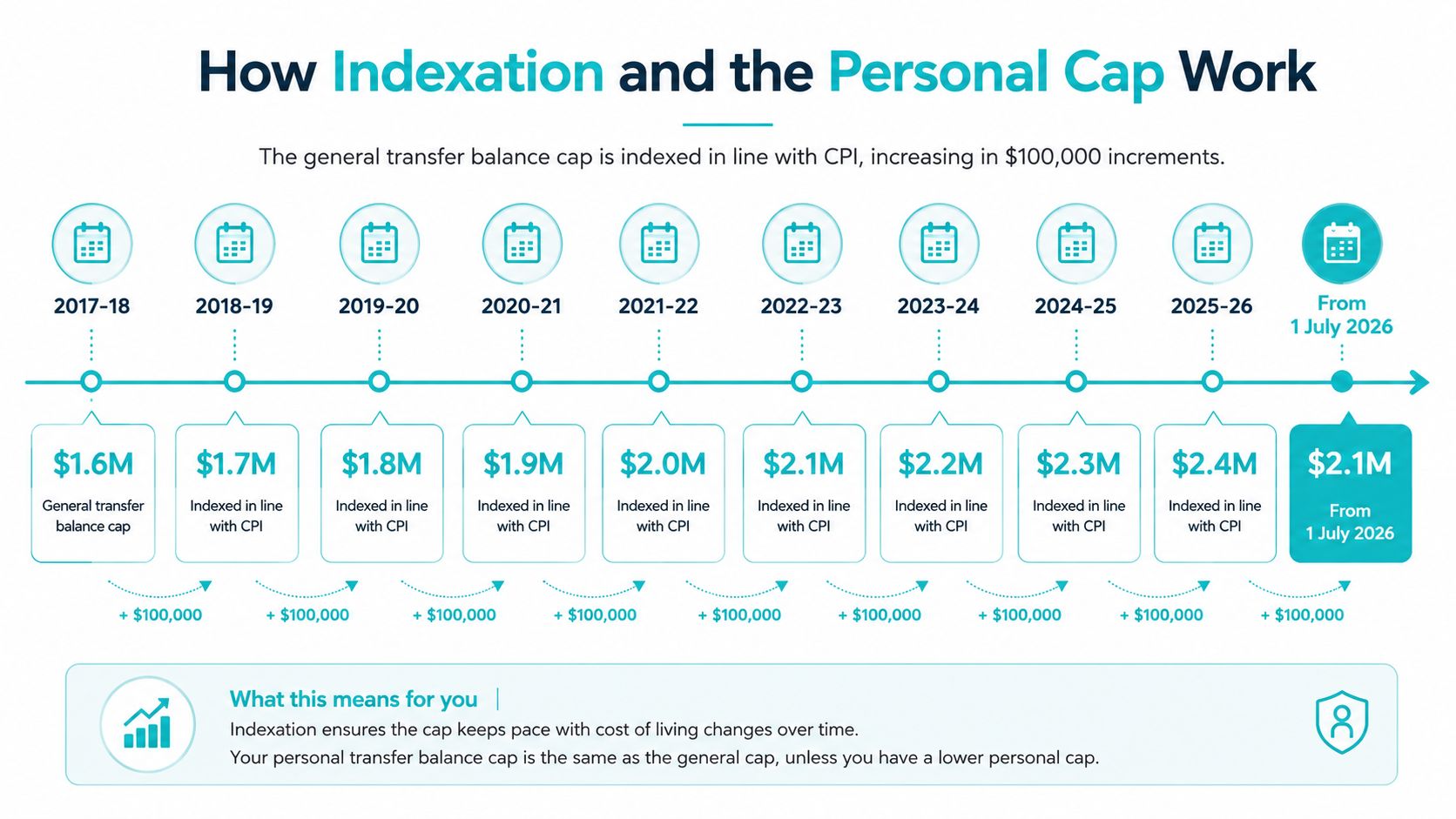
The cap began on 1 July 2017 under the Treasury Laws Amendment (Fair and Sustainable Superannuation) Act 2016. The ATO says it applies to the total amount transferred into retirement-phase income streams, with the general cap starting at $1.6 million for 2017–18. Since then, the cap has been indexed in $100,000 increments linked to CPI, reaching $1.7 million for 2021–22 and 2022–23, $1.9 million for 2023–24 and 2024–25, and $2.0 million for 2025–26. The ATO also notes the general transfer balance cap increased on 1 July 2026 from $2.0 million to $2.1 million. ATO transfer balance cap guidance
In plain English, the cap limits how much super can enter tax-free pension phase, not how much can sit in super overall.
A retirement phase income stream is the kind of pension that can receive that transfer, mainly an account-based pension, and in some cases a defined benefit pension. That is the point where the tax treatment changes. Money inside the cap can earn in the retirement phase, while money above the cap does not disappear. It stays in accumulation phase.
That accumulation side is often misunderstood. Earnings there are generally taxed at 15%, rather than 0% in pension phase. So the cap is really about where the money sits, and how it is taxed, not about whether super remains useful.
For people who want a simple way to keep retirement spending and account structure in view at the same time, a family expense tracker retirement resource can help line up cash flow with the way their super is organised.
How Indexation and the Personal Cap Work
The general cap doesn't sit still. It rises in $100,000 increments when indexation applies, and the ATO has already taken it from $1.6 million in 2017–18 to $2.1 million from 1 July 2026. That sounds simple enough until you realise your own number may be different from the headline cap.
Why your personal cap can differ
The ATO calculates a personal transfer balance cap using your transfer balance account history. That means the amount you can transfer into pension phase depends on how much cap space you've already used, not just on the current general cap. If you've only used part of your cap, you may get proportional indexation. If you've used it all, you don't.
The key rule is brutal in its simplicity. Once your transfer balance has ever equalled or exceeded your cap at the end of a day, you permanently lose future indexation gains. That's why pension commencement timing and partial commutations matter so much. Starting a pension too aggressively can lock you out of future cap growth, while leaving room unused can preserve flexibility later.
Here's the part people miss. Personal indexation is proportional, so the unused portion of your cap is what matters. The ATO's own guidance makes that point clearly, and it's why a person who started a pension years ago can end up with a different cap position from someone who started later, even if their balances look similar on paper. ATO personal transfer balance cap calculation
| General cap progression | When it applied | What it means |
|---|---|---|
| $1.6 million | 2017–18 | Initial general cap |
| $1.7 million | 2021–22 and 2022–23 | Indexed increase |
| $1.9 million | 2023–24 and 2024–25 | Indexed increase |
| $2.0 million | 2025–26 | Indexed increase before the next lift |
| $2.1 million | From 1 July 2026 | Current indexed level after the next rise |
A useful way to think about it is this. The headline cap tells you the current system limit. Your personal cap tells you what part of that limit is still available to you. Those are related, but they're not identical, and that difference can shape the best retirement start date.
For people comparing super contribution limits with pension limits, it helps to separate this rule from contribution caps altogether. If you're trying to see how those pieces fit together, the concessional contribution limits overview is a useful companion reference.
Which Super Accounts and Pensions the Cap Touches
The cap only bites when money moves into retirement phase. It doesn't apply to every super account in sight, and that's where a lot of confusion starts. An accumulation account, for example, isn't counted against the cap at all. It can still hold large balances, but it stays in the taxed super environment rather than the tax-free pension environment.
The main account types people mix up
An account-based pension is the most common retirement-phase product, and it counts against the cap. A transition-to-retirement income stream can also count once it moves into retirement phase. A defined benefit pension has its own separate treatment, with the ATO also referring to a defined benefit income cap. SMSF pensions are treated under the same cap rules, but the record-keeping sits closer to the member because the fund often reports directly through the ATO's transfer balance account system.
If you run an SMSF pension, keep your records tighter than you think you need to. The ATO's account history is what drives the cap outcome.
Lump sum withdrawals are different again. They're not the same as moving money into a retirement-phase income stream, so they don't work like pension commencement amounts. Death benefit income streams for dependants also have their own rules and shouldn't be lumped into the same bucket mentally.
| How Different Super Income Streams Interact With the Cap | ||
|---|---|---|
| Income Stream Type | Counts Against Cap | Key Practical Note |
| Account-based pension | Yes | The main retirement-phase income stream |
| Transition-to-retirement income stream | Sometimes | Counts once it moves into retirement phase |
| Defined benefit pension | Yes, under separate rules | A separate defined benefit income cap can apply |
| SMSF pension | Yes | Record-keeping and reporting matter a lot |
| Accumulation account | No | Earnings are taxed in accumulation, not at pension-phase rates |
| Lump sum withdrawal | No, not as a pension transfer | Different rule set entirely |
The practical point is simple. If someone says “my super is over the cap,” they may be mixing up total super balance with the amount moved into pension phase. That distinction is often the difference between a rushed decision and a clean one.
For people comparing pension options inside or outside an SMSF, the structural differences matter. The transition to retirement pensions guide helps show why the phase you're in changes the tax outcome and the reporting obligations.
Worked Examples That Make the Maths Real
A rule like this makes more sense when it's tied to actual numbers. The best examples aren't perfect, they're realistic enough that you can see how the decision changes when balances are higher than the cap.
Example one, a couple with $3.0 million combined
Suppose a couple has $3.0 million in super and wants to start account-based pensions in retirement. They decide to move $2.1 million into pension phase and leave $0.9 million in accumulation. That split fits neatly with the current general cap of $2.1 million from 1 July 2026. ATO transfer balance cap guidance
The tax logic is the point. Earnings on the pension-phase balance are taxed at 0%, while earnings on the accumulation balance are generally taxed at 15%. That doesn't mean the accumulation account is bad. It means the couple is choosing to keep part of their super in the taxed environment because they either don't need it in pension phase yet, or they want flexibility for later moves.
Example two, a member who used up cap space too early
Now take someone who started a $1.9 million pension in 2020. Their personal cap position is more complicated than the current headline figure. If that pension caused their transfer balance to meet or exceed their cap at the end of a day, they've permanently lost future indexation gains under the ATO's proportional rules. ATO personal transfer balance cap calculation
That can feel unfair, but it's the long-tail cost of using cap space too aggressively. Someone in that position may still have plenty of super, just not the same amount of future cap growth available to them. A partial commutation at the right time can sometimes preserve more future flexibility, but the exact outcome depends on the member's transfer balance history.
A balance can be large enough for retirement and still be structured badly if the pension start date was wrong.
These examples show why the answer is rarely “put everything into pension phase.” Sometimes the smarter choice is a deliberate mix of pension and accumulation, especially for couples with uneven balances, different ages, or plans to revisit the structure later.
What Happens if You Breach the Cap and How to Fix It
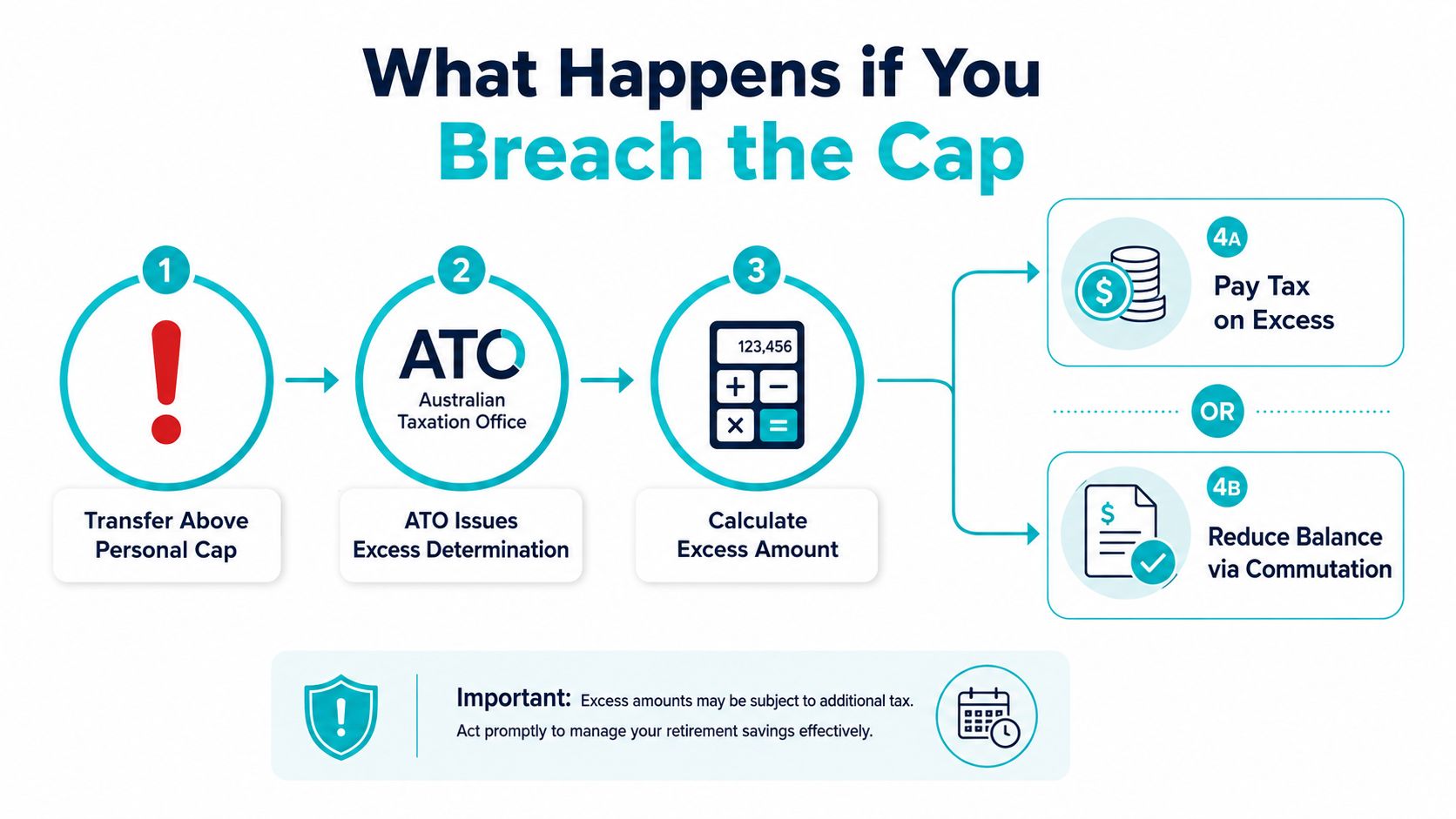
A breach occurs when your transfer balance sits above your personal cap at the end of a day. That timing point matters because the ATO looks at the day-end position, not a brief intraday spike that gets fixed before close. The system is largely automated, but timing mismatches and reporting errors can still create problems.
The correction path
Once the ATO identifies an excess, it can issue an excess transfer balance determination. The excess generally then needs to come out of retirement phase, usually by commutation back to accumulation or, depending on the member's circumstances, by a withdrawal from super. On the excess notional earnings, excess transfer balance tax can apply, and that tax is indexed and progressive. ATO general transfer balance cap indexation on 1 July 2026
The ATO wants the excess removed from the retirement-phase environment, and it expects the taxpayer to fix the position promptly after the determination arrives. In some cases there is a one-off chance to choose a different commute amount, but the election window is narrow and the paperwork has to be handled with care.
Why timing still matters after the breach
A breach rarely means the story ends there. It means the person needs to move quickly, check the account history, and make the correction in the right order. If the determination is ignored, the tax issue can keep building.
For SMSF members, reporting discipline matters. For retail and industry fund members, much of the reporting runs through the fund and the ATO system, but the member still needs to understand what the figures mean. If there is any doubt about the commutation choice, the sequence of transactions, or whether a pension should start at all, that is the point to get personalised advice rather than guessing.
Planning Strategies for Pre-Retirees, Retirees and High-Income Earners
For pre-retirees, the main decision is timing. Starting a pension too early can lock in a personal cap outcome you may regret later, while waiting can preserve flexibility if the general cap rises and your own balance situation changes. If one spouse has much less super, that can also affect how you think about re-contribution and long-term family outcomes.
For retirees already drawing a pension, the practical job is to watch the balance, not the headlines. If your pension balance keeps growing and you're near your personal cap, partial commutations may deserve attention before you accidentally burn through future indexation. It's also worth asking whether surplus really needs to sit in pension phase, or whether leaving some money in accumulation gives you better flexibility.
For high-income earners and executives, the cap is often less about day-to-day pension income and more about structuring super for estate and tax efficiency. That's where broad retirement planning and investment coordination matter together. If you're also thinking about external support on retirement protection or recovery from poor product advice, a resource like a retirement fund recovery lawyer may be useful in a separate context.
There's a wider planning lesson here. If you're also building wealth outside super, the building wealth through superannuation guide is a useful reminder that super is only one part of the financial picture. The right move depends on your exact cap position, family structure, retirement income needs and broader asset mix, which is why personalised modelling beats generic checklists every time.
Putting It All Together and Booking Your Next Step
The superannuation transfer balance cap limits how much can move into pension phase, not how much super you can have. It's indexed in $100,000 increments and has risen to $2.1 million from 1 July 2026. Your personal cap may be lower than the headline number if you've already used part of it, breaches trigger tax and correction steps, and the smartest answer always depends on balance size, age, income needs and family goals.
That's why the cap is better treated as a planning lever, not a cliff. If you want to see how it fits your own retirement picture, a quick modelling conversation can save a lot of second-guessing and help you choose a structure that matches your life.
We help people make the numbers make sense, especially when super, pensions and retirement timing all start to collide. If you'd like clear guidance on your personal cap and retirement options, visit Wealth Collective and book a free 10-minute introductory call.