Business hours
Monday to Friday (8.30AM - 5PM)
Weekend (Closed)



Tax loss harvesting is the practice of selling investments at a loss to offset capital gains. In Australia, those losses can't reduce salary or business income, and any unused net capital losses carry forward to future years.
That matters most when you're holding one investment that's fallen in value while another position has made a gain. The loss on paper stops being just an uncomfortable line item and becomes part of a tax decision, especially if you expect to rebalance, sell assets, or draw down the portfolio later in life.
For many investors, the frustration is simple. You can see the loss, but you don't yet know whether it's worth realising, what to buy instead, or how to avoid tripping over the ATO's anti-avoidance rules. A good overview of the surrounding wash-sale considerations for investors can help frame that decision before you act.
If your goal is to keep compounding capital while managing future tax outcomes, this is one of the cleaner tools available in an Australian portfolio. The mechanics matter, though, because the strategy only works when timing, records, and portfolio intent line up with the rules. For investors with a long horizon, the logic often connects directly with broader planning, including long-term investment strategy.
What Is Tax Loss Harvesting and Why It Matters
A common version of this happens in real life. You hold an ETF or managed fund that's down from where you bought it, but you also sold another asset during the year and now have a capital gain to manage. The question is not whether the loss hurts. It is whether that loss can be turned into future tax relief instead of sitting there unused.
The moment matters because the choice is made against a live portfolio, not a theory page. You may be deciding whether to sell a position that has drifted away from your target mix, whether to replace it with something similar, and whether the tax benefit is worth the market and compliance trade-offs. For investors who want a broader investment frame, long-term investment strategy often sits beside this decision because the portfolio still has to serve the same goal after the sale.
A loss only becomes useful when it is matched to a gain. Until then, it is just a recorded number.
That is why the strategy is better understood as a timing tool than a tax trick. It lets you choose when to recognise part of a portfolio decline, then keep that value available for a later tax year when gains do arise. The practical check is whether the trade still leaves you comfortable with the portfolio you hold after the sale, especially once wash-sale considerations for investors are part of the review in the context of tax loss harvesting strategies.
Why Australian investors pay attention to it
The idea matters to different people for different reasons. A pre-retiree might use it while gradually reshaping a portfolio. A high-income earner might use it to avoid paying CGT on gains that do not need to be realised all at once. A young professional with a growing ETF portfolio might use it to make market volatility work a little harder in their favour.
A loss sitting on paper can feel like a setback. In tax terms, it can also be a future offset waiting for the right gain.
That is why the strategy works best when you treat it as part of portfolio management rather than a one-off response to bad performance. You decide when to recognise part of the decline, then carry that tax outcome forward until it can offset a future gain. If you want a straightforward explanation of the rules that shape the strategy in practice, the taxation and tax planning page is a useful companion.
The broader point is simple. Tax loss harvesting is about managing the order in which gains and losses hit your return while keeping the portfolio aligned with your goals. Once you understand that, the next question is how Australian tax law changes the way the strategy works.
How Australian Tax Rules Shape Your Strategy
Australia's CGT system is what gives tax loss harvesting its logic, and its limits. Capital losses can only offset capital gains, not salary, dividends in the ordinary sense, or business income. If you don't have gains available in the same income year, the loss doesn't disappear. It's carried forward to future years, which is why recordkeeping matters as much as the sale itself. That rule is central to how investors think about timing, especially when they expect future sales or retirement drawdown events.
The ATO also distinguishes between discount capital gains and other gains. For individuals and trusts, the 50% CGT discount generally applies to assets held for at least 12 months, which changes the value of a harvested loss when it's eventually matched against a gain. If you bank a loss now and later realise a discounted gain, the loss can still materially reduce the taxable amount, but only if the trade is handled carefully and documented properly. The practical effect is that the tax benefit often shows up later, not on the same day you sell the underperforming asset.
Why the timing window matters
The strategy tends to be most effective when you already have realised gains, or when you know gains are likely later. That's because the loss has somewhere to go. If you harvest a loss without any gain to match it against, the tax benefit is deferred, not lost, but the cashflow result can feel underwhelming in the short term.
Practical rule: don't judge the trade only by the size of the paper loss. Judge it by whether the loss can be matched to a real capital gain now or banked for a later year.
That's also why rebalancing points matter. When a portfolio has drifted, or when retirement drawdown begins, gains and losses are often realised more deliberately. At those moments, a banked loss can make a real difference to the eventual CGT outcome. For a broader planning lens around that coordination, the tax planning and taxation resource fits neatly with this topic.
The rule set doesn't just create opportunity. It sets the boundaries for whether the loss is useful at all. Once you know those boundaries, the mechanics become easier to follow, and the implementation gets much more precise.
The Step-by-Step Mechanics of Harvesting Losses
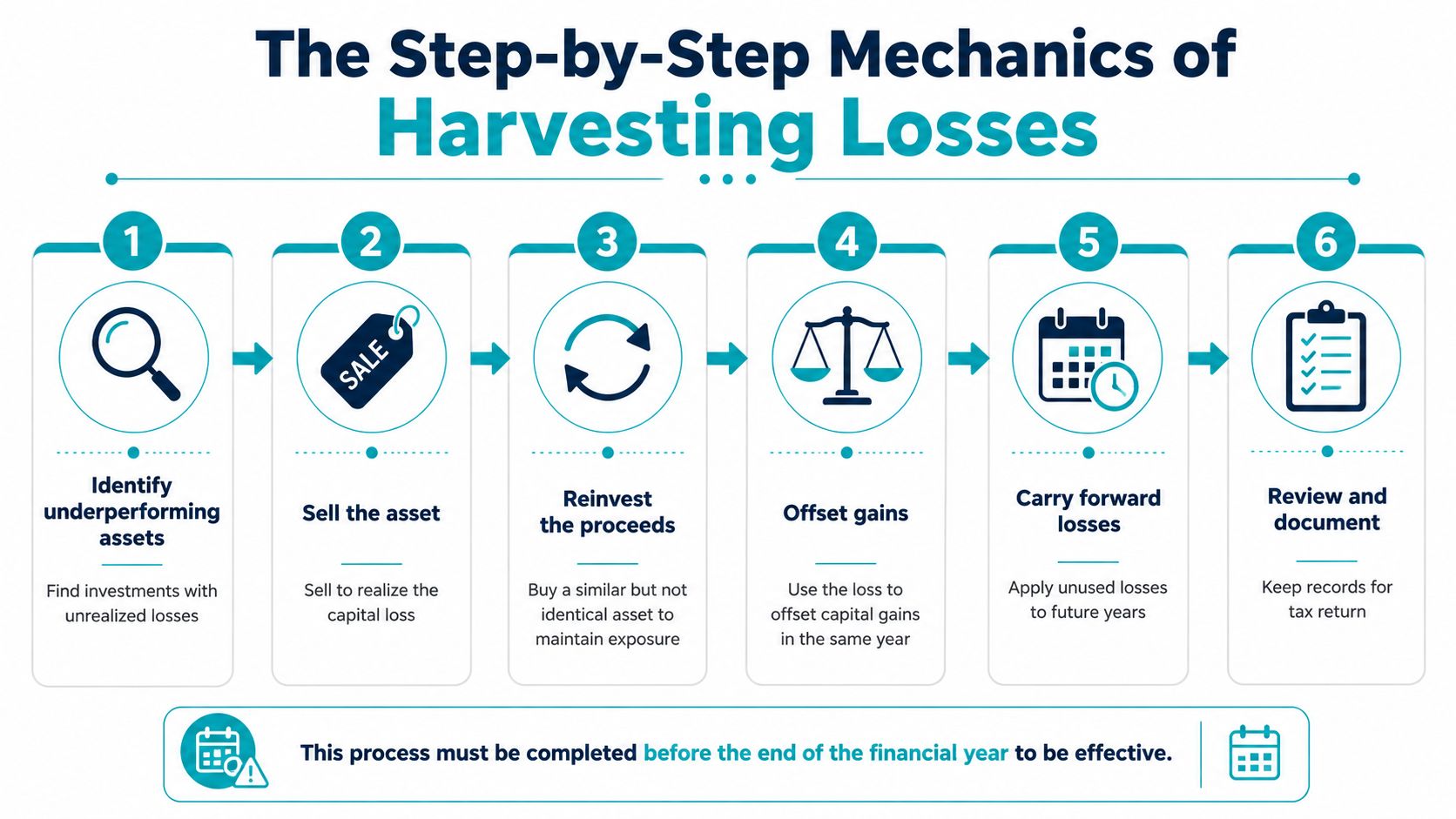
The cleanest way to think about tax loss harvesting is as a portfolio decision, not a reflex. You start by finding an investment with an unrealised loss, then ask whether selling it improves your after-tax position without disturbing your broader strategy. If the answer is yes, the next move is to realise the loss and replace the exposure with something similar enough to keep you invested, but different enough to avoid anti-avoidance problems.
How the sequence works in practice
-
Identify the position. Look for holdings that are below your cost base. The key question is whether that loss is meaningful in the context of expected capital gains, not whether it looks painful on screen.
-
Sell to realise the loss. A paper loss doesn't help your tax return until it's crystallised. Once sold, it becomes a capital loss that can be used according to the CGT rules.
-
Replace the exposure. Reinvest the proceeds in a substitute that tracks a similar risk profile but isn't substantially identical. That keeps the portfolio invested while the tax position is being managed.
-
Match the loss to gains. Use the realised loss against capital gains in the same year where possible. If there are no gains to absorb, the loss is banked forward.
-
Document everything. Keep the sale date, cost base, proceeds, and replacement holding in your records. That makes tax return preparation much cleaner and helps show that the loss was realised.
-
Review before year-end. The process has to be completed before the financial year closes if you want the loss to count in that year's return.
The step people usually skip is the replacement holding. They sell, feel good about booking the loss, then unintentionally undo the benefit by jumping straight back into the same exposure. That's where the wash-sale rules become relevant, and where the implementation needs more care than the basic concept suggests.
Keep the investment story and the tax story aligned. If the replacement changes your actual market exposure too much, you've solved the tax issue but created a portfolio problem.
That's why many investors treat harvesting as part of quarterly portfolio maintenance rather than an emergency move. The more organised the process, the easier it is to keep the investment plan intact while still banking the loss properly.
Navigating Wash-Sale Rules and Timing Risks
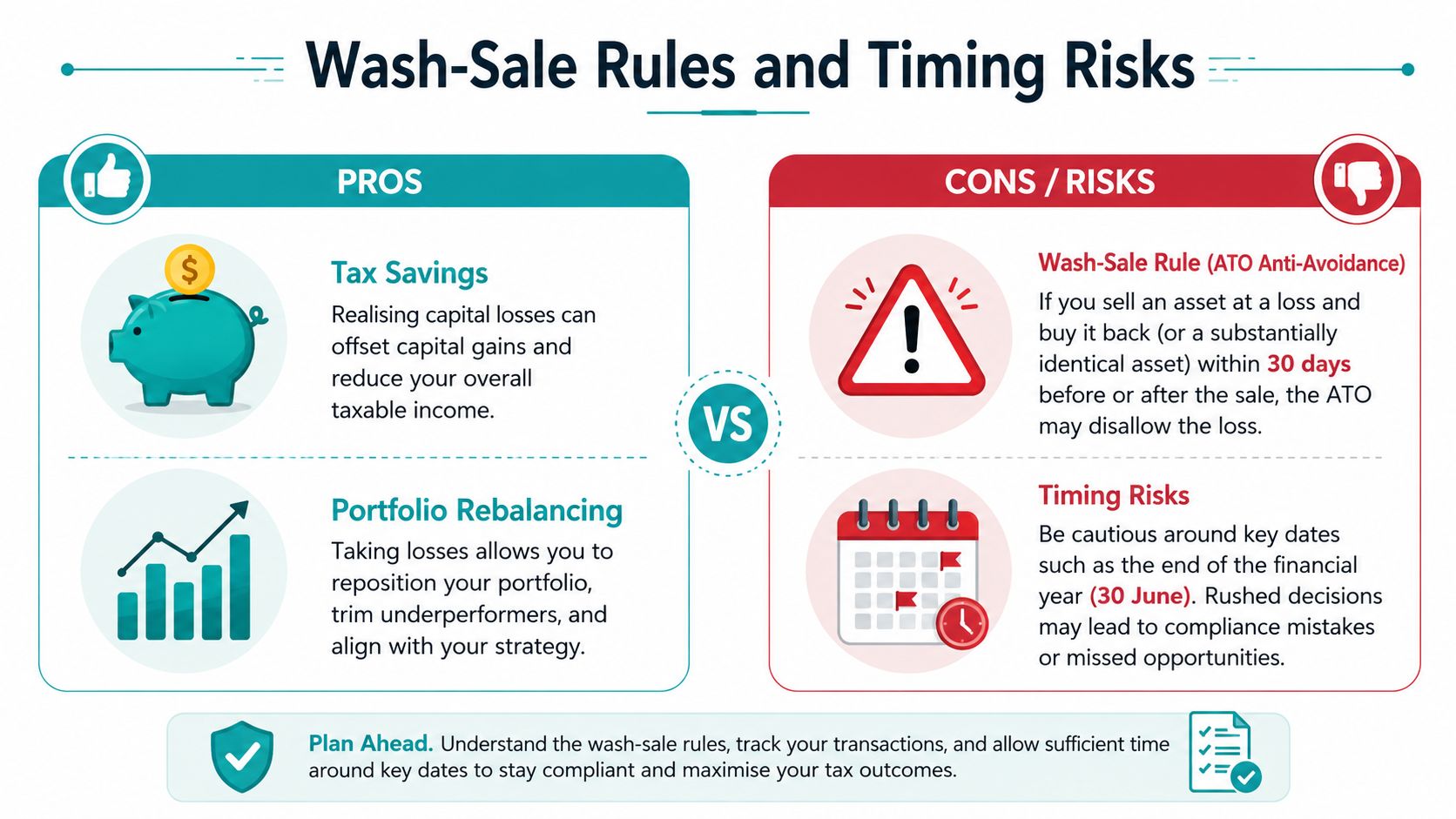
A loss sale only helps if the tax outcome matches the portfolio move. If you sell an asset at a loss and then buy back the same asset, or something so close that it is substantially identical, the ATO can ignore the loss when the main purpose is to create a tax benefit rather than make a genuine investment change. That is the wash-sale problem, and it can turn a well-timed trade into a compliance issue.
What counts as too close
The cleanest approach is to keep market exposure while avoiding a replacement that looks too much like the original holding. In practice, that often means moving into a similar broad-market ETF, or another comparable fund class, rather than repurchasing the exact same asset straight away. The point is to preserve the investment profile you want while showing that the portfolio has changed, not just the paperwork.
A few situations need extra caution:
- Same holding, same exposure: buying back the identical asset too quickly can invite scrutiny.
- Substantially identical replacement: a near clone can create the same issue, even if the label is different.
- Household coordination: if other accounts are trading at the same time, the full pattern matters, not just one account on its own.
Timing isn't only about the sale date
Another common mistake is treating the biggest unrealised loss as the one to harvest first. The better question is whether there are enough realised gains in the same income year to absorb it. If not, the loss still has value, but that value is carried forward for later use. That makes timing a planning decision, not a reaction to short-term market noise.
Disciplined planning often looks unremarkable on the surface.
The ATO focuses on whether the transaction changed your economic position, or merely produced a tax result.
Patience helps here. Some investors wait for their portfolio to settle before they return to the original holding. Others stay in a substitute position for longer because it fits their rebalancing schedule more cleanly. The right approach depends on the wider portfolio, the cash flow plan, and whether the tax benefit justifies the change in exposure.
For a useful external reference on the capital gains side of the conversation, see the Stewart Accounting CGT guide.
Worked Examples Showing Real Tax Outcomes
A banked loss becomes concrete when you put numbers around it. The first example is a two-year sequence. In year one, an investor sells an underperforming fund and crystallises a capital loss, then carries that loss forward because there's nothing useful to offset that year. In year two, the investor realises a capital gain on a different asset and uses the prior loss to reduce the taxable gain. If the later gain is discounted under the 12-month rule, the banked loss can be even more valuable because it trims the amount left after the discount is applied.
Example one, a banked loss used later
Suppose an investor realises a capital loss in one year and later realises a discounted gain on an asset held for more than 12 months. The loss is matched against the gain first, then the CGT discount is applied where relevant to the remaining gain. The practical result is a smaller taxable gain, which can lower the eventual CGT payable.
That pattern matters because it shows the strategy isn't about creating a deduction in the same way as an expense. It's about reducing the tax cost of a future gain that would have otherwise been fully exposed. The more carefully the loss is banked, the more flexibility the investor has when the gain arrives.
Example two, timing around retirement drawdown
A retirement transition often creates the right conditions for harvesting. An investor may rebalance out of concentrated positions, begin drawing down investments, or realise gains to simplify the portfolio. If earlier losses have been banked, those gains can be offset as they're realised, reducing the tax drag at a time when cashflow planning matters more than ever.
The value here is not just tax relief. It's control. The investor can choose which assets to sell, when to sell them, and how to sequence gains and losses so the portfolio supports retirement objectives instead of creating avoidable tax friction.
Real planning looks boring on the surface. The investor records the loss, waits for the right gain, then uses the CGT rules exactly as intended.
For readers who want a practical capital gains framing on similar mechanics, the Northern California tax counsel page offers a related perspective on advanced tax planning language, even though the legal setting differs.
Matching Tax Loss Harvesting to Your Situation
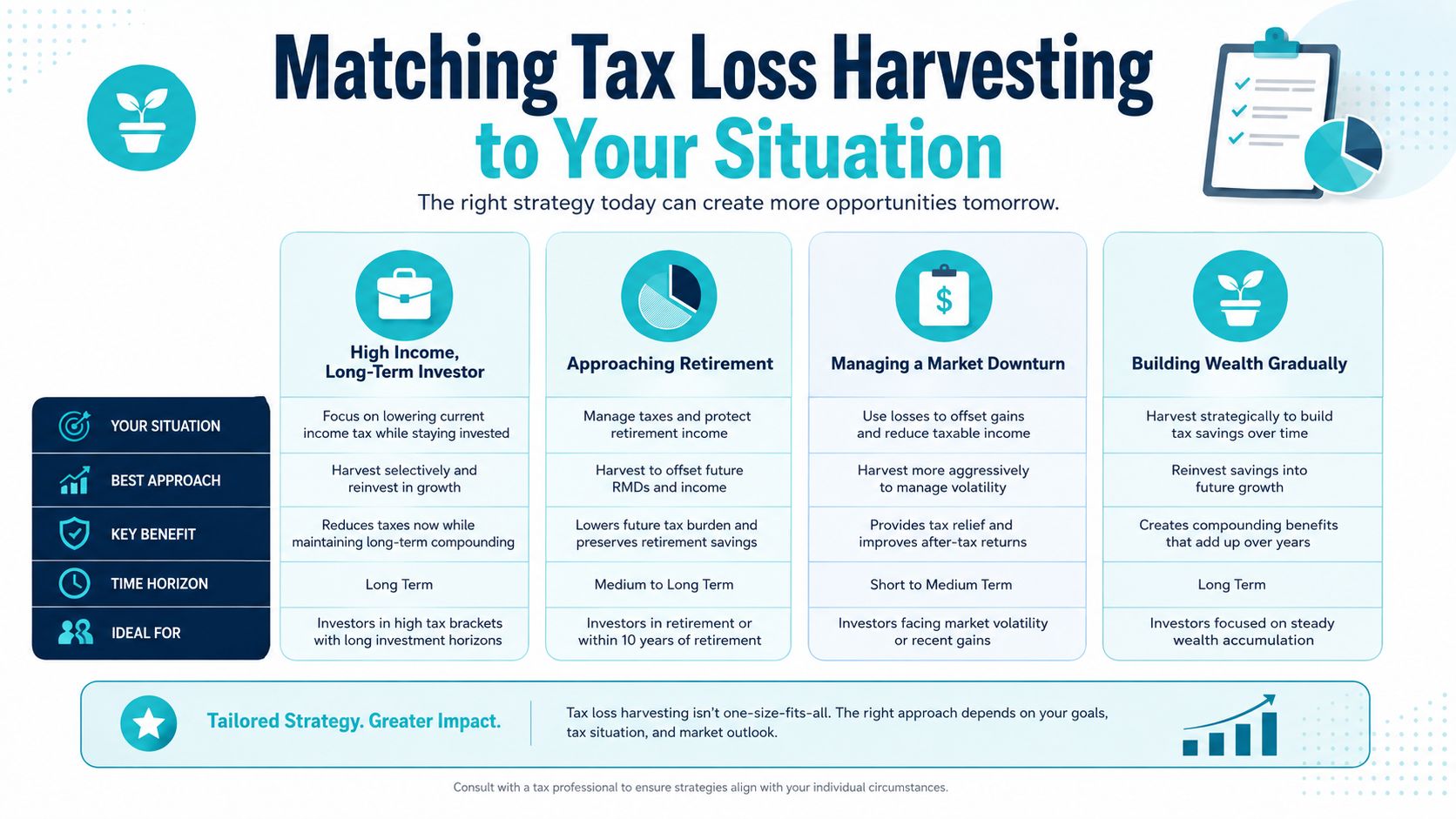
The strategy isn't equally useful for every investor. It tends to work best when there are both gains to manage and a portfolio large enough that selling one holding won't create a bigger planning problem than the tax benefit is worth. That makes the decision highly personal, which is why client segment matters.
Different investors, different priorities
-
Pre-retirees and retirees often have the clearest use case. They're already rebalancing, simplifying holdings, or drawing income, so realised gains and losses naturally appear as part of the plan.
-
Young professionals and dual-income families may use it more selectively. If the bigger priority is debt reduction or building emergency cash, harvesting can be useful, but it usually sits behind those core goals.
-
Individuals focusing on superannuation and insurance need to keep the plan coordinated. Tax efficiency helps, but it shouldn't come at the expense of protection or contribution strategy.
-
High-income earners and executives often have the most to gain from disciplined implementation because their portfolios can become complex quickly. The opportunity is real, but so is the need for careful coordination across accounts.
-
Small business owners may use harvesting alongside broader risk management, especially when personal and investment structures both need attention.
The main filter is simple. If you already have gains or are likely to realise them later, tax loss harvesting can fit well. If your finances are still dominated by cashflow pressure, insurance gaps, or debt reduction, the strategy may be secondary.
That's why a broad financial plan usually works better than a standalone tax move. You want the portfolio, the tax return, and the household balance sheet pointing in the same direction. A strategy that saves tax but weakens the rest of the plan isn't really a win.
Taking the Next Step with a Certified Adviser
Tax loss harvesting is easiest to use properly when it sits inside a broader advice process. That's the point of working with an adviser who can look at investments, superannuation, debt, insurance, and retirement together instead of treating each decision in isolation. Wealth Collective is a Perth and Dunsborough-based financial advice firm with more than 50 years of combined experience, and its three service pillars, Protection Plus, Guided Growth, and Retirement Roadmap, are built to connect those moving parts.
A sensible first step is to gather your current investment holdings and tax statements, then talk through which assets might be suitable for harvesting and which ones should be left alone. Wealth Collective's process starts with a free 10-minute introductory call, which makes it easier to confirm whether the timing and portfolio structure make sense before anything is sold. The firm also positions its advice around transparent communication and a satisfaction guarantee, so the decision-making process stays clear.
If you're comparing advisers, the how to choose a financial adviser guide is a practical place to start before you book. It's especially useful if you want tax-efficient investing handled as part of a broader plan rather than as an isolated annual task.
Talk to Wealth Collective if you want tax loss harvesting handled with the rest of your financial plan, not bolted on afterwards. Visit Wealth Collective to book an initial call, review your holdings, and discuss how a tax-aware investment approach could fit your goals.