Business hours
Monday to Friday (8.30AM - 5PM)
Weekend (Closed)



Your daughter lands in Perth on a working holiday visa. Or maybe it's your nephew, your partner's younger sister, or a family friend you've half-adopted because they're far from home. They're excited about beach days, regional travel and casual work. You're the one asking the sensible questions.
How much tax will they pay? Do they need to lodge a return? What happens if payroll got it wrong? And if they've already left a few documents untouched in a hostel drawer, is there money sitting there that can still be recovered?
That's where most “backpacker tax” articles fall short. They explain the headline rule and stop. That's fine for a traveller skimming on a phone. It's not enough if you're trying to help a family member avoid avoidable mistakes and keep their finances clean.
I see this a lot with financially organised Australians. You're not trying to become a tax agent for someone on a subclass 417 or 462 visa. You just want a clear answer on the tax on working holiday visa income, what matters, and where the expensive traps sit. Fair enough.
The challenge is that the Australian system looks simple from a distance and becomes messy once payroll, TFNs, deductions, ABNs and departure planning get involved. Even lifestyle choices can complicate things, especially if they're blending travel with short bursts of online work. If that's part of the picture, this guide on working remotely from another country is a useful companion because it highlights the practical friction that pops up when travel and income overlap.
Setting the Stage for Financial Success in Australia
A working holiday can be one of the best financial and life experiences a young adult has. Australia gives them the chance to earn, travel and build independence fast. But the trip goes better when the admin is handled early, not when they're trying to untangle it from an airport lounge on the way home.
The family version of this conversation usually sounds the same. They've found a job. They've filled in some payroll forms. They think tax has been “sorted”. Then someone back home asks one good question and the whole thing unravels. Did they get a TFN? Is the employer registered properly? Are they being paid as an employee or pushed onto an ABN arrangement they don't understand?
That's why compliance matters. Not because anyone enjoys forms, but because the cleanest Australian experience is the one where income, tax, super and records all line up from the start.
What sensible families should focus on first
If you're helping a family member, keep your attention on four basics:
- Visa status: Confirm they're on a subclass 417 or 462 visa before relying on working holiday tax treatment.
- Payroll setup: Make sure the employer has the right details and the worker has completed onboarding properly.
- TFN application: This is not a minor admin task. It affects how much tax gets withheld.
- Record keeping: Save payslips, contracts, income statements and super details from day one.
A good trip doesn't just run on wages. It runs on paperwork done properly.
Most of the stress I see isn't caused by the tax bill itself. It's caused by uncertainty. Once you know the rules, the decisions become straightforward. The key is to deal with the tax on working holiday visa income as part of the broader financial picture, not as an afterthought after they've already been paid incorrectly.
Understanding the Core Backpacker Tax Rules
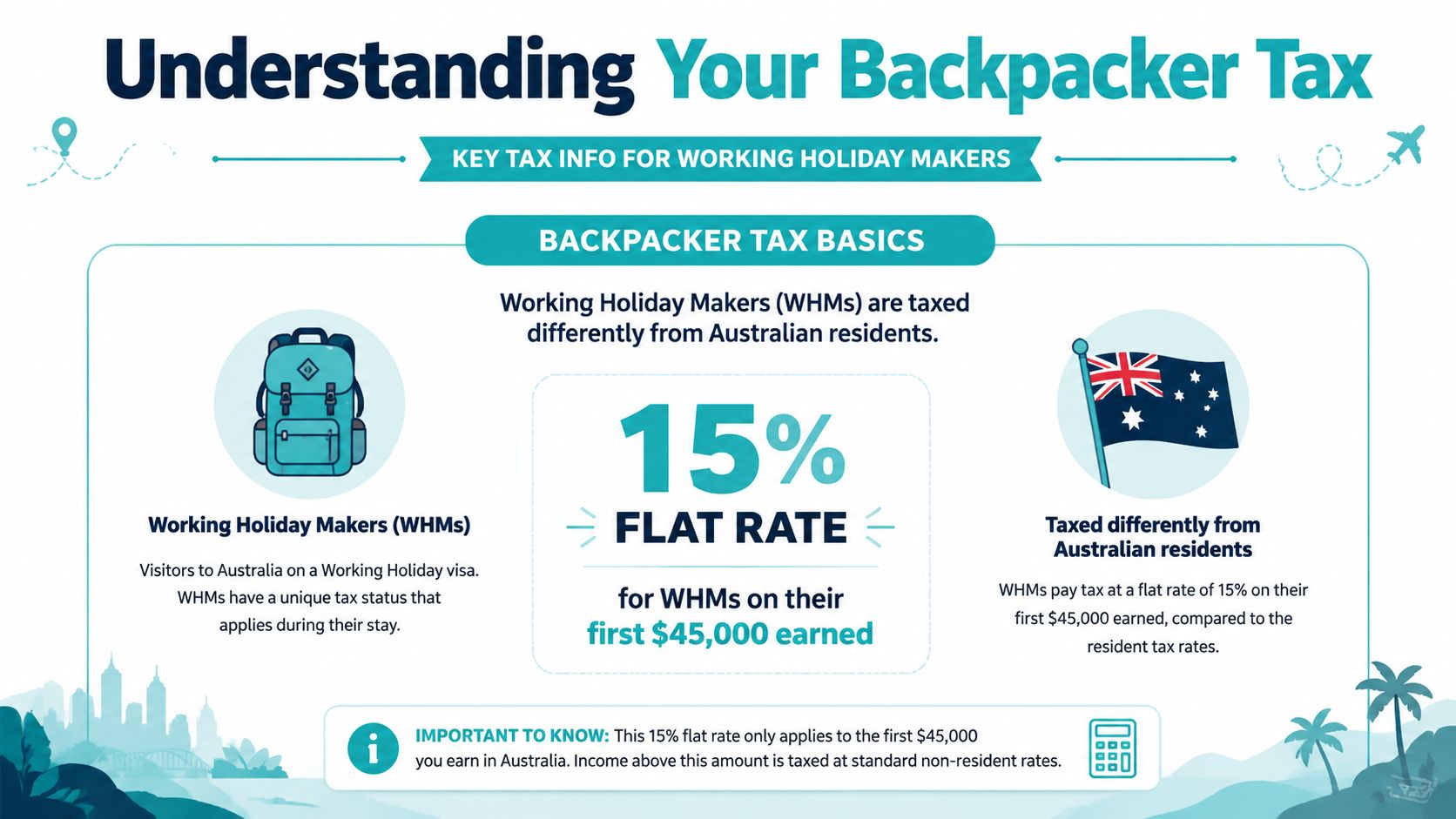
Here's the rule that catches families off guard. A person on a subclass 417 or 462 visa is usually taxed under the working holiday maker rates, not the standard rates many Australians expect from their own payslips.
For the 2025 to 2026 income year, that generally means 15% tax on the first $45,000 of working holiday maker income, with no tax-free threshold. Tax starts from the first dollar.
What this means in plain English
Many Australians look at a low-income payslip and expect little tax. That assumption fails quickly for working holiday makers.
Australian residents can usually earn up to $18,200 before ordinary income tax applies. Working holiday makers do not get that starting point. Their special tax rate applies from the first dollar earned under the WHM rules.
That single difference explains a lot of confusion. A family member can be earning modest wages and still have more tax withheld than an Australian resident employee on similar pay.
Who the rule applies to
The rules apply to people on the visa classes above, and payroll needs to be set up correctly for the employer to withhold under the working holiday maker system.
Use this as your quick check:
| Situation | Tax treatment |
|---|---|
| Subclass 417 or 462 visa holder | Special WHM tax rules apply |
| Income up to $45,000 | 15% tax rate applies |
| Resident-style tax-free threshold | Not available |
| Tax starts | From the first dollar |
Why families should care
The practical issue is not whether the tax feels high. The practical issue is whether the withholding is correct.
If you compare their payslip to your own, you can reach the wrong conclusion fast. Start with the visa. Then check whether the employer has them coded correctly as a working holiday maker and whether a TFN was provided.
That TFN point deserves attention. In my experience, one of the most overlooked refund opportunities comes from payroll errors caused by a missing or mishandled TFN, not from the basic 15% WHM rate itself. Families who understand that early put their relative in a much better position to avoid over-withholding and fix mistakes cleanly at tax time.
How Tax Residency Status Affects Your Bottom Line
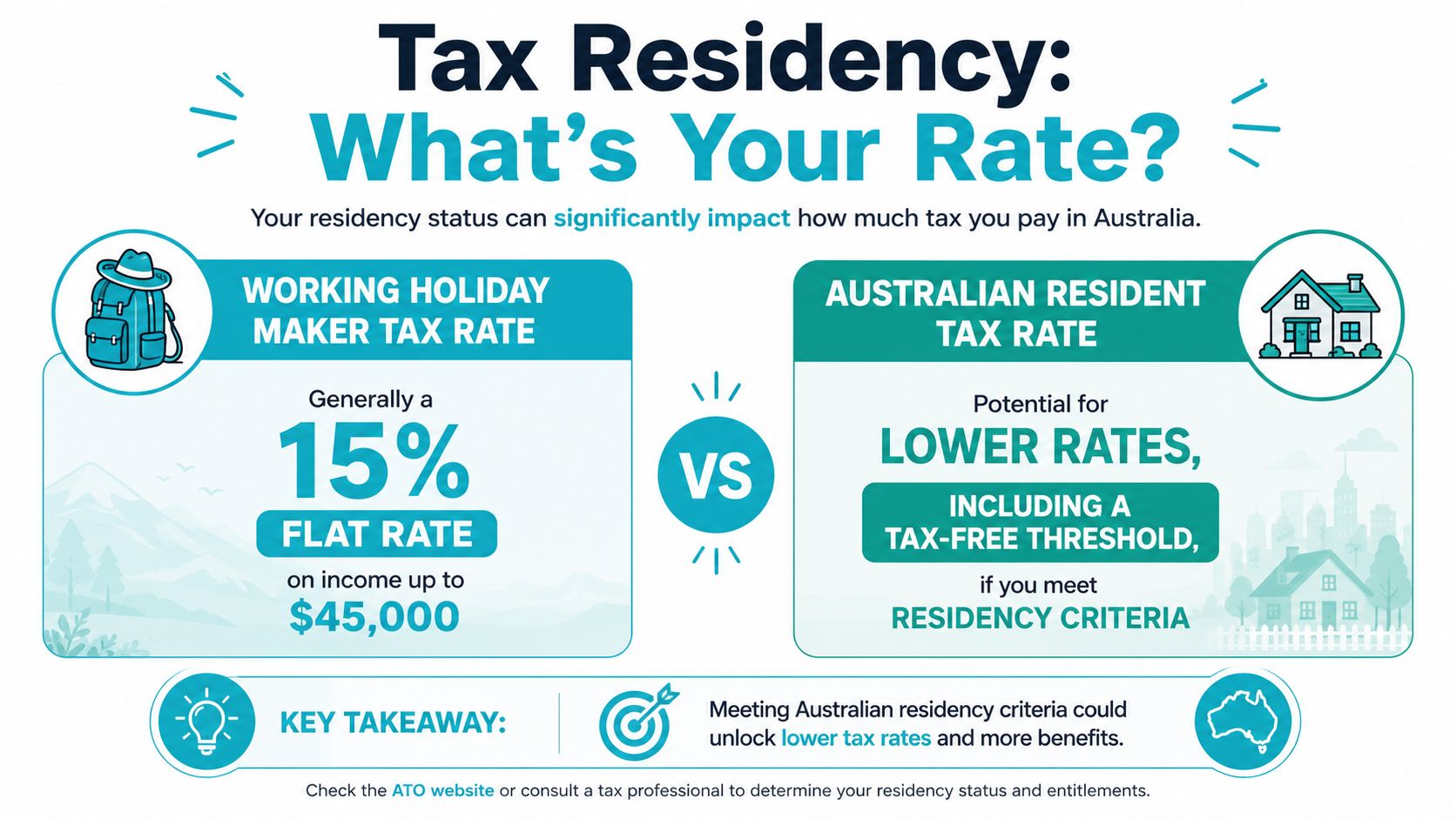
People mix up visa status and tax status all the time. They're not the same thing. A person can hold a working holiday visa and still need to think carefully about whether they are, or are not, an Australian resident for tax purposes in a broader sense.
That matters because residency can affect how other income is viewed, how certain claims are handled, and how a changing situation should be assessed. It's one reason I tell families not to rely on backpacker folklore from social media or hostel noticeboards.
The simple questions that matter
The ATO's residency analysis is legal in structure but practical in application. Strip out the jargon and you get a few core questions:
- Are they living here, or just travelling through?
- Have they set up a settled life in Australia, or are they moving around casually?
- How long are they staying and what does that stay look like in practice?
- Has their pattern of work or income changed beyond standard working holiday employment?
No single question should be read in isolation. Residency isn't a vibes-based decision, but it also isn't just a calendar exercise for most travellers.
A side-by-side view
A practical way to view this is:
| Working holiday position | Resident for tax purposes position |
|---|---|
| Usually assessed under special WHM tax rules | May access different tax treatment depending on full circumstances |
| Common for short-term travel and work | More relevant when someone establishes a settled life in Australia |
| Often tied to standard salary or wages from casual jobs | More important when income sources broaden or circumstances change |
The practical difference is not that someone can just choose the better option. They can't. The facts drive the outcome.
If a family member starts with café shifts and hostel hopping, that's one picture. If they later settle into one location, long-term accommodation and broader income activity, review the position properly.
Don't let residency assumptions create problems
The most common error is false confidence. Someone hears they've been in Australia for a while and assumes that automatically changes everything. Or they hear “working holiday maker” and assume nothing can ever change.
Both are sloppy conclusions.
If the only income is ordinary working holiday employment and the arrangement is temporary, the practical treatment is usually straightforward. If they start mixing in freelance work, side income, business activity or longer-term plans, stop guessing and get advice. That's where the tax on working holiday visa arrangements can shift from simple payroll withholding to a larger tax planning issue.
When and How to Lodge an Australian Tax Return
A common Perth family scenario goes like this. Your son, daughter, niece or nephew finishes a season of casual work, sees tax coming out of every payslip, then assumes a tax return will sort itself out later. That assumption costs money.
The first job is deciding whether they need to lodge. For working holiday makers from the 2020 to 2021 income year onward, the ATO says no tax return or non-lodgment advice is required where taxable income is under $45,001 and all income is salary or wages, as set out in its official guidance for working holiday makers in Australia.
Use a strict filter.
- Usually no return required: taxable income is under $45,001 and every dollar came from salary or wages.
- Return required: taxable income is more than $45,001.
- Return required: they earned income under an ABN.
- Return required: they want to claim work-related deductions.
That rule is straightforward. The mistake is stopping there.
If a family member had tax withheld without a valid TFN being linked properly to payroll, or their income statement does not line up with what was earned, a refund opportunity can be missed by doing nothing. This is the point financially switched-on families usually overlook. “No lodgment required” is not the same as “no review required.”
Check the records before you decide to leave it alone.
- TFN details and confirmation the employer had the correct number.
- Income statement or payroll records from each employer.
- Payslips and bank deposits to confirm gross pay and withholding match.
- ABN invoices or payment records if any contractor work was done.
- Receipts for deductible expenses if a return will be lodged.
If payroll documents are messy or missing, start with this guide on how to get a PAYG summary.
My advice is simple. Do not let a young traveller assume the ATO position means they should ignore tax time. Review the file, confirm the TFN was used correctly, and compare withholding against the actual facts. That small compliance check is often where a legitimate refund is found, especially after short-term jobs, rushed onboarding, or employer admin errors.
For relatives who need practical help pulling documents together or dealing with the process from overseas, Approved Experiences tax support is a useful starting point.
Claiming Your Superannuation When You Leave
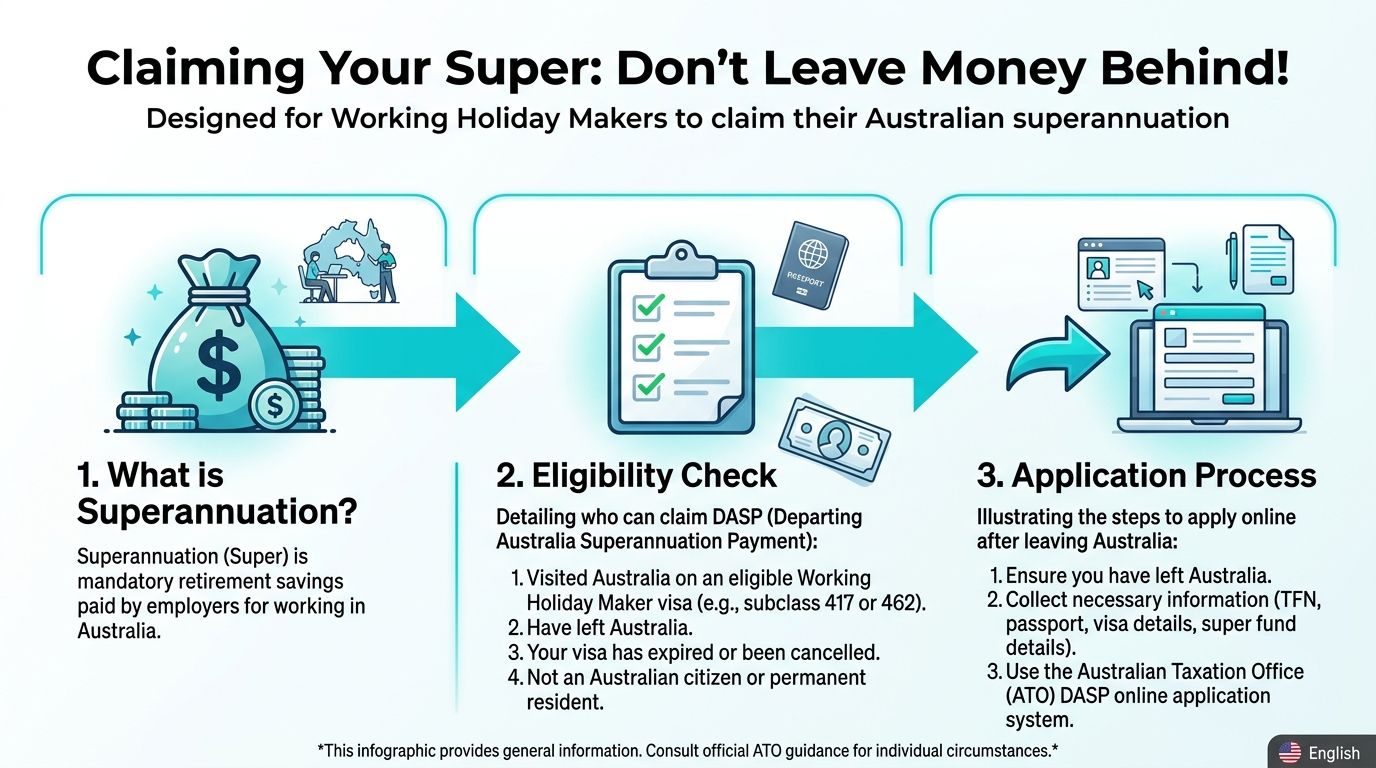
Superannuation is compulsory retirement savings paid into a fund while someone works in Australia. For many working holiday makers, it's also money they forget exists until long after they've gone home.
That's a mistake. If your family member worked in Australia and super was paid, claiming it after departure should be on the departure checklist, not an afterthought.
The clean process after leaving Australia
The relevant claim is usually handled as a Departing Australia Superannuation Payment, commonly called a DASP.
A sensible sequence looks like this:
- Confirm they've left Australia and their visa position has ended in the way required for a departure-based claim.
- Locate the super fund details from payslips, onboarding emails or employer records.
- Check personal details match across payroll, super and identification records.
- Lodge the claim through the correct channel after departure.
- Review the payment and tax treatment once processed.
The biggest practical issue isn't usually the claim itself. It's missing records. Young travellers switch phones, lose email access and forget which employer set up which fund. Fix that before they fly out if you can.
What families should do before departure
The best help you can give is administrative discipline.
- Save the fund name: Don't assume they'll remember it later.
- Keep identity records consistent: Name mismatches slow everything down.
- Retain final payslips: They often contain the clues needed to track the account.
- Store documents centrally: One shared folder beats searching old messages from another time zone.
If they don't understand super at all, this plain-English guide to what superannuation is in Australia helps fill in the basics before they tackle a claim.
Don't leave money stranded
I've seen plenty of travellers take their wages seriously and treat super like optional trivia. It isn't. It's part of the total value of working in Australia.
The exact amount and tax outcome depend on their circumstances, so don't make assumptions without checking the claim details. But the broad advice is simple. If they worked, check whether super was paid. If super was paid, deal with it properly when they leave.
Leaving Australia without checking super is like leaving part of the job unfinished.
Costly Tax Traps and How to Avoid Them
Most backpacker tax articles stop at the standard rate and call it a day. That's lazy. The expensive mistakes sit elsewhere, and the biggest one is the TFN trap.
A working holiday maker who earns under $45,000 and does not provide a TFN can have tax withheld at 45% on all payments. If their actual liability falls under the ordinary working holiday rules, they can lodge a return to recover the overpayment, meaning the difference between 45% withheld and 15% actual liability. That specific issue is set out in the ATO's schedule for working holiday maker withholding.

The TFN trap is the one families miss
People hear the simplified rule that lower-earning working holiday makers may not need to lodge. True in some cases. But if no TFN was provided and withholding happened at 45%, skipping the return can mean leaving a large refund unclaimed.
That's the nuance most generic guides fail to spell out.
If there's no TFN on file, don't assume the tax withheld was final. Check it.
Other mistakes worth shutting down early
The TFN issue is the headline trap, but it isn't the only one.
- ABN misuse: Some employers push young travellers onto an ABN when their work arrangement is, in fact, employment. That can create tax complexity, change lodgment requirements and muddy super obligations.
- Weak records: No payslips, no contracts and no saved onboarding details usually means a harder clean-up later.
- Blind trust in payroll: Most payroll teams do a decent job. Some don't. A wrong setup can run for months if nobody checks the first payslip.
A practical review checklist
If a relative asks you to sanity-check their situation, ask these questions:
| Question | Why it matters |
|---|---|
| Did you provide a TFN? | It affects withholding immediately |
| Are you paid as an employee or on an ABN? | The tax outcome and obligations differ |
| Do your payslips match what you expected? | Errors are easier to fix early |
| Have you kept payroll and super records? | Recovery gets harder without them |
One more caution. Young travellers increasingly earn money in mixed ways, including digital payments and sometimes crypto-linked spending or transfers. If that enters the picture, don't improvise. This NomadCards guide to crypto taxes is useful background for understanding why digital transactions can create tax questions people didn't expect.
The main point is simple. The tax on working holiday visa income only stays simple if the setup is right from the beginning. Once payroll, TFNs and side income get messy, the cost of “she'll be right” thinking goes up quickly.
Plan Your Financial Future with Wealth Collective
Helping a family member through a working holiday tax issue is often a reminder of a bigger truth. Financial systems reward people who get organised early.
A short-term visa arrangement can create questions about tax withholding, lodgment, super and records. Your own financial life is more complex than that. It involves super strategy, insurance, debt, investments, retirement timing and how to transfer wealth well when the time comes.
The short checklist to keep in mind
- Know the tax rule that applies: Working holiday tax treatment is different from resident treatment.
- Treat the TFN as urgent: Delays can create unnecessary withholding.
- Don't lodge blindly: Some people don't need to. Others absolutely do.
- Check super before departure: Too many travellers leave money behind.
- Review unusual setups early: ABN arrangements and mixed income deserve scrutiny.
If you're the person in the family who spots these issues for others, there's a good chance your own strategy deserves the same level of attention. Not more complexity. Better clarity.
That starts with choosing advice that's practical, direct and suited to your stage of life. If you're weighing your options, this guide on how to choose a financial advisor is a solid place to begin.
The right adviser should simplify decisions, not bury you in jargon. They should help you build, protect and eventually transfer wealth with a plan that fits your household.
If you want that kind of clarity, book a short introductory call with Wealth Collective. Whether you're helping family understand Australia's tax rules or sorting out your own super, investments, insurance and retirement planning, the team can help you turn complexity into a clear next step.