Business hours
Monday to Friday (8.30AM - 5PM)
Weekend (Closed)



You're probably at the point where work still feels familiar, but the idea of doing it the same way for another few years doesn't. You don't want to stop overnight, you don't want to guess at your spending, and you definitely don't want to leave super sitting there without a plan. That's exactly where a transition to retirement strategy earns its keep, because it lets you build a proper cash-flow bridge instead of forcing a hard cut from salary to retirement income.
What Is a Transition to Retirement Strategy
A transition to retirement strategy is a structured way to start using part of your super while you're still working. In Australia, it becomes available from age 60 once you've reached preservation age, and MoneySmart says the income stream must pay at least 4% and no more than 10% of the account balance each year, before it automatically moves into the retirement phase at age 65 (MoneySmart guidance on transition to retirement).
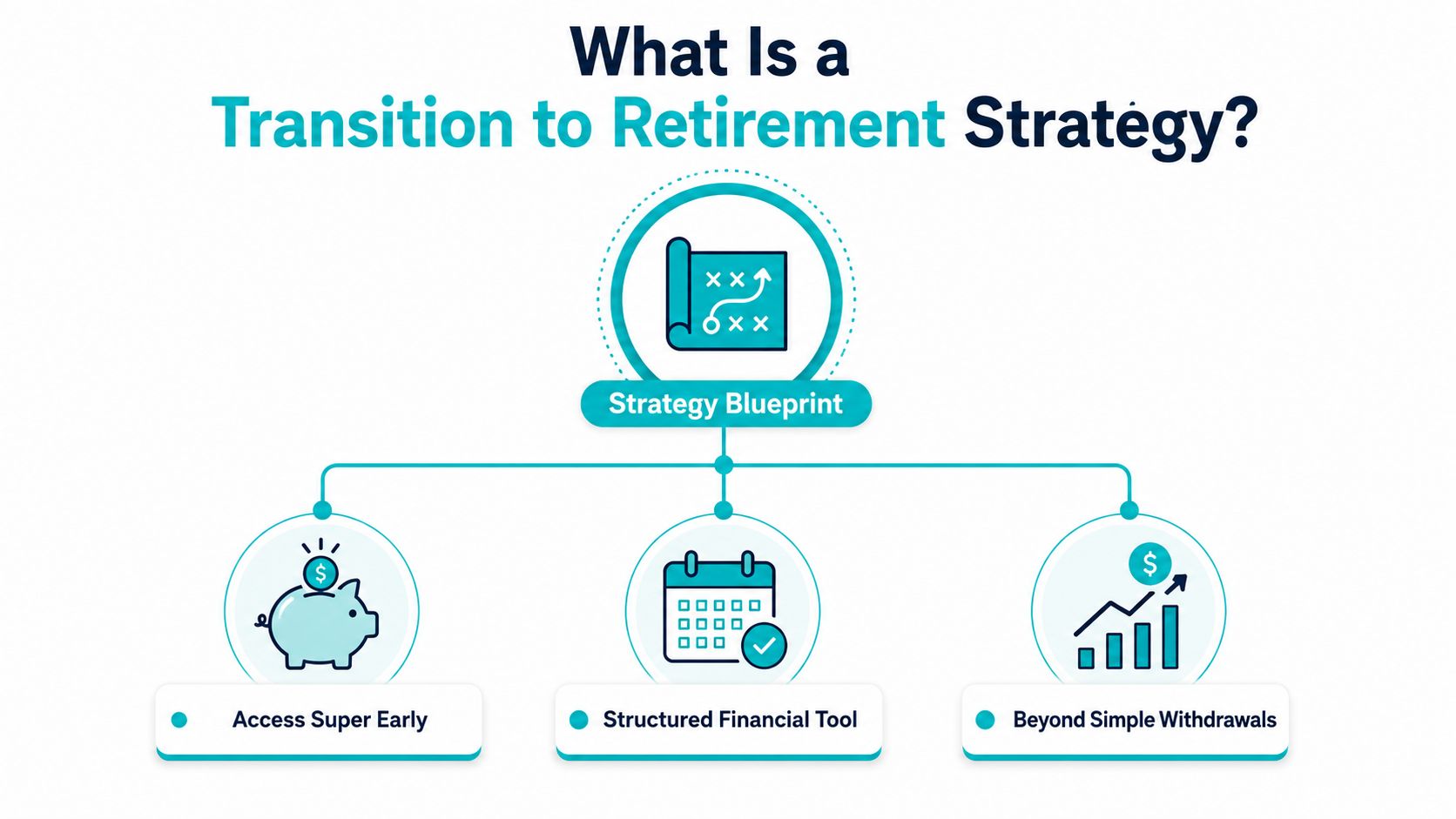
The point of TTR is flexibility, not early retirement
A lot of people misunderstand TTR as a loophole for early access. It isn't. It's a controlled income stream designed to help you reduce hours, protect lifestyle spending, or reshape how your pay is flowing without jumping straight out of work.
That matters because the strategy gives you a way to phase out of employment on your terms. You can keep earning a wage, use the TTR pension to replace part of that wage, and avoid the all-or-nothing pressure that catches so many pre-retirees off guard.
Practical rule: If your plan depends on a lump sum, TTR is the wrong tool. If your plan depends on a steady income bridge, TTR can be exactly the right one.
The mechanics are simple, but the rules are strict
The money still sits inside a super-based pension structure, which means you don't get free rein to withdraw whatever you want. The annual drawdown has to stay inside the permitted band, and the account shifts into retirement phase at age 65 under MoneySmart's framework (MoneySmart guidance on transition to retirement).
That's why advisers treat TTR as a planning tool, not a casual redraw account. It's there to support a specific transition. The whole point is to create order, preserve capital, and keep your income predictable while you're still in the workforce.
Assessing Your Financial Position and Retirement Goals
A transition to retirement strategy works only when it matches your real cash flow. Start with the numbers you spend, not the amount you hope is close enough. That means looking at household income, regular outgoings, and the gap you need to bridge while work hours change.
The cleanest method is direct. Pull two years of bank and credit card statements, total your spending, divide it by 24, and then strip out anything unusual. That gives you a monthly baseline that reflects how you live, not how you think you live (Citizens Bank retirement budgeting method). Once you have that figure, split it into what you must cover and what you choose to spend.
Build your baseline before you reduce work
Your spending pattern will change when work changes. Commuting drops away, but healthcare, hobbies, travel, and day-to-day comfort often rise. That is why a retirement budget has to be built from the inside out, not from a rough percentage of current salary.
Use this simple filter:
- Essential costs: mortgage or rent, utilities, insurance, groceries, transport, and medical costs.
- Lifestyle costs: travel, dining out, memberships, gifts, and help around the home.
- One-off costs: vehicle replacement, home repairs, and family support.
If you do not map those properly, your TTR income stream becomes a patch for a planning gap instead of a deliberate cash-flow bridge.
Tie the numbers to the life you want
Once the cash flow is mapped, write down what reduced work should look like in practice. Do you want three days a week instead of five? Do you want to keep working but stop relying on overtime? Do you want a gentler ramp into full retirement over time? The strategy has to fit the life, not the other way around.
A retirement calculator can help you test the numbers, and Wealth Collective's superannuation retirement calculator guide is a useful starting point for that exercise. The decision still comes back to your own situation. You need enough income to live well, enough flexibility to adapt, and enough clarity to know whether TTR is solving the right problem.
For broader estate and lifestyle planning context, Guidance from Bryan Fagan, PLLC is a useful reminder that retirement decisions should sit alongside documents, beneficiaries, and family priorities, not outside them.
How to Structure Your TTR Income Stream
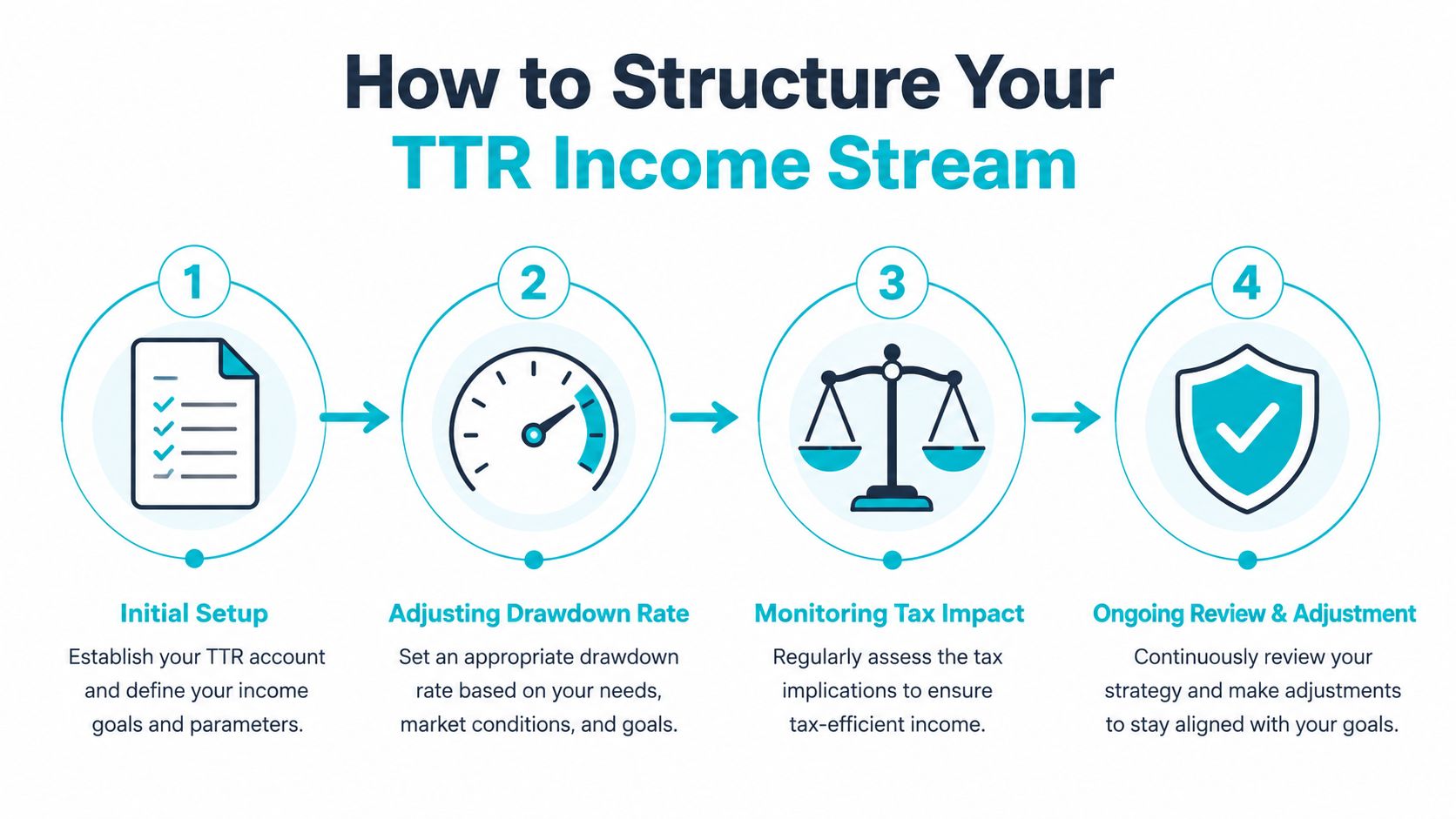
A TTR pension works best when you design the cash flow on purpose. The most useful model is simple, reduce work income a little, replace the gap with super income, and use the freed-up cash flow to keep your overall plan stable. That's how you turn a complicated rule set into a practical transition.
Start with the administrative sequence
The typical implementation is straightforward. First, contact your super fund. Then complete the required application and identity and preservation-age documentation. After that, choose the payment frequency and drawdown amount that fit the income pattern you need (OnePath Super Invest guidance on TTR setup).
That sequence matters because the account is constrained by eligibility and payment rules. You're not opening a casual spending account. You're setting up a regulated income stream with a purpose, and the paperwork needs to match that purpose.
Use TTR as a cash-flow bridge, not a standalone solution
Say you drop from five days to three. Your wage falls, but not to zero. A TTR pension can help replace part of the missing income so your lifestyle doesn't wobble while you reduce hours. That's the bridge.
In many plans, salary sacrificing remains part of the structure. The idea is to redirect some pre-tax income into super while drawing a controlled income stream back out. The result is cleaner cash flow, less pressure on take-home pay, and a more disciplined way to keep retirement savings moving while you're still employed.
Practical rule: Don't set the drawdown first and hope the rest works itself out. Work backwards from your monthly spending, then fit the pension payment and salary sacrifice around that number.
Keep the payment rhythm deliberate
Your payment frequency should match your household cash cycle. If your expenses are monthly, your pension draw should feel like a salary replacement, not a random transfer. If your work pattern changes seasonally or irregularly, your draw schedule needs to reflect that too.
For context on how a retirement income stream fits into the broader picture, see Wealth Collective's retirement income streams overview. The important point is this. Structure beats improvisation every time. A TTR pension should support your life, not force you to keep adjusting your life around the pension.
If you're also weighing debt against retirement income, exploring later-life lending solutions can help you think through how housing debt and retirement cash flow interact, but it's not a substitute for a clear super strategy.
Integrating TTR with Your Investment and Tax Planning
A strong TTR strategy is built around cash flow, tax, and investment structure working together. If you only look at the withdrawal amount, you miss the essential task, which is to organise money across different timeframes while you are still working and preparing to retire.
Use a Now/Soon/Later structure. Keep near-term money liquid, keep medium-term money steady enough to carry the transition, and keep longer-term money invested for growth. That protects the dollars you need soon from market noise, while giving the dollars you will not need for years room to keep working.
Match each bucket to a time horizon
The first bucket, Now, covers the income you need straight away. It should be the easiest money to access, because this is the part of the plan that has to keep daily life moving without forcing awkward asset sales.
The second bucket, Soon, is for spending over the next few years. You keep the money here that supports the transition itself, including the gap between work income and retirement income.
The third bucket, Later, is for the part of retirement that sits further out. It can take more market movement because it is not doing the heavy lifting on this year's bills.
This structure is practical. It stops you from pulling every dollar from the same place, no matter when you need it.
A useful planning guide from Investopedia's retirement transition overview treats the shift as a timing and tax-structure decision, not a simple account withdrawal. That is the right way to approach it. Your TTR stream should sit inside a broader cash-flow design, not stand in for one.
Think in terms of liabilities, not just returns
A retirement income stream is really a liability-matching exercise. Near-term needs belong in liquid assets, while longer-term needs can be supported by growth assets. Get that mix wrong and the plan feels tight even when the balance looks fine on paper.
The Australian super system makes this planning more important. APRA has reported that total superannuation assets reached $4.2 trillion and retirement-phase assets kept growing, which shows how much money is now moving through this stage of life (StrategicIM on TTR and retirement-phase planning). Large balances do not fix a poor structure. They can hide it for a while.
A TTR strategy also needs to sit alongside planning retiree health benefits, because medical costs can change the cash-flow bridge very quickly. If you ignore that expense layer, the rest of the plan can look better than it really is.
Align tax thinking with income design
Tax sits underneath every TTR decision. The goal is not to chase tax savings for their own sake. The goal is to avoid building a cash-flow plan that creates unnecessary tax friction or leaves you short later.
Test the transition against a lower-disposable-income scenario before you step away from work. If the plan still works when cash flow is tighter, it is ready. If it only works in a perfect month and a perfect market, it is not ready yet.
Common TTR Pitfalls and How to Mitigate Them
The biggest mistake people make with TTR is treating it like a set-and-forget pension setup. It isn't. It's a live income strategy, and live strategies need guardrails.
The first risk is sequence-of-returns risk. If markets fall early in the transition and you're pulling money out at the same time, the damage can compound faster than people expect. That's why many advisers keep a cash buffer or short-term reserve so spending doesn't force asset sales at the worst possible moment.

Build the buffer before you need it
A practical risk-control approach is to hold 12 to 24 months of planned withdrawals in cash or short-term bonds, pair that with scheduled rebalancing, and avoid reactive trading after a fall. That benchmark appears in professional retirement-transition guidance and it's useful because it keeps your spending off the same runway as your growth assets (OnePath Super Invest strategy explanation).
The second risk is underestimating fixed expenses. People often budget for the fun parts of retirement and forget the unglamorous ones, especially healthcare and maintenance. That's where plans fail, not in the spreadsheet, but in the ordinary bills that keep showing up.
Practical rule: If the budget only works after market growth, it doesn't work.
Know the withdrawal limits before you rely on the money
There's also a structural trap that catches people out. A TTR pension generally does not allow lump sum withdrawals until you've permanently retired or reached age 65. Until then, the account can only pay regular income amounts within the permitted drawdown range (Direct Wealth guidance on TTR restrictions).
That restriction changes everything. It means TTR is designed to support gradual retirement or income supplementation, not to behave like unrestricted super access. If you need capital flexibility, you need to plan for that separately.
For health-related spending, planning retiree health benefits is a sensible reference point because medical costs rarely stay flat once work stops. The right response isn't fear. It's preparation. Build the reserve, map the costs, and make sure your income design can absorb the ordinary shocks without breaking the rest of the plan.
Partnering with an Adviser for Your Retirement Roadmap
A transition to retirement strategy looks simple until you have to run one. Then you're juggling eligibility rules, drawdown limits, spending needs, tax structure, investment risk, and family decisions at the same time. That's why DIY can get messy fast.
A proper advice process turns those moving parts into one coordinated plan. It starts with your income sources, checks your spending reality, stress-tests your budget, and then fits the TTR income stream into a retirement roadmap that matches your life. That's the difference between hoping the numbers work and knowing what the next step is.
There's a useful overview at Wealth Collective's retirement planning advice page if you want to understand how a structured advice process fits into the broader picture. For many people, that's the point where the anxiety drops, because the decisions stop feeling isolated.
Wealth Collective's Retirement Roadmap is built for exactly this phase. It helps translate super rules, cash flow, and investment choices into a clear plan you can follow without second-guessing every move. If you want a direct conversation about whether a TTR strategy fits your situation, book a free 10-minute introductory call and get your retirement transition mapped properly.
If you're ready to stop guessing and start structuring your retirement income with clarity, speak with Wealth Collective. We'll help you turn your super, work income, and spending needs into a practical transition to retirement strategy that's built around your life, not a template.