Business hours
Monday to Friday (8.30AM - 5PM)
Weekend (Closed)


You're looking at your super statement, the mortgage is still there, the bills haven't slowed down, and the savings account doesn't feel far enough ahead. That's where a lot of Australians land, they know they should be doing something with spare cash, but they're not sure whether the next dollar should go to debt, super, or a buffer for life's surprises.
A capital accumulation plan is a structured way of building wealth through regular contributions that are invested over time. In plain English, it's a disciplined habit, not a single product. You keep topping up an investment arrangement on a schedule, then let time, compounding, and the investment mix do the heavy lifting. In Australia, the closest mainstream version is superannuation, where repeated contributions build retirement wealth under the Superannuation Guarantee, now 12% of ordinary time earnings from 1 July 2025 after rising from 9% in 2002 to 11.5% in 2024 and then 12% in 2025 (Banca Generali reference).
For many households, the key question isn't “what is a capital accumulation plan” in the abstract. It's whether CAP-style saving should sit inside super, outside super, or alongside debt reduction and emergency cash. That decision changes with age, income, and how close you are to needing the money.
The Question Most Australians Are Really Asking
Few people wake up wanting a financial acronym. They're trying to answer a more urgent question: should the extra cash go into super, the offset account, or an investment they can touch if life turns messy.
A capital accumulation plan, or CAP, is best understood as a repeatable contribution habit. You put money in on a schedule, the money is invested rather than left idle, and your balance grows across time as the contributions and returns stack up. The member chooses the investments, while the structure sets the rules around how money is paid in and how it's managed.
That's why a CAP is not just “a savings account with a fancy name.” It's a framework for disciplined investing. In the Australian context, the nearest everyday example is superannuation, because it turns regular contributions into long-term retirement savings through a mandatory system built around employer payments and, in many cases, employee top-ups (Banca Generali reference).
Practical rule: if you can only describe the plan as “I'll save when I remember,” it isn't really a CAP-style approach yet.
For most readers, the next useful step is to ask where this behaviour belongs in your own money life. A CAP can make sense if you've got surplus cash flow, a long time horizon, and a preference for steady contribution habits. It becomes less obvious when debt is expensive, cash reserves are thin, or you're close to needing the money.
The Australian system makes this more relevant than theoretical. Super is already the dominant accumulation vehicle, and the Superannuation Guarantee rate is 12% as of 1 July 2025 (Banca Generali reference). That means many households already have one CAP-like engine running in the background. The task is deciding how, or whether, to run a second one outside super.
How a Capital Accumulation Plan Actually Works
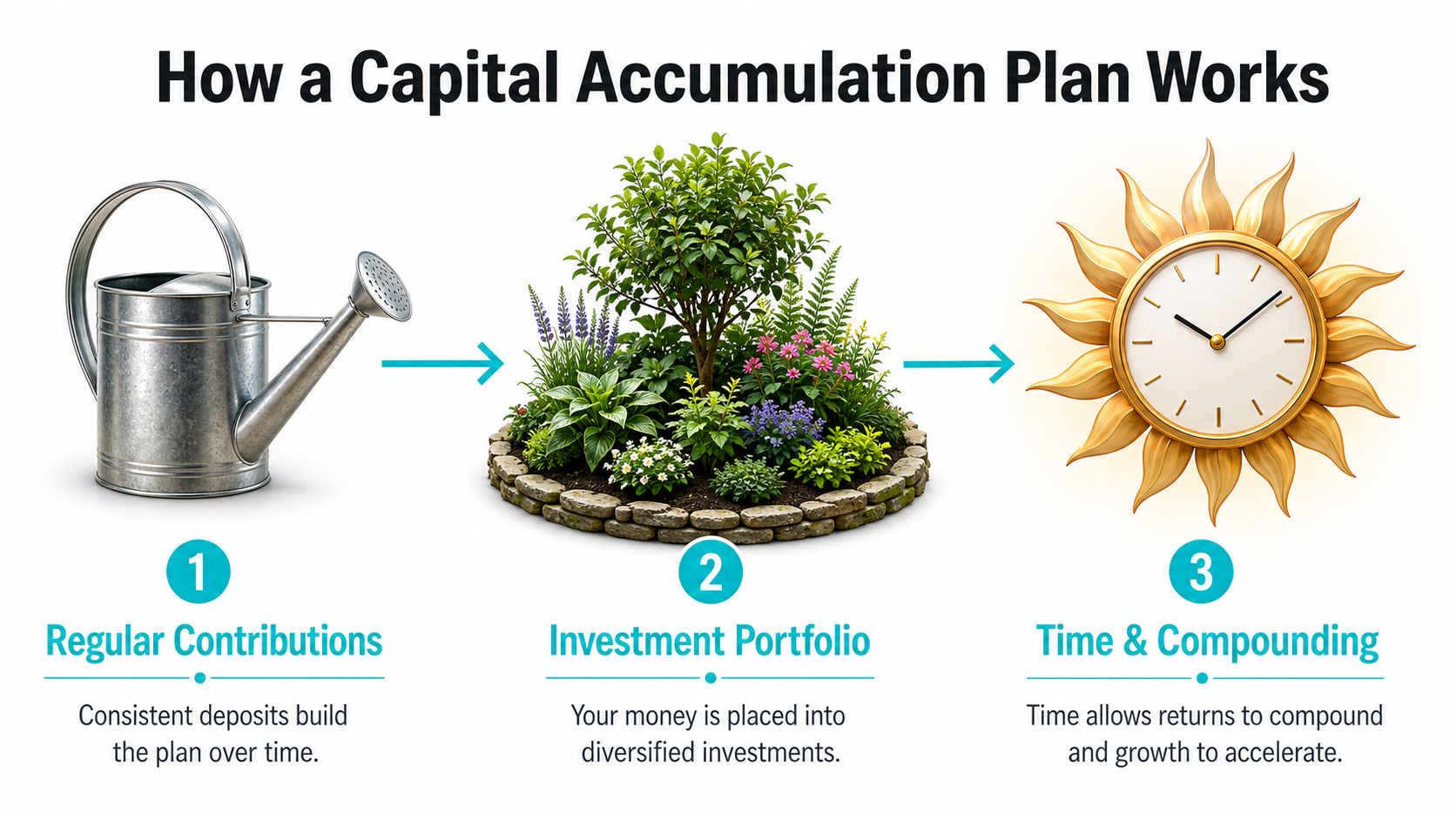
Think of a CAP like a garden hose that gets turned on at the same time every month. The watering can is your regular contribution, the garden is the portfolio, and time is what lets the whole thing grow into something more substantial.
The three moving parts
First, there's the contribution schedule. Investment education materials commonly describe this as a monthly or quarterly contribution pattern, where the same amount goes in each time (Skilling explanation). That regularity matters because it replaces guesswork with habit.
Second, there's the investment menu. In Canadian and Australian-style CAP guidance, the member directs money into two or more investment options selected by the sponsor, rather than into one pooled pot with no choice (SOA study note). The plan structure gives you options, the sponsor gives you the menu, and you make the allocation decision.
Third, there's compounding. Reinvested returns start working alongside your own contributions, which means the portfolio isn't just growing because you added money. It's growing because earlier growth begins to generate later growth as well.
The part people often miss is governance. A CAP sponsor has to provide ongoing disclosure of the default option, the fees and expenses, and how any adviser is compensated, because member choice only works when the information is clear (SOA study note). A 2024 guideline update also expanded what regulators may treat as CAPs, including arrangements such as VRSPs, LIFs, RRIFs, and TFSAs, while keeping the focus on default options and fees (Osler update).
If you want a simple rule to remember, it's this. Regular money in, clear choices available, and transparent fees out in the open. That's the plumbing. Without those three pieces, the plan may still exist, but it won't behave like a proper accumulation strategy.
If you're also thinking about how a buy-and-hold mindset fits into this, build wealth in 2026 is a useful complement because the discipline behind long-term investing matters just as much as the product wrapper.
The Power of Compounding With Regular Contributions
A fixed contribution sounds boring until you watch it work over time. Put $100 every month into an accumulation plan and you're doing two things at once, adding fresh money and buying units at different prices across the year, which means you buy more when prices are lower and fewer when prices are higher (Skilling explanation).
That's why regular investing can feel calmer than trying to guess the right entry point. You're not chasing the market, you're building a habit that keeps running through both good periods and rough ones.
A simple illustration
The table below is an illustration only, not a forecast. It shows why time matters more than many expect when the contribution amount stays the same.
| Time horizon | Monthly contribution | Assumed long-term return | Illustrative end balance |
|---|---|---|---|
| 10 years | $100 | Qualitatively positive and reinvested | Higher than the total contributions alone |
| 20 years | $100 | Qualitatively positive and reinvested | Substantially higher than the total contributions alone |
| 30 years | $100 | Qualitatively positive and reinvested | Much higher than the total contributions alone |
The point of the table isn't the exact dollar result. It's the shape of the outcome. The longer the contribution pattern runs, the more the earlier deposits get time to participate in growth, and the more the portfolio can rely on compounding instead of fresh cash alone.
Key takeaway: with CAP-style investing, the first year is important, but the tenth and twentieth years are what really change the outcome.
This is also why sporadic lump-sum saving can be less effective for many people than steady contributions. A lump sum can be useful if you have one, but many households don't. Regular contributions turn a big goal into a smaller recurring decision, and that makes follow-through much easier.
For Australian households, this logic connects neatly to super. Salary sacrifice and voluntary contributions are different ways of feeding the same accumulation habit. If you want a plain-language explanation of how that works, see what salary sacrifice into super involves.
Inside Super, Outside Super, or Through a Business
In Australia, the same accumulation habit can sit in three different places, and the right answer depends on what you need the money to do. Inside super is tax-advantaged and designed for retirement. Outside super gives you more access. A business structure can make sense for higher earners and owners who are balancing tax efficiency, reinvestment, and asset protection.
Comparing the three homes for capital accumulation
| Place for accumulation | Main advantage | Main limitation |
|---|---|---|
| Inside super | Tax-effective long-term accumulation | Access is restricted until the relevant retirement conditions are met |
| Outside super | Flexible access to capital | Tax treatment is different and less concessional |
| Through a business structure | Can suit owners who want structured investing and separation from personal assets | Needs careful setup and ongoing review |
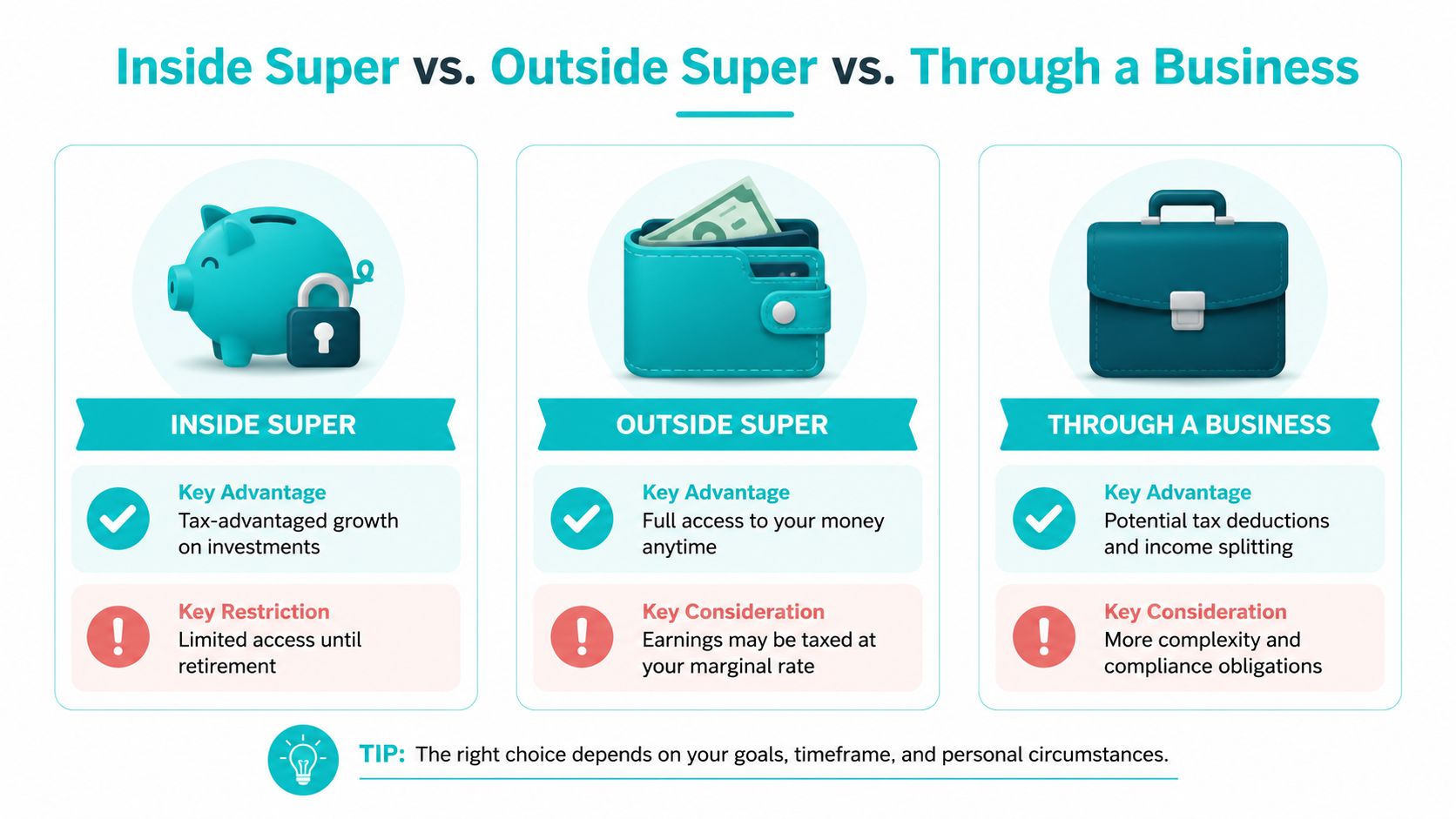
The big trade-off is access versus tax efficiency. Inside super usually makes the most sense when retirement is the main destination and you can tolerate less liquidity. Outside super matters when you need money available for a home deposit, business opportunity, or short-term goal. Through a business structure becomes more relevant when the person making the contributions is also running the business and wants the accumulation strategy to fit that structure.
The Superannuation Guarantee also changes the choice, because many employees already receive compulsory contributions in the background (Banca Generali reference). In that case, the decision is less about whether to accumulate at all and more about where to direct the next extra dollar.
If retirement is more than a decade away, liquidity can matter just as much as tax. If retirement is close, the balance usually shifts the other way.
For owners exploring more complex structures, the vehicle matters as much as the investment. If you're comparing super options and need to understand whether self-managed super has a role, what a SMSF is is a sensible next read because structure and control go together.
Matching Your Accumulation Strategy to Your Life Stage
A CAP-style plan should look different at 33, 48, and 58. The habit is the same, regular contributions over time, but the priority stack changes depending on whether you're juggling a mortgage, trying to maximise tax efficiency, or protecting the assets you already built.
A 30s dual-income family
A 33-year-old couple with stable income often has three competing jobs for spare cash, debt reduction, emergency savings, and wealth building. In that stage, CAP-style saving usually comes after a cash buffer and before anything too complex. Super is already running through employer contributions, so the practical question is whether extra money should go into offset, high-interest debt reduction, or a modest regular investing plan outside super.
A late-40s peak earner
A 48-year-old on stronger income often has more room to be deliberate. At this stage, the accumulation question usually shifts towards tax efficiency and sequencing, because the wrong structure can leave money trapped in the wrong place for too long. CAP-style behaviour here is about making the regular contribution system work harder, not just putting away more.
A 58-year-old pre-retiree
A 58-year-old thinking about retirement needs a different lens again. The main issue is no longer just growth, it's capital preservation, contribution timing, and reducing the risk of being forced to sell after a market drop. Independent household finance research has also noted that rising interest rates and cost-of-living pressures have increased strain on households, which makes liquidity planning more important in the years before retirement (MPRA paper).
Practical rule: if retirement is approaching, don't let accumulation turn into blind accumulation. The money still needs a job, and that job is changing.
A good 12-month plan for any of these stages starts with one question, what has to happen first for your household to stay stable? For some people that's debt reduction. For others it's super optimisation. For others it's rebuilding cash reserves before adding more investments.
Common Traps and Risks to Watch For
The easiest mistake is to treat a CAP like a product you buy once and never revisit. That's risky because the sponsor's default option, the fee structure, and your own life stage can all change the plan's usefulness over time.
The traps that quietly derail accumulation
- Default drift: Staying in a default option without checking whether the fees or investment mix still suit you.
- Contribution fatigue: Starting with good intentions, then stopping every time the market gets noisy or the budget gets tight.
- Sequence risk: Getting close to retirement and then holding too much volatility in the final years before drawdown.
- Fragmented definitions: Not realising that broader CAP-style guidelines now include more arrangements, including VRSPs, LIFs, RRIFs, and TFSAs, which means disclosure and governance matter across more account types than people assume (Osler update).
The default option deserves extra attention because disclosure is part of the plan's safety rails. Sponsors are expected to disclose the default investment option, the fees and expenses for each option, and how advisers are paid (SOA study note). If those details are hard to find, the plan may be legal, but it's not being presented in a way that helps you make a sound decision.
A second trap is emotional stopping and starting. People tend to add money when markets feel calm and hesitate when headlines get loud, but accumulation works best when the schedule stays steady. That's why plan design matters, because a good CAP removes some of the willpower burden from the person using it.
You'll often hear people focus on returns, but the hidden risk is usually implementation. Fees, access, timing, and whether the plan still matches your stage of life all matter as much as the underlying investment idea.
Your Next Steps and Questions Worth Asking an Adviser
The fastest way to sort CAP-style decisions is to bring the right documents and ask specific questions. A useful starting pack is your latest super statement, your payslip, a summary of any insurance inside super, and a list of debt balances. That gives an adviser enough context to see whether the next dollar belongs in super, outside super, or somewhere else.
Before you book a conversation, ask these questions:
- What's the default option? If I do nothing, where does my money go and why?
- What fees apply to each option? I want the total cost, not just the headline admin fee.
- What choices do I have? How many investment options are available, and how are they grouped?
- How often will I get disclosure? I want to know when statements, fee notices, and annual updates arrive.
- How is the adviser paid? I need to understand remuneration before I rely on the recommendation.
If you want a broader checklist on how to assess advice quality, how to choose a financial adviser is a practical place to start. It helps you separate a genuine planning conversation from a product pitch.
A budgeting link can also help at the household level, especially if you're deciding whether surplus money exists in the first place. A plain guide like common budgeting mistakes to steer clear of is useful when cash flow keeps getting eaten by small leaks rather than one big problem.
Wealth Collective's service pillars line up neatly with the decisions this topic raises. Protection Plus suits people who need the base layer of risk cover sorted before they invest more. Guided Growth fits households deciding how to direct surplus between super, debt reduction, and long-term investing. Retirement Roadmap is the right conversation when the focus shifts to contribution timing, access, and drawdown planning.
If your situation is unclear, start small and structured. A free 10-minute introductory call is enough to test fit, identify whether the next step is protection, growth, or retirement strategy, and decide whether a deeper advice process makes sense.
Wealth Collective helps Australians turn confusing money decisions into a clear plan for super, debt, investing, and retirement. If you want a practical conversation about where a capital accumulation strategy fits in your life, visit Wealth Collective and book an initial call.