Business hours
Monday to Friday (8.30AM - 5PM)
Weekend (Closed)



Ever felt disconnected from your superannuation, like your money is on a journey you have no say in? If you're seeking greater control and flexibility to build your wealth, a Self-Managed Super Fund (SMSF) might be the answer.
So, what exactly is an SMSF? Put simply, it’s a private super fund that you manage yourself. It’s the difference between being a passenger on a pre-planned bus tour and getting behind the wheel of your own car—you choose the map and the route towards your retirement destination.
Your Introduction to Self-Managed Super Funds
For a growing number of Australians, taking direct control of their retirement savings is a powerful strategic move. Instead of your super being managed by a large retail or industry fund, an SMSF puts you and up to five other members in the driver's seat as the fund's trustees.
This means you are personally responsible for all decisions, from the investments you choose to ensuring the fund complies with the law. While it’s a significant responsibility, it unlocks a level of control and flexibility that you simply won't find in a standard fund.
The numbers tell a compelling story.
According to the Australian Taxation Office, as of September 2025, there are 661,384 SMSFs in Australia. Together, they hold an incredible $1.07 trillion in assets. This isn't just a niche option; it’s a mainstream strategy for savvy investors and business owners. You can dive deeper into these SMSF statistics and trends on ScaleSuite.
So What Does This Control Mean for You?
Having direct control opens up a world of sophisticated investment and strategic possibilities. While it comes with more responsibility, the rewards can be immense for the right person.
With an SMSF, your investment strategy is built by you, for you, tailored to your exact goals and risk appetite. This could mean:
- Investing in direct property: You could purchase the commercial premises your own business operates from, creating a powerful loop where your business success fuels your retirement nest egg.
- Accessing unique asset classes: Think unlisted shares, certain collectibles, or other alternative assets that are off-limits in most conventional super funds.
- Implementing smarter tax strategies: An SMSF can be a brilliant vehicle for sophisticated tax planning, especially as you approach and move into retirement.
At Wealth Collective, we see an SMSF not just as a product, but as a core component of our Guided Growth and Retirement Roadmap services. It’s a structure designed to help driven clients build a wildly successful financial life. Understanding what an SMSF is and how it works is the first step in deciding if this hands-on approach is right for you. To explore if this is your path, book an initial call with our team.
How an SMSF Actually Works
So, what does ‘managing it yourself’ really look like in practice? The best way to think about your Self-Managed Super Fund is as your own private investment company with one mission: to grow your retirement wealth. You’re no longer just a member number in a massive fund; you’re in the driver's seat.
Essentially, you're cutting out the middleman to take direct control of your superannuation investments.
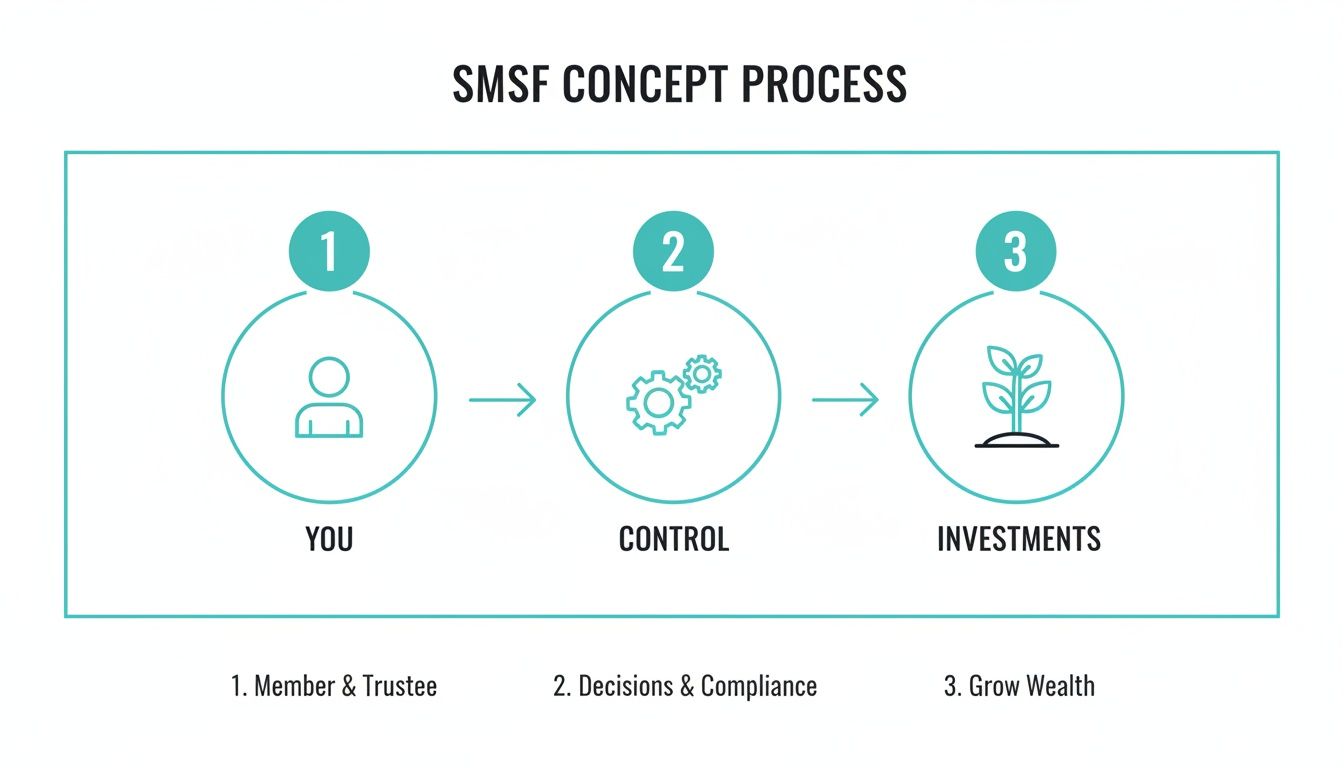
This direct line between you and your financial future is where the power of an SMSF lies. It puts you in charge of the decisions that will ultimately fund your life after work.
At its core, an SMSF is a legal trust structure. You and up to five other people (typically family members) act as the fund's trustees. Being a trustee makes you legally responsible for every aspect of the fund. This is where the real work—and the real opportunity—begins.
Your Core Duties as a Trustee
Becoming a trustee means you’re wearing several hats: director, administrator, and chief investment strategist. Your responsibilities are serious and absolutely non-negotiable.
Above all, every decision you make must be in the best financial interests of all the fund's members. This is to ensure the fund’s sole purpose is to provide retirement benefits, a legal requirement known as the Sole Purpose Test. It’s the golden rule of running an SMSF.
Your key duties will include:
- Creating and following an investment strategy: You need a written plan that outlines the fund’s goals and the specific investments you’ll use to get there. This isn’t a ‘set and forget’ document; it must be reviewed regularly.
- Actively managing the investments: You are the one researching, choosing, buying, and selling all the assets in your fund—from shares and property to term deposits and collectibles.
- Keeping meticulous records: Everything needs to be documented, including minutes from meetings, detailed financial statements, and all member records.
- Arranging an annual audit: Each year, an independent, ATO-approved auditor must go through your fund’s books to ensure you’ve complied with all superannuation laws.
The shift from being a passive member to an active director is profound. It's not about taking on a burden; it's about seizing the chance to align your retirement savings perfectly with your financial knowledge and goals.
You Don't Have to Go It Alone
While the buck stops with you, running an SMSF doesn't have to be a solo mission. In fact, working with the right professionals is the key to maximising benefits while ensuring compliance.
This is where Wealth Collective comes in. We guide our clients through these duties, providing clear, practical advice. For example, while the final investment calls are yours, we help you build a robust and compliant investment strategy. And while you’re responsible for the records, we connect you with specialist accountants who handle the administration, tax returns, and annual audit for you. If you’re curious about the first steps, learn more about setting up a superannuation fund.
This collaborative approach empowers you to be hands-on with your wealth creation. An SMSF, backed by expert advice, provides the perfect framework for building a successful financial future.
The Major Benefits of Managing Your Own Super
So, we've covered the nuts and bolts of what an SMSF is. Now, let’s get to the exciting part: the ‘why’. What really drives savvy Australians to take the wheel of their own superannuation?
It all comes down to one powerful word: flexibility. An SMSF is about more than just managing your super; it’s about unlocking strategic doors that are firmly closed in conventional funds.

For many of our clients, this flexibility is the game-changer. It's the difference between being a passenger and actively drawing the map to your own financial destination. At Wealth Collective, we believe in making your money work smarter, and an SMSF is an incredibly powerful tool for making that happen.
Unlocking a Wider Universe of Investments
By far the biggest drawcard of an SMSF is the sheer breadth of investment choice it offers. Your typical super fund gives you a set menu of options. An SMSF, on the other hand, opens up the entire kitchen.
This means you can move beyond the usual shares and bonds to build a portfolio with direct assets that truly align with your strategy, such as:
- Direct Residential or Commercial Property: Use your super savings to buy property directly. This could be a residential investment property or even the commercial premises your own business operates from.
- Unlisted Assets: Gain access to investments not traded on public markets, like shares in promising private companies or units in exclusive unlisted property trusts.
- Collectibles and Alternative Assets: An SMSF can hold unique assets like artwork or precious metals, as long as you adhere to the very strict rules around storage and personal use.
This is what true investment control looks like. It’s about shifting from being just another member in a massive fund to being the architect of your own retirement wealth.
Real-World Example: Let's say you're a small business owner paying $80,000 a year to rent your workshop. With a correctly structured SMSF, your fund could potentially buy that workshop. Your business would then pay its rent directly into your super fund, effectively turbo-charging your retirement savings while giving your business a secure home. This is a common strategy we help our business-owner clients implement.
Advanced Tax Planning and Strategy
An SMSF is a powerhouse for smart tax management, particularly as you get closer to retirement. Because you’re in control of the assets and the timing of transactions, you can make decisions that legally minimise your tax liability.
For instance, when your fund switches to the pension phase, the investment earnings on assets supporting your pension generally become tax-free. With an SMSF, you can strategically time the sale of assets during this phase to potentially eliminate capital gains tax altogether. This is a massive advantage that can save you tens, or even hundreds of thousands of dollars over the long run.
SMSFs also allow for sophisticated strategies like pension commutations to manage your Transfer Balance Cap, giving you a level of tax-planning precision that is simply out of reach in a large public fund. While an SMSF has many upsides, it's crucial to weigh them against the responsibilities. You can explore a balanced view in our article on the pros and cons of a self-managed super fund.
Sophisticated Estate Planning
Finally, an SMSF provides far greater control and certainty over what happens to your super when you pass away. With most retail or industry funds, a non-binding nomination is essentially just a suggestion—the fund's trustee still has the final say.
An SMSF allows you to create a Binding Death Benefit Nomination (BDBN), a legally enforceable directive that ensures your super goes exactly where you want it to go, no questions asked.
You can even structure your fund to pay ongoing pensions to your dependents, providing long-term financial security for your loved ones according to your exact wishes. This elevates your super from a simple retirement account into a core component of your family's legacy.
Understanding the Risks and Responsibilities
The control an SMSF offers is a huge drawcard, but it comes with serious, legally binding duties. As a trustee, you are not just an investor; you are legally accountable for the fund’s operation.
At Wealth Collective, we are upfront about the whole picture. Our aim is to give you a clear-eyed view of the challenges so you understand why professional guidance is so crucial to making an SMSF work for you.

The Sole Purpose Test: Your Guiding Star
Every single decision you make for your SMSF must pass the Sole Purpose Test. This is the bedrock of SMSF law and is non-negotiable. It states that the fund must be run for the sole purpose of providing retirement benefits for its members.
This means using the fund's money for personal benefit now is strictly forbidden. Buying a holiday home for the family to use or lending money from the fund to a relative are clear breaches. The Australian Taxation Office (ATO) enforces these rules rigidly, and the consequences are severe.
The Heavy Lifting: Time and Administration
Running an SMSF is a hands-on job. It requires a serious amount of your time to manage the fund correctly and keep everything in order. You are personally on the hook for every decision, transaction, and piece of paperwork.
This involves:
- Constant Oversight: Regularly reviewing your investment strategy and tracking asset performance.
- Meticulous Paper Trails: Documenting every decision, meeting, and transaction. Shoddy record-keeping is a fast track to compliance disasters.
- Yearly Duties: Working with accountants and auditors to get your annual return lodged correctly and on time.
If you’re already stretched for time, an SMSF can quickly feel like a burden. This is where working with an adviser who orchestrates these moving parts for you becomes a game-changer, letting you focus on the big-picture strategy.
The Compliance Minefield and Costly Penalties
Getting the super laws wrong, even by accident, can have devastating consequences. The ATO has broad powers to penalise trustees who don't follow the rules.
Let's be blunt: a major compliance breach can be financially crippling. If the ATO deems your fund "non-compliant," its assets could be taxed at the highest marginal rate of 45%. A single mistake could wipe out nearly half of your retirement savings.
Other penalties can also be applied, including:
- Administrative Fines: Thousands of dollars for specific rule-breaking, which must be paid by you personally, not from the fund's assets.
- Trustee Disqualification: The ATO can ban you from ever acting as an SMSF trustee again.
- Legal Action: For serious breaches, you could face civil or even criminal proceedings.
These regulations are complex and change often. Accepting full responsibility for staying on the right side of the law is a huge part of having an SMSF.
No Government Safety Net
It’s vital to understand that SMSFs do not have the same government compensation scheme that protects large APRA-regulated funds (like industry or retail funds) from losses due to theft or fraud.
The duty to protect your fund's assets falls squarely on your shoulders as the trustee. The security of your nest egg depends on your own diligence and the quality of the professionals you surround yourself with.
This honest look at the risks gets to the heart of our philosophy at Wealth Collective. An SMSF is a powerful tool for building wealth, but it demands expertise and careful handling. Our role is to provide that expert guidance, so you can enjoy the benefits with the confidence that the responsibilities are being managed properly.
Who Should Consider an SMSF
So, after learning about the control and flexibility an SMSF offers, the most important question is: is this the right move for you?
An SMSF isn't a one-size-fits-all product. It’s a serious commitment designed for people who want to be in the driver's seat of their retirement strategy. It’s for those who see super not as a forgotten account, but as a powerful engine for building real wealth.
Making the leap should come from a place of clarity about your goals and a frank assessment of your situation, knowledge, and time.
The Profile of a Typical SMSF Member
The kind of person who thrives with an SMSF often feels constrained by the off-the-shelf options in traditional super funds. They want direct control over their financial future—a desire that perfectly matches the driven professionals and business owners we work with every day.
Generally, an SMSF could be a great fit if you tick one or more of these boxes:
You Have a Substantial Super Balance: While there's no official minimum, a balance of $500,000 or more is often a good starting point to ensure the fixed running costs are cost-effective.
You're a High-Income Earner: If you're in a high tax bracket, you're likely looking for more sophisticated tax strategies. An SMSF can open the door to advanced options, particularly as you approach and enter retirement.
You Own a Business: For many business owners, the ability to buy their own commercial premises with their super is a game-changer. This strategy allows your business to pay rent directly to your super fund, building both your business assets and your retirement nest egg.
An SMSF is for those who are not just willing but eager to be hands-on with their financial strategy. It’s for the person who wants to be the architect of their retirement.
What the Numbers Tell Us
ATO data paints a clear picture of who is running an SMSF. According to figures from September 2025, a striking 85% of the 1.22 million SMSF members are aged 45 or older, with the median member age at 62. This shows SMSFs are typically set up by people who are well-established and getting serious about their retirement runway.
The data also shows the average member balance is a significant $849,678—well above the average in retail or industry funds. You can dig into these figures yourself on the latest annual statistics for SMSFs on the ATO website.
These stats highlight that an SMSF is a long-term play; over 65% of funds have been operating for more than 10 years. This level of control and wealth-building potential is precisely what attracts the clients we serve. If this sounds like you, learn more about our self-managed super services.
Is an SMSF Right for You? A Checklist
To help you think through this decision, use this practical checklist to self-assess whether you have the right mindset, resources, and motivation.
| Consideration | Ideal Profile for an SMSF | Questions to Ask Yourself |
|---|---|---|
| Super Balance | You have a combined balance of $500,000 or more (or a clear path to get there). | Is my balance large enough that the flat fees will be cost-effective compared to a percentage-based industry fund? |
| Investment Knowledge | You have a good understanding of investment principles and risk management. | Am I genuinely interested in researching and managing investments, or would I rather have an expert guide me? |
| Time Commitment | You are prepared to dedicate time to administration, research, and compliance. | Do I realistically have the time and energy for this, or do I need an adviser to manage the process for me? |
| Control vs. Convenience | You value direct control over your strategy more than the 'set-and-forget' nature of a public fund. | What is more important to me: total control and flexibility, or simplicity and having someone else handle it? |
| Specific Goals | You have a clear reason, like buying your business premises or accessing specific assets not available elsewhere. | Do I have a specific investment goal that can only be achieved with an SMSF? |
If you found yourself nodding along to the "Ideal Profile" column, an SMSF could be a powerful tool in your financial arsenal. The next step is a conversation with a professional to map out what it could look like for you.
So, Where Do You Go from Here?
You now have a solid picture of what a Self-Managed Super Fund is, how it works, and the real benefits and risks involved. But theory is one thing; putting it into practice is another.
The path from here isn't about rushing into setup forms. It’s about taking a deliberate pause to ensure this is the right move for you. This is a hands-on commitment that will demand your time and attention for years to come.
The Key Questions to Ask Yourself
Before you go any further, have an honest chat with yourself. Your answers will tell you whether an SMSF truly fits your life and financial future.
- Do I actually have the time? Realistically, running an SMSF means dedicating hours each month to oversight, record-keeping, and staying on top of the rules. Do you have that time to spare, or do you need a team to manage it for you?
- Am I confident making financial decisions? You don’t need to be a market wizard, but a good grasp of investment basics is crucial. Are you confident making the final call on where your retirement nest egg is invested, with professional guidance?
- Have I factored in the costs? There are set-up fees and ongoing annual costs. It’s crucial to weigh how these fees will impact your returns, especially on smaller balances.
- Do I have the right personality? Being a trustee requires diligence, organisation, and a commitment to playing by the book. Are you prepared to carry the full legal responsibility for your fund?
Answering these frankly is the most important piece of due diligence you can do.
Why a Conversation with an Expert Matters
Trying to navigate this decision alone can be daunting. The rules are complex and the penalties for getting it wrong are significant. This is why professional financial advice is so important before you commit. A good adviser does more than just quote regulations; they help you understand what it all means for you.
This is exactly where the Wealth Collective process begins. Our Clarity & Confidence Call is designed to provide absolute clarity, setting you up to protect and grow your wealth over the long haul.
Our job is to be your partner, cutting through the complexity so you can focus on your goals. We'll help you properly weigh the pros and cons, map out the costs, and design a compliant strategy that puts your money to work.
Your journey starts with a simple conversation. We invite you to book a complimentary, no-obligation 10-minute introductory call with one of our experienced advisers. In that short chat, we can get a sense of your goals and help you figure out if an SMSF is the right vehicle to get you there. Let us help you take the next step with expert support and complete peace of mind.
Here are some of the most common questions we get asked about the practical side of running a self-managed super fund.
How Much Money Do I Really Need to Start an SMSF?
There’s no legal minimum, but the industry rule of thumb is a starting balance of at least $200,000 to $500,000.
Why? It all comes down to costs. An SMSF has fixed annual costs for accounting, audits, and the ATO levy. If your fund balance is too small, those fees can take a serious bite out of your returns. With a larger balance, those same costs become a much smaller percentage of your assets, making the entire exercise far more efficient.
Part of our process at Wealth Collective is to run the numbers with you to see if an SMSF makes financial sense for your specific situation.
Can My SMSF Borrow Money to Invest?
Yes, but the rules are incredibly strict. The structure is called a Limited Recourse Borrowing Arrangement (LRBA), most often used to buy a single asset like an investment property.
The key phrase is "limited recourse." It means if the fund defaults on the loan, the lender can only repossess that one specific asset. They can't touch any other investments in your SMSF. It’s a protection mechanism, but setting one up is a complex legal and financial process that absolutely requires professional guidance.
What Happens if I Make a Mistake?
As a trustee, the buck stops with you. You are personally responsible for ensuring the fund follows all superannuation laws, and the Australian Taxation Office (ATO) can hand out hefty penalties for breaches.
For minor slip-ups, you might get an education direction. But for serious mistakes, you could face significant fines. In the worst-case scenario, the ATO could declare the fund "non-compliant," which can lead to a tax bill of up to 45% on the fund’s assets.
This is exactly why having experienced professionals manage the administration and compliance isn't just a good idea—it's essential for protecting your retirement nest egg from simple but costly errors. This is a core part of the service we provide.
Can I Go Back to a Normal Super Fund if I Change My Mind?
Absolutely. An SMSF isn’t a life sentence. If your circumstances change or you find you no longer want the responsibility, you can wind up the fund.
This involves rolling your super benefits back into a standard APRA-regulated fund. It’s a formal process that includes finalising accounts, a final audit, and lodging a last tax return. A financial adviser can walk you through the entire wind-up to make sure it’s done smoothly and by the book.
Getting your head around the world of SMSFs takes clarity, confidence, and expert guidance. At Wealth Collective, our job is to translate these complex rules into a clear, actionable plan that works for you.
If you’re ready to see whether an SMSF is the right move, book a complimentary 10-minute introductory call with our team.