Business hours
Monday to Friday (8.30AM - 5PM)
Weekend (Closed)


You've been earning a solid salary for years, building super, paying down debt and perhaps holding an investment property. Yet the question keeps returning: what is passive income, and could it make work optional or retirement less stressful?
The marketing answer is usually simple. Buy an asset, collect money while you sleep and let compounding do the rest. The Australian answer is more useful. Passive income can support financial independence, but its value depends on tax, inflation, investment structure, liquidity, risk and the amount of work still required.
A rental property, dividend portfolio and super pension can all produce cash flow, but they don't produce the same after-tax result. This distinction matters for Perth pre-retirees, professionals building wealth and small business owners deciding whether investments belong in their own name, a company, a trust or super. The right question isn't “Which passive income idea pays the most?” It's “Which income stream leaves me with a dependable, useful result after costs and tax?”
A Real Question Real Australians Are Asking
A Perth professional in her late fifties recently described the situation many people recognise. She had accumulated super, owned her home and had enough savings to feel responsible, but not enough confidence to know whether retirement income would last. She didn't want another job disguised as a side hustle. She wanted to know whether her existing assets could provide reliable cash flow.
A younger couple might ask the same question from a different starting point. They're scrolling through social media, seeing dividend portfolios, property claims and online businesses presented as effortless wealth. Their concern isn't retirement yet. It's whether they can build an income-producing asset base while paying a mortgage and raising a family.
Both questions are reasonable. The phrase passive income is heavily marketed, and it often disguises the difference between an asset that produces cash and a project that demands ongoing attention. Australian tax rules also classify income by its source, not by whether the owner feels busy managing it.
Why the Australian context matters
A dividend, rental payment, interest payment or capital gain may be passive in the everyday sense, but each can have a different tax outcome. Superannuation can change the result again, particularly when an account moves from accumulation to pension phase. A company holding investments has another layer of rules to consider.
The Australian Bureau of Statistics includes interest, dividends, rent, royalties and capital gains within net investment income classifications in household income surveys, while the Australian Taxation Office tracks these categories through individual tax returns ABS income methodology. That gives us a practical starting point: passive income is common, but it isn't automatically simple, tax-free or suitable for everyone.
This article focuses on the decisions that matter. You'll learn how passive income works, how Australian tax treatment changes the result and how to assess an opportunity before committing capital. The approach is practical because generic promises rarely survive contact with a tax return or a retirement cash-flow plan.
What Passive Income Actually Means
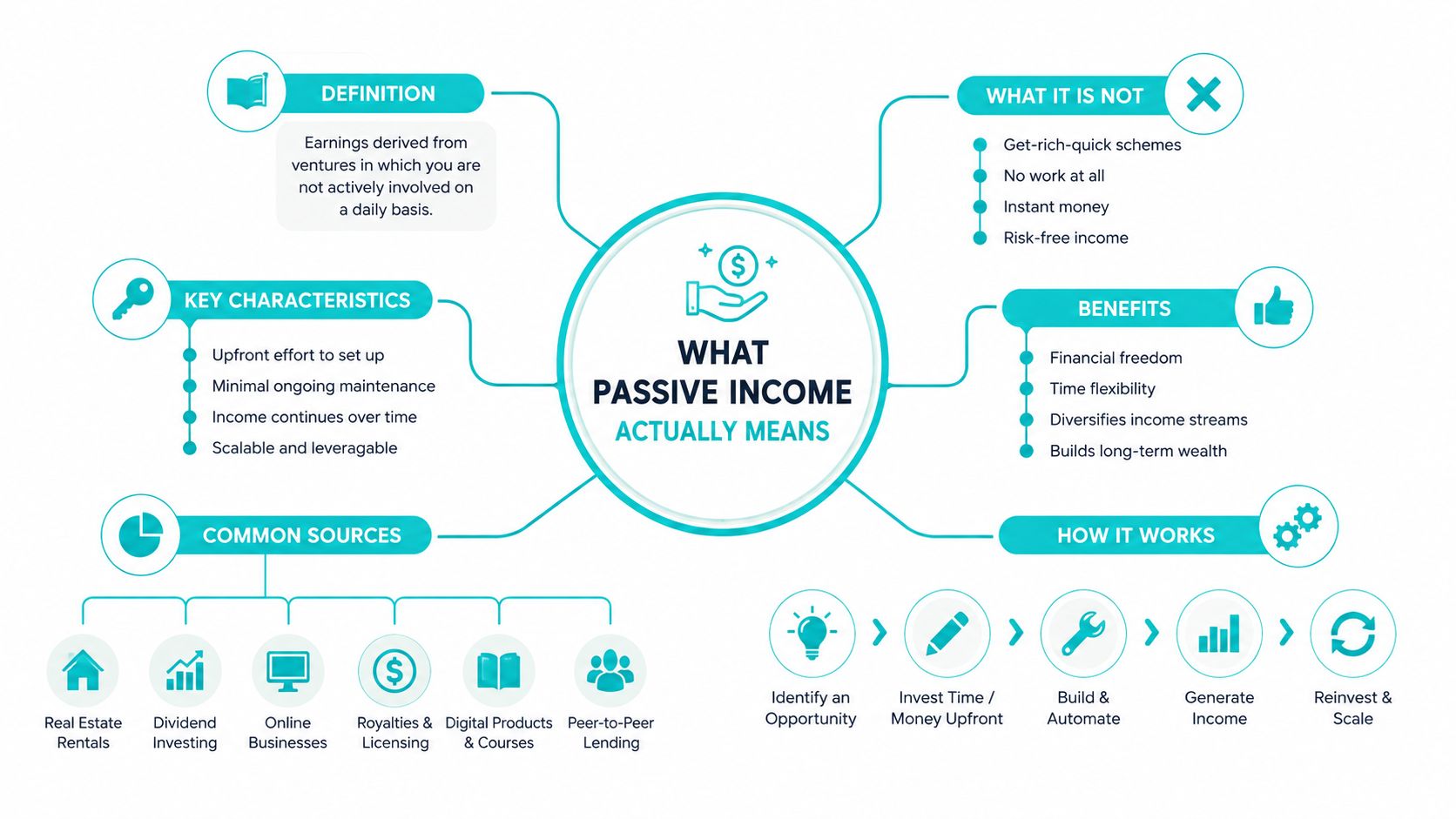
Passive income is money generated by an asset or arrangement with little day-to-day effort after the initial setup. A wage is active income because you're paid for your labour. A consultant's fee is active income because the client pays for work performed. Rent from an investment property, interest on savings and dividends from shares are generally passive investment income because the asset produces the return.
That definition describes cash flow, but it doesn't settle the tax question. The Australian Taxation Office treats passive income as a source-based classification. Its guidance includes dividends, interest, royalties, annuities, rental income and certain gains on assets, including assets that generate passive income or aren't used solely in carrying on a business ATO passive income glossary.
A useful three-part test
Use this test when reviewing your own income:
- Identify the asset. Is the cash coming from shares, property, deposits, intellectual property, a managed fund or a retirement product?
- Identify the activity. Are you being paid for labour, or is an asset producing the return?
- Identify the taxpayer. Is the income received personally, through super, a trust or a company?
The third question is where many online explanations fall short. Two investors can own similar assets and receive similar gross income, yet keep different amounts after tax because their structures and other income differ.
Passive also doesn't mean effortless. A landlord still deals with vacancies, repairs and compliance. A dividend investor still chooses investments, reviews concentration and accepts market movements. A person receiving royalties may need to maintain rights, contracts or distribution channels. The income may be less labour-intensive than employment, but it still requires design and oversight.
For a broader introductory explanation before applying Australian tax rules, Victoria OHare's passive income guide offers a useful general reference. Treat it as background reading, not a substitute for checking how an income source fits Australian tax and superannuation rules.
Practical rule: Classify the source first, then assess the effort, tax treatment and risk. Calling something passive doesn't change its legal treatment.
The Main Types of Passive Income in Australia
Australian investors usually encounter a small group of established income sources. Each has a different balance between control, capital, reliability and administration.
Rental property produces income when a tenant pays to use the property. The owner remains responsible for the asset, whether directly or through a property manager, and the rent can be affected by vacancies, maintenance, interest costs and market conditions. The Wealth Collective guide to investment property explains how rental property can create cash flow while also carrying concentration and borrowing risks.
Shares can provide dividends and capital growth. Dividend payments aren't guaranteed, and the share price can fall even when a company continues distributing income. Australian resident investors may also receive franking credits attached to eligible franked dividends, subject to the rules that apply to their circumstances.
Interest comes from bank deposits, term deposits and debt securities. It's usually easier to access than property and simpler to administer, but the income can change as interest rates change. It also may not preserve purchasing power after tax and inflation.
Royalties arise when someone pays to use intellectual property, such as a book, design, invention or licensed work. Natural-resource arrangements can also produce royalties. The upfront work can be substantial, and income depends on demand, contractual rights and ongoing commercial relevance.
Annuities are contracts, commonly issued by insurers, that can provide a structured income stream in exchange for capital. They can help create predictable retirement cash flow, but the contract terms, access rules and trade-off between certainty and flexibility need careful review.
Managed funds pool investor money and invest across assets. The fund is a vehicle rather than a separate economic source. It may distribute interest, dividends, rent or capital gains, and the investor must understand the distribution statement and the underlying portfolio.
An SMSF is also a wrapper, not an income source. It can hold investments such as shares, managed funds and property, but it brings trustee responsibilities, administration and compliance obligations. Setting one up solely because it sounds complex is poor advice.
| Income Source | Typical Setup Effort | Capital Required | Income Reliability | AU Tax Treatment |
|---|---|---|---|---|
| Rental property | High | High | Variable | Rent and gains generally enter assessable income, with deductions subject to the rules |
| Shares | Moderate | Flexible | Variable | Dividends and gains are generally assessable, with franking rules potentially relevant |
| Interest | Low | Flexible | Variable | Interest is generally assessable income |
| Royalties | High upfront | Varies | Variable | Royalties are generally assessable income |
| Annuities | Moderate | Usually substantial | Contract-dependent | Treatment depends on the product and circumstances |
| Managed funds | Low to moderate | Flexible | Variable | Distributions usually retain their underlying tax character |
| SMSF | High | Depends on investments | Depends on investments | The fund's structure and phase determine treatment |
The right shortlist depends on your objective. A retiree may value dependable payments and access to capital. A younger professional may prioritise growth and liquidity. A business owner may need to avoid contaminating a company's tax position with too much passive income.
How Passive Income Is Taxed in Australia
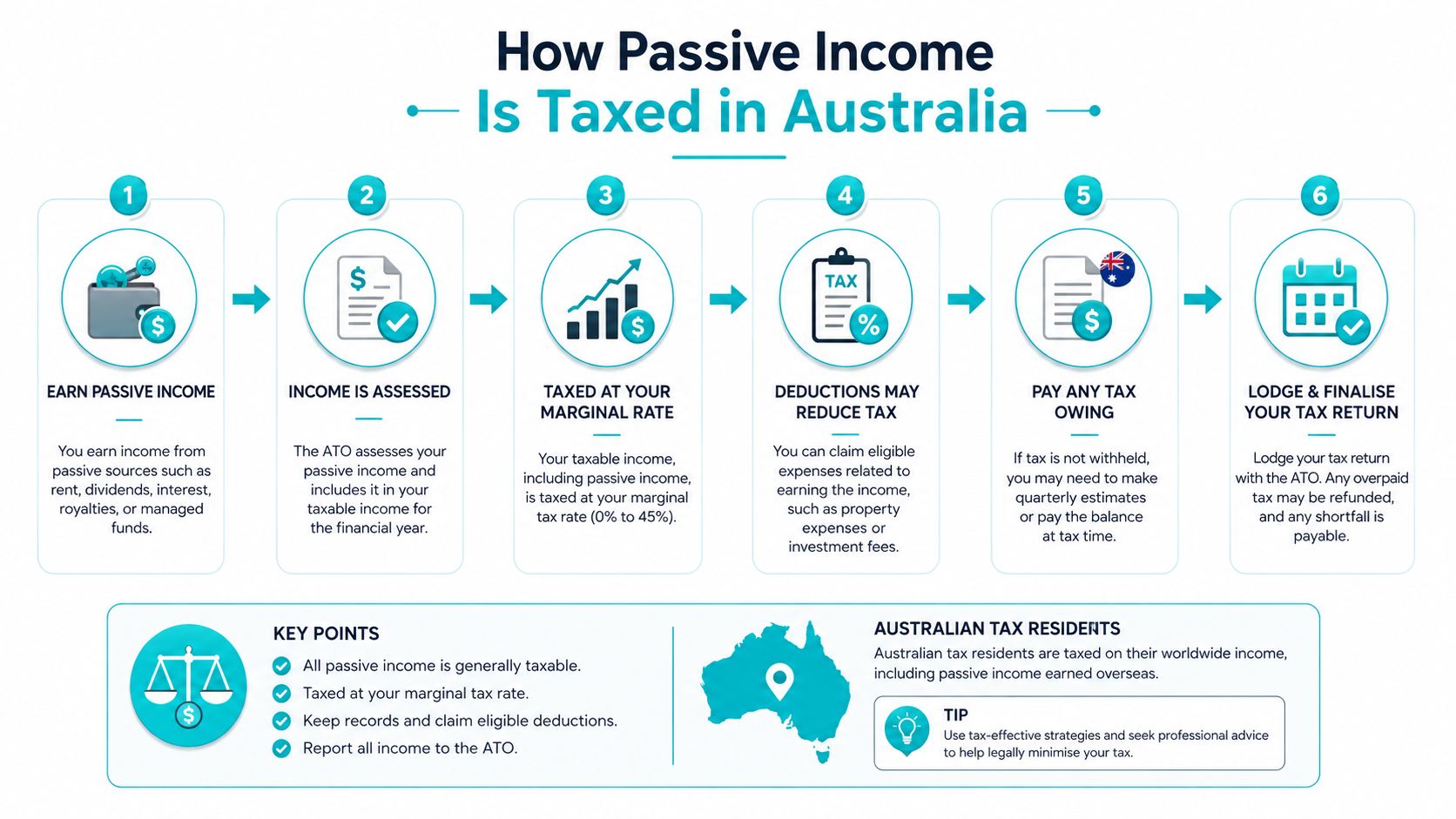
Passive income isn't taxed under a separate “passive income rate” for individuals. It generally forms part of assessable income and is taxed under the resident marginal tax scale, which ranges from 0% to 45%, plus the Medicare levy where applicable ATO resident tax rates. Your other income, deductions, ownership structure and timing determine how much of the gross return you keep.
Consider two people who each receive $10,000 of passive income. They may not keep the same amount because one could hold the asset personally at a higher marginal rate, while the other could receive income through a different structure or offset it with allowable deductions. The headline yield is only the starting point.
The four tax mechanics that change the result
Negative gearing occurs when deductible investment expenses exceed investment income, creating a net loss that may reduce taxable income, subject to the applicable rules. It can improve an investor's current tax position, but it doesn't turn a poor investment into a good one. You're still funding the shortfall, carrying borrowing risk and relying on the asset and rental market.
Franking credits can improve the after-tax value of franked Australian share dividends for eligible resident taxpayers. The ATO guidance on receiving dividends and distributions explains who can claim the associated tax offset and the restrictions affecting exempt-income recipients.
Superannuation adds an important distinction. The Parliamentary Budget Office notes that super pension accounts have a 0% tax rate, so franking credits from franked Australian share dividends are refunded in full, while accumulation accounts are taxed at 15% on earnings and 10% on capital gains Parliamentary Budget Office analysis. This is one reason the same dividend portfolio can produce a different net outcome inside pension phase compared with personal ownership.
For small business owners, company structure needs a separate check. A base rate entity can access the 25% company tax rate if aggregated turnover is under $50 million and no more than 80% of assessable income is base rate entity passive income. The ATO's definition includes distributions and franking credits, royalties, rent, interest, qualifying security gains and net capital gains ATO company tax rate rules. If passive income dominates, the company may instead face the 30% rate, increasing tax friction on retained earnings.
For property owners considering capital gains, David Beshay Real Estate's guide to reducing CGT on a home sale provides general property context. Your own eligibility still depends on the asset, use and ownership history.
Use Wealth Collective's explanation of the tax benefits of rental property as a starting point, then have the numbers modelled rather than relying on deductions as the investment rationale.
How to Evaluate a Passive Income Idea
A passive-income idea earns a place in your plan only after it passes five tests. Don't start with the advertised yield. Start with what the asset does to your household cash flow and balance sheet.
The five filters
- Time: Count setup, administration, tenant issues, portfolio reviews and tax work. A digital product may need heavy upfront effort, while a managed fund may require less day-to-day involvement.
- Capital: Assess how much money must be committed and whether that capital could be needed for a home, debt reduction, education or emergencies.
- Risk: Separate income variability from capital loss. A payment that looks attractive can be cut, delayed or overwhelmed by a falling asset value.
- Liquidity: Ask how quickly you can access the money without selling at an unfavourable time. Property is harder to liquidate than listed securities or cash holdings.
- Tax efficiency: Calculate the net result after deductions, marginal tax, franking credits, super rules and transaction costs. Tax efficiency should support a sound investment, not rescue a weak one.
Applying the filter
A high-yield dividend portfolio may score well on liquidity and administration, but its income and capital value can fluctuate. A positively geared inner-city unit may produce surplus rent, yet the owner still carries vacancy, maintenance, borrowing and concentration risk. A balanced managed fund may spread exposure across assets, but its distributions aren't fixed and the investor has less control over individual holdings.
A small SMSF might offer investment control, but control comes with trustee duties and operating responsibilities. It isn't automatically more tax-efficient or more appropriate than an existing super fund.
| Option | Strongest Feature | Main Question |
|---|---|---|
| Dividend portfolio | Liquidity and potential franking benefits | Can you tolerate fluctuating income and market value? |
| Rental property | Tangible asset and potential leverage | Can your cash flow withstand vacancies and costs? |
| Managed fund | Diversification and professional management | Do the strategy and fees suit your objective? |
| SMSF | Control over retirement assets | Are the responsibilities justified by your needs? |
Avoid three traps. Don't chase the highest yield without checking its durability, don't borrow without a genuine cash buffer, and don't let one property, company or sector dominate your financial future.
Common Myths About Passive Income
Myth one, passive income is tax-free. It isn't. Australian tax law generally brings interest, dividends, rent, royalties and relevant gains into the income tax system. Franking credits can improve the outcome for eligible resident taxpayers, but they don't make every dividend tax-free.
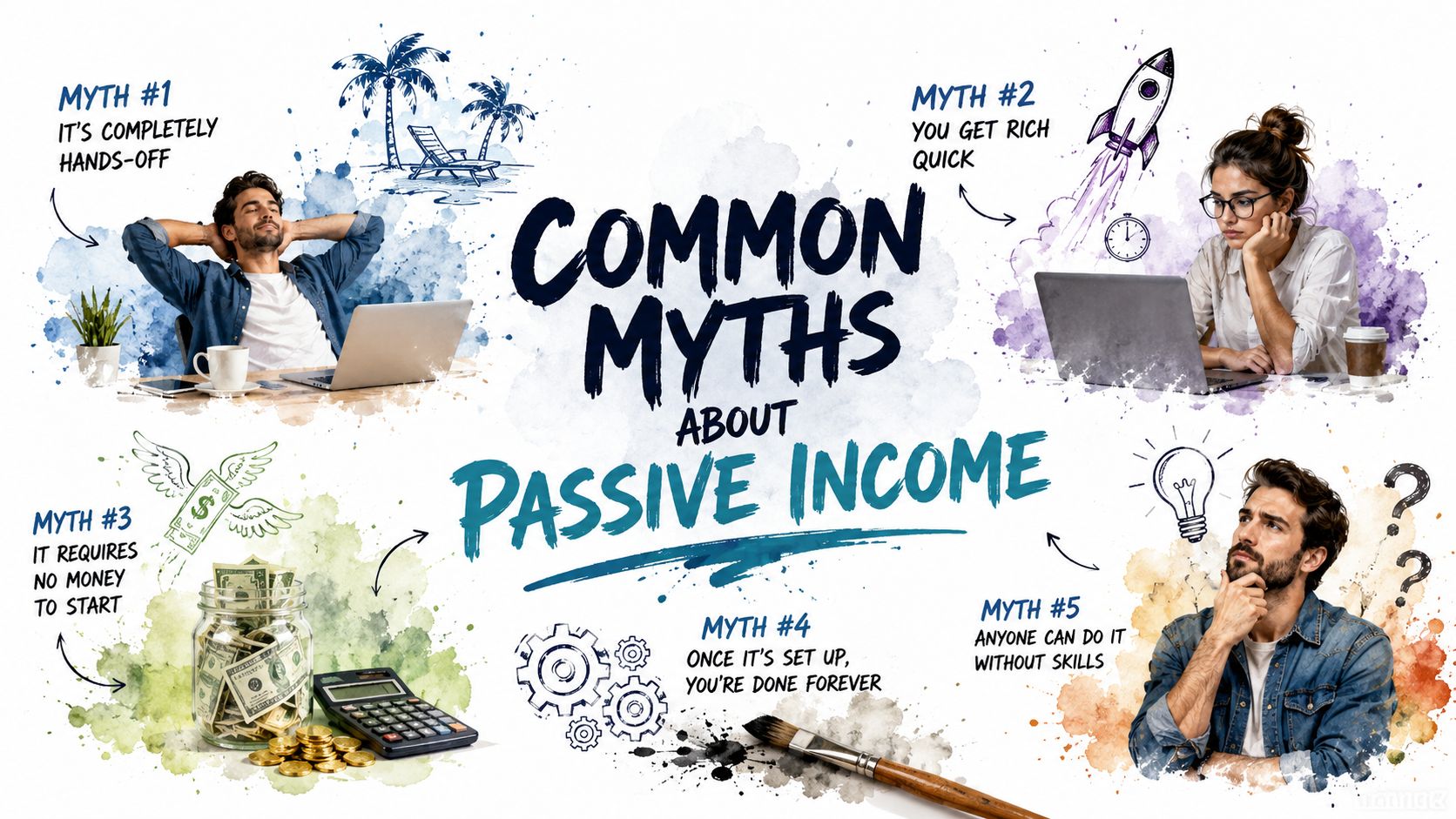
Myth two, property becomes passive once the tenant moves in. A property manager can reduce your workload, but you still own a financed, physical asset. Vacancies, repairs, insurance, compliance and refinancing remain part of the economics.
Myth three, royalties are easy money. Royalties can continue after the original work is complete, but the work usually starts with creating something valuable and securing enforceable rights. Demand can fade, contracts can change and distribution still matters. A broader passive income myth explained discussion is useful for challenging the lifestyle marketing around the phrase.
Myth four, you need a million dollars to begin. You don't need a particular wealth milestone to start investing. Shares, managed funds and super contributions can provide accessible entry points, although the appropriate starting amount depends on cash flow, debt, emergency reserves and the investment vehicle.
Myth five, the highest yield is the best choice. A high distribution can reflect higher risk, a temporary payment or a falling asset price. Judge an income stream by its net, sustainable and risk-adjusted contribution to your plan.
The honest version is less glamorous but more useful. Passive income is a tool for funding goals. It's not a shortcut around investment risk, tax or the need for sound decisions.
Practical Starter Steps and How Wealth Collective Can Help
Start with your life stage, not an online list of ideas. The same asset can be sensible for one household and completely wrong for another.
Pre-retirees and retirees
Map your required retirement cash flow before choosing an income source. Review superannuation, the timing of pension-phase withdrawals, dividend holdings and whether an annuity could add useful certainty. Franking credits may matter, but only when the ownership structure and eligibility rules support the outcome.
This work fits the Retirement Roadmap pillar. The focus is sequencing income, preserving flexibility and reducing the chance that you're forced to sell growth assets at an inconvenient time.
Young professionals and dual-income families
Build the foundation first. Keep expensive debt under control, establish appropriate personal insurance and direct regular investment towards diversified shares or managed funds where the time horizon supports it. Don't buy an investment property just because rent sounds passive.
The Protection Plus pillar addresses personal risk, while Guided Growth focuses on super, investments and debt strategy. Wealth Collective's guide to starting investing can help you understand the basic sequence before you decide what to implement.
Small business owners
Separate operating risk from investment strategy. Review whether a company is holding passive investments and test the base rate entity passive-income condition before allowing investment income to become a dominant part of assessable income. Consider key-person protection and only investigate an SMSF when control, investment needs and trustee responsibilities justify it.
A sound sequence: Protect the household and business, establish the cash-flow buffer, choose the structure, then invest.
Bring your current super statements, debts, insurance, investment accounts and expected retirement dates to an initial conversation. A free 10-minute introductory call is enough to identify the central issue and determine whether a detailed plan would help.

Frequently Asked Questions About Passive Income
Is passive income tax-free in Australia?
No. Interest, dividends, rent, royalties and relevant capital gains generally form part of assessable income. Structure and timing affect the net result.
How much capital do I need to start?
There isn't one universal starting figure. Begin only after accounting for cash reserves, debt, insurance and near-term obligations.
Is an SMSF the same as a regular super fund?
No. An SMSF gives members trustee responsibility and greater control, but also adds administration and compliance duties.
Is rental property still sensible in 2026?
It can be, but only if the property, debt, cash flow, tax position and diversification fit your plan. Don't treat rent alone as proof of a good investment.
If you want your own passive-income options tested against tax, risk and retirement needs, book an introductory conversation rather than guessing from generic examples.
Wealth Collective helps Australians connect passive-income decisions with investment strategy, personal protection and retirement planning through Protection Plus, Guided Growth and Retirement Roadmap. Visit Wealth Collective to arrange a free 10-minute introductory call and discuss which income structure fits your circumstances.