Business hours
Monday to Friday (8.30AM - 5PM)
Weekend (Closed)



Salary sacrifice is one of the smartest, yet most underused, strategies for growing your wealth in Australia. Put simply, it’s an arrangement you make with your employer to have a portion of your pre-tax salary paid directly into your super fund. This move can lower your taxable income right now and seriously boost your retirement savings for later. At Wealth Collective, we see this as a foundational step for clients wanting to take control of their financial future.
What Is Salary Sacrifice and How Can It Help You?

Let's break this down without the financial jargon. Picture your salary as a bucket of water. Normally, you receive the whole bucket, the tax office takes a big scoop out, and you live on what's left. With salary sacrifice, you ask your employer to pour a bit from your bucket directly into your superannuation tank before the tax office gets to it.
This simple act of redirecting your income means that part of your earnings never hits your bank account as regular income. Instead, it goes straight to work in the low-tax environment of super. For professionals and anyone on a higher income, this is a game-changer for building your nest egg faster.
To give you a quick overview, here’s a snapshot of how it all works.
Salary Sacrifice Super at a Glance
| Feature | Description |
|---|---|
| Contribution Type | Pre-tax contributions made directly from your salary. |
| Tax on Contributions | Taxed at 15% in your super fund (up to the concessional cap). |
| Effect on Income | Reduces your taxable income for the financial year. |
| Main Benefit | Potential tax savings by paying a lower rate on sacrificed income. |
| Who It Suits | Most beneficial for middle to high-income earners. |
This table shows just how powerful salary sacrificing can be. It’s a disciplined, automated way to prioritise your future self.
The Power of Pre-Tax Contributions
The real magic of salary sacrifice lies in the tax difference. Your regular income is taxed at your marginal rate, which can be as high as 45% (plus the Medicare levy). In stark contrast, contributions made through salary sacrifice are typically taxed at just 15% when they enter your super fund.
That immediate tax saving is what accelerates your wealth-building journey. It's a key strategy we implement with our clients because it puts your money to work much more efficiently than just relying on your employer's standard contributions. For a deeper dive into the basics, you can check out our guide on what superannuation is in Australia.
A Real-World Example for High Earners
Let's make this tangible. Imagine you’re a professional in Perth earning over $180,000 a year. Salary sacrificing into super could be your secret weapon for cutting your tax bill and fast-tracking your retirement savings.
For instance, if a couple each earning $180,000 decides to salary sacrifice $15,000 each year, they could individually save around $5,250 in income tax for the 2025-26 financial year. That’s a significant saving that goes directly toward building a more comfortable future.
At Wealth Collective, our Guided Growth service is designed to help you execute these exact strategies. We work with you to move past the theory and into confident action, making sure your super is working just as hard as you are.
The Mechanics of Setting Up a Salary Sacrifice Arrangement
So, how do you actually get a salary sacrifice arrangement up and running? The good news is it's usually far more straightforward than most people think. It all boils down to a formal agreement between you and your employer.
You're essentially telling them, "Hey, instead of paying me this part of my salary, please send it straight to my super fund before you take out any tax." It’s not a complicated legal document, just a clear instruction for your payroll team to follow.
The Journey From Decision to Deposit
Let's walk through what that looks like in practice, from the moment you decide to start, to the money landing in your super account.
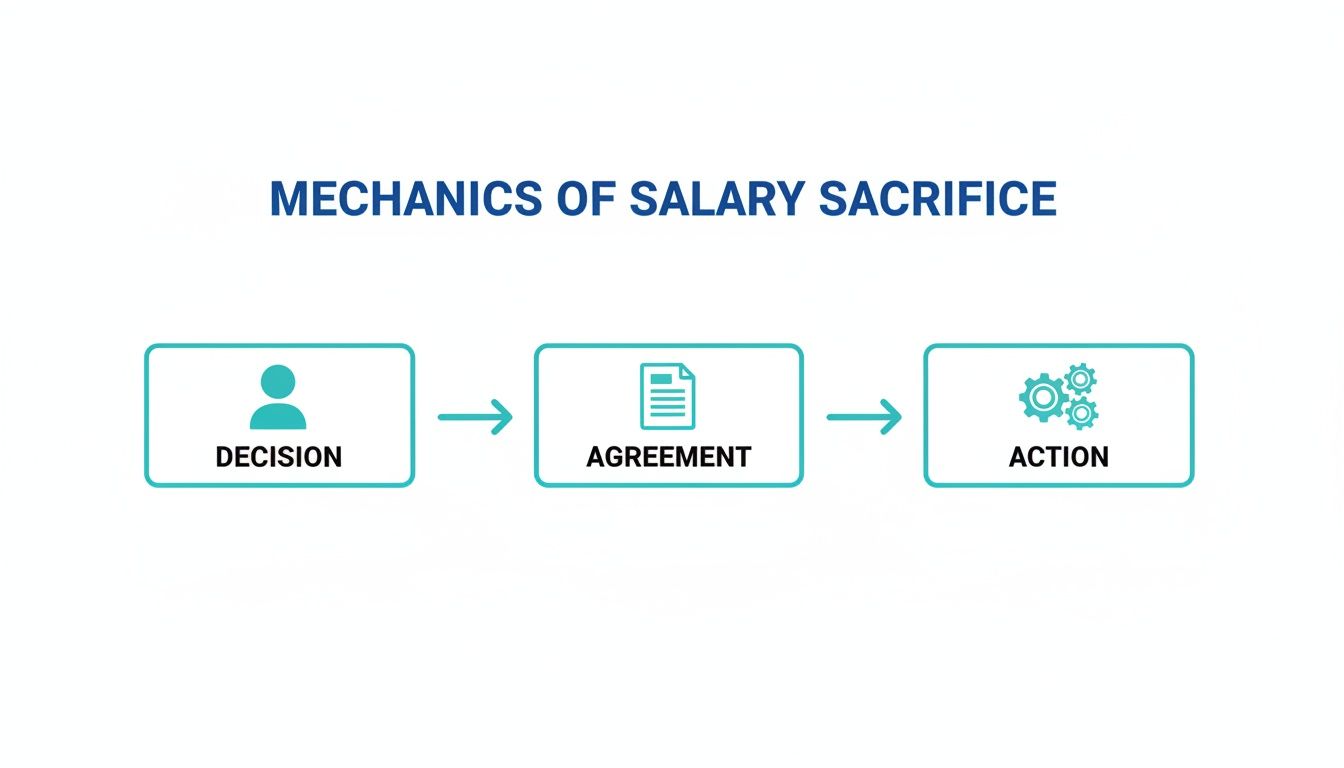
- You Decide: First, you figure out how much you want to contribute from your pre-tax pay each cycle. This can be a fixed dollar amount or a set percentage of your salary.
- Make it Official: You’ll need to formally notify your employer. This is usually done by filling out a specific HR or payroll form that gives them the authority to adjust your pay.
- Payroll Gets to Work: Your employer's payroll team then adjusts their system. They deduct the amount you’ve nominated from your gross pay before calculating your income tax for the pay period.
- Money In The Bank (Your Super Bank): Finally, they pay that sacrificed amount into your super fund, typically at the same time they make their normal Superannuation Guarantee (SG) contributions.
This simple flow puts your money to work for you almost immediately, turning a slice of your regular income into a powerful, tax-advantaged investment for your future.
Think of a salary sacrifice arrangement as an automated wealth-building plan. Once it's set up, the contributions happen like clockwork with every payslip, helping you build a strong savings discipline without lifting a finger.
Your Employer’s Role in the Process
While you kick things off, your employer is the one who makes it happen. Their main job is to correctly adjust the payroll system to reflect your new arrangement.
This involves calculating your new, lower taxable income and ensuring the sacrificed funds are sent to your super fund on time and in line with regulations. It's a common practice, so most employers, especially larger companies, will know exactly what to do.
Crucially, they must continue to pay your compulsory SG contributions based on your original, pre-sacrifice salary. They can’t use this arrangement as a way to reduce what they owe you.
Setting up salary sacrifice is a foundational step towards taking active control of your financial future. At Wealth Collective, our Guided Growth service simplifies these kinds of powerful financial strategies. We help our clients move from understanding to implementation, providing the clarity and support needed to set up arrangements like salary sacrifice with confidence. To see how we can help you take action, book a free, no-obligation initial call and start your journey towards a more prosperous retirement.
How Salary Sacrificing Can Cut Your Tax Bill
This is where salary sacrifice really comes into its own: the tax savings. When you direct a portion of your pre-tax salary into super, you’re not just giving your retirement nest egg a boost. You’re also lowering your taxable income for the year, which means less tax to pay right now.
The magic happens because of the difference in tax rates. Instead of paying tax at your personal marginal rate, which can be as high as 47% (including the Medicare levy), your sacrificed contributions are taxed at a flat 15% when they enter your super fund. It’s an immediate and powerful tax discount that leaves more of your money invested and working for you.
Let's Look at a Real-World Example
To see just how effective this is, let's consider someone earning $200,000 a year. At this income, every extra dollar they earn falls into the top tax bracket of 47%.
Now, imagine they decide to salary sacrifice $15,000. The table below shows the stark difference between taking that money home versus putting it into super.
Tax Savings Example: Salary Sacrifice vs Take-Home Pay (2026)
| Metric | Without Salary Sacrifice | With $15,000 Salary Sacrifice |
|---|---|---|
| Portion of Salary | $15,000 | $15,000 |
| Tax Rate Applied | 47% (Marginal Rate) | 15% (Super Contributions Tax) |
| Tax Paid | $7,050 | $2,250 |
| Net Amount Kept | $7,950 (in your pocket) | $12,750 (in your super) |
By choosing to salary sacrifice, an extra $4,800 ends up in their retirement fund instead of with the tax office. That's a significant difference from a simple payroll change.
The process itself is surprisingly straightforward. It’s a simple arrangement you make with your employer to put this automated, tax-smart savings strategy in motion.
Staying Within the Contribution Caps
While it’s a great strategy, there are limits. The Australian Taxation Office (ATO) sets a cap on how much you can contribute to super under these favourable tax rules. These are known as concessional contributions, and they include both your salary sacrifice amounts and your employer’s mandatory Superannuation Guarantee (SG) payments.
For the 2025-26 financial year, the general annual concessional contributions cap is $30,000. It's crucial to keep track of all contributions going into your super to make sure you don't go over this limit. Any amount above the cap is typically taxed at your marginal rate, which can undo the benefits.
Two Important Rules to Know: Unused Caps and Division 293
There are a couple of other key rules that could influence your salary sacrifice strategy, especially for those with fluctuating incomes or higher salaries.
Carry-Forward Contributions: If your total super balance was under $500,000 at the end of the last financial year, you may be able to use any of your unused concessional cap from the previous five years. This "catch-up" rule is fantastic if you've had a lower-income year or want to make a larger contribution as you get closer to retirement. You can learn more about how this works in our guide on using carry-forward concessional contributions.
Division 293 Tax: If you're a high-income earner, you need to be aware of this. For individuals whose combined income and concessional super contributions exceed $250,000 a year, an additional 15% tax is applied to the contributions above this threshold. This brings the total tax on those contributions to 30%. While not as good as 15%, it’s still a much better outcome than paying the top marginal rate of 47%.
Knowing these rules is vital, but you don't have to figure it all out on your own. A good financial adviser can translate these complex tax laws into a clear, personalised plan that aligns with your specific situation. This is where Wealth Collective's process shines, helping you navigate the rules to maximise your contributions effectively.
Weighing Up the Pros and Cons
So, is salary sacrificing the right move for you? Like any smart financial strategy, it's not a simple yes or no. It’s a powerful tool, especially for higher-income earners, but you need to be sure it fits your specific situation.
Before you jump in, it’s worth taking a moment to look at both sides of the coin. Understanding the real-world benefits and the potential trade-offs is the key to making a decision you feel good about.
The Upside: What You Stand to Gain
The advantages of salary sacrificing are pretty compelling, mainly because they offer a direct path to growing your retirement savings faster while lightening your tax load.
- The Big One: The Tax Break: This is the most immediate and attractive benefit. Instead of your income being taxed at your personal marginal rate (which can be as high as 47%), the money you sacrifice into super is taxed at just 15%. That's a huge difference, and it means more of your money goes to work for you, not the ATO.
- Fast-Track Your Retirement Fund: Your employer's super contributions are a great start, but salary sacrificing puts your savings into a higher gear. By tipping in extra, pre-tax dollars, you’re actively accelerating the growth of your nest egg.
- Let Compounding Do the Heavy Lifting: The extra money you contribute isn't just sitting in an account; it's invested. Inside super’s low-tax world, your investment returns compound more effectively, meaning your earnings start generating their own earnings. It’s a snowball effect that can dramatically boost your final balance over time.
- Set-and-Forget Savings: Once you’ve set it up with your employer, the process is automatic. The contribution comes out of your pay before you even see it, creating a disciplined savings habit without you having to think about it.
The Downsides: What You Need to Consider
Of course, there are trade-offs. It's crucial to think about how these might affect your financial life today.
When you choose to salary sacrifice, you're swapping cash in your pocket today for a much bigger retirement pot tomorrow. Whether that’s the right trade-off really comes down to your personal financial position and what you need your money to do for you right now.
These aren't necessarily deal-breakers, but they are important things to keep in your back pocket.
- Less Cash in Your Take-Home Pay: This is the most obvious one. Since that money is going directly to your super fund, your fortnightly or monthly pay packet will be smaller. You need to be sure you can comfortably cover all your living expenses, loan repayments, and other goals with the reduced amount.
- Your Money is Locked Away: Super is built for the long haul. Any funds you add through salary sacrifice are generally 'preserved' until you hit your preservation age (which is 60 for most people) and retire. You can't just dip into it for an emergency or a holiday, which is why having a separate, easily accessible emergency fund is non-negotiable.
- It Could Affect Your Borrowing Power: This one can be a surprise. When you apply for a home loan, some banks might look at your lower take-home pay rather than your higher gross salary. This could potentially reduce the amount they're willing to lend you, so it's something to keep in mind if you're planning a big purchase.
Ultimately, figuring out what is salary sacrifice super and if it works for you means looking at it from all angles. The strategy is at its most powerful when it’s part of a bigger, well-thought-out financial plan. Our Guided Growth service is designed to help you navigate these pros and cons, ensuring your super strategy is perfectly aligned with your broader wealth creation goals.
Your Step-By-Step Salary Sacrifice Implementation Checklist

Alright, you’ve done the reading, weighed the pros and cons, and decided salary sacrificing might be right for you. It’s time to make it happen.
Getting a salary sacrifice arrangement up and running is usually much more straightforward than people think. Here’s a simple checklist to walk you through it.
Step 1: Review Your Budget and Financial Goals
First things first, take a close look at your current budget. Can you comfortably live on your reduced take-home pay once the sacrificed amount is taken out? This strategy is all about long-term gain, so it shouldn't put a painful squeeze on your day-to-day life. This is a critical step in the Wealth Collective process, as any strategy must support your overall lifestyle.
Step 2: Check Your Super Fund and Contribution History
Next, grab the details for your super fund, including your member number and the fund’s ABN. You'll need these soon. It’s also a smart move to check how much you and your employer have already contributed this financial year.
You need to know how much of your concessional cap has been used by the standard Superannuation Guarantee (SG) payments to make sure you don't accidentally tip over the annual limit.
It also helps to know what you're working towards. A fascinating study from the ARC Centre of Excellence in Population Ageing Research (CEPAR) found that when people were shown an estimate of their retirement income, they were 33% more likely to start making extra contributions. Seeing the end goal clearly makes saving for it much easier. You can read more about these findings on Money Management.
Setting up a salary sacrifice isn't just a paper-pushing exercise. It's you actively taking the wheel on your retirement journey. Following a clear process turns a good idea into a real, wealth-building habit.
Step 3: Talk to Your Employer or Payroll Department
Your next stop is a chat with your HR or payroll team. You need to confirm they offer salary sacrifice arrangements (most do) and find out what their process involves. They’ll be the ones to give you the necessary paperwork, which is usually called a 'Salary Sacrifice Agreement' or something similar.
Step 4: Complete the Salary Sacrifice Agreement
Now it’s time to fill out the form. You’ll enter your personal details, super fund information, and the exact amount you want to sacrifice each pay cycle. You can usually choose either a fixed dollar figure (like $500 per fortnight) or a percentage of your salary.
Give it a final once-over to make sure every detail is correct before you sign and hand it back.
Step 5: Monitor Your Payslips and Super Account
Once your arrangement is live, your job isn't quite finished. For the next few pay cycles, keep a close eye on your payslip to make sure everything is working as it should.
- Is the correct amount being deducted from your pre-tax salary?
- Has your taxable income been reduced?
- Is your employer's SG contribution still being calculated on your original, higher salary?
It’s also a good idea to log in to your super fund’s online portal and confirm the extra contributions are landing in your account on time.
While this checklist gives you a clear path, fitting this strategy perfectly into your wider financial life is where expert guidance from Wealth Collective makes a real difference. A book a free, no-obligation initial call is the perfect way to get personalised guidance and make sure your strategy is firing on all cylinders.
When to Get Professional Advice on Your Super Strategy
Salary sacrificing is a fantastic tool, but it's just one tool in your financial toolbox. Making it work effectively means seeing how it fits with everything else you’ve got going on—your mortgage, your investments, and your long-term goals.
Knowing when to call in an expert can be the difference between a good plan and a truly great one that sets you up for the future.
You can follow a YouTube tutorial to change the oil in your car, but if you want to tune a high-performance engine for the racetrack, you bring in a specialist. Your finances are no different. Sometimes you need a professional to make sure everything is running in perfect harmony, especially when life gets a bit more complex.
Key Moments to Seek Expert Guidance
Certain life stages or financial situations add layers of complexity. In these moments, getting advice isn't just a nice-to-have; it’s essential for dodging costly mistakes and making the most of your money.
It’s probably a good time to chat with a financial adviser if you find yourself:
- Nudging the Contribution Caps: If you’re getting close to the $30,000 annual concessional contributions cap, precision is key. An adviser can help you map out the exact amount to contribute so you get the full tax benefit without accidentally going over and paying extra tax.
- Dealing with Division 293 Tax: Earning over $250,000 a year? You’ll likely have the Division 293 tax on your super contributions to think about. An adviser can run the numbers to see if salary sacrificing is still the best move for you and explain exactly how it all works.
- Juggling Multiple Financial Goals: Trying to pay down your mortgage, build an investment portfolio, and save for your kids' university all at the same time can feel like spinning plates. An adviser helps you create a clear strategy to allocate your money where it will have the most impact.
- Getting Serious About Retirement Planning: As you get closer to retirement, your focus needs to shift from simply growing your nest egg to making it last. This is where professional advice becomes invaluable for structuring tax-effective income streams and managing your investments for the long haul.
Your financial situation is unique to you. A generic definition of salary sacrifice can’t account for your specific income, family life, and what you want to achieve. Professional advice tailors the strategy to fit you perfectly, ensuring it works alongside your entire financial plan.
How a Tailored Plan Makes the Difference
This is exactly why we created the Guided Growth service at Wealth Collective. It’s a process designed to cut through the noise and give you a clear, actionable plan built for your life, not someone else's.
We look at your complete financial picture—your income, debts, investments, and super—to figure out how a strategy like salary sacrifice slots into your bigger goals. We help you answer those tricky questions and fine-tune your approach so that every dollar you earn is working as hard as it possibly can.
Our goal is simple: to give you the confidence that your strategy is not only working but is perfectly aligned with the future you want to create.
Ready to get clear guidance and build a super strategy that truly fits? Book a free, no-obligation initial call with our team today. Let’s start mapping out your path to a wildly successful financial future.
Common Questions About Salary Sacrifice Answered
Once you get your head around the basics of salary sacrifice, a few practical questions almost always come up. It's one thing to understand the theory, but feeling confident about the nuts and bolts is what really matters. Let's clear up some of the most common queries.
Think of this as the final check-in before you put this powerful strategy to work.
Can I Stop or Change My Salary Sacrifice Amount?
Yes, you're always in the driver's seat. One of the best things about a salary sacrifice arrangement is its flexibility; you're never locked into a permanent contract.
Life changes, and your financial strategy should be able to change with it. If you need more cash in your pocket for a while, you can simply ask your employer to pause or reduce your contributions. On the flip side, if you get a pay rise or have a bit of extra room in the budget, you can easily ramp them up. A quick chat with your HR or payroll team is all it takes to adjust your agreement.
What Happens If I Change Jobs?
Your salary sacrifice agreement is made directly with your current employer, so it won’t automatically carry over to a new role. You’ll need to set up a fresh agreement when you start with a new company.
The good news is that most employers are well-equipped to handle these arrangements. It’s always smart to confirm this during the interview or onboarding process. Once you start, you'll simply follow their internal procedure to get your pre-tax contributions flowing again.
Think of your salary sacrifice arrangement like a subscription with your employer. If you change providers (jobs), you simply need to start a new subscription. It's a standard process, not a major hurdle.
Does Salary Sacrifice Affect My Employer’s Standard Contributions?
No, it shouldn't. By law, your employer must pay the Superannuation Guarantee (SG) based on your ordinary time earnings (OTE). This is your full salary before any amount is sacrificed.
An employer can't use your salary sacrifice contributions as a way to lower their own mandatory SG payments. For instance, if your salary is $120,000 and you sacrifice $10,000, your employer still has to calculate their SG payment based on the full $120,000. It’s not based on your reduced taxable income of $110,000. It’s always a good idea to double-check your payslips to make sure this is being handled correctly.
Is This a Good Strategy If I Am Self-Employed?
If you're a sole trader or run your own business, you don't have an 'employer' to arrange salary sacrifice with. But don't worry, you can get the exact same tax outcome through a different route: making personal concessional contributions.
You just contribute directly to your super fund from your business or personal account, and then claim that amount as a tax deduction when you lodge your annual tax return. This effectively lowers your taxable income, and the contribution is taxed at the same friendly rate of 15% inside super. You get the same great result—a bigger retirement nest egg and a smaller tax bill.
Navigating the details of what is salary sacrifice super is the first step, but applying it perfectly to your unique financial life is what truly builds wealth. Wealth Collective specialises in creating clear, actionable strategies that align with your goals. To ensure your super is working as hard as possible for you, book a free, no-obligation initial call with our team today.