Business hours
Monday to Friday (8.30AM - 5PM)
Weekend (Closed)


TPD insurance is a lump-sum payment designed to help if a permanent illness or injury means you'll never be able to work again. In Australia, it's a major part of the safety net, with almost 90% of TPD cover held through superannuation funds, and in the 12 months to 31 December 2018 consumers paid $3.548 billion in TPD premiums while making more than 26,000 claims.
For a lot of people, this only becomes real when they picture their own life. A couple with a mortgage. A business owner whose income stops if they stop. A professional in their peak earning years who assumes serious illness happens to someone else.
The hard question is simple. If your income disappeared permanently, what would happen next?
Most households could name the immediate bills. Mortgage repayments, school fees, groceries, utilities. The harder costs come after that. Rehab. Ongoing care. Changing a bathroom so it's easier to use. Replacing income that was meant to support your partner, your kids, or your retirement savings.
That's where TPD insurance fits. It's not there to make a terrible situation feel fair. It's there to give you financial options when your life has changed in a way that can't be undone.
Your Financial Safety Net for the Unthinkable
Mark is 43. He has a mortgage, two school-aged kids, and a salary that carries most of the household. After a serious diagnosis, the question in his home changes fast. It is no longer about holidays or renovations. It is whether the family can stay in the house if he never works again.
That is the problem TPD insurance is built to solve.
TPD, short for Total and Permanent Disability insurance, pays a lump sum if an illness or injury leaves you permanently unable to work under your policy terms. A simple way to view it is as money that buys time, choices, and stability when your earning power has been permanently cut off.
For Mark, that could mean clearing enough of the mortgage so his partner is not forced to sell. It could mean paying for rehab, specialist treatment, or changes to the home if daily life becomes harder. It could also mean protecting the family's routine for a while, so decisions are made carefully, not in a panic because bills are due.
What that lump sum is really for
People often hear “insurance payout” and assume the money is only there to replace wages. TPD usually has a wider job than that, because a permanent disability affects more than the monthly pay packet.
A payout may help cover:
- Debt reduction: paying down or clearing a mortgage, personal loan, or credit card balance
- Medical needs: covering treatment, recovery support, equipment, or care costs not met elsewhere
- Home changes: making the home safer and easier to live in if mobility becomes an issue
- Family breathing room: giving your household time to adjust without every decision being driven by cash flow
That broader role is why TPD matters. A serious illness or injury can hit your finances from several directions at once. Income may stop, expenses may rise, and long-term plans can change in a matter of weeks.
Many Australians already hold some TPD cover through super, often without choosing the details themselves or checking whether the amount would be enough in a real claim. That is where confusion starts. Having cover is not the same as having cover that fits your job, income, debts, and family responsibilities.
At Wealth Collective, this is usually the turning point in the conversation. People arrive asking, “Do I have TPD?” The better question is, “If my life changed like Mark's, would my current cover give my family enough room to cope?”
That is the practical value of this insurance. It gives you options at a time when options are suddenly scarce.
Decoding TPD Insurance What It Really Covers
A good way to think about TPD is this. If your working life is suddenly reset, a TPD payout acts like a financial reset button for the rest of your plan. It won't restore your health, but it can help rebuild the structure around your life.
MoneySmart describes TPD as a lump-sum benefit paid when illness or injury leaves you permanently unable to work, and the key trigger depends on the policy definition. That definition is the part that deserves your full attention.

The two definitions that change everything
Own occupation means the insurer looks at whether you can return to your specific pre-disability job.
Any occupation means the insurer looks at whether you can work in any role suited to your education, training, or experience.
That distinction comes directly from MoneySmart's explanation of TPD insurance, which also notes that own occupation cover is typically more expensive but easier to claim, while any occupation usually has a higher evidentiary threshold and is cheaper.
A real-world example
Take a surgeon who loses fine motor control in their hands.
Under an own occupation definition, the question is whether they can return to being a surgeon. If the answer is no, the claim may fit the policy definition, even if that person could still teach, consult, or work in a non-surgical role.
Under an any occupation definition, the insurer may ask a broader question. Could this person still work in another role that suits their education, training, or experience? If yes, claiming may be harder.
That's why two policies with similar premiums can produce very different outcomes at claim time.
What TPD usually aims to fund
TPD isn't meant for one narrow expense. It's usually there to support a mix of needs that arrive at the same time.
| Need | Why it matters |
|---|---|
| Income replacement | Helps cover the earnings your household may no longer receive |
| Medical expenses | Supports treatment, rehab, equipment, and related costs |
| Home modifications | Helps fund changes that make the home more usable |
| Ongoing care | Provides flexibility if support is needed over the long term |
Practical rule: If you can't explain your TPD definition in one sentence, you probably don't yet know how your policy would respond in real life.
Another point people miss is structure. MoneySmart notes that TPD can be held inside super or outside super, and cover outside super generally offers broader design flexibility. That brings us to one of the biggest decisions Australians face.
TPD Insurance Inside Super vs Retail Policies
A common real-life scenario goes like this. You log into your super account after years of ignoring it, see a line for insurance, and assume the job is done. Then a harder question appears. If your health changed permanently, would that policy match your work, your debts, and the way your family lives?
That is the difference between having cover and having a plan.
Inside super
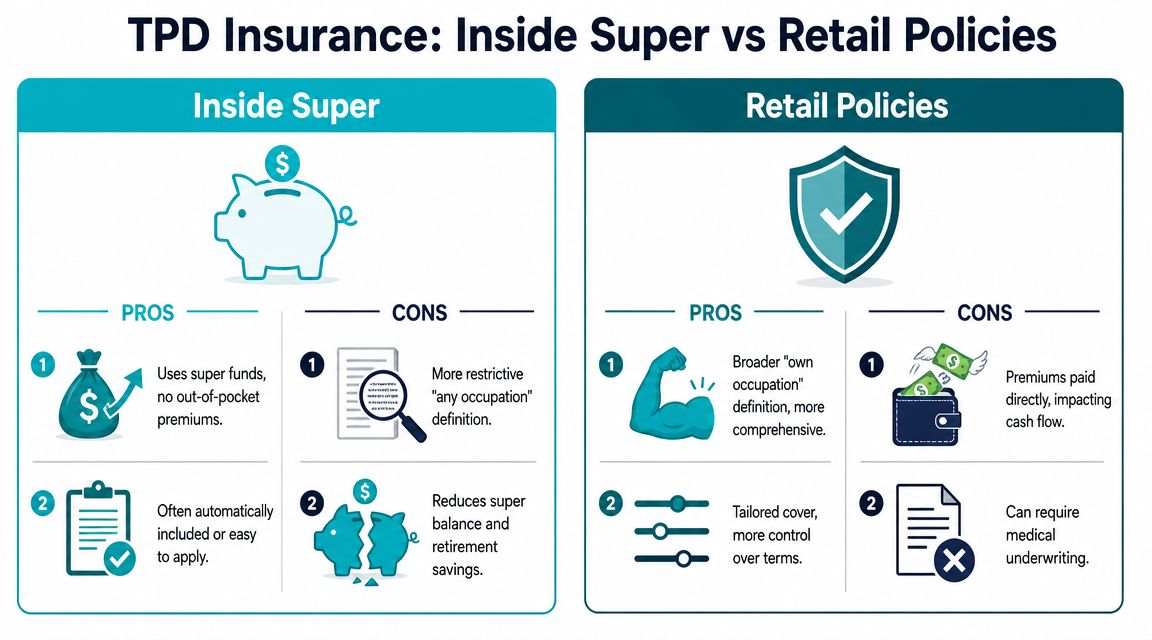
For many Australians, TPD begins inside super because it is simple to set up and the premiums usually come out of the super balance instead of the household bank account. That can make cover feel easier to keep.
But "paid from super" does not mean "free". It still comes from your money. It just comes from your retirement savings rather than your weekly cash flow.
The other point people often miss is flexibility. Super-based cover can be a practical starting point, but it may offer fewer choices around policy design, occupation-specific wording, and how the cover is structured. For a straightforward situation, that may be fine. For a specialist worker, business owner, or household with larger commitments, those details can matter a lot at claim time.
There can also be another layer to think about. Even if the insurance policy pays, getting money out of super can involve superannuation release rules as well as the insurance definition.
Retail policies
Retail TPD sits outside super under a policy chosen for your circumstances. It usually gives more room to shape the cover around how you earn, what you owe, and what your family would need if work stopped for good.
A good analogy is off-the-rack versus custom-fit clothing. Off-the-rack can fit reasonably well and cost less effort upfront. Custom-fit takes more work at the start, but the fit is built around you.
That said, retail cover is not automatically better. Premiums are usually paid directly, and the application process can be more detailed because the insurer wants a clearer picture of your health, work, and risks. Some people prefer simplicity inside super. Others prefer more control outside it.
How to compare the two
The useful question is not which option sounds more familiar. It is which one would put the right amount of money in the right place, with the fewest surprises, if your life changed suddenly.
A practical comparison looks like this:
- Inside super may suit you if: you want a simple entry point, prefer premiums to come from super, and your needs are relatively straightforward
- Retail may suit you if: your occupation is specialised, policy wording matters more, or you want greater control over definitions and structure
- Both need checking for: claim definitions, waiting for underwriting requirements, ownership structure, and whether the funding method fits your broader financial plan
Tax can confuse people here too, especially if they are comparing several insurance types at once. If that question is on your mind, this guide on is income protection deductible in Australia can help clarify one part of the picture.
If your current cover sits in super, review it as part of the whole fund rather than as a standalone line item. Insurance, fees, investments, and fund rules all interact. Wealth Collective's guide on how to switch super funds can help you assess the wider decision in a calm, structured way.
Here, advice adds real value. At Wealth Collective, we help clients compare what they already have, spot the trade-offs, and choose a structure that fits real life rather than just the default setting.
How TPD Differs From Life and Income Protection
A lot of people ask the wrong question. They ask, “Do I need TPD or income protection?” In many cases, that's like asking whether you need a seatbelt or brakes.
Each type of cover does a different job. The cleanest way to understand them is to think of personal insurance as a toolkit. One tool handles death. One handles permanent disability. One helps when you're unable to work for a period of time.
Three covers, three different triggers
- Life insurance: pays a lump sum to your beneficiaries if you die
- TPD insurance: pays a lump sum if you become permanently unable to work under the policy definition
- Income protection: pays an ongoing monthly benefit if illness or injury stops you working, usually for a temporary or longer-term period depending on the policy terms
The biggest difference is the trigger. Life insurance responds to death. TPD responds to permanent disability. Income protection responds to loss of income caused by being unable to work.
Why people mix them up
The overlap is emotional, not technical. All three are about protecting your household when health or life changes suddenly. But they solve different financial problems.
A lump sum from TPD is often used for major structural costs. Think debt, care, and changing the family's long-term financial position. Income protection is more like a pay packet substitute. It helps with regular living costs while you're off work.
If tax treatment is part of your decision-making, this guide on is income protection deductible in Australia gives useful context on how that cover is commonly treated. It's a separate issue from whether the policy itself is the right fit, but it's still worth understanding.
How they work together
The strongest protection plan usually isn't one policy. It's a combination that covers different risks without leaving obvious gaps.
A simple way to map it is:
| Cover type | Main purpose | Payment style |
|---|---|---|
| Life | Protects dependants after death | Lump sum |
| TPD | Supports a permanent change in working capacity | Lump sum |
| Income protection | Supports ongoing cash flow while you can't work | Monthly benefit |
If you want a plain-English overview of the broader topic, Wealth Collective's guide to life insurance types is a useful starting point.
The TPD Claim Process A Realistic Timeline
Individuals often don't worry about the claim process until they need it. By then, they're already dealing with a diagnosis, specialists, paperwork, and the stress of not knowing what happens next.
That's why it helps to have a realistic picture. TPD claims are rarely fast, and they're rarely simple. APRA's life insurance claims and disputes data for the year to December 2022 shows that TPD and disability income insurance together accounted for 27% of all disputes, and the claims-paid ratio for Group Ordinary TPD was 18%, one of the lowest among the product types APRA reported.
What usually happens
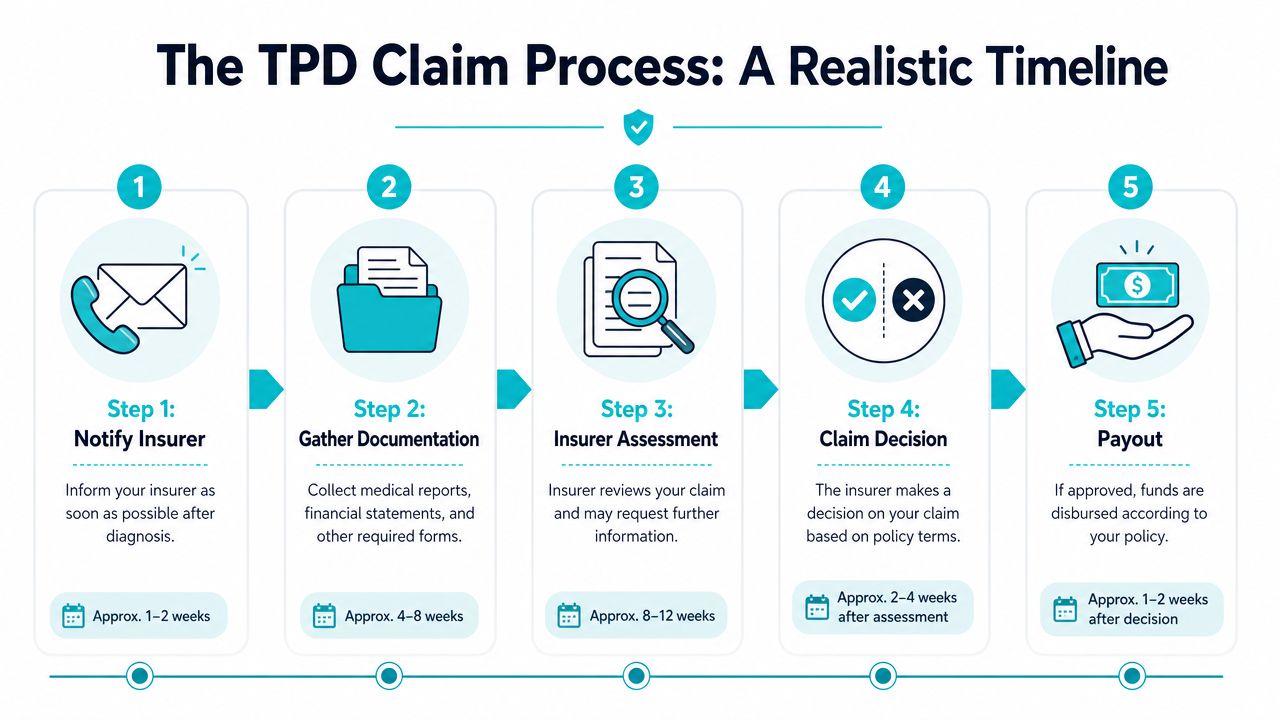
You notify the insurer
This usually starts once it becomes clear your condition may meet the policy definition. Early notice matters because the insurer will explain forms, evidence requirements, and the next steps.You gather evidence
This can include medical reports, treating specialist notes, employment details, financial records, and claim forms. This stage often takes longer than people expect because documents come from several places.The insurer assesses the claim
The insurer reviews whether your circumstances match the wording in the policy. They may ask for more information, request independent medical assessments, or seek clarification about your job duties and history.A decision is made
The answer may be approval, decline, or a request for further material. If the policy has technical wording, this is where the detail really matters.Payment follows if the claim is accepted
The funds are then paid according to the structure of the policy and where it's held.
Where claims often get stuck
- Medical disagreement: your doctor and the insurer's assessor may not frame your work capacity the same way
- Occupational ambiguity: the exact duties of your role may matter more than your job title
- Definition mismatch: many disputes come down to whether the event fits “own occupation” or “any occupation” wording
- Missing paperwork: incomplete records slow everything down
A TPD claim is partly a medical process, but it's also a documentation process. Strong evidence doesn't just say you're unwell. It connects your condition to the policy wording.
If you're facing a claim, practical support can make a real difference. Wealth Collective has a guide on TPD insurance claims that outlines what to gather and what to expect.
Who Needs TPD and How Much Is Enough
The short answer is that anyone whose financial plan depends on their ability to earn should at least consider TPD. That includes people who don't think of themselves as “insurance people”.
A young professional might not have children yet, but they may have debt, rent or a mortgage, and years of future earning power tied to one career path. A family with one or two main incomes has a more obvious exposure. A self-employed person often has the sharpest exposure of all, because if they stop, business income may slow or stop with them.
Three common situations
Young professionals
You may not own much yet, but your income potential is one of your biggest assets. If a permanent illness disrupts that path early, the financial impact can last for decades.
Questions to ask yourself:
- Would debt become a burden? Student debt, a car loan, or a first mortgage can become much harder to manage without your income
- Is your career specialised? The more specialised your role, the more policy definitions matter
- Could your family step in? Many assume someone else would help, but that support may be limited
Families with large fixed costs
Parents usually feel the risk immediately because their money already has jobs assigned to it. Mortgage. Childcare. Groceries. School costs. Future plans.
In this situation, TPD is often about protecting the household, not just the individual. A lump sum can buy time and stability when one partner can't work again.
Self-employed and business owners
If your expertise drives revenue, your health is tightly linked to your business value. TPD can help create a financial backstop while you work out whether the business can continue, be sold, or needs to be restructured.
How much cover is enough
There isn't one universal figure because the right amount depends on your life. But the calculation usually starts with real costs, not a generic round number.
Consider:
- All major debts: mortgage, investment debt, personal loans, business-related obligations
- Medical and recovery needs: treatment, rehab, equipment, transport, support services
- Home changes: access modifications, safety improvements, practical upgrades
- Family living costs: what your household needs if your income disappears permanently
- Future flexibility: retraining, care planning, or building an investment buffer
Policy design also matters, not just the sum insured. TAL reports that TPD cover can be purchased up to $1.5 million online and up to $3 million by phone, and that its TPD Support Option can pay partial claims of 20% of the TPD benefit at 12-month intervals if accepted under that option, showing how payout structure can be designed for different needs and budgets through TAL's TPD insurance product information.
That kind of structure illustrates an important trade-off. A policy can be shaped to manage cost, but the way money is paid can also affect how much immediate liquidity you have when life changes fast.
Your Next Steps to Financial Security with Wealth Collective
By this point, the main takeaway is clear. What is TPD insurance? It's not just a definition on a product page. It's a plan for protecting your financial life if your ability to work ends permanently.
The catch is that the right policy depends on details individuals often don't review closely. The definition. Whether the cover sits inside super or outside it. How much is enough. Whether the payout structure would suit your real costs.
A calmer way to handle it
For readers who want help sorting through that, Wealth Collective's Protection Plus service looks at personal insurance structures, including how TPD cover is arranged and whether the affordability and design fit your broader financial plan.
That matters because good advice in this area isn't about pushing more cover. It's about matching cover to the risks already sitting in your life.
A sensible review usually focuses on a few practical questions:
- What do you already have? Many people are paying for cover they haven't properly checked
- Does it pay out? Definitions and ownership structure matter just as much as the premium
- What gap are you trying to solve? Debt protection, family security, business continuity, or a mix of all three
Good insurance advice should leave you with fewer unknowns, not more paperwork and more jargon.
If you've been putting this off because it feels technical, that's normal. The first step doesn't need to be a big one. A short introductory conversation can tell you whether your current cover deserves a closer look and what the next step would be if it does.
If you want clarity on your current insurance setup and whether your TPD cover fits your life, book an introductory call with Wealth Collective.